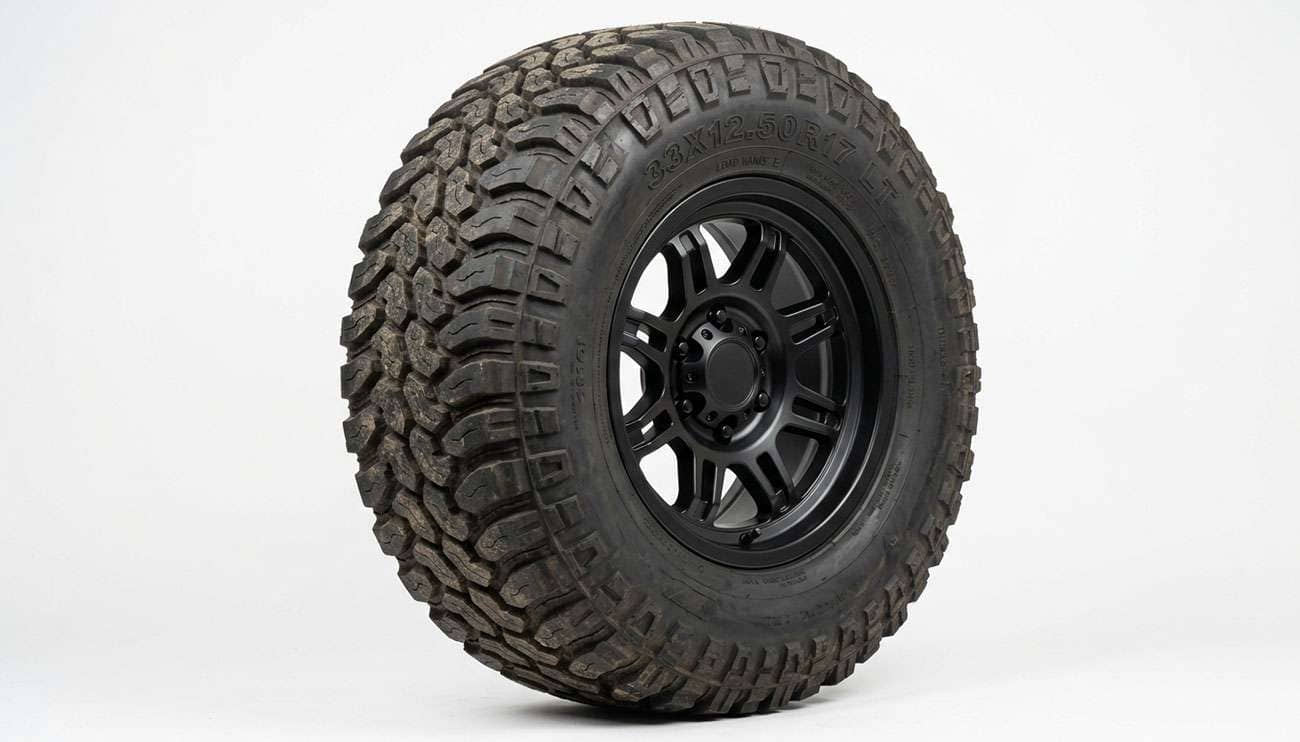
Folks call the shop about this one more than just about any other off-road size, so let me save you the phone call. A 33x12.50R17 is a 33-inch-tall tire that's 12.5 inches wide and bolts onto a 17-inch wheel. In metric terms, the closest match nobody actually makes is around a 315/65R17, and the size most people end up cross-shopping it against is the 285/70R17. They're close cousins, but they are not the same tire, and the difference is exactly the kind of thing that bites you at full lock in a parking lot. I've been mounting 33s on trucks since before some of you were born, so stick with me and I'll lay the whole thing out plain.
The reason the 17-inch version gets so much love comes down to one number folks usually skip right past: sidewall. A 33 on a 17-inch wheel carries a full 8 inches of sidewall, and that tall stack of rubber is what lets you air down for the trail, soak up a washboard road, and shrug off a sharp rock without folding a bead. Run that same 33 on a 20-inch wheel and you're down to about 6.5 inches of sidewall. Same tire height, very different ride. That's the heart of why the old-timers running early Broncos, square-body Chevys, and Jeeps swear by the smaller wheel.
If you came here for the numbers and nothing else, here they are, measured the way I'd measure them on the shop floor:
Now, a word of honesty before you take those to the bank: that "33" is a nominal number, a target the manufacturers aim at, not a law. A real-world 33x12.50R17 from one brand might measure 32.8 inches and another might come in at 33.1. Construction, tread depth, and how stiff the carcass is all move the needle a hair. If you're building to tight clearance, always go by the actual molded specs for the exact tire you're buying, not the number stamped on the sidewall. That little habit has saved more fender liners than I can count.
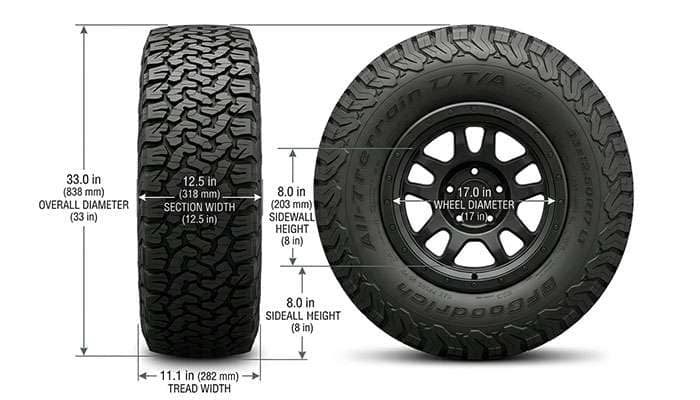
Unlike a metric size such as 285/70R17, the 33x12.50R17 wears its dimensions right on its sleeve. There's no aspect-ratio math to chase. The first number is the height, the second is the width, and the R17 is the wheel. Here's what each one is really telling you.
This is the part most folks care about, because tire height is what gives a truck its stance and its ground clearance. A 33 stands about an inch and a half taller than a typical stock 31-something, which is enough to fill an arch nicely and clear a rock that a stock tire would've kissed. It also means your speedometer is now telling little white lies, but more on that down the page.
Twelve and a half inches across is a genuinely wide tire. That fat footprint is what puts rubber on the dirt and gives you the aggressive, planted look. The trade-off is that all that width has to go somewhere when you turn the wheel, and on a lot of stock trucks "somewhere" is your sway bar, your control arm, or the back of your front bumper. Width is usually what causes rubbing, not height.
Here's where the 17-inch wheel earns its keep. Take the 33-inch height, subtract the 17-inch wheel, divide by two, and you've got an 8-inch sidewall on each side. That's a tall, flexible wall of rubber. Air down for the trail and that sidewall wrinkles and wraps around obstacles for grip. Hit a pothole on the highway and it cushions the blow before it ever reaches your rim. It's also a lot harder to bend an expensive wheel when there's eight inches of tire protecting it. This is the whole reason a 33-on-17 is the darling of the overlanding and rock crawling crowd. If you want to see how the same tire behaves on different diameters, our guide on the equivalent of 33 12.50 R15 walks through the even taller-sidewall version that the classic 4x4 guys still run.
A 33x12.50R17 turns roughly 611 times to cover a mile. That figure drives your speedometer reading and plays into your gearing, so it's worth knowing. As for the wheel it rides on, you can run this tire on anything from an 8.5-inch up to an 11-inch-wide rim, but I'll tell you what I tell everyone who walks in: put it on a 10-inch wheel if you can. That width lets the tread sit flat and square on the ground the way the engineers intended, instead of crowning up in the middle or pinching in at the edges.
This is the big question, and it's worth answering carefully because there are two different answers depending on what you actually want.
The true mathematical equivalent works out to about a 315/65R17. Run the numbers and a 315/65R17 stands 33.1 inches tall and 12.4 inches wide — practically a dead ringer for the 33x12.50R17. The catch is that 315/65R17 is a fairly uncommon size, so you won't find nearly as many tread patterns and brands in it.
The practical, real-world equivalent — the size that actually sits on the shelf next to a 33 and gets cross-shopped against it every single day — is the 285/70R17. It's close, but it's not a twin, and the differences are the kind of thing that matter. A 285/70R17 stands about 32.7 inches tall and 11.2 inches wide. So compared to a true 33x12.50R17, the 285/70R17 is roughly a third of an inch shorter and a meaningful 1.3 inches narrower. If you want the deep dive on that exact size, we've got a full breakdown of what a 285/70R17 is equivalent to as well.
So when someone asks me "what's a 33 equivalent to for 17-inch rims," my honest answer is: mathematically it's a 315/65R17, but the tire you'll most likely end up comparing it to on the lot is the 285/70R17. Just go in knowing the 285 is the smaller, narrower of the two.
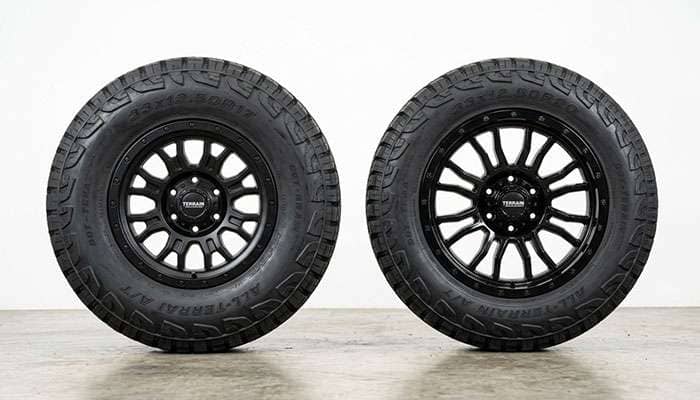
Here's the head-to-head you really came for. These are the sizes that land in the same conversation as a 33x12.50R17, and the table below puts the real numbers side by side. Read it once and you'll never get talked into the wrong tire.
Feature |
33x12.50R17 |
285/70R17 |
285/75R17 |
265/70R17 |
|---|---|---|---|---|
Overall Diameter |
33.0 in |
32.7 in |
33.8 in |
31.6 in |
Section Width |
12.5 in |
11.2 in |
11.2 in |
10.4 in |
Is It a True 33? |
Yes |
Close (a hair short) |
Slightly taller |
No — it's a 31 |
Not quite, and this is the comparison I get asked about most. They sit within about a third of an inch of each other in height, so on stance alone you'd struggle to tell them apart across a parking lot. But the 33x12.50R17 is a solid 1.3 inches wider. That extra width is more footprint, more aggressive looks, and more chance of rubbing on a stock truck. People treat the 285/70R17 as the "metric 33" because it's so widely available, and that's fair shorthand — just remember the real 33 is the bigger, beefier of the two.
This one trips people up. A 285/75R17 actually measures about 33.8 inches tall, so it's marketed and talked about as a "33," but it's really creeping toward a 34. It's about three-quarters of an inch taller than a true 33x12.50R17 and, like the 285/70, it's narrower at 11.2 inches. If you're tight on clearance up top, that extra height matters. If you've got the room and want a touch more ground clearance without going full 35, it's a nice in-between.
No, and don't let anybody tell you otherwise. A 265/70R17 comes in around 31.6 inches tall — that's a 31, plain and simple, a full inch and a half shorter than a real 33. It's a perfectly good size and a popular factory fitment, but it is not a 33. If you put a 265/70R17 next to a 33x12.50R17 on the same truck, the difference in both height and width is something you'll see from across the lot.
Step up to a 35x12.50R17 and you keep the same 12.5-inch width but jump to a 9-inch sidewall and a 35-inch height — more clearance, but now you're firmly into lift-kit, regear, and trimming territory. Step down to a 31x10.50R17 and you've got a 7-inch sidewall and a narrower, lighter tire that fits a lot of trucks with no drama. The 33 sits right in the middle, which is exactly why it's the most popular of the three. If you're still deciding how tall to go, our rundown on 31 vs 33 vs 35 vs 37 vs 40 inch tires and which size you need is the honest map through it.
Same tire, different wheel. A 33x12.50R18 is the identical 33-inch-tall, 12.5-inch-wide footprint, just wrapped around an 18-inch wheel, which drops your sidewall to 7.5 inches. Go to a 33x12.50R20 and the sidewall shrinks again to 6.5 inches. The overall tire height and your speedometer don't change one bit between them — only the ride does. More wheel and less sidewall gives you a firmer, sportier feel and a flashier look; more sidewall gives you the cushion and trail toughness. If you're weighing the 20-inch route, we measured it out in full over on what size tire is a 33 12.50 R20.
Bolting on a set of 33s isn't free, and anyone who tells you it is hasn't done enough of them. Here's the straight talk on what changes, because the downsides of a wider, taller tire are real even when they're worth it.
Your truck's computer was set up around the smaller tire it left the factory on. Put a taller 33 under it and every rotation now covers more ground than the computer thinks, so your speedometer reads slow. Going from a common factory size up to a 33, you'll typically see the needle reading a couple miles per hour under your true speed. It's worth getting a recalibration or at least knowing your error, both for your wallet at speed traps and for honest trip math. This is the same idea behind the well-known 3 percent rule for tires that keeps a size swap from throwing everything out of whack.
That 12.5-inch width is the prime suspect when a fresh set of 33s starts rubbing. At full steering lock, a wide tire can catch the sway bar, the lower control arm, or the front of the wheel well. On a lot of trucks you'll need a modest level kit, a little fender liner trimming, or the right wheel offset to tuck them cleanly. None of it is the end of the world, but plan for it instead of finding out in your driveway.
More tire is more weight, more rolling resistance, and more wind to push, so expect to give back a mile or two per gallon. That added weight hangs out past your axles and suspension, too — what we call unsprung weight — so steering can feel a touch lazier and stops can take a hair longer. On an aggressive mud tire you'll also pick up some road hum. None of that is a dealbreaker for folks who want the capability and the look; it's just the toll for the ticket. While you're shopping, give the sidewall a look for the right load range and ply rating for how you actually use the truck.
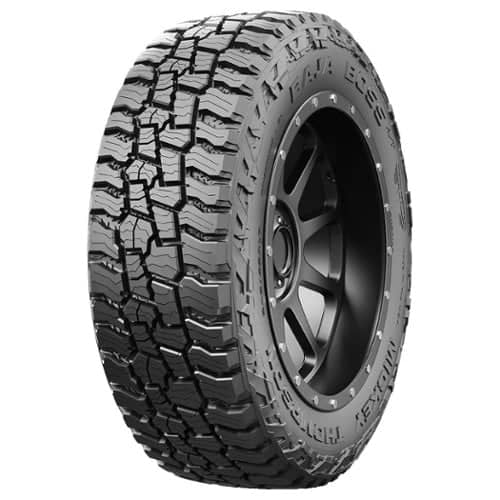
The good news is that 33x12.50R17 is one of the most stocked off-road sizes out there, so you've got real choice. If you want a do-it-all tire that's quiet enough for the daily and tough enough for the weekend, the Mickey Thompson Baja Boss A/T and the BFGoodrich All-Terrain T/A KO2 are two I hand people all the time. For a hybrid that splits the difference between trail bite and street manners, the Nitto Ridge Grappler and Toyo Open Country R/T are hard to beat. And if you're going to live in the mud and rock, a true mud-terrain like the BFGoodrich Mud-Terrain T/A KM3, the Falken Wildpeak M/T01, or the General Grabber X3 will dig when you need it. Not sure which lane you're in? Our guide on H/T vs A/T vs M/T tires sorts out which family fits your driving.
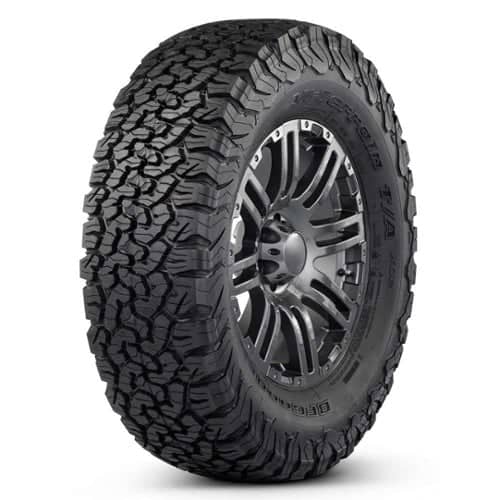
And if you're putting 33s under a classic hauler, you're in good company — the square-body Chevy crowd has been running this exact look for decades. Our C10 squarebody wheel and tire guide covers how to get the stance right on those trucks. When you're ready to see what's in stock, browse the full lineup of 33x12.50R17 tires at Performance Plus Tire and we'll get you rolling.
So, what is a 33x12.50R17 equivalent to? On paper it's a 315/65R17, and in the real world it's the close cousin of the much more common 285/70R17 — just taller and wider than that 285. It's a true 33-inch tire on a 17-inch wheel, and that combination gives you a generous 8-inch sidewall that's the best friend of anybody who airs down, wheels rough terrain, or just wants a tire that shrugs off potholes. Know that going wider means a fibbing speedometer, a little rubbing to sort out, and a couple lost MPG, and you'll walk into the purchase with your eyes open. Do that, pick the right tread for how you drive, and a set of 33s on 17s is one of the best-looking, best-riding upgrades you can put under a truck.
Here's the short version to keep in your back pocket when you're standing in the shop deciding.
A 33x12.50R17 is an imperial-sized tire that stands 33.0 inches tall (838.2 mm), measures 12.5 inches wide (317.5 mm), and mounts on a 17-inch wheel. It carries an 8.0-inch sidewall and turns roughly 611 revolutions per mile.
The closest true metric equivalent is approximately a 315/65R17, which stands about 33.1 inches tall and 12.4 inches wide. Because that size is less common, most drivers cross-shop the 33x12.50R17 against the widely available 285/70R17, which is slightly shorter and narrower.
They are close but not identical. A 33x12.50R17 stands about 33.0 inches tall and 12.5 inches wide, while a 285/70R17 measures about 32.7 inches tall and 11.2 inches wide. The 33 is roughly a third of an inch taller and about 1.3 inches wider, so they look similar in stance but the 33 has a noticeably larger footprint.
Not exactly. People use "285" as shorthand for a metric 33 because a 285/70R17 is close to 33 inches tall, but it is narrower than a true 33x12.50R17 and a hair shorter. A 285/75R17, on the other hand, actually measures about 33.8 inches, making it slightly taller than a 33. So a 285 can be in the 33 ballpark, but it is not a one-to-one match.
No. A 265/70R17 measures about 31.6 inches in overall diameter, which makes it roughly a 31-inch tire — about an inch and a half shorter than a true 33x12.50R17. It is also narrower at about 10.4 inches wide.
A 33x12.50R18 has the same 33-inch height and 12.5-inch width as a 33x12.50R17, so the overall tire size and speedometer reading are identical. The only difference is the wheel: the R18 wraps that same tire around an 18-inch wheel, which reduces the sidewall from 8.0 inches down to about 7.5 inches.
The main trade-offs are a slower speedometer reading, a higher chance of rubbing at full steering lock (often requiring a level kit, trimming, or correct wheel offset), a typical loss of 1–2 MPG from extra weight and rolling resistance, slightly lazier steering from added unsprung weight, and more road noise with aggressive mud-terrain tread.