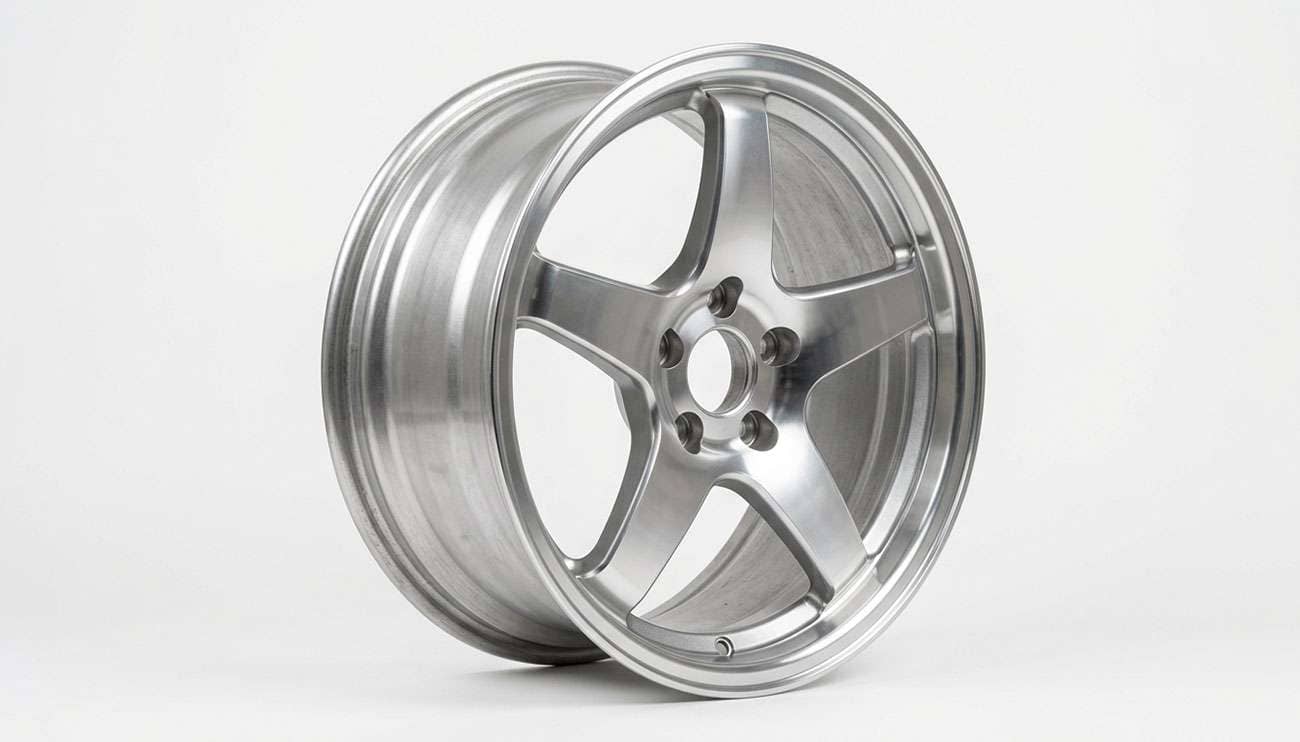
17x8 means the wheel is 17 inches in diameter and 8 inches wide. The width is measured across the inside of the barrel, bead seat to bead seat, not across the outer lip. That is the whole of what those two numbers say. What they do not say is where the wheel ends up once it is bolted to the car. Across 17x8 wheels on the market, backspacing runs from roughly 2.5 inches to 6.3 inches. Two wheels stamped the exact same size can place your tire nearly four inches apart.
I have been fitting wheels since the seventies, and I will tell you the mistake I watch people make more than any other. They find the size, they order the wheel, and the box shows up with something that will not clear the brake caliper or something that sticks out past the fender like a wagon wheel. The size was right. The size was never the problem.
Most explanations of 17x8 stop after the first sentence. The part nobody puts in front of you is that 17x8 is two of the four numbers you need. Here is the full set.
The Number |
What It Is |
What It Controls |
What Happens If You Get It Wrong |
|---|---|---|---|
17 (diameter) |
Bead seat diameter in inches |
Which tires physically mount, brake caliper clearance |
The tire will not seat. You find out immediately |
8 (width) |
Inside width, flange to flange |
Which tire section widths are approved, sidewall shape |
Tire bulges or stretches. Handling and wear both suffer |
Bolt pattern |
Lug count and circle diameter, such as 5x114.3 |
Whether the wheel goes on the hub at all |
It does not mount. You find out in the driveway |
Offset or backspacing |
Where the mounting pad sits relative to the centerline |
Caliper clearance inboard, fender clearance outboard, bearing load |
Rubbing, tramlining, and bearings that die early |
Two of those four are printed in the size. Two are not. That is the gap this article is about.
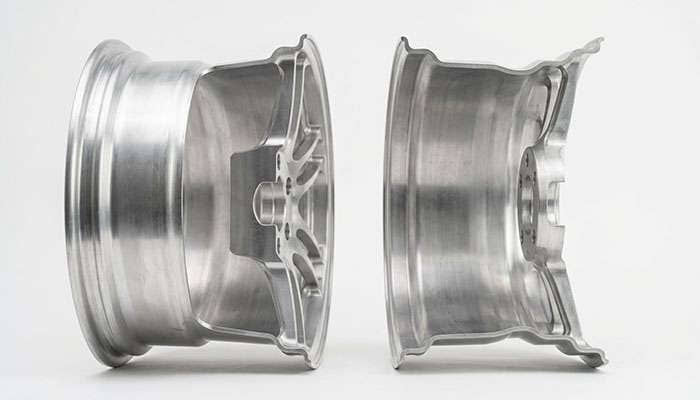
Offset is the distance from the wheel's mounting face to its true centerline, in millimeters. Positive offset means the mounting pad sits outboard of center, tucking the wheel in toward the suspension. Negative offset means it sits inboard of center, pushing the wheel out toward the fender. Zero means the pad is dead on center.
Backspacing is the same idea measured differently. It is the distance in inches from the mounting face to the inboard edge of the rim. Old school shops speak backspacing. Import and modern catalogs speak offset. They describe the same physical position, and both are stamped or printed somewhere on a properly documented wheel.
Now the numbers that matter. Across 17x8 wheels in the current market, offsets cluster around a median of about +30mm, with roughly seven in ten running positive, about one in six sitting at zero, and the remainder negative. The middle half of the market falls between 0mm and +38mm. Translate that to backspacing and the middle half runs about 4.5 to 6.0 inches, with the full working range stretching from around 2.5 inches at the aggressive end to about 6.3 inches at the tucked-in end.
Four inches of spread. Same stamp on all of them.
Here is what that means in the driveway. A 17x8 with 6-inch backspacing on a modern front-drive car tucks the tire up under the fender where the factory wanted it. A 17x8 with 4-inch backspacing on the same car pushes that tire two inches further out. On some cars that is the look you were after. On others it is a fender lip eating the shoulder of a brand new tire every time you load the trunk and hit a dip.
If you want the full picture on how these two measurements relate and how to convert between them, we laid it out in our guide to wheel offset, backspacing, and bolt patterns. And if you are working with an older car and a tape measure rather than a spec sheet, our walkthrough on how to measure backspacing on classic car rims covers the straightedge method that has not changed in fifty years.
The industry rule of thumb is that rim width should land somewhere between 70 and 90 percent of the tire's section width converted to inches. Run the math on an 8-inch rim and you get a working band of roughly 225mm to 255mm for the sizes most people are shopping. That band is where the tread sits flat on the road and the sidewall does the job it was shaped to do.
But here is the piece that gets flattened in most answers. The aspect ratio moves the ceiling. A low-profile tire and a tall-sidewall tire do not behave the same way on the same 8-inch rim, because the sidewall has different distances to travel from bead to tread. Ask what fits a 17x8 without saying what series you are running and you get an average instead of an answer.
Aspect Ratio |
Section Widths That Work on 8 Inches |
The Sweet Spot |
Typical Application |
|---|---|---|---|
40 series |
235 to 255 |
245/40R17 |
Track days, autocross, stiff sidewall response |
45 series |
225 to 245 |
235/45R17 |
The most common 17x8 fitment on the road |
50 series |
215 to 245 |
225/50R17 |
Daily drivers wanting ride quality back |
55 to 60 series |
215 to 245 |
235/60R17 |
Crossovers, muscle cars, comfortable highway miles |
70 series and taller |
235 to 265 |
255/70R17 |
Trucks, SUVs, all-terrain setups |
Read that table sideways and you see it. A 40-series tire on an 8-inch rim tops out around 255. A 70-series tire on the same rim goes to 265. The rim did not change. The sidewall did. If you want to run the same exercise for a different rim width, our reference on tire size for wheel width covers the full spread.
One more thing worth knowing before you order. A tire's published section width is measured on one specific reference rim, and mounting it wider or narrower changes the actual number. The working figure the industry uses is about two tenths of an inch of section width change for every half inch of rim width change. Move a tire from a 7-inch rim to an 8-inch rim and it grows roughly four tenths of an inch across. On a car that already rubs at full lock with a full load, four tenths of an inch is not a rounding error. Our piece on putting the same size tire on different rim widths shows what that does to the contact patch.
For low and mid-profile tires, 255mm is the honest ceiling on an 8-inch rim. You will see people running 265 on an 8, and the tire will hold air and the car will drive. What you are doing is pinching the tire, which pulls the sidewalls inward and crowns the tread so the center carries more load than the shoulders. You get faster center wear, less wet grip, and a bead that has less margin against unseating under a hard lateral load.
For 70-series and taller truck tires, 265mm is genuinely approved on an 8-inch rim by most manufacturers, because a tall sidewall has the room to make the transition without distorting. That is not a loophole. It is a different tire doing a different job.
The rule I give people in the shop is simple. Whatever chart you read, the final authority is the data sheet for the exact tire you are buying, not the nominal size. The Tire and Rim Association and its European counterpart ETRTO publish the standards, but the approved rim width range belongs to the specific tire specification, including load index and construction. Two tires both labeled 255/45R17 from different makers can carry different approved ranges. The manufacturer's current data sheet settles it, and any tire shop worth using will check it before they mount.
Going the other way, the narrowest sensible tire on a 17x8 is about 215mm. Below that you are stretching the tire, standing the sidewalls up more vertically than designed, and putting the rim lip out where the first pothole of the season will find it. Stretched fitments have a following, and I have built cars that ran them. Just know that you are trading impact protection for appearance, and a bent 17x8 costs more than the tire did.
Yes. A 265/70R17 is comfortably inside the approved rim width range for an 8.5-inch wheel, and it also fits an 8.0-inch wheel. On the 8.5 it sits closer to its design width, which is the better of the two.
That is the tire answer. The fitment answer is where it gets interesting, and this is a truck and SUV size, so the fitment answer is the one that will actually cost you money.
A 265/70R17 stands about 31.6 inches tall and measures about 10.4 inches across the section. On a 17x8.5 with a factory-style positive offset it will usually tuck in fine. Drop to a negative offset wheel because you wanted the aggressive stance, and that same tire now sits two or three inches further outboard. At full steering lock with the suspension compressed, the inner shoulder finds the sway bar end link or the firewall, and the outer shoulder finds the fender liner. Nothing about the tire size changed. The wheel position did.
Three things to check before you commit on a truck or SUV in this size range. Measure the clearance from your current tire's inner shoulder to the strut or spring perch at full lock. Measure from the outer sidewall to the fender lip with the vehicle loaded, not empty. And if you are going to a wider or more negative wheel, do both measurements again with a straightedge held against the new mounting position. Our breakdown of what size a 265/70R17 tire is in inches has the full dimensional workup if you need to run the clearance math.
One inch of rim width. Same diameter, same tires will physically mount across a lot of the overlap, different behavior.
Consideration |
17x7 |
17x8 |
|---|---|---|
Comfortable tire range |
About 195mm to 235mm |
About 215mm to 255mm |
Section width of the same tire |
Reference |
About 0.4 inch wider |
Sidewall shape |
More rounded, more give over sharp edges |
Flatter, more lateral support in corners |
Steering feel |
Softer initial response, more roll onto the shoulder |
Quicker turn-in, less squirm |
Ride quality |
Slightly more compliant on rough pavement |
Firmer, transmits more surface texture |
Weight |
Lighter, typically by one to two pounds per wheel |
Heavier, more unsprung mass at each corner |
Clearance risk |
Lower, sits closer to the factory envelope |
Higher, especially at low offsets |
Which one is better depends entirely on what you are building. If the car is a daily driver on bad pavement and you want the tire to absorb something, the 17x7 with a taller sidewall is the smarter piece. If you are chasing steering response and you want the tread flat under load, the 17x8 earns its extra pound.
What I will say is that a lot of people go to the 8 because it looks right and then fight the consequences for years. Wider is not automatically better. Wider is a trade, and you should know which side of the trade you are on before the box arrives.
Smaller diameter. Every time. The ride quality lives in the sidewall, and the sidewall is whatever is left after the wheel takes its share of the overall diameter.
Take a fixed overall tire diameter, which is what your speedometer and your transmission calibration care about. Put a 16-inch wheel under it and you have a tall stack of rubber between the rim and the road. Put a 20-inch wheel under the same overall diameter and that stack is maybe half as tall. The rubber is the spring. Less rubber, less spring, more of every expansion joint arriving at the seat of your pants.
So the ranking, holding overall diameter constant, goes like this. A 16 or 17-inch wheel with a 55 to 65 series tire rides best. An 18-inch with a 45 to 50 series is the compromise most modern cars ship with. A 20-inch or larger with a 30 to 40 series looks the way people want it to look and rides the way physics says it must.
There is a second variable, and it is the one people forget. Unsprung weight. A heavier wheel and tire package at each corner takes longer to react to a bump, which means the suspension has more work to do keeping the tire on the ground. Two wheels that measure 17x8 can differ by five pounds each depending on whether they are cast, flow formed, or forged. That difference is felt over broken pavement more than it is felt anywhere else.
If you are weighing a 17 against something taller, we have run that comparison directly in our piece on the advantage of 17-inch wheels, including where the tradeoff stops being worth it.
My honest opinion after a lot of years of this. The 17-inch wheel is the last size where you can still have real sidewall, real tire selection, and a wheel that looks modern. Above that you start paying for looks with ride quality and with the cost of a bent rim.
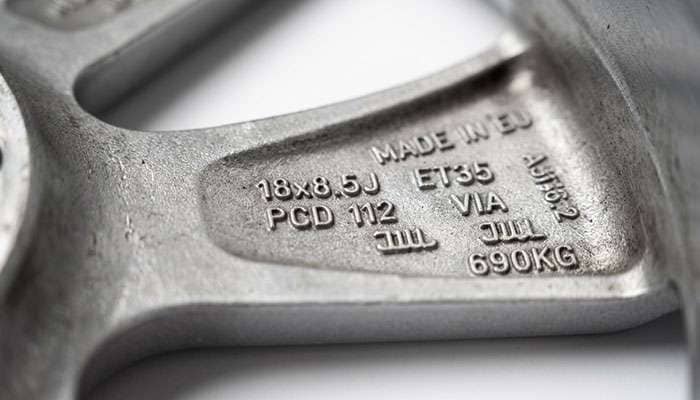
If you have the wheel in your hands, the information is on it. Here is where to look.
The back of the spokes or the inside of the barrel. Most wheels carry a cast or stamped code that reads something like 17x8 5x114.3 ET35. That is diameter, width, bolt pattern, and offset in millimeters. ET is short for the German Einpresstiefe, which is where the convention came from.
Near the valve stem. Some manufacturers put the size stamp on the inner flange right by the stem hole. Wipe the wheel weight adhesive off and look carefully. It is often faint.
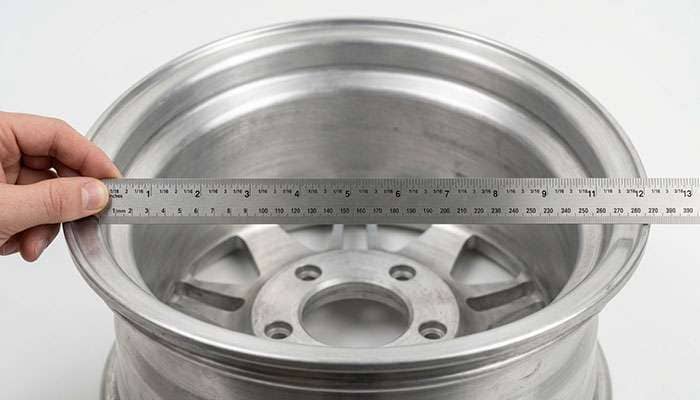
Measure it yourself if there is no stamp. This happens constantly on older wheels and on anything that has been refinished. For width, lay a straightedge across the inside of the barrel from bead seat to bead seat. Do not measure the outer lip. The lip adds about a half inch on most designs, which is exactly how people end up believing their 8-inch wheel is an 8.5. For backspacing, lay the straightedge across the back of the rim, then measure straight down to the mounting pad.
Count and measure the bolt pattern. On a five-lug wheel, measure from the center of one stud hole to the outer edge of the hole two positions away. On a four or six-lug, measure straight across from center to center of opposite holes. Get this wrong and nothing else matters.
One note for the classic car crowd, since a lot of you are reading this. A meaningful share of 17x8 wheels on the market ship as blank five-lug, undrilled from the factory so a shop can cut them to whatever pattern your car actually uses. If you are working on something from the fifties or sixties with an oddball pattern, that is your path forward, and it is why you should never assume a size that is not offered in your bolt pattern is off the table.
A wheel with the wrong offset bolts up and drives away. That is what makes it expensive. You do not find out on day one. You find out in stages, and by the time you find out, you have paid for it in parts.
The first drive. Pushing the wheel outboard changes the scrub radius, which is the distance between where your steering axis meets the road and where the tire's contact patch centers. Change it and the steering starts fighting you under braking, tugging toward whichever wheel has more grip. On grooved concrete you get tramlining, where the car follows the ruts instead of your hands.
The first few thousand miles. The camber curve the suspension was designed around now operates on a tire sitting in a different place. Wear concentrates on one shoulder instead of spreading across the tread. If you catch it at the first rotation you have lost a little tread. If you do not, you have lost the tire.
The first year. This is the one that hurts. Your hub bearing was engineered for a load applied at a specific distance from its centerline. Push the wheel out an inch and you have lengthened that lever arm, and the bearing now carries a bending moment it was never rated for. It does not fail dramatically. It starts as a hum at highway speed that changes pitch when you sway the car side to side.
Eventually. Bearing replacement, which on a lot of modern cars means a hub assembly rather than a bearing. Or a tire that has been rubbing the fender liner every time the suspension loads, cutting the shoulder until it lets go. Neither is a good afternoon.
The engineering behind all of this is not folklore. The Tire and Rim Association and ETRTO publish the dimensional standards, SAE defines the load and durability test methods, and the Tire Industry Association trains technicians to treat unexplained wear on one shoulder as a fitment question rather than an alignment question. If you want the full accounting of what goes wrong and in what order, our article on the potential problems with incorrect wheel offset goes further than I have room for here.
17x8 tells you two things, and they are the two easiest things to get right. Seventeen inches across, eight inches wide, measured on the inside of the barrel where the bead sits.
The two numbers that decide whether the wheel actually works on your car are not in that stamp. Bolt pattern determines whether it mounts. Offset determines whether it clears, whether it wears evenly, and whether your bearings live a full life. Across wheels that all read 17x8, there is roughly four inches of variation in where that wheel ends up sitting. Nobody puts that number next to the size, and it is the number that costs people money.
So get the size, then get the other two. Measure what is on the car now, write down the offset or backspacing, and match it or make a deliberate decision to change it. When you are ready to look at what is out there, browse the 17 inch wheel selection and filter by your bolt pattern first.
The inside. Rim width is measured across the bead seats, flange to flange, where the tire actually sits. The outer lip typically adds around half an inch to the overall physical dimension, which is why a wheel that measures 8.5 inches across the lips is still an 8-inch wheel. Measuring the outside is the most common reason people believe they have a wider wheel than they do.
For a car, 235/45R17 is the most common and most forgiving fitment on an 8-inch rim. It sits close to the design width so the tread stays flat, it gives you enough sidewall to protect the rim from curb damage, and it is widely available across nearly every tire category. For trucks and SUVs running taller sidewalls, 255/70R17 fills the same role.
ET35 means the wheel has 35mm of positive offset, so the mounting face sits 35mm outboard of the wheel's true centerline. ET comes from the German word Einpresstiefe, meaning insertion depth. A higher ET number tucks the wheel further in toward the suspension. A lower or negative number pushes it out toward the fender.
Often yes, but the offset has to be checked, not assumed. Adding an inch of width adds half an inch to each side of the centerline. If the replacement wheel keeps the same offset, that extra half inch goes inboard toward the strut and outboard toward the fender simultaneously. Measure your existing clearance at full steering lock with the suspension loaded before ordering.
Take the rim width, add half an inch to account for the flanges, divide by two to find the centerline, then add the offset converted to inches. On a 17x8 that gives you 4.25 inches at zero offset. A wheel with 25mm of positive offset works out to roughly 5.23 inches of backspacing. A wheel with 25mm negative lands near 3.27 inches.
No. A wider rim flattens the tread and sharpens turn-in, which helps on smooth pavement. It also adds unsprung weight, firms up the ride, and moves the tire closer to whatever it can rub against. On rough roads a narrower wheel with more sidewall often puts more rubber on the ground more of the time, because the suspension has an easier job keeping the tire in contact.