
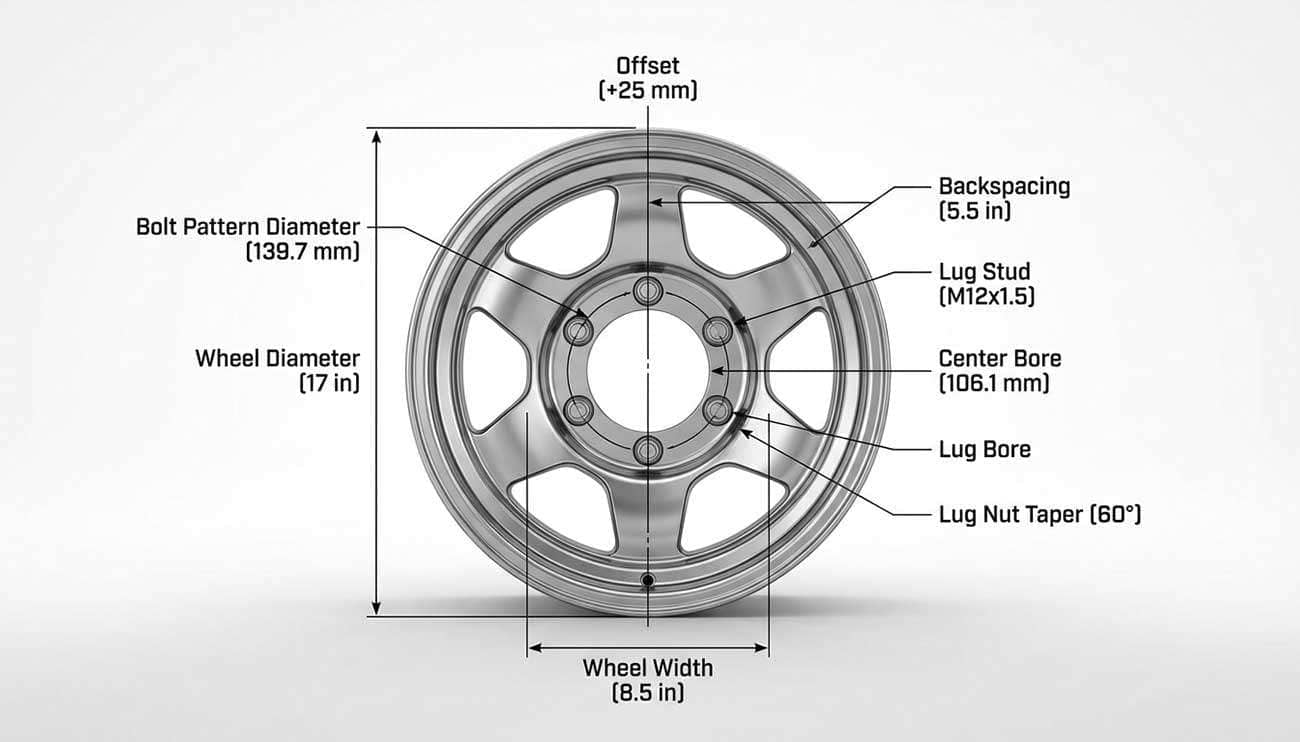
6 lug wheels feature six lug nuts positioned in a circular pattern at each wheel's center. This configuration has become the standard mounting system for many trucks and SUVs, especially Chevrolet models. The "lug" refers to the bolts or studs that secure your wheel to the vehicle's hub.
These six lugs create what's known as a bolt pattern. A bolt pattern uses two key numbers that tell you exactly how a wheel mounts to your vehicle. The first number (6) shows how many lug bolts each wheel has, while the second number represents the diameter of the imaginary circle these lugs form. You'll see this diameter listed in either inches or millimeters.
The most common 6 lug configuration is 6x5.5 inches, which equals 6x139.7mm in metric measurements. Here's how it works: "6" means six lug nuts, and "5.5" (or "139.7mm") indicates the diameter of the circle where these lugs sit. This particular measurement became the industry standard for many truck manufacturers, particularly Chevrolet trucks and SUVs.
Six lug wheels offer distinct advantages for larger vehicles. The hexagonal layout delivers superior stability and load-bearing strength compared to wheels with fewer lugs. This makes them perfect for trucks, SUVs, and vehicles that regularly haul heavy loads or pull trailers.
Chevrolet adopted the 6x5.5 bolt pattern for their trucks back in the late 1960s. This wheel configuration became the go-to standard for Chevrolet's 1500 series 4x4 pickup trucks from that time forward. You'll find this same pattern across multiple Chevrolet models including the Silverado, Tahoe, Suburban, and Avalanche.
Measuring 6 lug patterns is straightforward compared to odd-numbered configurations. While odd patterns need special measuring tools, you can measure a 6 lug pattern by finding the distance between two directly opposite lugs. The six lugs form a hexagon shape, which makes measurement much simpler.
Keep in mind that while 6x5.5 (139.7mm) dominates Chevrolet trucks and SUVs, not all 6 lug patterns match across different manufacturers or even within the same brand. Variations exist between different models and production years, so you'll want to verify exact specifications when choosing replacement wheels.
Compatible vehicles with the 6x139.7mm pattern extend beyond Chevrolet to include GMC Sierra 1500 models from matching years, newer Tahoe and Suburban vehicles, the Chevrolet Avalanche, and select Toyota Tundra models.
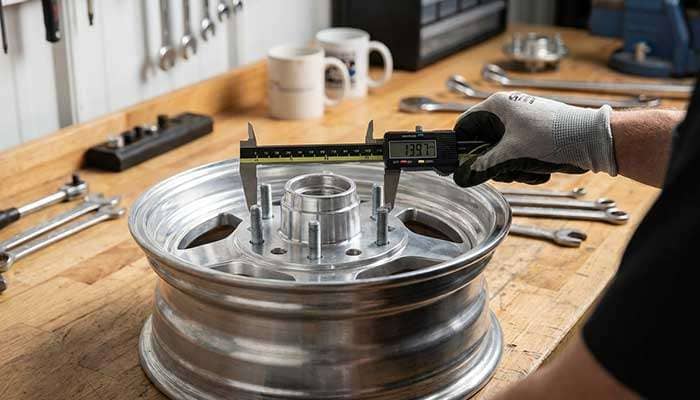
Measuring a 6 lug bolt pattern requires understanding two critical numbers that determine wheel compatibility. The bolt pattern, also called the bolt circle or Pitch Circle Diameter (PCD), tells you exactly how a wheel mounts to your vehicle.
Bolt Circle Diameter represents the measured diameter of an imaginary circle formed by the centers of the wheel studs or bolt holes. When you have six lugs, this measurement creates the 6-lug bolt pattern that defines compatibility with your vehicle. The pattern uses two numbers - six for the lug count and a diameter measurement that's crucial for proper wheel fitment to your vehicle's hub.
Even-numbered patterns like 6-lug configurations follow a straightforward measuring process. You measure in a straight line from the center of one bolt hole to the center of the bolt hole directly across from it. This direct approach makes 6 lug patterns much easier to measure than odd-numbered patterns that require special measuring techniques.
The 6-lug pattern appears in both imperial and metric measurements. The most popular 6-lug pattern for trucks and SUVs is 6x5.5 inches, which equals 6x139.7mm. These numbers are identical - 5.5 inches converts directly to 139.7mm.
You'll encounter these common 6-lug bolt pattern conversions:
6x4.5 inches = 6x114.3mm
6x4.52 inches = 6x115mm
6x5 inches = 6x127mm
6x5.2 inches = 6x132mm
6x5.3 inches = 6x135mm
These standardized measurements help identify compatible wheels regardless of whether specifications are listed in inches or millimeters.
Accurate measurement of a 6-lug bolt pattern follows these steps:
Place a ruler or caliper across the wheel, measuring from the center of one lug hole to the center of the hole directly opposite. For 6-lug wheels, measure straight across through the wheel's center.
Measure from the center of each hole rather than the edges - this prevents the most common measurement error.
Record your measurement in millimeters or inches.
Verify your measurement by checking your vehicle's specifications in the owner's manual or consulting with a professional.
Quality calipers provide the most precise measurements, though a standard ruler works for basic measurements. Bolt pattern gages are specialized tools that quickly identify bolt patterns without manual measurement.
When you're uncertain about your measurements, consulting a wheel fitment guide or speaking with a service professional is the smart approach. They can provide the exact bolt pattern based on your vehicle's make, model, and year.
6 lug wheels have earned their place as the go-to choice for trucks and SUVs because they deliver the perfect balance of strength and practicality. These wheels provide significantly more durability than 4-lug setups while avoiding the extra weight that comes with 8-lug configurations designed for heavy-duty commercial applications.
The hexagonal arrangement of six lugs creates superior load-bearing capabilities that make these wheels ideal for vehicles that regularly haul cargo or tow trailers. This design distributes stress more evenly across the wheel, which means better stability when you're carrying heavy loads or tackling challenging terrain. You get the strength you need without the penalty of excessive weight that can hurt your vehicle's performance and fuel economy.
Vehicle manufacturers choose lug counts based on a simple principle: heavier vehicles need more mounting points for safety and performance. Passenger cars typically use 4 or 5 lug patterns, which work fine for lighter loads. 6 lug wheels step up the game for light trucks and SUVs that need to handle more demanding tasks. When you move up to 8-lug configurations, you're looking at 3/4-ton and 1-ton trucks built for maximum durability and extreme hauling capacity.
Off-road enthusiasts particularly appreciate 6 lug wheels for their ability to handle punishment. These wheels stand up to the stresses of rocky trails, deep ruts, and uneven terrain while maintaining reliable performance. The strength-to-weight ratio gives you the durability you need for adventures without making your vehicle sluggish on the road.
Chevrolet recognized the benefits of this configuration early, adopting the 6x5.5 (139.7mm) pattern for their trucks in the late 1960s and sticking with it ever since. This consistency means the same wheels can fit across different models in their lineup - a Silverado 1500, Tahoe, or Suburban can often share the same wheel fitment. This standardization makes it easier for owners to find replacement wheels or upgrade to aftermarket options.
The popularity of 6 lug wheels comes down to practical engineering. They provide the right amount of strength for vehicles that need to work harder than passenger cars but don't require the heavy-duty capabilities of commercial trucks. This sweet spot explains why 6 lug wheels remain the standard choice for manufacturers building vehicles that handle both daily driving and weekend adventures with equal capability.
Different truck and SUV manufacturers use distinct 6 lug bolt patterns, and understanding these variations is crucial when selecting replacement wheels. These subtle yet important differences determine which wheels will properly fit your vehicle.
Chevrolet has maintained consistency with their 6 lug pattern across decades of truck production. The 6x5.5 inch (139.7mm) bolt circle diameter became Chevrolet's standard configuration for 1/2-ton trucks starting in 1967. Most Chevy models manufactured after 1999 continue to use this exact 6x5.5 inch pattern.
This pattern appears across numerous Chevrolet vehicles:
Chevrolet Colorado (2004-2012)
Chevrolet Express Full-Size Van (1996-Current)
Chevrolet Avalanche (2003-2013)
Chevrolet Blazer 2WD (1969-1999)
Chevrolet K5 Blazer 4WD (1969-1991)
Chevrolet Silverado 1500 (1999-Present)
This long-term standardization offers significant advantages for Chevrolet owners, allowing wheel interchangeability across multiple models and years within the lineup.
Ford takes a different approach with their 6 lug bolt pattern. Starting in 2004, Ford F-150 trucks and Expedition SUVs adopted the 6x135mm configuration, departing from the 5x135mm pattern used on 1997-2003 F-150 models. Ford's current 6 lug specifications include:
6x135mm bolt pattern
87.1mm center bore
14mm x 2.0 lug nut size
Recommended torque: 150 ft-lbs
This pattern remains exclusive to Ford vehicles and typically doesn't interchange with other manufacturers' wheels.
Toyota utilizes the 6x5.5 inch (139.7mm) bolt pattern across multiple vehicle generations. While this measurement appears identical to Chevrolet's pattern, significant differences exist in hub design and center bore dimensions. Toyota's 6 lug pattern appears on:
FJ Cruiser (2007-2014)
Land Cruiser (1995-1997)
Sequoia (2001-2007)
Tacoma 4x4 models (1995.5-present)
Tundra (1999-2005)
The Toyota Tacoma demonstrates remarkable consistency, maintaining the 6x139.7mm bolt pattern across all generations from the earliest 1995.5 models through current 2024-2025 models. Despite sharing the same bolt pattern dimensions as Chevrolet, Toyota wheels typically feature a larger center bore, often requiring hub-centric rings when mounted on other vehicles.
Choosing the right 6 lug wheels goes far beyond matching bolt patterns. At Performance Plus Tire, we guide customers through the essential factors that ensure optimal fitment, performance, and safety for their vehicles.
Proper wheel fitment starts with exact bolt pattern matching—even a 1mm deviation prevents proper seating. For 6 lug configurations, verify both the lug count and precise bolt circle diameter. Modern vehicles typically use hub-centric designs, where the wheel's center bore must equal or exceed the hub diameter. When the center bore is larger, hub-centric rings become necessary for proper centering.
Brake clearance presents another critical consideration. The wheel's spoke design and barrel depth must provide adequate clearance for your vehicle's brake components. Additionally, confirm that the wheel's lug seat type—cone, ball, or mag—matches your vehicle's requirements with the correct lug nuts or bolts.
Wheel offset, measured in millimeters, represents the distance from the wheel's centerline to its mounting surface. Positive offset moves the wheel inward toward the suspension, while negative offset pushes it outward. We recommend staying within ±5–10mm of your stock offset unless you've confirmed adequate clearance.
Backspacing—the distance from the mounting surface to the wheel's inside edge—affects clearance for brake calipers and suspension components. When increasing wheel width, each 1-inch width increase requires approximately 6mm more positive offset to maintain similar positioning.
The load rating indicates maximum weight capacity per wheel. This specification must meet or exceed half your vehicle's heaviest gross axle weight rating. Find this information on the wheel itself, from the manufacturer, or on your vehicle's identification label typically located on the driver's door jamb.
Match your wheel selection to intended use—daily driving, off-roading, or towing each demand different wheel characteristics. Industry standards recognize specialized categories: SureFit wheels provide direct bolt-on replacement, SpecFit offers slightly more aggressive OEM+ fitment, CustomFit works with modified suspension systems, and CustomFitEXT accommodates extreme suspension modifications.
Our expert team helps you navigate these specifications to ensure you get wheels that not only fit perfectly but also enhance your vehicle's performance and appearance.
When shopping for 6 lug wheels, customers often have specific questions about compatibility and specifications. We've compiled answers to the most common inquiries to help you make informed decisions.
No, 6 lug wheels vary significantly in bolt patterns and dimensions. Different manufacturers use distinct bolt circle diameters even when using six lugs. Common 6 lug patterns include 6x135mm (Ford), 6x139.7mm (Chevy/Toyota), 6x114.3mm (Nissan/Dodge), 6x120mm, and 6x132mm. Even within the same manufacturer, bolt patterns may change across different vehicle models and production years.
Beyond bolt patterns, 6 lug wheels also differ in center bore diameter, offset, and overall wheel dimensions. These variations make it essential to verify exact specifications before purchasing replacement wheels.
Ford and Chevy 6 lug patterns are not interchangeable. Chevy uses a 6x139.7mm (6x5.5") bolt pattern, while Ford F-150s and Expeditions from 2004 onward use a 6x135mm pattern. This 4.7mm difference prevents direct wheel swapping between these manufacturers.
The center bore sizes also differ, with Ford typically featuring a larger bore diameter. Attempting to mount Ford wheels on Chevy vehicles or vice versa can result in improper fitment and safety hazards. We recommend always confirming your vehicle's exact specifications before purchasing wheels.
The 6x5.5" (6x139.7mm) bolt pattern represents the most widespread 6 lug configuration in the automotive industry. This pattern appears across numerous truck and SUV models from both domestic and import manufacturers.
Chevrolet has used this pattern consistently for their trucks and SUVs since the late 1960s. You'll also find this pattern on Toyota trucks, GMC vehicles, and select other manufacturers' models. This widespread adoption makes it easier to find wheel options when upgrading or replacing your existing wheels.
Understanding 6 lug wheels is essential for truck and SUV owners looking to replace or upgrade their wheels safely and effectively.
• 6 lug wheels feature six mounting bolts in a circular pattern, with 6x5.5" (139.7mm) being the most common configuration for trucks and SUVs
• Different manufacturers use distinct bolt patterns - Chevy uses 6x139.7mm while Ford uses 6x135mm, preventing direct wheel interchangeability between brands
• Measure 6 lug patterns by finding the distance from center of one bolt hole to the center of the directly opposite hole across the wheel
• Always verify exact bolt pattern, offset, and load rating compatibility before purchasing - even small deviations can cause safety issues
• 6 lug wheels provide optimal strength-to-weight ratio for light trucks and SUVs, offering better load capacity than 4-lug without 8-lug weight penalties
The hexagonal lug arrangement has become the industry standard for vehicles that need to balance everyday drivability with the capability to handle heavy loads and challenging terrain. When selecting replacement wheels, prioritize exact fitment specifications over visual appeal to ensure safe, reliable performance.
Ford typically uses a 6x135mm bolt pattern, while Chevy uses a 6x139.7mm (6x5.5") pattern. This 4.7mm difference prevents direct interchangeability between these manufacturers' wheels.
To measure a 6 lug bolt pattern, place a ruler or caliper across the wheel, measuring from the center of one lug hole to the center of the hole directly opposite. Ensure you're measuring from the center of each hole for accuracy.
6 lug wheels offer an optimal balance between strength and weight for medium-duty vehicles. They provide enhanced durability compared to 4-lug setups, making them ideal for vehicles that routinely carry heavy cargo or navigate challenging terrain.
No, 6 lug wheels come in various bolt patterns and sizes. Common patterns include 6x135mm, 6x139.7mm, 6x114.3mm, 6x120mm, and 6x132mm. They also differ in center bore diameter, offset, and overall wheel dimensions.
When selecting 6 lug wheels, consider vehicle compatibility (exact bolt pattern, hub-centric design, brake clearance), wheel size and offset, and load rating. Also, match your wheel selection to intended use, whether it's daily driving, off-roading, or towing.



