
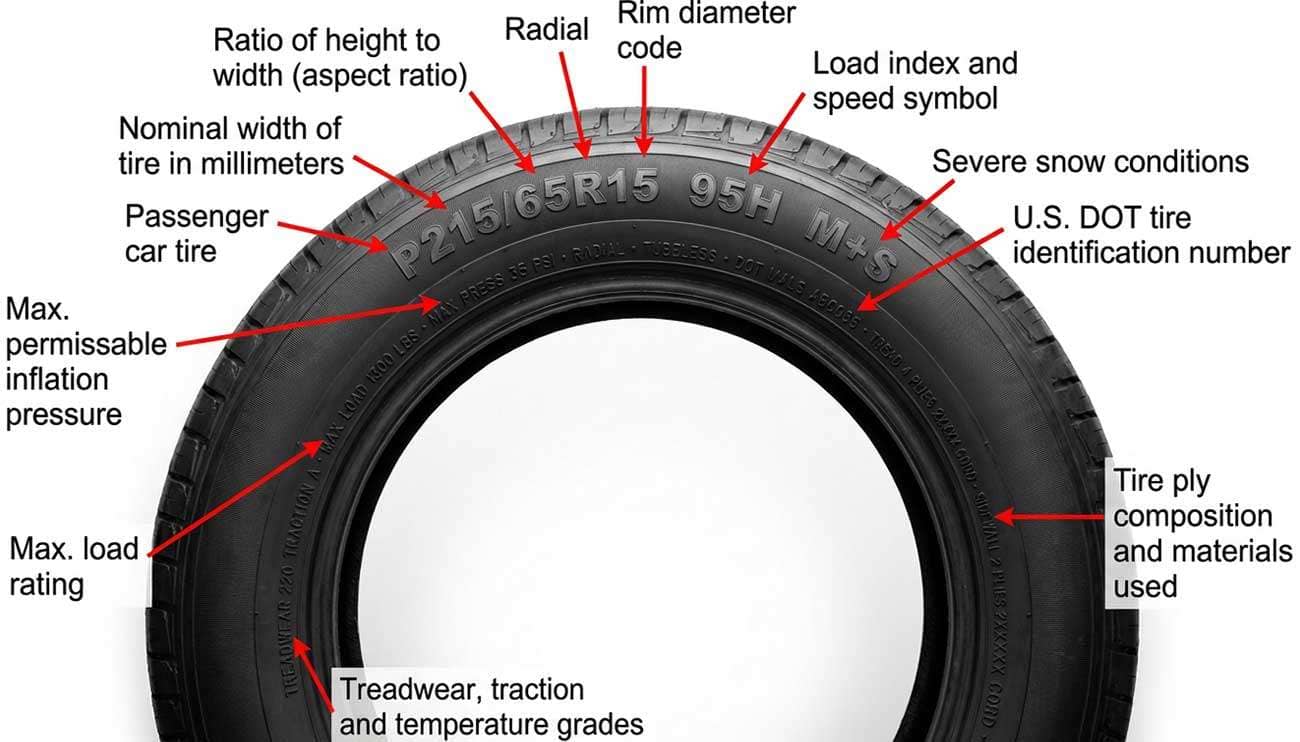
Tire size codes are the standardized numbers and letters molded into your tire's sidewall that tell you everything you need to know about that tire's dimensions, construction, load capacity, and speed limits. These codes help you select the right tire for your specific vehicle and driving needs, ensuring proper fit and optimal performance.
The tire size designation is the most important information on your tire sidewall. These codes have evolved over the years, which explains why you'll see a mix of metric and imperial measurements along with various letter combinations. Most passenger cars use either P-Metric or Metric (Euro-metric) sizing systems, while pickup trucks and SUVs typically require Light Truck Numeric or Light Truck High Flotation systems.
A standard passenger tire size code looks like "P215/65R15 95H". Here's what each part means:
1. Vehicle Class Indicator - The first letter tells you what type of vehicle this tire is designed for:
P: Passenger vehicles (cars, SUVs, crossovers, minivans, smaller pickup trucks)
LT: Light trucks that carry heavy loads or tow trailers
ST: Special Trailer tires for trailers, campers, and boat trailers
T: Temporary spare tires
C: Commercial van tires
No letter: Euro-metric tire
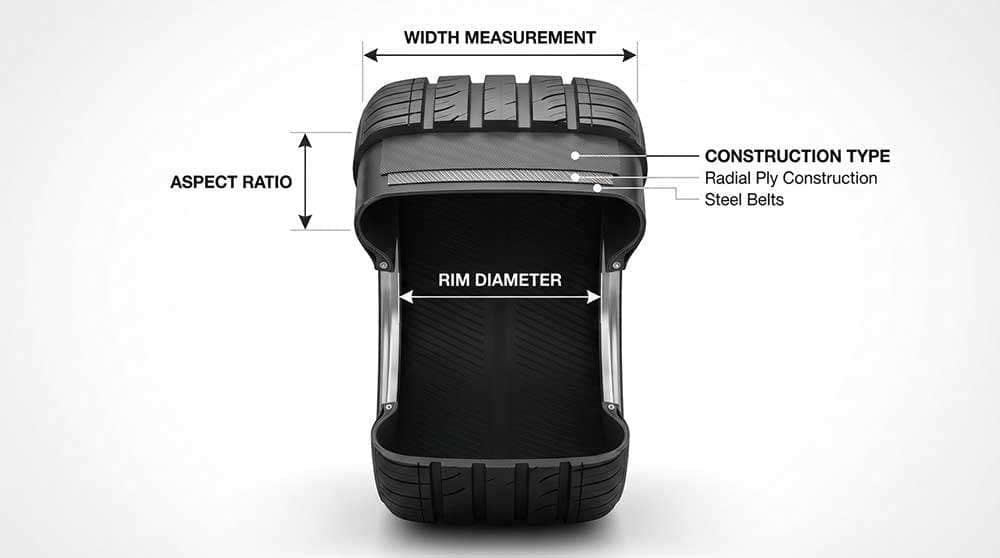
2. Section Width - The first three-digit number (215 in this example) shows the tire's width in millimeters from sidewall to sidewall.
3. Aspect Ratio - The two-digit number after the slash (65 in this example) represents the sidewall height as a percentage of the tire's width. Higher numbers mean taller sidewalls.
4. Construction Type - The letter after the aspect ratio (R in this example) indicates how the tire is built:
R: Radial construction, with layers running across the tire
D: Diagonal or bias ply construction
B: Belted bias construction
5. Rim Diameter - The two-digit number after the construction type (15 in this example) specifies the wheel diameter in inches that fits this tire.
6. Load Index - The two or three-digit number (95 in this example) corresponds to the maximum weight this tire can safely carry when properly inflated. For passenger vehicles, load indices typically range from 75 to 105.
7. Speed Rating - The final letter (H in this example) represents the tire's maximum safe speed under ideal conditions. An H rating means the tire can handle speeds up to 130 mph (210 km/h).
These standardized codes ensure your tires match your vehicle's specific requirements and driving conditions. Using the wrong tire size can negatively impact handling, fuel economy, speedometer accuracy, and safety.
Tire size codes work the same way across all manufacturers, making it easy to compare tires from different brands. Your vehicle manufacturer lists the recommended tire sizes in your owner's manual or on a placard usually found on the driver's side door jamb.
Knowing how to read these codes helps you make smart decisions when buying replacement tires and ensures your vehicle performs at its best. Whether you're commuting daily, heading off-road, or towing heavy loads, the right tire size makes all the difference in performance and safety.
Reading tire sidewall codes becomes straightforward once you understand what each number and letter represents. These codes tell you everything about your tire's capabilities, from size specifications to performance limits.
The first letter in your tire size reveals the intended vehicle type. "P" marks passenger vehicle tires, covering cars, SUVs, crossovers, minivans, and smaller pickup trucks. "LT" identifies light truck tires built for vehicles that haul heavy loads or pull trailers. "ST" appears on special trailer tires made specifically for boat trailers, utility trailers, and travel trailers. "T" designates temporary spare tires meant for emergency use only. "C" indicates commercial van tires designed for heavy-duty applications. When no letter appears before the numbers, you're looking at a Euro-metric tire, which may have different load capacities than P-metric tires despite identical dimensions.
The three-digit number following the vehicle class shows tire width in millimeters, measured from sidewall to sidewall. Most passenger and truck tires use widths ending in 5, such as 185, 195, or 205. After the slash, the aspect ratio indicates sidewall height as a percentage of tire width. A P215/65R15 tire has a sidewall height equal to 65% of its 215mm width. Higher aspect ratios create taller sidewalls, which affect ride comfort and handling characteristics. You can calculate actual sidewall height in inches by multiplying the section width (converted to inches) by the aspect ratio percentage.
A single letter identifies how the tire is built internally. "R" stands for radial construction, where plies run perpendicular to the direction of travel. This design offers better road grip, lower rolling resistance, improved fuel economy, and superior durability - making it standard for modern passenger vehicles. "D" indicates diagonal or bias-ply construction with cords running at angles across the tire. "B" represents bias-belted tires, similar to diagonal construction but with additional stabilizer belts above the top ply layer. If no letter appears, the tire uses cross-ply construction with diagonally placed nylon cords.
The rim diameter appears as a one or two-digit number specifying wheel diameter in inches. This measurement shows the diameter of the wheel that the tire fits. A P215/65R15 tire mounts on a 15-inch wheel. The number represents the distance between bead seat areas where the tire seals against the wheel.
The load index, a two or three-digit number after the rim diameter, corresponds to maximum weight a properly inflated tire can safely carry. A load index of 91 means the tire can handle 1,356 pounds (615 kg) per tire. Passenger car load indices typically range from 75 to 105. The speed rating, shown as a letter after the load index, indicates maximum sustained speed capability. Common ratings include S (112 mph/180 km/h), T (118 mph/190 km/h), H (130 mph/210 km/h), V (149 mph/240 km/h), W (168 mph/270 km/h), and Y (186 mph/300 mph). Tires with higher speed ratings generally provide better handling characteristics even at legal driving speeds.
Beyond the basic size designation, tire sidewalls contain important markings that help you make better purchasing decisions and ensure proper tire maintenance. These additional codes provide crucial safety and performance information that every vehicle owner should understand.
The DOT (Department of Transportation) code certifies that your tire meets U.S. Department of Transportation safety standards. This Tire Identification Number (TIN) starts with "DOT" followed by 8-13 characters. The first characters identify where the tire was manufactured, along with size and type information.
The most important part of the DOT code is the manufacturing date. For tires made after 2000, the last four digits tell you exactly when your tire was produced. The first two numbers show the week (1-53), and the last two show the year. For example, "4518" means the tire was made in week 45 of 2018.
You may need to check both sides of your tire to find the complete DOT code, as manufacturers sometimes place the full code (including the date) on only one sidewall. Tires made before 2000 have only three digits in the date code, making it harder to determine the exact year. Any tire showing only three digits is over 20 years old and needs immediate replacement.
The Uniform Tire Quality Grading (UTQG) system was created by the National Highway Traffic Safety Administration (NHTSA) to help you compare tire performance across different brands. Since 1979, most passenger tires must display these ratings (winter tires, deep-treaded light truck tires, and temporary spares are excluded).
The UTQG system includes three key ratings:
Treadwear Rating - A number from 100-1000 that indicates how long the tire should last compared to other tires. A tire rated 200 should theoretically last twice as long as one rated 100 under controlled test conditions. Keep in mind that actual treadwear depends on your driving habits, road conditions, and climate.
Traction Grade - Rated AA (best), A, B, or C (lowest), this measures how well your tire stops on wet pavement. The test measures straight-line braking on wet asphalt and concrete. This rating doesn't cover cornering or turning performance.
Temperature Grade - Rated A (best), B, or C, this shows how well your tire resists heat buildup. Grade A tires perform above 115 mph, B-rated tires handle 100-115 mph, and C-rated tires work between 85-100 mph. Every tire sold in the United States must meet at least a C rating.
The E-mark shows that a tire meets European safety standards. You'll see either an uppercase "E" or lowercase "e" with a number in a circle or rectangle. The number identifies which country approved the tire.
An uppercase "E" means the tire complies with ECE Regulation 30 (passenger cars) or Regulation 54 (commercial vehicles). A lowercase "e" indicates certification under European Directive 92/23/EEC.
The country codes range from 1 to 54. E1 represents Germany, E11 is the United Kingdom, E4 is the Netherlands, and E2 is France. These codes extend beyond Europe to include Australia (E45), Japan (E43), and South Africa (E47).
Some tires carry multiple E-markings if they've been approved by different countries. These markings help verify that imported tires meet local safety standards, which is particularly important when buying tires manufactured overseas.
Different vehicle types require specific tire size formats designed for their unique performance demands and operating conditions. Understanding these format differences helps you select the right tires for your specific vehicle and application.
Most passenger vehicles use either P-metric or Euro-metric tire size formats. P-metric sizes begin with the letter "P" indicating they were designed based on the Tire and Rim Association's (TRA) standard. A typical P-metric size appears as "P225/60R16 99H" where "P" denotes passenger vehicle use.
Euro-metric sizes omit the initial letter but maintain identical dimensional elements (e.g., "225/60R16 99H"). While dimensionally equivalent to P-metric sizes, Euro-metric tires often have slightly different load-carrying capabilities. Both formats display width in millimeters, aspect ratio as a percentage, construction type, and rim diameter in inches.
Light truck tires use two primary sizing conventions designed for heavier loads and towing applications. LT-metric sizes typically begin with "LT" (e.g., "LT285/70R17") and are engineered for pickup trucks with higher cargo carrying and towing capabilities. The load range, indicated by letters C, D, E, or F, appears after the size designation to signify the tire's strength and inflation capacity.
Flotation sizing represents a different approach, arranged with overall diameter first, followed by section width and rim diameter (e.g., "35x12.50R17LT"). Here, "35" indicates the tire's total height in inches, "12.50" represents the width in inches, and "17" specifies the rim diameter. These tires are designed specifically for off-road applications on loose surfaces like sand or dirt where they effectively "float" on the surface.
Motorcycle tire sizes predominantly use the metric system, appearing as "180/55R17" where "180" indicates width in millimeters, "55" represents aspect ratio, "R" denotes radial construction, and "17" specifies rim diameter in inches. Some motorcycle tires use alternative sizing systems, including the alpha code format (e.g., "MT90-16") or standard inch designation for vintage motorcycles.
Trailer tires are marked with "ST" (Special Trailer), as in "ST205/75R15," signifying their specific design for trailer applications only. ST tires feature reinforced construction to handle the unique weight distribution and sway characteristics of trailers. For smaller trailer wheels (12 inches or less), numeric sizing such as "4.80X8" is common, where "4.80" represents width in inches and "8" indicates rim diameter.
Proper size selection remains essential for optimal performance, safety, and longevity regardless of format. Vehicle manufacturers specify recommended tire sizes in owner's manuals to ensure appropriate load capacity, handling characteristics, and operational safety.
Reading actual tire size codes becomes straightforward once you see how each element works together. These examples show you exactly what to look for when checking your current tires or shopping for replacements.
A typical passenger car tire displays P225/50R16 91S. Here's what each part tells you:
The "P" confirms this tire is designed for passenger vehicles. The "225" shows the tire width of 225 millimeters from sidewall to sidewall. The "50" after the slash represents the aspect ratio - the sidewall height equals 50% of the tire's width. The "R" indicates radial construction, which provides better fuel economy and handling. The "16" means this tire fits a 16-inch wheel.
The service description "91S" gives you two crucial pieces of information. The "91" load index corresponds to a maximum capacity of 1,356 pounds per tire. The "S" speed rating means this tire can safely handle speeds up to 112 mph.
Euro-metric tires look almost identical: 225/50R16 91S. The only difference? No "P" at the beginning. This matters because Euro-metric tires may have different load capacities than P-metric tires despite identical dimensions.
Light truck tires use the "LT" prefix, as in LT285/70R17. This designation means the tire is built for vehicles that carry heavy cargo or tow trailers.
Flotation sizing works differently: 35x12.50R17LT. The "35" shows the tire's total height in inches, "12.50" indicates the width in inches, and "17" specifies the rim diameter. These tires excel on loose surfaces like sand and mud.
Special trailer tires carry "ST" markings like ST205/75R15. These tires are exclusively for trailers and feature reinforced construction to handle unique trailer dynamics.
Commercial van tires might show 195/70R15C. The "C" suffix indicates commercial-grade construction for heavier loads.
Heavy-duty truck tires use formats like 11R22.5, where "11" represents width in inches, "R" means radial construction, and "22.5" specifies rim diameter with tubeless design.
Motorcycle tires follow metric sizing: 180/55R17 uses the same basic principles as automotive tires.
Understanding these examples helps you identify the right tire for your specific vehicle and driving needs. When you know what each number and letter means, you can make confident decisions about tire replacement and upgrades.
Understanding tire size codes is important before making a purchase, yet many drivers make critical errors that can compromise safety and performance. We see these mistakes frequently, and they can lead to serious problems with handling, fuel efficiency, and overall vehicle safety.
One of the most dangerous errors involves selecting tires with incorrect load ratings. When you choose tires with lower load indices than your vehicle requires, you create excessive strain that can cause tire failure and loss of vehicle control. The load index isn't just a suggestion - it's a safety requirement that prevents overloading and the dangerous tire failures that often result.
Many customers also misunderstand how tire dimensions affect their vehicle's performance. Installing tires with incorrect width can create handling difficulties and cause premature wear. Wrong diameter selection is equally problematic, as it alters your vehicle's calibration and affects speedometer accuracy due to changes in overall circumference.
UTQG ratings cause confusion for many drivers. The traction grade measures wet braking performance in a straight line only - it doesn't evaluate cornering capabilities. These ratings come from controlled test conditions that may not reflect your actual driving environment, so don't rely on them as the complete picture of tire performance.
Another frequent mistake involves tire pressure. Many drivers inflate their tires to the maximum pressure shown on the sidewall instead of following the vehicle-specific recommendations found in their owner's manual or door jamb placard. This can negatively impact handling, comfort, and tire wear.
Speed ratings also create problems when misunderstood. Using tires with lower speed ratings than your manufacturer specifies compromises vehicle handling characteristics and safety margins. Speed ratings indicate more than just maximum velocity - they also reflect overall performance characteristics like cornering ability and ride quality.
These mistakes are easily avoided when you know what to look for and follow manufacturer specifications for your specific vehicle.
Understanding tire size codes is essential for vehicle safety, performance, and proper tire selection. These standardized markings contain critical information about dimensions, capabilities, and intended use.
• Tire codes follow a standard format: P215/65R15 95H indicates vehicle type (P), width (215mm), sidewall height ratio (65%), construction (R-radial), rim diameter (15"), load capacity (95), and speed rating (H)
• Vehicle class prefixes matter for safety: P (passenger), LT (light truck), ST (special trailer), and C (commercial) designations ensure proper load capacity and performance characteristics for specific applications
• Load index and speed ratings are non-negotiable: Using tires with lower ratings than manufacturer specifications compromises safety and can lead to tire failure or handling issues
• DOT codes reveal manufacturing date: The last four digits show week and year of production (e.g., "4518" = week 45 of 2018) - replace tires over 6-10 years old regardless of tread depth
• UTQG ratings help compare tire performance: Treadwear numbers indicate relative longevity, while traction grades (AA, A, B, C) measure wet braking ability and temperature grades show heat resistance
Always consult your vehicle's owner manual or door jamb placard for manufacturer-recommended tire specifications to ensure optimal safety and performance.
A tire size code, such as P215/65R15 95H, provides essential information about the tire. The "P" indicates it's for passenger vehicles, "215" is the width in millimeters, "65" is the aspect ratio, "R" means radial construction, "15" is the rim diameter in inches, "95" is the load index, and "H" represents the speed rating.
P-metric sizes begin with "P" and are based on U.S. standards, while Euro-metric sizes omit the initial letter. Although dimensionally similar, Euro-metric tires may have different load capacities. For example, 225/60R16 99H could be either P-metric or Euro-metric, depending on the presence of the "P".
Look for the DOT code on your tire's sidewall. The last four digits indicate the manufacturing date - the first two numbers represent the week (1-53), and the last two indicate the year. For instance, "4518" means the tire was made in week 45 of 2018.
UTQG ratings include Treadwear (100-1000), indicating relative longevity; Traction (AA, A, B, C), measuring wet braking ability; and Temperature (A, B, C), representing heat resistance. These ratings help consumers compare tire performance across different brands.
Using the recommended tire size ensures proper fit, optimal performance, and safety. Incorrect tire sizes can affect handling, fuel efficiency, speedometer accuracy, and overall vehicle safety. Always consult your vehicle's owner manual or door jamb placard for the correct tire specifications.



