
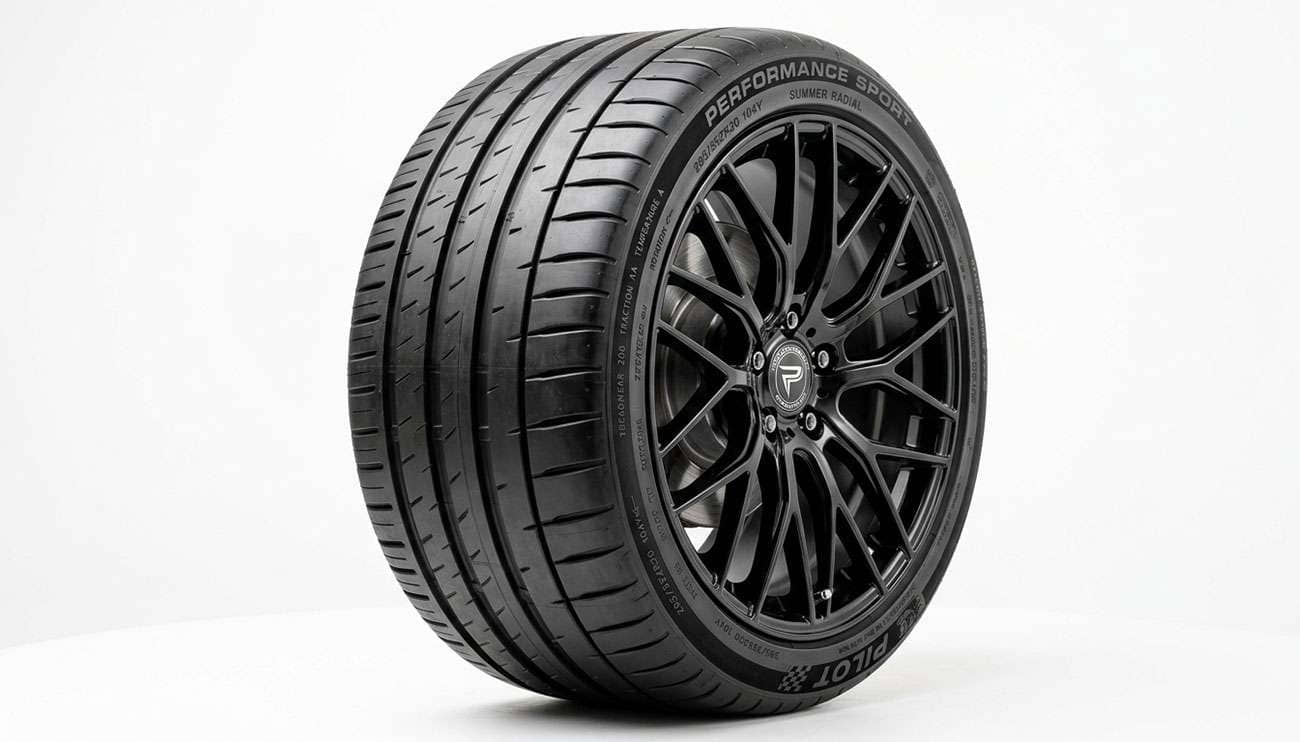
Summer tires are good for four specific jobs: dry grip, wet grip at highway speed, steering precision, and heat stability on hot pavement. Which of those four you actually get depends on the summer tire tier you bought, and there are four of them. Grand Touring, High Performance, Ultra High Performance, and Extreme Performance summer tires do not share a temperature range, a wet-weather character, or a purpose. Buy the wrong tier for your driving and you get none of the four benefits.
Every article on this subject quotes the same number at you. Forty-five degrees. Bridgestone says it, Les Schwab says it, Michelin says it, and a dozen dealer blogs repeat it. Then they all stop, because the honest follow-up is uncomfortable: that number does not belong to summer tires at all. Forty-five degrees Fahrenheit is roughly where all-season compounds cross over. It got copy-pasted onto summer tires somewhere around 2010 and never got corrected.
Three of the four summer tire tiers stop working well above 45 degrees. One of them is already unreliable at 55. Nobody tells you which tier you own, the sidewall does not say, and the salesman probably does not know either. That is the actual answer to what summer tires are good for, and it is the reason two drivers can buy tires from the same aisle and have completely opposite experiences.
Summer Tire Tier |
What It Is Actually Good For |
Realistic Temperature Floor |
Wet Grip vs. a Good All-Season |
Typical UTQG Treadwear |
Who Should Buy It |
|---|---|---|---|---|---|
Grand Touring Summer |
Quiet ride, long tread life, strong wet traction, low rolling resistance |
About 40 degrees F |
Better |
400 to 560 |
Daily sedan in a warm climate, no track use |
High Performance Summer |
Balanced dry and wet grip, real steering response, usable tread life |
About 45 degrees F |
Better |
300 to 420 |
Sport sedan or coupe, spirited street driving |
Ultra High Performance Summer |
Dry cornering grip, short braking, sharp turn-in |
About 50 degrees F |
Roughly equal when new, worse once worn |
200 to 300 |
Sports car, canyon roads, occasional autocross |
Extreme Performance Summer |
Peak dry grip once the compound is heat-cycled up to temperature |
About 55 to 60 degrees F |
Worse, hydroplanes at lower speeds |
100 to 200 |
Track days, autocross, timed events |
Four jobs. Take them one at a time, because the mechanism behind each one explains why the tier matters so much.
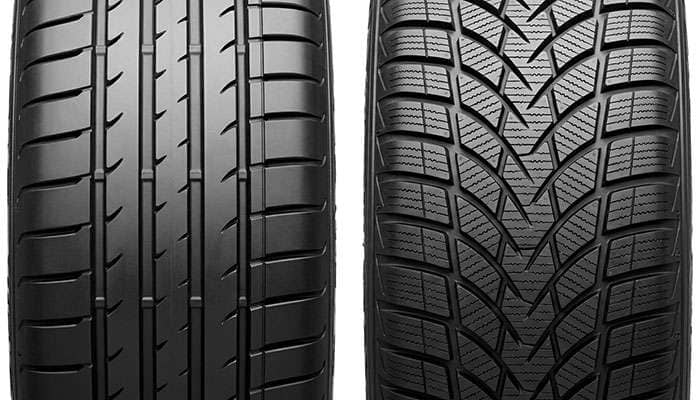
Dry grip. A summer tire puts more rubber on the pavement than an all-season of the same size. That is the void ratio, meaning the percentage of the tread face that is groove instead of rubber. An all-season typically runs 30 to 35 percent void. A High Performance summer tire runs closer to 25 percent, and an Extreme Performance summer tire can drop under 20. More contact area is only half of it. The other half is compound, and that is where the real difference lives.
Wet grip at highway speed. This is the benefit most people find counterintuitive, and it is real, but only for the bottom two tiers. Hydroplaning happens when a tire cannot pump water out of the contact patch fast enough. Grand Touring and High Performance summer tires use wide, straight circumferential channels that move water in a straight line at speed, which works better than the twisty, siped pattern on an all-season. Move up to Ultra High Performance and Extreme Performance and the void ratio drops far enough that the advantage reverses. Those tires hydroplane earlier than a decent all-season, not later.
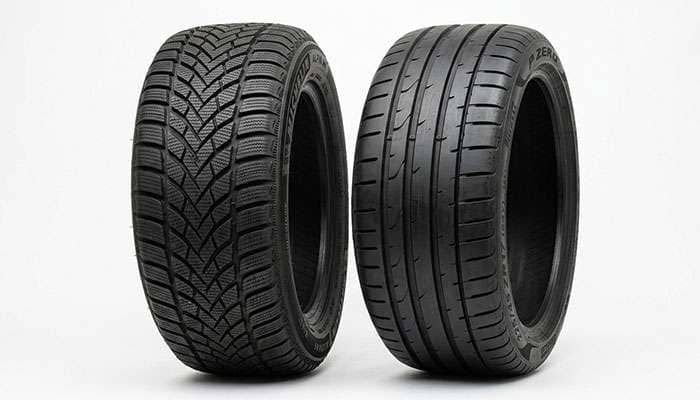
Steering precision. All-season tires are covered in sipes, which are the fine slits cut across the tread blocks. Sipes exist to give the block extra biting edges in snow and slush. They also let the block fold over and squirm sideways when you load it in a corner. Summer tires largely delete the sipes, so the tread block stands up under load instead of collapsing. That is the entire source of the connected, immediate steering feel people describe. It is a structural effect, not marketing.
Heat stability. Asphalt in Long Beach in August routinely reads 130 to 140 degrees F at the surface. An all-season compound is formulated to stay pliable near freezing, which means it is already soft at the top of its range and goes greasy under sustained heat and load. Summer compounds are built for the hot end and hold their shape there. If you want the deeper comparison between the two categories, our breakdown of summer vs all-season tires covers the head-to-head in more detail.
Rubber generates grip two ways. The first is adhesion, meaning molecular bonding between the compound and the road surface. The second is hysteresis, meaning the compound deforms around the tiny stones in the asphalt and lags on the rebound, converting energy into heat and dragging against the surface texture. Both mechanisms need the polymer to be in its rubbery state.
Every rubber compound has a glass transition temperature. Below it, the polymer chains can no longer relax and re-form fast enough to conform to the microtexture of the pavement. The compound stops behaving like rubber and starts behaving like hard plastic. This is not a gentle slope. It is a knee in the curve, and once you go over it, grip falls away quickly rather than gradually.
Here is the tradeoff that produces the four tiers. The softer and grippier you make a compound, the higher its glass transition temperature climbs. Stickier tire, earlier failure point. There is no way around it, and no manufacturer has solved it. That is why an Extreme Performance summer tire that produces stunning grip on a warm track surface is genuinely dangerous on a 50-degree morning, while a Grand Touring summer tire is perfectly reasonable at 40.
The 45-degree figure describes roughly where all-season compounds cross over. Applying it to all four summer tiers is like saying every engine redlines at 6,500 rpm. It is true of some of them by coincidence.
There is a second issue with the top two tiers that has nothing to do with the ambient low. Ultra High Performance and Extreme Performance compounds need surface temperature in the tire to reach their working range. On a racetrack you get there in two laps. On a 12-minute commute in stop-and-go traffic you never get there at all, which means the driver who bought the grippiest tire in the store is running it outside its window every single day and getting less grip than a cheaper tire would deliver. The UTQG tire ratings molded into the sidewall give you the traction and temperature grades that hint at where a tire sits, and reading them is the fastest way to identify your tier without guessing.
It is not a month. Anyone who gives you a month is guessing on your behalf, because the answer depends on your tier and your local climate, and both of those vary enormously.
The trigger is the seven-day rolling average overnight low, not the daytime high. That distinction matters more than any other part of this section. Your tires are coldest on your first drive of the morning, which is exactly when you are least warmed up, least alert, and most likely to be on a cold on-ramp or a cold off-camber turn. A day that peaks at 68 in the afternoon but drops to 38 at 6 a.m. is not a summer tire day if you commute early.
So the rule is simple. Mount your summer tires when the seven-day forecast low stays above your tier's floor from the table above, and take them off when it drops back below. For a Grand Touring summer tire that is 40 degrees. For an Extreme Performance tire it is closer to 55, which in most of the country means the tire is only appropriate for four or five months a year.
Practically, that lands roughly here. In Southern California most drivers can run a Grand Touring or High Performance summer tire nearly year round, with the caveat that high desert and mountain routes change the math fast. In Atlanta or Dallas you are looking at early April. In Chicago, Denver, or Boston, mid to late April at the earliest for High Performance, and May before an Ultra High Performance tire makes sense. In Seattle, May, because the overnight lows lag the daytime highs badly through spring.
If you are running two sets, how you store the off-season set matters more than most people think. Compound ages, flat spots set, and ozone attacks the sidewall. Our guide on how to store wheels and tires covers the specifics, including why stacking mounted and unmounted tires calls for different handling.
No. And the reason is not snow, which is what makes this question worth answering properly rather than with a one-word dismissal.
The dangerous scenario is dry, clear, sunny pavement at 33 degrees F. No snow, no ice, no visual cue that anything is wrong. The compound is well below its glass transition temperature, so it is behaving like plastic instead of rubber. Braking distances stretch, the tire breaks away without the usual progressive warning, and the driver has no reason to suspect the tires because the road looks fine. Independent winter testing consistently shows summer tires losing a large fraction of their dry braking performance in near-freezing conditions, before snow ever enters the picture.
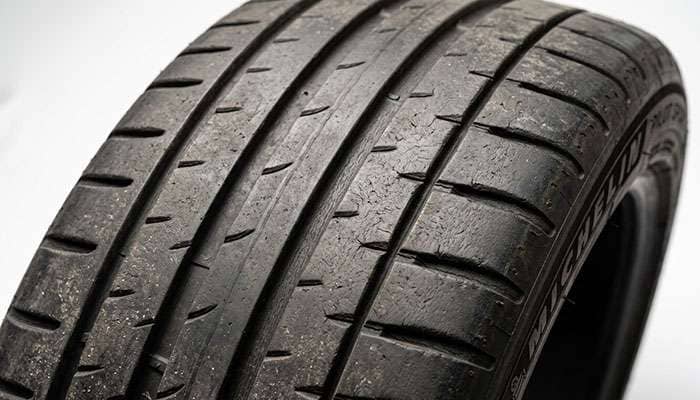
The second problem is permanent. Take a summer compound below roughly 20 degrees F and the tread blocks can develop fine cracks at the corners and in the groove bases. That is cold cracking, and it does not heal when the weather warms up. The tire is compromised structurally from that point forward regardless of how much tread is left on it. If you find cracking anywhere on a tire, the inspection should not stop at the tread, because sidewall damage is the failure mode that actually strands people. Our piece on tire sidewall damage and whether it is safe to drive walks through what is repairable and what is not.
Third, there is a compliance angle. Summer tires carry no M+S marking and no Three Peak Mountain Snowflake symbol. A number of jurisdictions require one or the other during posted winter conditions, and enforcement is real in mountain corridors. Chain control checkpoints in California routinely turn back vehicles on summer tires.
All-season tires have their own cold limit, and it is closer than most drivers assume. If you are trying to decide whether your all-seasons are enough for your winter, our guide on what temperature is too cold for all-season tires has the numbers.
Seven of them, and the order below is roughly the order in which they will actually annoy you.
Tread life. A UTQG treadwear grade of 200 does not mean 200 anything, it is a relative index, but the practical effect is that an Ultra High Performance summer tire may deliver 18,000 to 25,000 miles where a touring all-season delivers 60,000. On an Extreme Performance tire you can see the wear happen over a single season.
You now own two sets. Unless you live somewhere that never drops below your tier's floor, summer tires are half of a two-set system. That means purchase cost, storage space, and two mount-and-balance operations a year.
Wet performance collapses faster than you expect. Summer tires often start life at 8 to 9/32 of an inch of tread depth, where an all-season starts at 10 to 11/32. When you wear both down to 4/32, the summer tire has lost a much larger fraction of its water evacuation volume. The tire that hydroplaned at 62 mph when new may do it at 48 mph three seasons later. The federal minimum of 2/32 is a legal floor, not a wet-weather recommendation.
Noise. Large solid tread blocks with few grooves have nowhere to route air, so the top two tiers hum. On coarse concrete it can be loud enough to raise your stereo volume.
Ride harshness. Summer tires generally use stiffer sidewall construction and more internal reinforcement. Combined with the low-profile sizes they usually come in, impact harshness over expansion joints goes up noticeably.
Cold storage risk if you forget. Leave them mounted through a cold snap and you can take permanent cold-cracking damage on a tire you paid a premium for.
Size availability. Summer tires exist mostly in performance sizes. If you drive a truck, a minivan, or anything on a 16-inch wheel with a tall sidewall, your options narrow quickly.
What You Are Noticing |
What Is Actually Happening |
Tire Problem or Temperature Problem? |
What to Do About It |
|---|---|---|---|
Steering feels numb and greasy for the first ten minutes on cool mornings |
Compound is below its working range and has not reached operating temperature |
Temperature |
Drive gently until warm. If your mornings are routinely under 50 degrees F, you are in the wrong tier |
Hydroplaning at speeds that never used to trigger it |
Groove volume lost to wear, water evacuation rate has dropped |
Tire |
Measure tread depth. Below 5/32 a summer tire has very little wet margin left |
Cupped or feathered outer shoulders |
Running outside the compound window plus low inflation lets the blocks scrub instead of grip |
Both |
Set pressures cold to the door placard, check alignment, stop running below the tier floor |
Fine cracks at tread block corners or in groove bases |
Cold cracking from sub-freezing exposure, permanent and structural |
Tire, already damaged |
Replace. Inspect sidewalls on all four before assuming only one is affected |
Shudder, binding, or a wind-up feeling in slow tight turns on an AWD vehicle |
Rolling circumference mismatch forcing continuous slip through the center coupling |
Tire |
Stop driving it that way. Match all four corners immediately before the driveline is damaged |
A roar that grew louder across one season |
Irregular wear pattern from repeated cold-cycle operation and scrubbing |
Both |
Rotate, verify alignment, and re-evaluate whether the tier suits your climate |
No, and this is the one on the list that can hurt you rather than just cost you money. Both the U.S. Tire Manufacturers Association and the Tire Industry Association take the same position: match tire type, size, construction, and speed rating across all four corners. Vehicle manufacturers say the same thing in the owner's manual. Here is why, broken down by what you drive, because the failure mode is different for each.
Front-wheel drive. Put the winter tires on the front, which is what most people instinctively do because that is where the power and steering are, and you have built a car that turns and accelerates fine while the rear end has dramatically less grip. Lift off mid-corner on a cold wet road and the back steps out with no warning. Put the winters on the rear instead and the front will not turn or stop. There is no correct way to split them.
Rear-wheel drive. Winters on the rear gives you traction to pull away from a stop and nothing to steer or brake with. Winters on the front gives you a car that turns in sharply and then rotates. Same problem, different sequence.
All-wheel drive. This is the expensive one. AWD systems compare wheel speeds continuously and expect all four tires to roll the same distance per revolution. Most manufacturers specify a maximum rolling circumference difference in the range of two to three percent, and many express it as a tread depth spread of about 2/32 to 4/32 of an inch across the four tires. A worn winter tire next to a fresh summer tire blows straight past that. The result is not a handling quirk, it is continuous differential slip inside the center coupling, which generates heat in a viscous unit or clutch pack that was never designed to work full time. Replacing a transfer case or a center differential is a four-figure repair that starts as a tire decision. Our breakdown of AWD tire requirements covers the tolerance figures and how to measure your own spread.
Speed rating. There is a paperwork issue on top of the physics. Mixing an H-rated winter tire with a Y-rated summer tire means the vehicle's effective maximum speed is now the lowest-rated tire on it, and the handling balance is compromised because the two tires have different construction stiffness. Insurers and some state inspection regimes care about this.
If budget forces you to buy only two tires right now, do not split by type. Buy two of the same type you already have, put the new pair on the rear regardless of which wheels drive the car, and finish the set when you can.
The best summer tire is the one matched to your tier, and there is no universal winner. A tire that dominates a track test can be the wrong purchase for a 12-minute commute in Long Beach, because it will spend every one of those minutes below its working temperature. Here is the criteria list to shop against.
Pick your tier honestly first. Not the tier you want to be in. Count the number of days per year you actually drive hard. If the answer is under ten, you want High Performance, not Extreme Performance.
Check the UTQG temperature grade. Grades run A, B, and C, measuring the tire's resistance to heat buildup at sustained speed. C is the federal minimum and it is legal, but for sustained highway running through Phoenix, Las Vegas, or the Central Valley in August, look for A.
Check the UTQG traction grade. AA, A, B, and C, measured as wet skid performance on asphalt and concrete. AA is meaningfully better than A on wet pavement, and the grade is molded right into the sidewall so you can verify it in the parking lot.
Read the treadwear number as a budget signal. It is a relative index, not a mileage promise, but a 180 and a 480 will not cost you the same per year no matter what the sticker price says.
Match or exceed the original speed rating. Do not downgrade to save money. The speed rating reflects construction and heat capacity, not just a top speed you will never see.
Look at the tread picture before you buy. If it is mostly solid rubber with three thin channels and no sipes at all, you are looking at an Extreme Performance tire. Know that going in rather than finding out in the first rainstorm.
Check the starting tread depth. More depth means more wet-weather margin over the life of the tire. Ask for the spec rather than assuming.
If you have already decided you want the sharp end of the range, our track-tested roundup of the best high performance tires for sports cars gets into specific models and where each one lands.
Driving on a summer tire outside its window is not a single event. It is a ladder, and each rung costs more than the one above it.
Weeks one through four. You lose grip you never notice, because nothing about normal driving asks for it. The bill comes due once, in an emergency stop or an evasive swerve, and by then the extra stopping distance is already spent.
Months two through six. Irregular wear sets in. Tread blocks that are too stiff to conform scrub instead of gripping, and you get heel-and-toe wear, cupping, and feathered shoulders. That wear is not recoverable by rotating. The tire is now noisy and permanently uneven.
Months six through twelve. If the tire has seen sub-freezing temperatures, cold cracking becomes visible at the block corners. At that point the remaining tread depth is irrelevant. The tire is scrap and you are buying a set early.
Somewhere in the middle of all that, the wet margin goes. This is the one that actually causes crashes. A worn summer tire on a wet freeway hydroplanes at speeds that are perfectly legal and felt completely safe eighteen months ago.
If the vehicle is all-wheel drive, add the driveline. Sustained circumference mismatch cooks a center coupling. That repair frequently costs more than two full sets of tires.
The end of the ladder is always the same. A full set of four, bought earlier than you planned, plus whatever the driveline needed. Buying the right tier the first time is cheaper than every branch of this.
Step one. Walk out to the car and read the sidewall. Write down the size, the speed rating letter, and the UTQG line, which reads as a treadwear number followed by a traction grade and a temperature grade.
Step two. Use the treadwear number and the tread picture to place yourself in the tier table at the top of this article. Under 200 with almost no sipes is Extreme Performance. Two to three hundred is Ultra High Performance. Three to four hundred is High Performance. Four hundred and up is Grand Touring.
Step three. Pull up the ten-day forecast and look at the overnight lows, not the highs. Compare the lowest of them against your tier's floor.
Step four. Check tread depth with a gauge or a quarter. If Washington's head disappears you are above 4/32. Below that, a summer tire has very little wet-weather margin left in it.
Step five. Inspect the tread block corners and groove bases for fine cracking, then run your hand around both sidewalls looking for bulges, cuts, or scuffing. Cracking means replacement, not monitoring.
Step six. Set all four pressures cold, first thing in the morning before driving, to the figure on the driver's door placard. Not the number on the tire sidewall, which is a maximum rather than a recommendation.
Step seven. If your tier does not match your climate or your actual driving, plan the change now rather than in the middle of the first cold snap. You can browse the full range of summer tires and filter by size to see what is available for your vehicle.
Summer tires are good for dry grip, wet grip at speed, steering precision, and heat stability. The catch is that those four benefits are distributed unevenly across four different tiers of summer tire, and the tier you own determines which of them you actually receive. A Grand Touring summer tire genuinely will outperform an all-season in the rain. An Extreme Performance summer tire genuinely will not, and it will also be unsafe on a morning that feels perfectly mild.
The 45-degree number that appears in every article on this topic is not wrong so much as misapplied. It describes all-season compounds. Summer compounds sit anywhere from 40 to 60 degrees depending on how sticky the manufacturer made them, and the stickier ones need heat in the tire before they work at all, which a short commute never supplies.
Identify your tier, match it to your overnight lows, run the same tire type on all four corners, and a summer tire will do exactly what it promises. Skip that work and you will spend performance-tire money on a worse experience than a good all-season would have delivered.
Summer tires are good for dry grip, wet grip at highway speed, steering precision, and heat stability on hot pavement. Which of those benefits you actually get depends on the tier. Grand Touring and High Performance summer tires deliver strong wet performance along with the dry grip, while Ultra High Performance and Extreme Performance tires trade wet capability away for peak dry cornering. All four rely on a stiffer, less siped tread block and a compound formulated for the hot end of the range rather than the cold end.
There is no fixed month. Mount them when the seven-day rolling average overnight low stays above your tier's floor, which is roughly 40 degrees F for Grand Touring, 45 for High Performance, 50 for Ultra High Performance, and 55 to 60 for Extreme Performance. In practice that means early April across much of the South, mid to late April in the Midwest and Northeast, and May in the Pacific Northwest. Use the overnight low rather than the daytime high, because your first drive of the morning is when the tires are coldest.
The best summer tire is the one matched to your tier and your climate, not the one that wins track tests. Shop by criteria: pick your tier honestly based on how many days a year you actually drive hard, look for a UTQG temperature grade of A if you run sustained highway speeds in extreme heat, favor a traction grade of AA for wet performance, match or exceed your original speed rating, and check the starting tread depth for wet margin. A tire that needs heat in it to work will underperform a cheaper tire on a short commute.
No. The danger is not limited to snow and ice. On dry, clear pavement in the low thirties, a summer compound is below its glass transition temperature and behaves like hard plastic, so braking distances stretch and the tire breaks away without progressive warning. Below roughly 20 degrees F the tread blocks can develop permanent cold cracking that does not heal when temperatures rise. Summer tires also carry no M+S or Three Peak Mountain Snowflake marking, which matters where winter traction requirements are posted and enforced.
Short tread life, since an Ultra High Performance summer tire may return 18,000 to 25,000 miles against 60,000 for a touring all-season. You also need a second set for cold months, which means storage space and two mount-and-balance jobs a year. Summer tires start with shallower tread than all-seasons, so wet-weather margin disappears faster as they wear. Add road noise and ride harshness on the upper tiers, the risk of permanent cold cracking if you leave them on through a cold snap, and limited size availability outside performance fitments.
No. On front-wheel drive, winters on the front give you a car that turns and accelerates while the rear has far less grip, producing snap oversteer on a lift. Reverse them and the car will not turn or stop. Rear-wheel drive has the same problem in a different order. All-wheel drive is the costliest case, because most systems tolerate only about a two to three percent rolling circumference difference, and exceeding it drives continuous slip through the center coupling until the unit overheats and fails. Both the U.S. Tire Manufacturers Association and the Tire Industry Association call for the same tire type, size, construction, and speed rating on all four corners.



