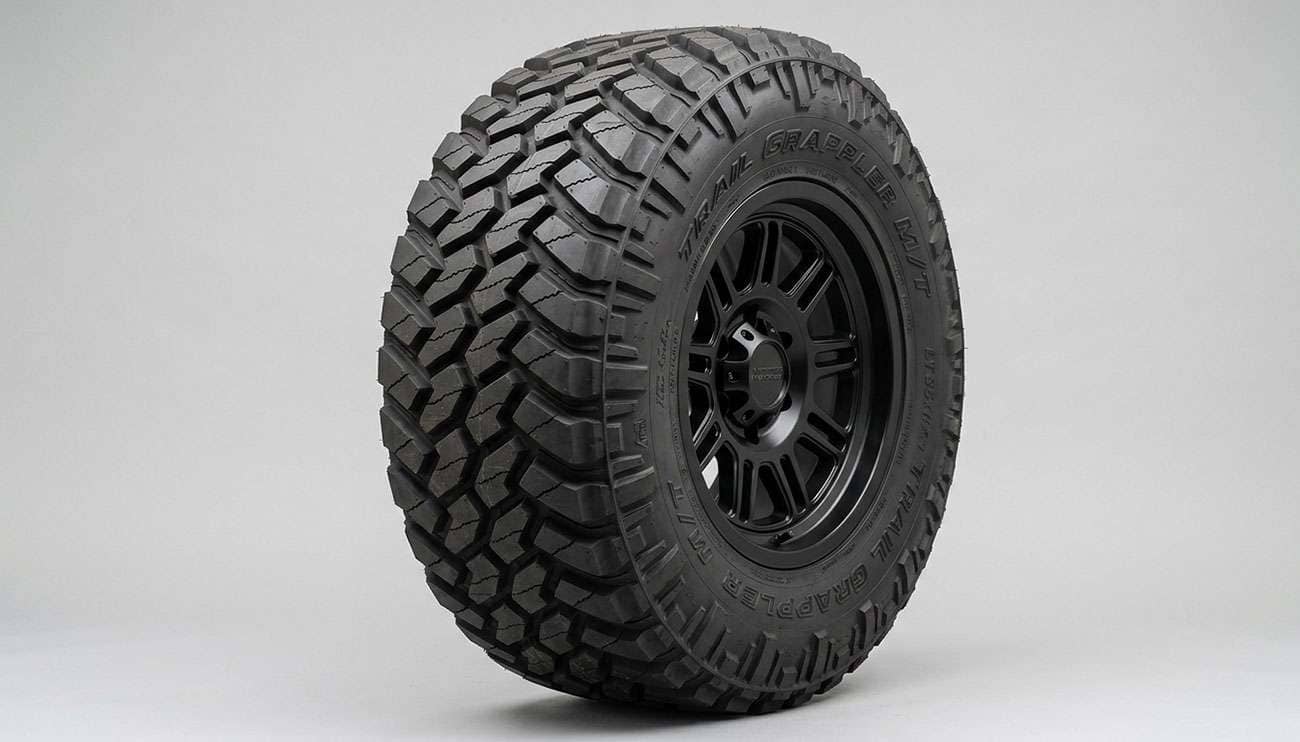
Forty years in this business and I still see the same thing every week. Guy walks into the shop, points at a set of tires that look the part — aggressive shoulders, deep tread, mean stance — and asks if they're "good off-road tires." Sometimes yes. A lot of times, no.
Here's the thing nobody at the big-box stores will tell you: an off-road tire that looks aggressive isn't the same as an off-road tire that performs aggressively. The marketing photos hide what matters. The price tag tells you almost nothing. The only way to tell a real off-road tire from a fake one is to look at three features the cheap brands skimp on — and to understand what fails when those features aren't there.
So let me walk you through the three. Not what marketing says they do. What actually breaks when you don't have them.
The construction of a serious off-road tire comes down to three things:
You'll see other specs on the box. Tread depth, treadwear warranty, weight, load index. Those matter, but they're downstream of the three above. If a tire skimps on sidewalls, voids, and sipes, the rest of the spec sheet doesn't save it. If a tire gets those three right, it'll work harder than tires costing twice as much.
Now let me show you what each one actually does — and what happens when it's not there.
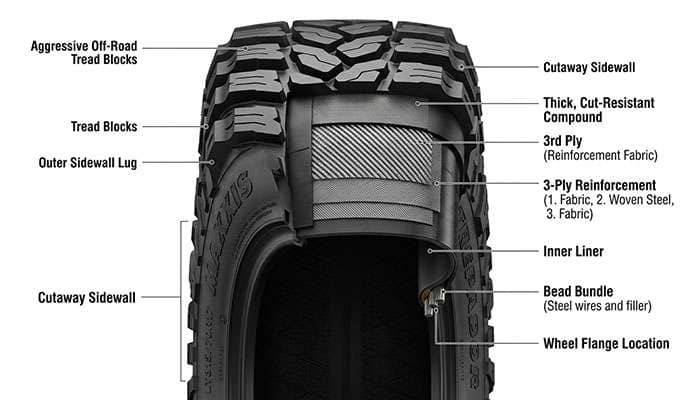
The sidewall is the part of the tire between the tread and the wheel rim. On a passenger highway tire, it's thin and flexible — designed for fuel economy and ride comfort. On a real off-road tire, it's a different animal entirely.
Reinforcement means three things. First, more plies of fabric or steel woven into the rubber. A typical highway tire has 1 or 2 plies. A serious off-road tire — the LT-rated stuff truck guys actually buy — usually has 2 to 3 plies, with some heavy-duty E-rated tires running 10-ply equivalent ratings. Second, the rubber compound itself is tougher — cut and chip resistant, designed to take impact without splitting. Third, the tread blocks extend down onto the sidewall as functional biters, which both adds traction at low PSI and protects the sidewall from sharp objects.
Here's what fails without reinforcement: you take a stock-tire-grade sidewall onto a rocky trail, hit one sharp rock at the wrong angle, and the sidewall splits. Not a slow leak — a split. You're done. The tire is unrepairable; sidewall punctures can almost never be safely patched. You're walking back to camp or waiting for a tow.
I've seen this happen in the shop more times than I can count. Guy spent a thousand bucks on a "rugged" set of tires that looked the part. First weekend out at a forest service road, he hit a piece of sharp shale and ripped through the sidewall like it was paper. Tire was 1-ply with a passenger compound. The aggressive tread design was cosmetic.
What to look for on a real tire: the spec sheet should say "3-ply sidewall," "cut-resistant compound," "reinforced sidewall," or call out specific tech like BFGoodrich's CoreGard or Nitto's three-ply construction. The BFGoodrich All-Terrain T/A KO3 uses a CoreGard sidewall that's 20% tougher than the previous generation. The Nitto Ridge Grappler runs three-ply sidewalls with damage-resistant compounds. Those are real reinforcement specs. Marketing words like "tough" and "durable" without supporting numbers are not. For more on what sidewall damage actually looks like, our guide on tire sidewall damage covers it in detail.
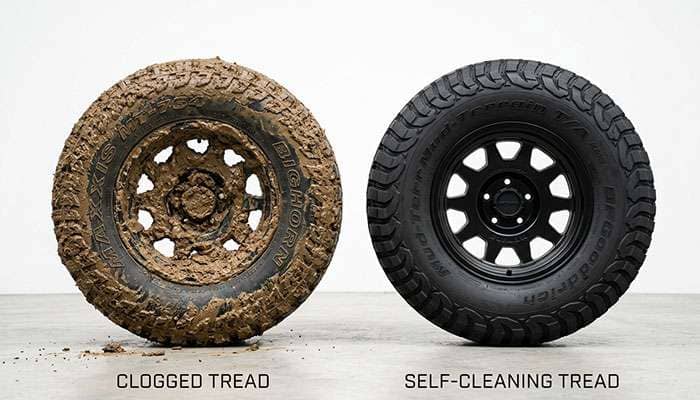
Voids are the spaces between tread blocks — the channels and gaps that give a tire its tread pattern. On a highway tire, voids are tight and shallow because the goal is maximum rubber contact and minimum noise. On an off-road tire, voids are wide and deep because the goal is something completely different.
The principle is called self-cleaning. As the tire rotates under load, centrifugal force flings mud, snow, and gravel out of the wide voids before it has time to pack in. A real off-road tire literally throws debris off itself with every revolution. The wider the voids and the larger the tread blocks, the better this works.
Here's what fails without wide voids: you drive into mud or wet snow on a tire with tight, tightly-spaced tread, and within a hundred feet, the voids fill solid. Now your aggressive-looking tire is a slick. Zero traction. The tire is no longer making contact with the dirt — it's making contact with a layer of compressed mud bonded to itself. You're stuck.
I watched this exact thing happen to a guy in a $60,000 Jeep at a trailhead a few years back. Brand-new Jeep, brand-new tires that he'd ordered online because they "looked like the ones in the Wrangler ads." Got stuck in fifteen feet of mud at the entrance to a trail. We had to winch him out. The tires looked aggressive, but the void spacing was barely deeper than an all-season. They packed up immediately and never recovered traction. Two thousand dollars in tires that couldn't do the one job he bought them for.
What to look for on a real tire: visible wide channels between blocks when you stand the tire on edge. Tread depth of 16/32" or deeper for an A/T, 18/32"+ for an M/T or R/T. Stone ejector ridges built into the voids. Marketing language to look for: "self-cleaning," "mud-phobic shoulder blocks," "wide tread voids." If you can't see daylight through the tread pattern from a few feet away, the voids probably aren't wide enough for serious off-road use. Want help matching tread aggression to your driving mix? Our guide on H/T vs. A/T vs. M/T tires walks through how to pick.
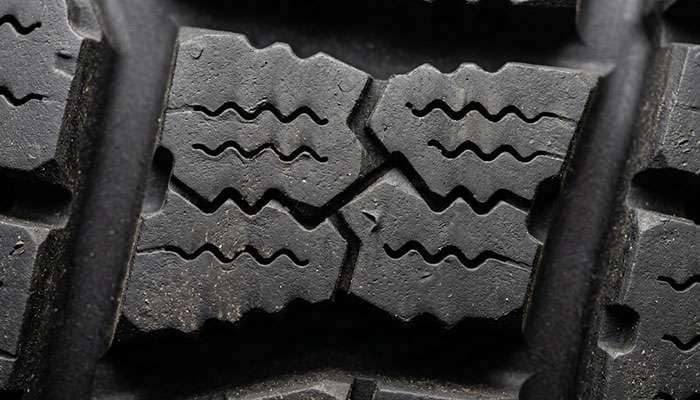
Sipes are the small cuts and slits inside the tread blocks. You almost have to bend down and squint to see them on the showroom floor. Most buyers never notice they're there. They're also the difference between a tire that works in the rain and a tire that doesn't.
Here's what sipes do. Each cut creates two extra biting edges in the rubber. Multiply that by hundreds of sipes per tire and you've got thousands of additional micro-edges that grab the road on wet pavement, packed snow, and ice. They also let the tread block flex slightly under load, which improves contact area on uneven surfaces. On a serious modern off-road tire, the sipes are 3D — they zigzag at multiple angles — and full-depth, meaning they keep working as the tire wears.
Here's what fails without sipes: a tire with chunky aggressive tread but no siping looks great on a dry trail and turns into an ice skate the moment it rains. Wet pavement braking distances stretch out 20-30%. Hydroplaning kicks in earlier. On wet rocks, the contact patch slides instead of grabbing. Cold weather on packed snow becomes genuinely dangerous because there's nothing in the rubber to bite.
Sipes are also what gets a tire its 3PMSF (Three-Peak Mountain Snowflake) rating. That little snowflake-on-mountain symbol on the sidewall means the tire passed a standardized severe-snow test. It's not just a winter thing — it's a quality marker. A 3PMSF-rated A/T or R/T tire is generally a tire that took siping seriously.
What to look for on a real tire: bend down and look at a tread block. You should see multiple wavy or zigzag cuts inside each block. Marketing terms that flag good siping: "3D sipes," "full-depth siping," "interlocking sipes," "biting edges." If you live anywhere that sees winter, the 3PMSF symbol is non-negotiable.
Here's where the money disappears. Most $80-per-tire bargain "off-road" tires are exactly what they look like — aggressive tread patterns molded onto highway-grade construction. The differences from a serious tire are mostly invisible on the showroom floor. They show up on the trail.
Feature |
Cheap Off-Road Tire |
Quality Off-Road Tire |
|---|---|---|
Sidewall plies |
1-2 ply, passenger compound |
2-3 ply, cut-resistant compound |
Sidewall lugs |
Cosmetic shoulder blocks only |
Functional biters extending onto sidewall |
Void spacing |
Tight, decorative pattern |
Wide, engineered for self-cleaning |
Tread depth |
10-12/32" |
16-18/32" or deeper |
Sipes |
Few or none |
3D full-depth, biting-edge optimized |
3PMSF rating |
Rare |
Common on quality A/T and R/T tires |
Compound |
Generic rubber |
Cut, chip, and tear-resistant |
Real cost over 50,000 miles |
High (early replacement, off-road failures) |
Lower (longer life, performs under stress) |
Here's the math nobody likes. Saving $80 per tire today on a cheap off-road set means saving $320 across all four. That's real money. But one sidewall split on a trail run costs you a tire ($150-300), a tow ($200-500), and possibly a wheel ($300-1,000) if the rim got damaged when the tire failed. Plus the day you lost and the trip you cut short. The "cheap" tires were never cheap. They were just front-loaded with savings and back-loaded with cost.
For a longer view on real-world off-road tread life and replacement timing, our off-road tire tread life article walks through how the better tires actually pay for themselves.
You don't need to be a tire engineer. You need a thirty-second checklist:
If you're picking your first set of off-road tires and don't know where to start, our guide to choosing off-road tires walks through the full decision tree.
Reinforced sidewalls, wide voids, sipes. Three features. Get them right and you have a tire that does the job. Get any of them wrong and you have a tire that looks the part on the showroom floor and lets you down on the trail. The fancy marketing language doesn't matter. The brand name doesn't matter as much as people think. What matters is whether those three features are actually there in the construction — and the easiest way to tell is to look for them yourself.
Need help picking a real off-road tire for what you actually drive? Browse our off-road tire selection or call us at 888-926-2689. Tell us what you drive and how you use it, and we'll match you to the right tire — one that has all three features built in, not just painted on.
Reinforcement combines three things: extra plies of fabric or steel woven into the rubber (typically 2-3 plies versus 1-2 in a passenger tire), a cut and chip-resistant rubber compound, and tread blocks that extend onto the sidewall as functional biters. Look for spec sheet callouts like "3-ply sidewall," "cut-resistant compound," "CoreGard" (BFGoodrich), or branded reinforcement tech. Marketing words like "tough" or "durable" without supporting numbers don't count.
Wide voids excel in mud, soft snow, and loose dirt by self-cleaning under rotation. They're somewhat less ideal on hardpack or rocky terrain, where smaller, more numerous tread blocks provide better grip. That's why category matters — mud-terrain (M/T) tires have the widest voids, all-terrain (A/T) tires have moderate voids tuned for both, and rugged-terrain (R/T) tires split the difference. Match void aggression to where you actually drive.
Quality all-terrain tires that carry the 3PMSF (Three-Peak Mountain Snowflake) rating typically have engineered siping that performs well in moderate winter conditions. They won't match a dedicated winter tire on glare ice, but for most snow and wet conditions, a 3PMSF-rated A/T tire eliminates the need for seasonal swaps. Avoid A/T tires that lack the 3PMSF rating if you face regular winter weather.
Partly. You can visually verify wide voids, deep tread, sidewall lug extension, and the presence of sipes inside tread blocks. What you can't see is sidewall ply construction or compound chemistry, which require checking the spec sheet. The combination of visual inspection plus spec sheet review gives you a reliable picture. A tire that looks aggressive but has no sipes and a 1-ply sidewall is a tire that will disappoint you off-road.
For most truck and SUV off-road use, look for 2-3 ply sidewall construction. Heavy-duty applications — towing, hauling, serious rock work — benefit from LT-rated tires with E load range, which corresponds to 10-ply equivalent ratings. Stock passenger-rated tires (often 1-ply sidewall) are not suitable for serious off-road use because their sidewalls aren't built to withstand impact from rocks or sharp debris.
If you actually drive off-road, yes. The real cost of a cheap off-road tire shows up the first time it fails — a sidewall split costs a tire ($150-300), a tow ($200-500), potentially a wheel ($300-1,000), and the trip you were on. A quality off-road tire with proper reinforcement, voids, and siping typically lasts longer, handles more terrain, and avoids those failure modes. Over 50,000 miles, the better tire usually costs less per mile despite the higher upfront price.