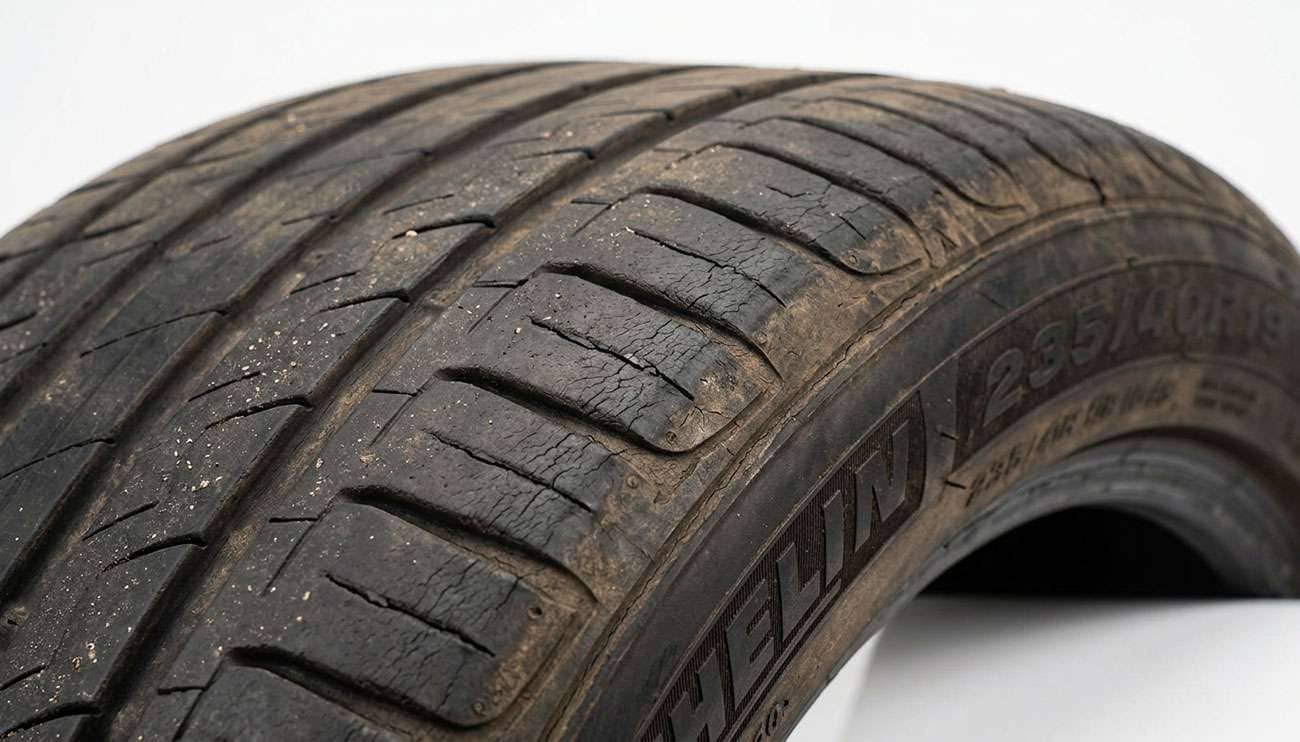
Heat is the number one enemy of tires. But the answer that matters is the one nobody gives you: almost none of that heat comes from the weather. A rolling tire manufactures its own heat through sidewall deflection, and how much it makes is set by load divided by inflation pressure, not by the number on the thermometer. A correctly inflated tire crossing the desert at 115°F runs cooler than a tire twenty percent low on a mild 72°F morning. The air temperature is a modifier. You are the throttle.
Search this question and every page tells you the same word, heat, and then stops. Some of them stop in a way that is actively misleading. The page Google currently promotes for this query leads with ambient road temperature reaching twice the air temperature, which sounds alarming and points you at the sky, when that same page later admits the real mechanism is the deflection of an underinflated sidewall. The heat that kills tires is not something you drive through. It is something you make. Here is the table that tells you how much you are making.
Your situation |
Dominant heat source |
Relative heat load |
What fails first |
Urgency |
|---|---|---|---|---|
Commuter car, pressure checked monthly, at placard |
Normal rolling hysteresis only |
Baseline |
Nothing, tire ages out before it overheats |
Routine, check monthly |
Any vehicle running 15 to 25 percent below placard |
Excess sidewall deflection |
Severe, the single largest multiplier |
Belt-to-carcass bond at the shoulder |
Correct today, inspect for prior damage |
Loaded SUV or half-ton at placard pressure, family plus cargo |
Load rising while pressure stayed put |
Moderate to high |
Shoulder wear, then bead area |
Raise pressure before the trip |
Towing or hauling near the vehicle rating |
Load at or beyond what pressure supports |
Severe and sustained |
Tread separation on the loaded axle |
Set to load tables, not placard |
Sustained 80 mph highway running in summer |
Deflection cycles per minute plus ambient |
High, and it compounds with any of the above |
Whatever is already weakest |
Check speed rating and cold pressure |
Correctly inflated car in extreme desert heat |
Ambient and road surface only |
Low, roughly baseline plus a margin |
Accelerated aging, not sudden failure |
Normal maintenance |
This is where most articles quietly contradict themselves, and it is worth resolving cleanly because the answer changes what you do about it.
Ask the internet what the number one reason for tire failure is and you get underinflation. Ask what the number one enemy of tires is and you get heat. Both answers appear authoritative, both come from real sources, and they look like they are in conflict. They are not. Heat is the mechanism that destroys the tire. Underinflation is the most common thing that produces the heat. One is the weapon, the other is the most frequent hand on it.
That distinction is not academic. If you believe heat is a weather problem, your response is to worry in July and forget in October. If you understand heat as something the tire generates in proportion to how hard it is being flexed, your response is to control the flex, which you do year round with a pressure gauge and an honest look at what you are carrying. The Tire Industry Association frames it the same way: when pressure is sufficient for the load, the heat from flexing sidewalls stays minimal and harmless. When pressure is not sufficient for the load, flex climbs, heat climbs with it, and the bonds between the plies and the rubber components begin to break down.
So underinflation is not a separate enemy from heat. It is the accelerator pedal on the only enemy there is. Our companion piece on the number one reason tires fail works through the full list of failure causes; this article stays on the mechanism underneath all of them.
The word for it is hysteresis, and once you understand it, every piece of tire safety advice you have ever read stops being a list of rules and starts being one idea with several applications.
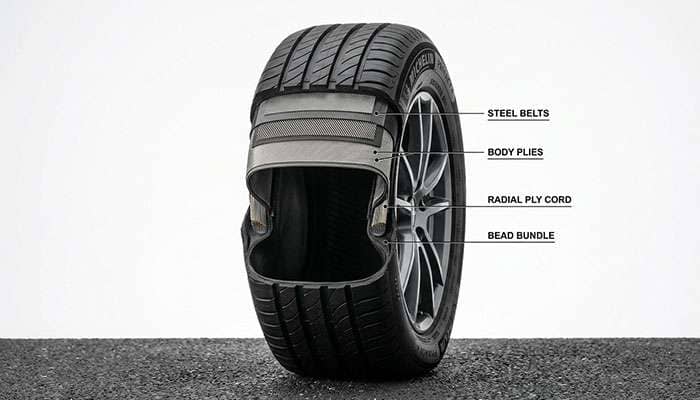
Rubber is viscoelastic. When you deform it and let it spring back, it does not return all of the energy you put in. A small fraction is lost internally to friction between the polymer chains, and that lost energy has to go somewhere. It becomes heat, inside the rubber, distributed through the thickness of the material. Bounce a rubber ball and it never returns to the height you dropped it from; the missing height left as warmth. A tire does the same thing, except it does it at the contact patch roughly seven to fourteen times per second at highway speed, continuously, for hours.
Every rotation, the section of tire entering the contact patch is squashed flat and then released back into a curve. That cycle of flattening and recovery is the deflection, and the energy lost in each cycle is the heat. Now the important part: the amount of energy lost per cycle scales with how far the tire deflects. A tire carrying the right load at the right pressure deflects a modest, designed-for amount, and the heat produced is small enough that airflow over the sidewall carries it away as fast as it is made. Drop the pressure and the same load pushes the sidewall further through its arc. The deflection grows, the energy lost per cycle grows faster than linearly, and now the tire is producing heat faster than it can shed it.
That last sentence is the whole failure mode. It is not that a hot tire is dangerous in the moment. It is that a tire generating more heat than it can dissipate has no equilibrium. The core temperature climbs steadily the longer you drive, which is precisely why underinflation failures happen forty minutes into a highway trip rather than in the first mile, and why they cluster on long summer drives rather than around town.
There is a second reason the shoulder is where this shows up. Heat does not distribute evenly through a tire. It concentrates where the rubber is thickest and where the structure changes, and the shoulder is both: it is the transition from the flat tread to the curved sidewall, and it is where the steel belt edges terminate. Belt edges are stress risers. Every deflection cycle works that junction, and the heat generated there has further to travel before it reaches a surface where it can escape. That is why heat failures start at the shoulder and work inward rather than starting in the middle of the tread.
Two more inputs feed the same equation. Speed raises the number of deflection cycles per minute, so a tire at 80 mph is being worked substantially harder than the same tire at 55 mph. Load increases the depth of each deflection, because more weight pushes the sidewall further. Pressure, speed, and load are the three terms, and pressure is the only one you can adjust in thirty seconds at a gas station.
Yes, but far less than the search results imply, and the mechanism is different from what people assume.
Ambient heat matters in two modest ways. First, it raises the starting temperature of the whole system, so a tire that was going to stabilize at a safe operating temperature now stabilizes somewhat higher, eating into the safety margin. Second, and more usefully, it accelerates chemical aging of the rubber compound over years, which is why tires in Phoenix and Long Beach reach the end of their service life on age before they reach it on tread depth. That is a real effect and it is worth knowing about, but it is a slow one.
What hot weather does not do is take a healthy, correctly inflated tire and burst it. The pavement being 140°F does not put a tire near its structural limits on its own. What it does is stack on top of self-generated heat, and if you were already running low on pressure or heavy on load, that stacking is what pushes the tire over the line. This is why blowouts spike in summer while the actual cause remains inflation and load. The season is the accomplice, not the culprit. Our piece on why tires can blow out in high temperatures covers the seasonal pattern in detail.
There is a second, useful consequence of ambient temperature that catches people out in the other direction. Air pressure moves roughly one PSI for every ten degrees of temperature change. A tire set correctly on a cool morning reads higher after an hour on hot pavement, and drivers sometimes bleed that pressure off to bring it back to the placard number. That is a mistake. The placard figure is a cold inflation pressure, meaning measured before driving, and the rise you see when hot is normal and expected. Bleeding it off leaves you genuinely underinflated once the tire cools, which is exactly the condition that generates dangerous heat. If you want the specific thresholds where tire temperature becomes a structural problem, our guide to what counts as a dangerous temperature for tires lays out the numbers.
The table at the top of this article sorts drivers by how much heat their tires are being asked to make. This section is the reasoning behind the rows, because the difference between the first row and the fourth is roughly the difference between a tire that will die of old age and one that can fail this month.
The baseline path. A passenger car at its placard pressure, carrying a normal load, is operating exactly where the engineers put it. The tire deflects the designed amount, generates a predictable and modest amount of heat, and sheds it continuously. In this condition heat is not your enemy in any practical sense. Your tire will reach the end of its tread life or its service age long before heat does anything to it. This is the overwhelming majority of drivers, and it is worth saying plainly rather than manufacturing alarm.
The underinflation path. This is the one that produces failures. Twenty percent below placard is not visually obvious on a modern low-profile tire, which is the entire reason the National Highway Traffic Safety Administration mandated tire pressure monitoring systems under FMVSS 138. A TPMS warning light does not illuminate until pressure is around twenty-five percent below the recommended figure, which means the light is a late warning, not an early one. By the time it comes on you have been generating excess heat for a while. Anyone relying on the dashboard light rather than a gauge is running the most dangerous heat path on this list without knowing it.
The load path. This one is invisible because nothing about the tire changed. You loaded four adults, a week of luggage, and a cooler into a crossover, and the pressure that was correct for a solo commute is now insufficient for what the tire is carrying. The sidewall deflects further, heat climbs, and the driver has no reason to suspect anything because the gauge still reads what it always read. Most vehicle placards list a higher pressure for full load; almost nobody reads that line. If you routinely carry weight, our guide to what happens when the rear axle is overloaded covers where the margin actually goes.
The speed path. Sustained high-speed running multiplies deflection cycles, and it is the reason speed ratings exist at all. A tire rated S is validated to 112 mph, H to 130, V to 149, and those ratings are endurance validations under FMVSS 139 rather than statements about how fast the tire can briefly go. On its own, at correct pressure, high speed is survivable. Combined with low pressure or high load, it is the accelerant that turns a slow problem into a fast one.
Heat damage is cumulative and mostly internal, which is what makes it dangerous. The tire does not warn you the way a nail does. But it does leave marks, and knowing them lets you catch a tire that has already been cooked before it comes apart. Use the table below to work out what you are actually looking at.
What you observe |
What it means |
Is the tire still sound? |
What to do |
|---|---|---|---|
Both shoulders worn faster than the center tread |
Chronic underinflation, tire has been running hot for months |
Structurally uncertain, wear is permanent |
Correct pressure now, have the tire inspected |
Fine circumferential cracking in the shoulder grooves |
Compound has been heat-cycled past its comfortable range |
Degraded, cracking does not reverse |
Inspect closely, plan replacement |
Rubber at the shoulder looks dull, brown-tinged, hardened |
Thermal aging of the compound in the hottest zone |
Aged early, margin reduced |
Check the date code and assess as an old tire |
Rhythmic thump or vibration that will not balance out |
Belts have begun separating, tire is out of round |
No, this is structural failure in progress |
Stop driving on it, replace |
Bulge or blister in the sidewall |
Plies have already separated, air is in the gap |
No, and it is not repairable |
Do not drive on it, replace immediately |
Tire was run flat or very low, now looks completely normal |
Damage is internal and invisible from outside |
Unknown, and that is the problem |
Have it dismounted and inspected inside |
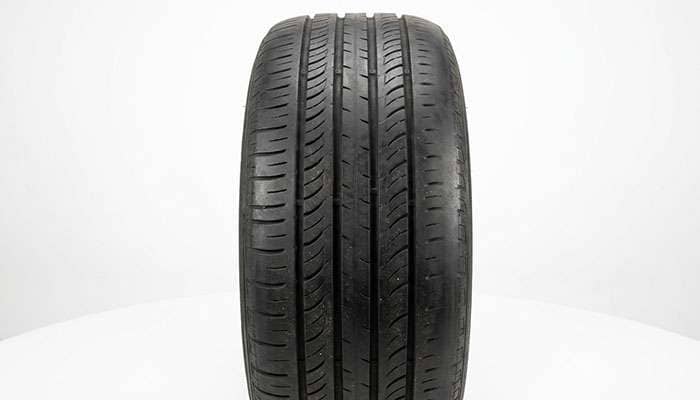
The first place to look is the shoulder, for the reason described earlier: it is where flex is hardest, where belt edges terminate, and where heat has the furthest to travel before escaping. Wear that is heavy on both shoulders and light in the center is the classic underinflation signature, and it is telling you the tire has been running hot for a long time. It is worth distinguishing from wear heavy on one shoulder only, which is an alignment problem rather than a pressure problem, and from wear heavy in the center, which is overinflation.
The sidewall is the second place. A bulge is not really a heat symptom so much as a heat consequence: it means internal plies have already separated and air has pushed into the gap. That tire is finished, and it is a roadside failure waiting for a speed and a pothole. Our explainer on what a sidewall bubble actually is covers why a bulge is never repairable, and if you are looking at damage and trying to decide whether to keep driving, our guide on whether sidewall damage is safe to drive on is the one to read before you move the vehicle.
The last row of that table is the one that catches people, and it deserves stating plainly. Heat damage does not reverse. Adding air to a tire that has spent two weeks at 20 PSI restores the correct deflection going forward, but it does not restore the bonds that already broke down. The tire looks normal, holds air, and reads correct on the gauge, while carrying an internal weak point that showed up in none of those checks. A tire that has been run significantly low should be inspected by someone who can dismount it, not just aired up and forgotten.
It changes it more than any other variable on this list, and it is the one situation where placard pressure is the wrong target.
When you tow, three things happen at once. Load rises sharply, particularly on the rear axle where tongue weight lands. Speed stays high, because you are usually on a highway. And the duration is long, which matters because heat is cumulative and needs hours to reach its peak. Every term in the heat equation moves the wrong way simultaneously, which is why trailer and tow-vehicle tire failures are so overrepresented in summer highway incidents.
The correct response is not the door placard. That figure assumes the vehicle's normal load. For heavy loads you want load and inflation tables, which specify the pressure required to carry a given weight per tire, and you want the pressure set cold before you leave. The Federal Motor Carrier Safety Administration codifies this thinking for commercial vehicles in 49 CFR 393.75, which prohibits operating on a tire whose cold inflation pressure is below what the load being carried requires. The regulation applies to trucks, but the physics applies to your half-ton with a boat behind it.
This is also where tire construction earns its keep. LT-metric light truck tires use heavier casings and higher load ranges, and they are built to run at pressures a passenger tire cannot accept. That is the entire point: a higher permitted pressure supporting a heavier load produces the same modest deflection, which produces the same modest heat. Load Range D and E casings are not simply tougher rubber, they are a different operating point on the same curve. Running a P-metric tire at the loads an LT tire is designed for does not just risk overloading it, it guarantees a deflection depth the tire was never validated for, and the heat follows from there. If you are unsure what your current tires are actually rated to carry, our guide on how to read tire load range and ply ratings walks through the markings and what each one permits.
They matter, they are printed on the sidewall of nearly every passenger tire you own, and virtually no buyer looks at them. This is the most actionable and least used piece of information in this entire article.
Under 49 CFR 575.104, the Uniform Tire Quality Grading standard requires passenger tires to carry three grades: treadwear, traction, and temperature. The temperature grade is a measure of the tire's resistance to heat generation and its ability to dissipate that heat, tested on an indoor wheel at sustained speed. Grade A indicates capability above 115 mph, B covers 100 to 115 mph, and C is the minimum permitted, corresponding to 85 to 100 mph. Grade C is the legal floor, meaning any tire below it cannot be sold.
Here is what looking through our own catalog turns up, and it is not what most people would predict. Across roughly 36,000 passenger tires carrying a temperature grade, about 29,200 are graded A and about 7,000 are graded B. So grade A is common, which means accepting a B is a choice you are making rather than a constraint you are stuck with. And more interesting still, the tires that land on B are frequently the premium long-wear touring tires people buy specifically because they are supposed to be the sensible option.
Two tires make the point. The Michelin Defender2 carries a UTQG of 840 B B, an outstanding treadwear figure paired with a B temperature grade. The Bridgestone Turanza QuietTrack carries 800 A A, giving up a negligible amount of tread life while earning the higher temperature grade and a better traction grade at the same time. Both are excellent tires from top-tier makers, and neither choice is wrong. But if you are the driver on the loaded-highway or hot-climate path described earlier, that grade difference is the specification that speaks directly to your problem, and almost nobody checks it.
The pattern behind it is a real engineering trade-off rather than a quality difference. Compounds formulated for very long tread life tend to run warmer, and manufacturers balance treadwear against heat generation deliberately. Knowing that lets you choose which side of the trade you want rather than assuming the highest treadwear number is automatically the best tire for you. The practical rule: if your miles are long, hot, and loaded, weight the temperature grade. If your miles are short, mild, and light, weight the treadwear.
One important caveat. UTQG does not apply to LT-metric light truck tires, which are exempt from the standard. If you are shopping LT sizes for towing, there will be no temperature grade on the sidewall to read, and load range becomes your heat specification instead. That is not an oversight in the regulation; it reflects that LT tires are rated by the load-and-pressure tables discussed in the previous section rather than by a single consumer grade.
Excess heat is not a switch that flips from fine to catastrophic. It is a bill that grows, and every stage on the way is more expensive than the stage before it.
How long the heat load continues |
What is happening inside the tire |
What it costs you |
|---|---|---|
First few tanks of fuel |
Higher rolling resistance from excess deflection |
Measurable fuel economy loss, nothing permanent yet |
A few weeks to a couple of months |
Shoulder wear accelerates, compound begins hardening |
Tread life shortened, uneven wear that will not correct |
Sustained over months |
Belt-to-carcass bonds degrade at the shoulder |
Structural damage that is invisible and irreversible |
One long, hot, heavily loaded highway run |
Core temperature exceeds what the bonds tolerate |
Tread separation or blowout at speed, plus body damage |
Aftermath of a highway failure |
The tire is gone and it took bodywork with it |
Tow, replacement set, panel and liner repair, or worse |
The escalation is worth dwelling on because of where it turns. The first two rows are money. The third row is the one that matters, because that is where the damage stops being something you can see or measure and becomes a weak point riding along with you. Nothing on your dashboard reports it. The gauge reads correct once you air the tire back up. And the failure, when it comes, arrives at highway speed with no warning, because all the warning happened months earlier in a form nobody was looking at.
Every one of these works by reducing deflection or improving dissipation. There is nothing else to do, because there is only one mechanism.
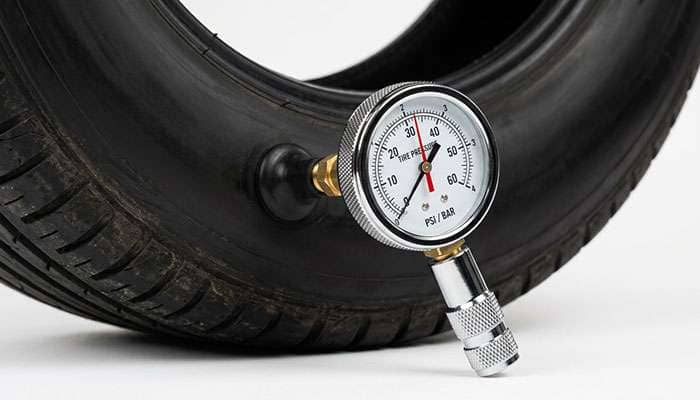
1. Check pressure cold, monthly, with a real gauge. Cold means before driving, or at least three hours after. A pencil or digital gauge costs a few dollars and is the single highest-value tool you can own for tire safety. Do not use the TPMS light as your check; it is designed to warn you after you are already twenty-five percent low.
2. Set pressure to the door placard, not the sidewall. The number molded into the sidewall is the maximum the tire may be inflated to, not the pressure your vehicle wants. The placard in the driver's door jamb is the figure the vehicle manufacturer determined for your car's weight and suspension.
3. Read the loaded column on the placard. Most placards list a second, higher pressure for full-load operation. If you are carrying people and cargo, that is your number, and using it is the entire fix for the load path described above.
4. Do not bleed off hot pressure. A tire reading four or five PSI above placard after an hour of driving is behaving exactly as designed. Releasing that air leaves you underinflated when it cools.
5. Use load and inflation tables when towing. The placard assumes normal load. Towing is not normal load. Set cold pressure to what the tables specify for the weight on each tire, and re-check before every trip rather than once a season.
6. Inspect the shoulders, not just the tread depth. Run a hand around the shoulder of each tire looking for fine cracking, hardened or discolored rubber, and shoulder wear that outpaces the center. That is your thermal history, and it is where heat damage shows first.
7. Read the temperature grade when you replace. If your miles are long, hot, and loaded, a grade A tire is available at essentially every price point, and choosing one costs you almost nothing in tread life. Check the UTQG figures before you commit rather than after, and if you want help matching a grade to how you actually drive, our team can walk you through the options for your size.
Heat is the number one enemy of tires, and every page that tells you so is technically correct and practically useless, because they leave you thinking the enemy is the weather. It is not. The overwhelming majority of the heat that destroys a tire is generated inside the tire itself, by sidewall deflection, in proportion to load divided by inflation pressure. Ambient temperature stacks on top of that and can be the last straw, but it is never the whole load. This is why the same question produces two different answers depending on how it is phrased, and why both answers are right: heat is the mechanism, and underinflation is the most common way drivers turn it up.
What that buys you is control. You cannot do anything about the road being 140°F in August. You can do something about the three terms that actually set your tire's operating temperature, and one of them takes thirty seconds with a gauge. Check pressure cold and monthly, use the loaded figure when you are loaded, use load tables when you tow, and when you buy your next set, spend ten seconds reading the temperature grade. The drivers who lose tires to heat are almost never the ones who got unlucky with the weather. They are the ones who were running the heat up for months without a gauge in the glovebox.
Heat. But the majority of that heat is generated by the tire itself through sidewall deflection as it rolls, not absorbed from hot air or hot pavement. How much heat your tire produces is set by the load it carries divided by its inflation pressure, which means a properly inflated tire in extreme heat runs cooler and safer than an underinflated tire on a mild day.
Both, because they are the same event described from different ends. Heat is the mechanism that breaks down the bonds between the plies and the rubber components until the tire comes apart. Underinflation is the most common reason a tire generates enough heat to reach that point. Controlling inflation is how you control heat.
Hot weather accelerates the chemical aging of rubber over years and raises the baseline temperature the tire operates from, but it does not by itself burst a healthy, correctly inflated tire. Summer blowouts spike because ambient heat stacks on top of heat already being generated by low pressure or heavy load. The weather is the accomplice rather than the cause.
Adding air restores correct deflection going forward, but it does not repair damage already done. Heat degrades the bonds between the internal components, and that degradation is permanent. A tire run significantly low for any distance can hold air normally and read correct on a gauge while carrying an internal weak point, which is why it should be inspected by a shop that can dismount it rather than simply re-inflated.
Grade A is the highest and it is widely available, so there is rarely a reason to accept less if your driving involves long highway runs, hot climates, or regular cargo. Note that some premium long-wear touring tires carry a B grade, because compounds built for very high treadwear tend to run warmer. LT-metric light truck tires carry no UTQG grade at all, so for towing you should be reading load range instead.
No. Tire pressure rises roughly one PSI for every ten degrees of temperature increase, and a reading several PSI above the placard after driving is normal and expected. The placard figure is a cold inflation pressure, measured before driving. Bleeding off hot pressure leaves the tire underinflated once it cools, which creates exactly the excess deflection and heat you were trying to avoid.
Towing moves every term in the heat equation the wrong way at once. Load rises sharply, especially on the rear axle, speed stays high because you are on a highway, and the duration is long enough for heat to accumulate to its peak. Door placard pressure assumes normal load, so for towing you should set cold pressure using load and inflation tables for the actual weight on each tire.
At the shoulder, the transition between the tread and the sidewall. That zone flexes hardest, it is where the steel belt edges terminate and create stress risers, and heat generated there has the furthest to travel before reaching a surface where it can escape. Look for fine circumferential cracking, rubber that appears dull and hardened, and shoulder wear that is outpacing the center of the tread.