
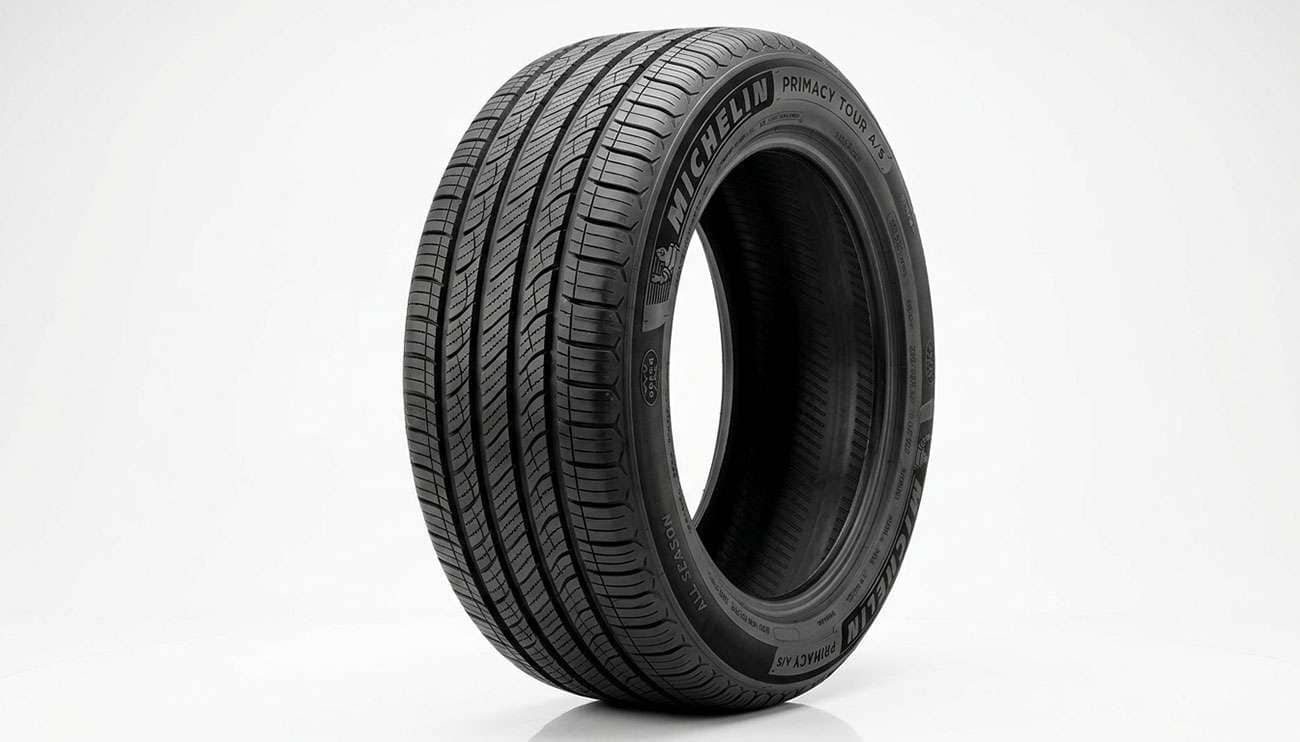
Yes, for the right buyer, and the honest version of that answer is narrower than most reviews will tell you. The Primacy Tour A/S is one of the most refined riding all-season tires money can buy, and it is the tire the luxury automakers reach for when cabin quiet is an engineering target rather than a nice surprise. What it is not is a mileage tire. Its treadwear warranty tops out at 55,000 miles, drops to 30,000 on run-flat versions, and pays nothing at all if your set came on the car from the factory.
I have had that last conversation at the counter more times than I can count. Fellow rolls in on a three-year-old luxury sedan with 34,000 miles, tread is down to the bars, and he wants the prorated adjustment he read about online. Then we look at the sidewall and there is a little star or an MO stamped next to the size, and I have to tell him the bad news standing right there. That is not a Michelin problem and it is not a Primacy problem. It is a thing nobody explains at the point of sale.
So before we get into whether it is a good tire, here is the scorecard I would give a customer who asked me straight.
What You Care About |
How the Primacy Tour A/S Does |
|---|---|
Ride comfort and cabin quiet |
Top of the class, and this is the whole reason it exists |
Wet grip and braking |
Excellent, one of its underrated strengths |
Steering response |
Better than most touring tires thanks to a firmer sidewall |
Light snow |
Competent, roughly 17 percent better than the MXM4 it replaced |
Deep snow and ice |
Not its job, no severe snow rating, buy winter tires |
Tread life warranty |
The weak spot, and it forks four different ways |
Price |
Premium, roughly 181 to 535 dollars per tire by size |
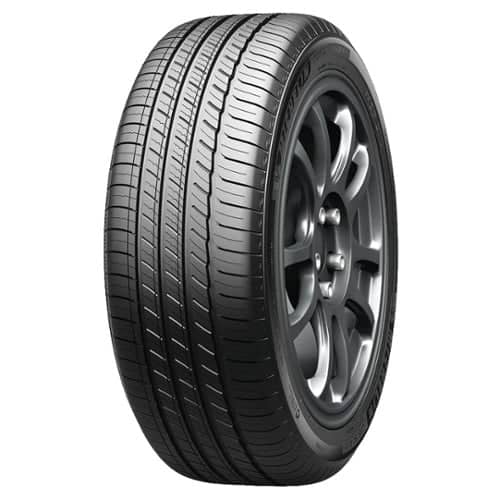
This is the question that brings people in, and it is the one every article on the internet gets wrong by picking one number and calling it the answer. There are four numbers. Which one applies to you depends on what is stamped on your sidewall.
Your Situation |
Mileage Warranty |
How to Tell |
|---|---|---|
Retail purchase, H or V speed rated |
55,000 miles |
Letter after the load index reads H or V |
Retail purchase, W speed rated |
45,000 miles |
Letter after the load index reads W |
Zero Pressure run-flat version |
30,000 miles, capped |
ZP appears on the sidewall |
Original Equipment, 2018 model year or newer |
None at all |
Automaker code near the size, see below |
Michelin excludes Original Equipment tires from the mileage warranty starting with the 2018 model year. That is written into the warranty terms in plain language, and it is entirely legitimate, because an OE tire is not the same product as the retail tire that shares its name. The automaker specifies it, Michelin builds to that spec, and the compound and construction get tuned to whatever that carmaker was chasing on their vehicle. Sometimes that is rolling resistance for a range number. Sometimes it is a specific noise signature to match the cabin insulation. Whatever it is, the tire is different, and Michelin does not warrant somebody else's spec sheet for mileage.
Here is how you tell. Look at the sidewall right around the size marking for a short code that has nothing to do with size or load. The common ones you will run across on a Primacy:
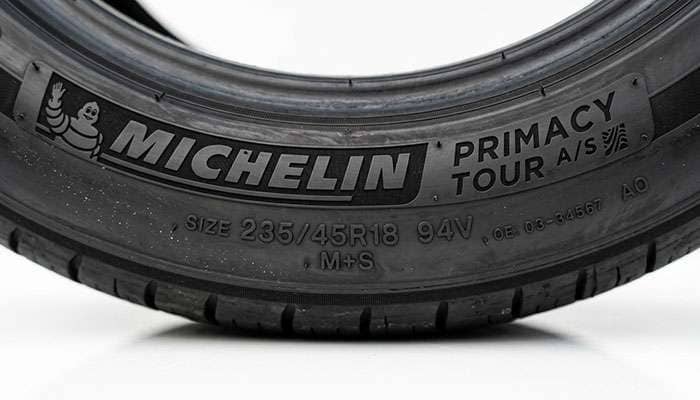
If one of those is on there, you are on a factory tire. That does not make it a worse tire, and I want to be clear about that, because people hear this and assume they got shorted. Plenty of OE Primacys are terrific. It just means the mileage warranty is not part of the deal, and it means the replacement set you buy over the counter will not be an identical tire even if the sidewall says the same words. If you want the fuller picture on that difference, we wrote it up in the difference between OEM and aftermarket tires.
Split fitments cut the number in half on the back. If your car runs a wider tire on the rear than the front, those rear tires cannot be rotated front to back, so Michelin covers them for half the standard mileage. Nobody mentions that when you are buying a staggered set for a rear-drive sedan, and it catches people out.
And separate from mileage entirely, every Michelin carries a materials and workmanship warranty good for six years from purchase or the life of the usable tread. Free replacement inside the first year or the first 2/32 of wear, prorated after that. That one is not affected by any of the above, and it is the warranty that actually covers a tire that fails rather than one that simply wears out.
Real-world reports on the Primacy Tour A/S cluster in the 40,000 to 55,000 range for retail sets on sedans and crossovers driven normally. I have seen plenty come off at 50,000 looking honest. I have also seen a 2020 crossover chew through a set at 28,000, and when we pulled the alignment sheet the toe was out on both fronts. Nine times out of ten, a Primacy that dies early died of something you could have caught.
The three that matter, in the order I check them: inflation, rotation interval, and alignment. Run it five pounds low and the shoulders carry load they were not meant to carry, temperature climbs, and the compound goes away faster. Skip rotations past ten thousand miles and the drive axle eats itself while the other two look brand new, and you still buy four tires. Let toe drift out of spec and the tire scrubs sideways every foot of every mile.
One more piece of housekeeping. Speed rating is not a bragging right, it is a construction difference, and on this tire it is worth ten thousand miles of warranty. If you have a choice between an H, V, or W rated size for your car, that choice has consequences beyond top speed. We laid the tradeoff out in H versus V rated tires. And when you do file a treadwear claim, understand going in that it pays on remaining depth rather than handing you a new set, which we walked through in tire mileage warranty proration.
Very. It is one of the quietest all-season tires in production, and unlike a lot of marketing claims, there is real engineering behind this one.
Michelin calls the package Enhanced ComfortControl with PIANO Noise Reduction Tuning. Cut through the branding and here is what is actually happening. A rolling tire makes noise mostly because tread blocks slap into and out of the contact patch. Each block entry is a little pressure pulse. If every block is the same length, every pulse lands at the same interval, and you get a single tone. Your ear is extraordinarily good at picking a pure tone out of background noise, which is why a cheap tire whines at you on the highway.
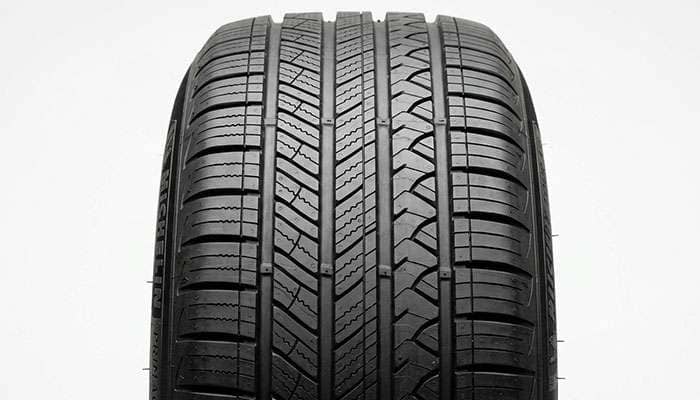
The fix is to stop the pulses from lining up. The Primacy Tour A/S uses an asymmetric five-rib tread with the block lengths varied around the circumference so the energy smears across a band of frequencies instead of stacking on one. Broadband noise reads to the ear as a soft rush rather than a whine, even at the same overall decibel level. On top of that, Michelin shapes the shoulder grooves so the sound they generate partially cancels the sound coming off the tread face, and puts chamfers on the block edges so the transition into the contact patch is gradual instead of a hard slap. Underneath, a smoother belt package cuts down the structural vibration that gets transmitted up through the suspension rather than through the air.
It is not the quietest tire made. In back-to-back testing, the Bridgestone Turanza QuietTrack edges it, and Continental's touring tires are right there too. If absolute silence is the only thing you care about and nothing else matters, the QuietTrack is a legitimate answer and we stock it.
What the Primacy does that those do not is stay composed while being quiet. Michelin gave this tire a firmer sidewall than a typical comfort tire, which means the steering stays crisp and the car does not float over a crown in the road. The tradeoff is that at parking-lot speeds over broken pavement you feel a little more of the surface than you would on a softer-sidewalled competitor. Highway speeds, it disappears. I would take that trade every time on a car with any pretensions to handling.
If your tires got loud after being quiet, though, do not go shopping yet. That is almost never the tread design. That is cupping from tired shocks, or heel-and-toe wear on the shoulder blocks from missed rotations, or a wheel bearing that has nothing to do with the tire at all. We sorted the symptoms out in tire noise causes explained, and it is worth ten minutes before you spend a thousand dollars.
Two separate things got jammed together into one label, which is why this trips people up.
Touring is a market segment, not a specification. It describes a tire built for long-distance road comfort on a passenger car or crossover. The priorities are ride quality, low noise, even wear, and predictable manners. You will also see grand touring, which is the same idea with a higher speed rating and sharper steering for cars that are quick as well as comfortable. The Primacy Tour A/S sits squarely in grand touring.
A/S means all-season. That is a compound and tread design intended to work across a temperature range instead of being optimized for one end of it. A summer tire uses a compound that goes stiff and glassy below about 45 degrees Fahrenheit. An all-season compound stays pliable down into the cold, and the Primacy uses sunflower oil in the mix specifically to hold that flexibility. You give up some warm-weather grip to get it. That is the deal, and it is a good deal for most people.
What A/S does not mean is winter capable. There is no test behind the letters. The marking that is earned is the three peak mountain snowflake, which requires passing a standardized snow traction test, and the Primacy Tour A/S does not carry it. It handles a dusting fine and it is meaningfully better in snow than the MXM4 it replaced. Deep snow and ice are a different tire's job.
If you want to see how the whole touring category sorts out by use case, we ranked it in best touring tires for daily commuters.
I will give you the version I would give a friend, not the version off the box.
Ride refinement. This is the best thing about the tire and it is not close. It takes the edge off expansion joints, tar strips, and coarse chip-seal in a way that makes a mediocre car feel more expensive than it is.
Wet performance. Underrated. Four circumferential grooves move water out of the contact patch, and the silica-heavy compound holds grip on a cold wet morning when a lot of tires are still waking up. Wet braking is where premium compounds actually earn back their price.
Steering feel. That stiffer sidewall means the tire builds cornering force quickly and holds the line. Most comfort-first tires feel vague. This one does not.
Even wear. When the alignment and rotations are right, these wear flat across the face. That is worth real money because it means you use the whole tire instead of replacing a set with tread left on the inside shoulders.
Rim protection. Sizes with a sidewall height under 125 millimeters get a molded rim protector. If you run low-profile wheels in a city with aggressive curbs, that little rubber ledge has saved a lot of expensive rims.
The warranty number. Competitors in this segment routinely offer 25 to 45 percent more warranty mileage at the same money or less. That is the honest knock on this tire and there is no talking around it.
Winter beyond a dusting. No severe snow rating. If you live somewhere with real winters, budget for a second set.
Low-speed ride harshness. The firm sidewall that makes it steer well makes it a touch busier over potholes at 25 miles an hour. Larger wheel diameters make this more noticeable, and at that point it is a wheel package issue as much as a tire issue, because a shorter sidewall has less rubber left to absorb the hit.
Price. It is expensive. We will get to why.
Depends what you mean by smooth, because two different complaints hide under that word. Some people mean quiet. Some people mean they do not want to feel the road. Those call for different tires.
Tire |
What It Is Best At |
Give Up |
|---|---|---|
Primacy Tour A/S |
Quiet plus composure, the balanced pick |
Warranty miles, some low-speed compliance |
Primacy MXV4 |
Softest, most absorbent ride of the family |
Steering sharpness, older design |
Defender2 |
Nearly as quiet with far more warranty mileage |
A small amount of refinement and steering feel |
CrossClimate2 |
Genuine winter capability in an all-season |
Noticeably more road noise |
Primacy MXM4 |
The OE tire on a lot of luxury cars, familiar feel |
Superseded on snow and noise by the Tour A/S |
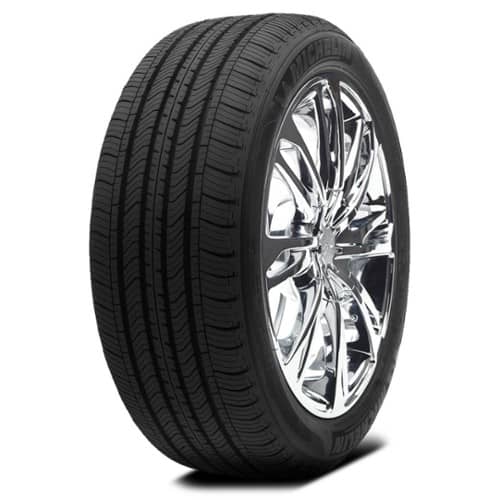
Here is how I actually sort people at the counter. If you want the plushest ride and you do not push the car, the MXV4 is still the softest thing Michelin makes in this space. If you want quiet but you also want the car to feel like it has a spine, that is the Primacy Tour A/S. And if you are honest with yourself that you mostly want quiet and long life, the Defender2 gets you 90 percent of the refinement with a warranty that makes a lot more sense on paper.
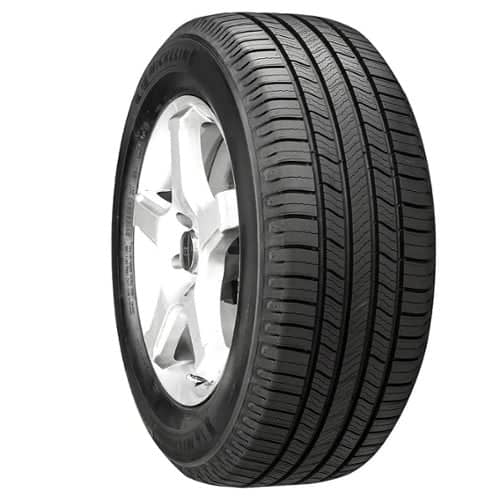
That last one is the recommendation I make most often, and it costs us margin to say it. But a customer who comes back in four years is worth more than one who feels oversold. If quiet is the whole ballgame for you, our road tested rankings in the quietest and smoothest tires will narrow it faster than another spec sheet.
Four tires land in the same conversation, and every one of them is a legitimate alternative. This is a competitive segment and Michelin does not run away with it.
Tire |
Its Argument |
Price Range |
|---|---|---|
Michelin Primacy Tour A/S |
Best blend of quiet and composure, OE pedigree |
181 to 535 dollars |
Bridgestone Turanza QuietTrack |
Measurably the quietest of the group |
133 to 302 dollars |
Continental TrueContact Tour |
Best value, strong wet grip, long warranty |
123 to 256 dollars |
Pirelli Cinturato P7 All Season Plus 2 |
Sportiest steering of the group, European feel |
98 to 275 dollars |
Goodyear Assurance ComforTred Touring |
Softest ride, built around a comfort layer |
71 to 233 dollars |
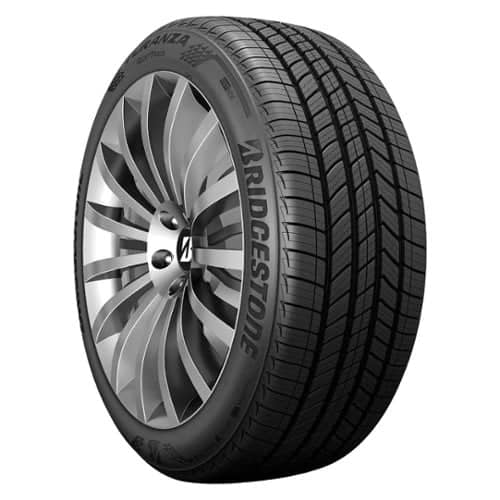
The Turanza QuietTrack is the one that beats the Primacy at its own headline claim. If a customer tells me the only thing they hate about their car is highway drone, that is where I point them.
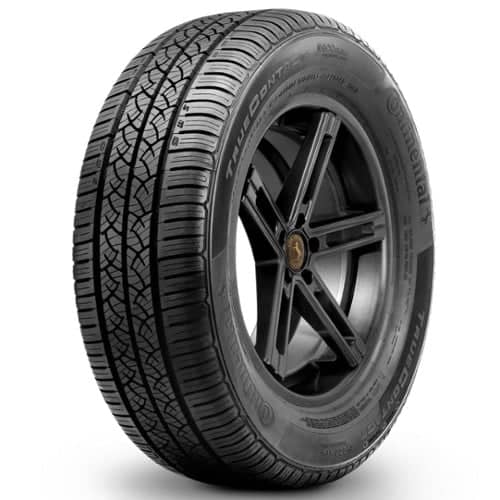
The Continental TrueContact Tour is the value play and I say that with respect. It gives up a little polish and takes back a meaningful chunk of the price along with a longer warranty. For somebody putting 20,000 miles a year on a commuter, it is often the smarter buy and I will say so.
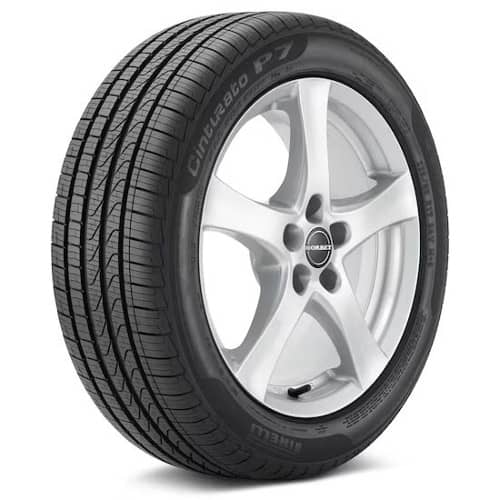
The Pirelli goes the other direction and leans into steering response, which suits a German sedan owner who is not ready to give up the feel of the car. The Goodyear ComforTred Touring goes the opposite way with a dedicated comfort layer under the tread, and it is the softest riding thing on that list by a wide margin. Pick the axis you actually care about and the choice makes itself.
Three real reasons and one that is just how the market works.
The compound costs money. High-silica tread compounds with sunflower oil in the mix are harder to manufacture than a conventional carbon-black compound. Silica does not disperse into rubber easily, so it takes longer mixing cycles at controlled temperatures, and mixing time is capacity. What you get for it is grip that holds up in the cold and low rolling resistance at the same time, which are normally opposing goals. That combination is the reason Michelin can claim strong wet numbers and good fuel economy on the same tire.
Homologation is expensive. Michelin says Primacy is the top pick among premium automakers, and that roughly one in four premium vehicles sold in North America rolls out on Michelin rubber. Getting there is not a sales call. The tire maker develops a specific version for a specific vehicle, then runs validation cycles with the automaker on noise, ride, wear, and braking until the numbers land. That development cost gets spread across the whole line, retail sets included.
The construction is not minimal. Two-ply polyester casing, twin steel belts, and a polyamide reinforcement layer over the top. That polyamide cap is what keeps the tire round at speed and it is not free. Cheaper tires in this segment skip it or use less of it.
And Michelin charges what the name will carry. That is not a knock, it is just true, and it is true of every premium brand in every category. The question worth asking is not whether you are paying a brand premium. You are. The question is whether you are buying the thing the premium actually delivers.
Here is my honest read after a lot of years of this. The Primacy Tour A/S is not overpriced. It is mis-sold. Nobody should buy this tire for mileage, because on that axis it loses to half the segment. You buy it because the ride and noise quality is genuinely at the top of the class and because it is the tire your car was engineered around. Sold on that basis the price makes sense. Sold as a long-life tire it does not, and that is where the disappointed reviews come from. We dug into the broader brand premium question in why Michelin tires are so expensive.
If This Is You |
Verdict |
|---|---|
Luxury sedan or crossover, moderate annual miles, want the factory feel back |
Buy it, this is exactly the tire |
Long highway commute, cabin noise is your main gripe |
Buy it, or cross-shop the Turanza QuietTrack |
20,000 plus miles a year, cost per mile is the priority |
Look at the Defender2 or TrueContact Tour instead |
Real winters with ice and accumulation |
CrossClimate2, or this plus a winter set |
Currently on OE Primacys expecting a mileage adjustment |
Check the sidewall code first, then decide |
Staggered fitment on a rear-drive car |
Fine tire, just know the rears carry half the warranty |
Sizes, current pricing, and the rest of the segment are on our touring tires page. If you are not sure whether your set is an OE fitment or which speed rating your car actually calls for, give us a call before you order. That is a two-minute conversation that saves a lot of grief.
So, is it a good tire? It is a very good tire that gets asked to be something it was never built to be. Michelin engineered the Primacy Tour A/S to make a car feel expensive from the driver's seat, and on that count it succeeds better than almost anything else you can bolt on. The ride is composed, the wet grip is legitimately strong, and the noise engineering is real work rather than a marketing slide.
Where it disappoints people is mileage, and most of that disappointment is an expectations problem rather than a product problem. Fifty-five thousand miles is a modest warranty in this segment. Thirty thousand on a run-flat is short. Nothing at all on a factory set is a genuine shock if you did not know it was coming. None of that makes the tire bad. It makes it a comfort tire that got sold to some people as a mileage tire.
Know which one you are buying and you will be happy with it. Buy it for the ride, keep the alignment honest and the rotations on schedule, and it will give you every mile it has and be pleasant the whole way. If what you actually need is maximum tread for the dollar, I would rather point you at something else and see you again in five years than sell you the wrong tire today.
Look on the sidewall near the size marking for a short code that is not part of the size or load rating. Common ones include MO or MOE for Mercedes-Benz, a star symbol for BMW, AO or RO1 for Audi, N0 through N5 for Porsche, VOL for Volvo, and TPC Spec for General Motors. If any of those are present, you have a factory-spec tire, which means no mileage warranty for 2018 model year vehicles and newer, and it means a retail replacement will not be an identical tire.
No. It does not carry the three peak mountain snowflake symbol, which is the marking that requires passing a standardized snow traction test. It does have zigzag sipes in the inboard ribs and a compound designed to stay flexible in cold weather, and Michelin rates it roughly 17 percent better in snow than the Primacy MXM4 it replaced. That makes it competent in a light dusting. For ice or real accumulation you want a dedicated winter tire or an all-weather tire like the CrossClimate2.
Michelin caps the mileage warranty on all Zero Pressure tires at 30,000 miles regardless of which line they belong to. A run-flat carries reinforced sidewall inserts so the tire can support the car with no air in it, and that extra structure adds weight and stiffness that work against tread life. The cap applies across the board, so it is not specific to the Primacy.
You can, and the two new tires go on the rear axle regardless of which wheels drive the car. The deeper tread belongs at the back because that is what keeps the rear end from stepping out in standing water. Try to keep the tread depth difference between axles inside about 4/32 of an inch, and be aware that all-wheel-drive vehicles often specify a much tighter tolerance in the owner's manual to protect the driveline.
If ride refinement and steering feel are what you care about, yes. The Primacy is the more polished tire and it feels better on a luxury car. If cost per mile is what you care about, the Defender2 is the stronger buy, because it delivers most of the quiet and comfort with a substantially longer warranty at similar money. Testing puts the comfort gap between them smaller than the marketing suggests.
Because they cannot be rotated. Michelin's mileage warranty assumes tires get rotated front to back on a normal schedule, which spreads wear across all four. On a split fitment the rear tires are a different size and have to stay on the rear axle, so they wear faster and Michelin covers each rear tire for half the standard mileage. This is standard across the industry rather than a Michelin policy, and it is worth factoring into your budget when you buy a staggered set.



