
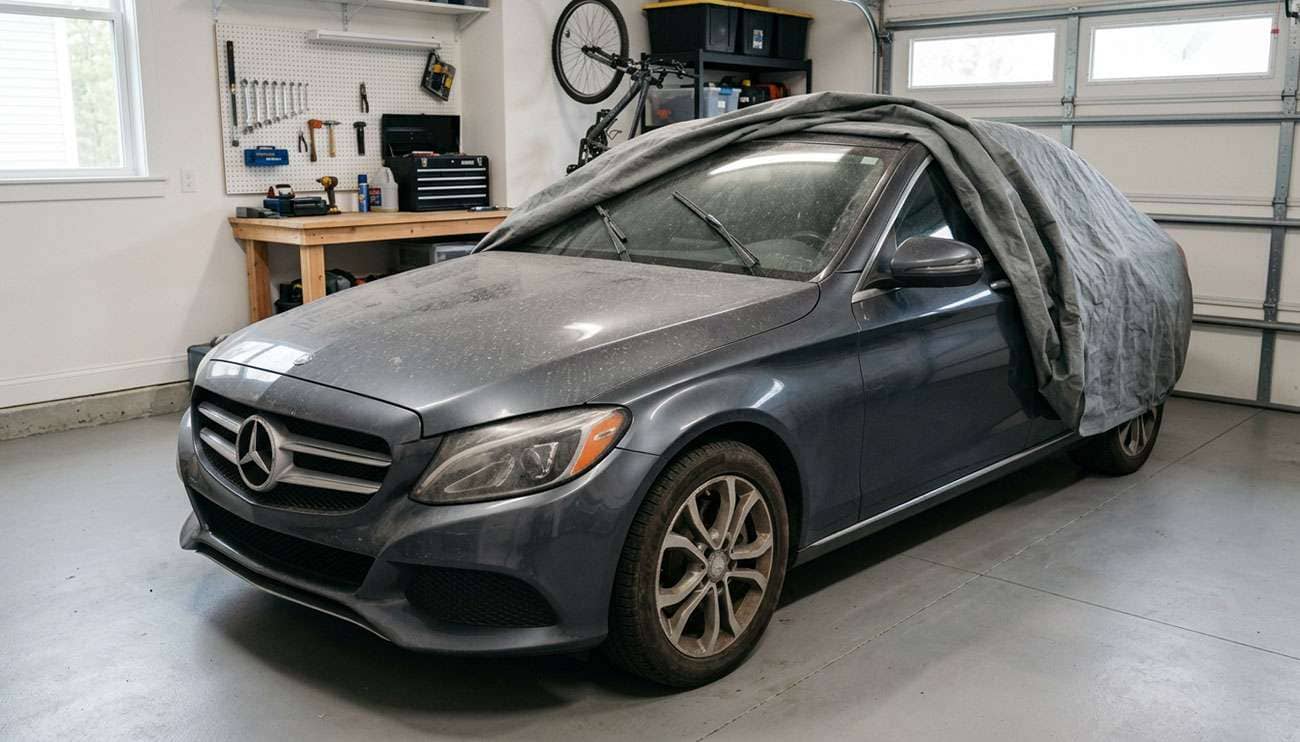
Ask ten drivers how long a car can sit before its tires go bad and you'll get ten different answers — most of them wrong. The common assumption is that tires deteriorate when you drive them and rest when you don't. The actual data says something closer to the opposite: a tire that never rolls is a tire losing performance in ways that a daily-driven tire isn't.
The National Highway Traffic Safety Administration and the U.S. Tire Manufacturers Association both recommend replacement windows that factor in age independent of mileage. Most tire makers use a five- to ten-year guideline depending on storage conditions. That applies whether the rubber is mounted to a car, sitting on a shelf, or stacked in a warehouse. The clock doesn't stop because the car isn't moving.
This guide walks through what actually happens to tires on a parked vehicle across a week, a month, six months, two years, and beyond — and what you should do about it if you're inheriting a car that sat, parking one for a deployment, or planning a long trip overseas.
A parked tire is degrading on three independent tracks at once. They stack, and they accelerate each other. Understanding the three mechanisms is the key to understanding the timeline.
Clock 1 — Pressure loss. Every tire leaks air slowly through its sidewall, the bead seat where it meets the wheel, and the valve stem. The industry figure for a sealed, healthy passenger tire is roughly 1 to 3 PSI per month under normal conditions. Cold weather accelerates it — pressure drops about 1 PSI for every 10°F drop in ambient temperature. A car parked in an uninsulated garage from October through April can lose 6 to 10 PSI without any leak at all, just from physics.
Clock 2 — Physical deformation. The weight of the vehicle pressing down on a stationary contact patch causes the rubber and the internal nylon cap layer to take a "set." The result is flat spotting — a portion of the tire that's no longer perfectly round. For a deeper look at the mechanical side, see our companion piece on tire flat spots from sitting. The two forms of damage are distinct but they compound: an underinflated tire flat spots faster, and a flat-spotted tire handles pressure loss worse.
Clock 3 — Chemical aging. This is the one drivers rarely think about and the one that ultimately decides tire replacement. Rubber compounds contain antioxidants and antiozonants designed to slow oxidation and ozone attack. These additives are consumed over time whether the tire rolls or not. Once they're depleted, the rubber begins a one-way process: the polymer chains stiffen, sidewall cracks appear, and the structural bond between tread and belt package weakens. UV exposure and heat both accelerate the reaction significantly.
For the first 14 days of inactivity, the damage is almost entirely reversible. A healthy tire on a garaged vehicle will lose roughly 0.5 to 1 PSI per week under stable temperatures. Drop the garage temperature 20 degrees overnight and the same tire may show a 2 PSI drop by morning that partially recovers as temperatures rise.
Flex memory begins forming almost immediately — especially on performance tires with softer compounds — but at this stage it's purely temporary. Fifteen to twenty minutes of highway driving restores the tire to round and the ride to normal. No cracking, no structural change, no measurable hardening.
If a car is going to sit for two weeks or less, the only meaningful action is to confirm the tires are at the correct pressure before parking and again before driving. Our guide to finding your recommended tire pressure covers where to find the placard value and why cold-inflation readings matter.
At the 30-day mark, things shift. Industry data from multiple tire manufacturers — including data cited by Edmunds, Firestone, and Continental — points to one month of immobility as the threshold where severe flat spotting becomes a real risk. That's especially true on cold concrete, on performance compounds, or at pressures below the placard specification.
Compound hardening also begins to register at this stage, though it's still measured in single percentage points rather than full durometer shifts. The antioxidants in the rubber compound are consumed by oxygen exposure at a steady rate — roughly twice as fast internally (since tires are inflated with air containing 21 percent oxygen) as externally. A tire sitting at full pressure without movement is being oxidized from the inside out every hour of every day.
Pressure drift at one month is typically 3 to 5 PSI if unchecked, enough to change the contact patch shape and compromise load-carrying capacity. This is where most drivers first notice the consequences when they finally move the car — a bumpy ride, a TPMS warning light, or both.
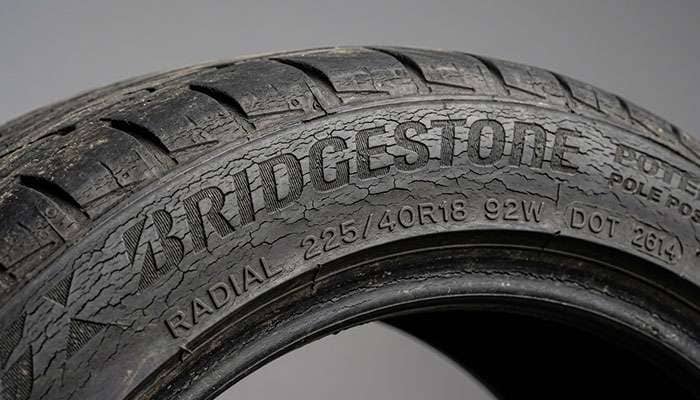
Between the three- and six-month mark, the chemical clock becomes visible. Fine cracks begin appearing on the sidewall, usually in the area closest to the tread shoulder and the bead. The pattern looks like dry, cracked mud — short, shallow fissures running in multiple directions. This is ozone cracking, and it's a visual signal that the antiozonant additives are being consumed faster than the rubber can hold them.
The cracking rate depends heavily on environmental factors:
At six months, a tire stored under good conditions may show no visible cracking. The same tire stored outdoors in a hot, sunny climate may already be developing cracks deep enough to reach the cord layer. Our full breakdown of the process lives in the tire dry rot guide.
Pressure loss at six months ranges from 6 to 15 PSI depending on temperature swings. Flat spotting at this stage is often semi-permanent — the tire may round out eventually with sustained highway driving, but the process can take hours rather than minutes.
Past the one-year mark of continuous inactivity, the tire has crossed from "ages more slowly than it drives" into "significantly degraded." Visible sidewall cracks are common even on tires stored in controlled environments. The rubber compound has lost a measurable percentage of its flexibility — a durometer test will show 3 to 8 shore A points of hardening, depending on compound and conditions.
The more dangerous development at this stage is internal. Oxygen exposure on the inside of the tire attacks the bond between the rubber and the steel belt package. Belt separation — where the steel belts pull away from the tread rubber — becomes a measurable risk. Belt separations don't always show externally before they fail, which is what makes them so dangerous: a tire can look serviceable from the outside and fail catastrophically at highway speed.
At two years of continuous inactivity, most tire manufacturers will decline to dismount or remount the tire. That's not a legal rule — it's a liability rule. The industry consensus is that a tire that sat under load for two-plus years has accumulated enough unseen damage that handling it carries meaningful risk. Treat any tire with two-plus years of zero rotation under load as suspect until proven otherwise.
The NHTSA and U.S. Tire Manufacturers Association both recommend consulting the tire's manufacturing date at five years and replacing at six years regardless of tread depth if conditions warrant. Several automakers — Mercedes-Benz, Volkswagen, and Nissan among them — print a six-year tire replacement guideline in their owner's manuals independent of mileage.
A tire that sat for five to six years has gone through enough chemical aging that even a pristine-looking sidewall doesn't guarantee structural integrity. The antioxidant package is depleted. Interior rubber may have begun turning to powder. Belt adhesion has measurably weakened. The tire can still hold air and roll down the road — which is precisely the problem, because it can do both right up until the moment it fails.
This is the point at which tread depth becomes irrelevant to the replacement decision. A garaged tire with full tread and a 2020 date code should be replaced in 2025-2026 whether it's been driven or not. Reading the date code is straightforward once you know where to look — our guide to reading DOT tire date codes walks through the format. For a broader look at expected tire lifespan under normal use, see our article on the lifespan of a tire from purchase to replacement.
Ten years is where industry opinion converges into a hard limit. The National Highway Traffic Safety Administration, Bridgestone, Michelin, Continental, Goodyear, and the Tire Industry Association all take the same position: a tire that is ten years old or older should be removed from service regardless of visual condition, tread depth, or storage conditions.
Tire shops will almost universally refuse to dismount, remount, or repair a tire past its tenth birthday — partially because of liability, partially because the rubber is often so brittle by that point that the act of dismounting it can damage the bead seal. If you've acquired a car whose tires are stamped with a date code ten or more years in the past, the decision has already been made for you.
This rule applies to spare tires, too. The full-size or compact spare in the trunk of a garaged car ages at the same rate as the four tires on the road. A 15-year-old untouched spare is no more reliable than any other 15-year-old tire, and arguably less so because it's never been inspected.
If you're dealing with a vehicle that's been parked for months or years — an inherited car, a barn find, a deployment return, a COVID-era second vehicle finally coming back to service — run through this inspection before trusting the tires at highway speed.
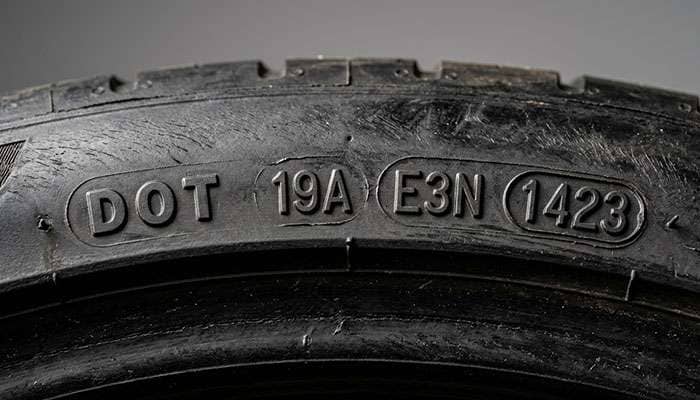
1. Read the date code. Locate the DOT stamp on the sidewall. The last four digits give you the week and year of manufacture (e.g., 3419 = week 34 of 2019). If any tire on the vehicle is six or more years old, factor that into your replacement math immediately.
2. Check inflation pressure. Set cold pressure to the door placard specification. Note which tires were significantly low — a tire that's lost 10+ PSI is a tire to watch for slow leaks.
3. Inspect sidewalls in strong light. Look for cracking patterns, especially near the shoulder and the bead. Fine surface crazing is usually cosmetic. Cracks you can fit a fingernail into are structural and disqualifying.
4. Feel the rubber. Press a fingernail into the tread rubber. Healthy rubber gives slightly and rebounds. Rubber that feels hard as plastic has lost compound flexibility and won't grip properly — especially in wet or cold conditions.
5. Look for bulges or bubbles. A raised area on the sidewall indicates internal belt or ply damage. Any visible bulge is an immediate replacement trigger. Our guide on tire sidewall damage covers this in detail.
6. Drive carefully at first. Take the vehicle on a low-speed loop for five miles before attempting highway speed. Listen for unusual thumping, feel for vibration, and watch for TPMS alerts. If anything feels wrong, stop and re-inspect.
7. Re-check pressure after the first drive. Slow leaks often don't become obvious until the tire has been stressed by driving. A pressure check after the first 30 miles catches leaks that weren't apparent during the initial inspection.
If you know a car is going to sit for a month or longer, these steps significantly slow all three degradation clocks.
1. Inflate 5–10 PSI above placard. Higher cold pressure reduces sidewall flex at the contact patch, limits flat spotting, and buffers against monthly pressure loss. Never exceed the max cold pressure printed on the sidewall.
2. Wash and dry the tires. Road grime contains chemicals that accelerate rubber degradation. Clean sidewalls age more slowly than dirty ones.
3. Park on a clean, dry surface. Oil, solvent, and moisture contact attacks rubber. A concrete floor with a moisture barrier beneath is ideal; bare dirt or asphalt that heats up in summer is worst.
4. Insulate from cold concrete. For storage periods of two months or longer, place carpet squares or 2-inch foam board under each tire. The rubber-to-floor temperature differential drives flat spotting faster than ambient temperature alone.
5. Keep the vehicle out of direct sunlight. UV exposure accelerates ozone cracking. A car cover, a shaded garage, or even a tarp reduces degradation by a measurable fraction.
6. Control humidity if possible. Climate-controlled storage is best. If unavailable, a dehumidifier in a sealed garage helps significantly.
7. Move the vehicle monthly. Even a roll forward and backward of 10 feet redistributes the contact patch. A full 20-minute drive at highway speed once a month is even better — it warms the rubber, cycles the antioxidants, and redistributes the air inside the tire.
8. Check pressure every 30 days. Top off to the over-inflation target. Tires that go flat during storage are far more prone to permanent damage than tires that stay properly inflated.
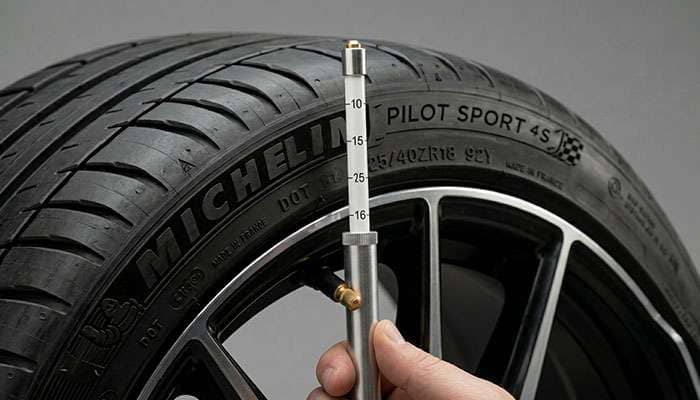
If a vehicle is going to be a low-mileage driver — a second car, a weekend toy, a garage-kept classic, or a seasonal hauler — the tire selection matters more than most buyers realize. The goal is a compound engineered to resist aging and flex fatigue over calendar years, not just tread wear over miles.
Tire |
Treadwear Rating |
Why It Suits a Car That Sits |
|---|---|---|
800 (UTQG) |
Michelin's MaxTouch Construction distributes load evenly across the contact patch, slowing flat spotting. Long-life compound is engineered for calendar durability as well as mileage. |
|
700 (UTQG) |
EcoPlus technology uses a tread compound with specific silica blends that resist stiffening from age. Strong sidewall construction holds shape during extended parking. |
|
820 (UTQG) |
85,000-mile tread warranty reflects compound designed for long service life. The reinforced sidewall and aging-resistant compounds make it a strong fit for low-mileage use cases. |
|
800 (UTQG) |
Premium touring construction with quality materials that hold up well over calendar time. The stiffer sidewall resists flat spotting during storage periods. |
Note on classic and vintage applications: if the car in question is a classic or weekend cruiser with bias-ply or period-correct rubber, the inactivity damage timeline runs faster across the board. Classic car owners should refer to our specific guide on when classic car tires should be replaced, and for a deeper look at whether vintage rubber is ever worth keeping in service, see are vintage tires safe to use.
The short answer to "how long can a car sit before the tires go bad" is that it depends on which clock is ticking loudest. Pressure loss is measurable within days. Flat spotting becomes a risk at one month. Chemical aging produces visible damage between three and six months and becomes structurally significant between one and two years. By the five- to six-year mark, manufacturer replacement guidelines apply regardless of tread. At ten years, every major tire maker and the NHTSA agree that the tire comes out of service.
The practical takeaway for most drivers: if a vehicle is going to sit longer than two weeks, take five minutes to inflate above placard and log the date. If it's going to sit longer than a month, budget for proper storage prep. If a car has already sat for a year or more, inspect the tires carefully before trusting them at speed — and verify the date code before deciding whether to replace proactively.
When the answer is replacement, Performance Plus Tire stocks the full lineup of long-life touring and all-season options that match the low-mileage use case. Picking rubber engineered for calendar durability rather than just mileage is the single biggest decision a low-use vehicle owner can make.
Tires on a parked car begin losing pressure within days and can develop flat spots at 30 days. Chemical aging produces visible damage between three and six months. At five to six years, manufacturer replacement guidelines apply regardless of use. At ten years, industry consensus calls for mandatory replacement. The threshold depends on which form of damage matters most for your situation.
Yes, in several measurable ways. Driving generates heat that cycles antioxidants through the rubber, redistributes compound additives, and rotates the contact patch to prevent flat spotting. A tire that never rolls is oxidizing from the inside while sitting loaded on a single pressure point, with no compound circulation to offset either process.
It depends on the tires' manufacturing date, storage conditions, and visible condition. If the tires are less than six years old by DOT date code, stored indoors out of sunlight, have no visible cracking, and hold pressure properly, they may be serviceable after thorough inspection. Tires stored outside, in heat, or past the six-year mark should be replaced.
Starting the engine alone does not help the tires. A full 20-minute drive at highway speed once every two to four weeks is what actually protects tire rubber — the sustained rotation generates heat that softens the compound, cycles antioxidants, and prevents flat spots from setting permanently.
Most tire manufacturers and the NHTSA recommend replacement at six years regardless of tread depth, and mandatory replacement at ten years. Tread depth measures wear but not chemical aging. A tire with deep tread and a ten-year-old date code has compromised rubber chemistry that makes belt separation and sidewall failure significantly more likely.
Pressure loss shows up first, typically within days. Flat spots produce thumping and vibration on the first drive after a month or more of parking. Visible sidewall cracking appears between three and six months. Hardened rubber that no longer grips properly develops over one to two years. Belt separation risk, which is internal and often invisible, becomes significant past the two-year mark.



