
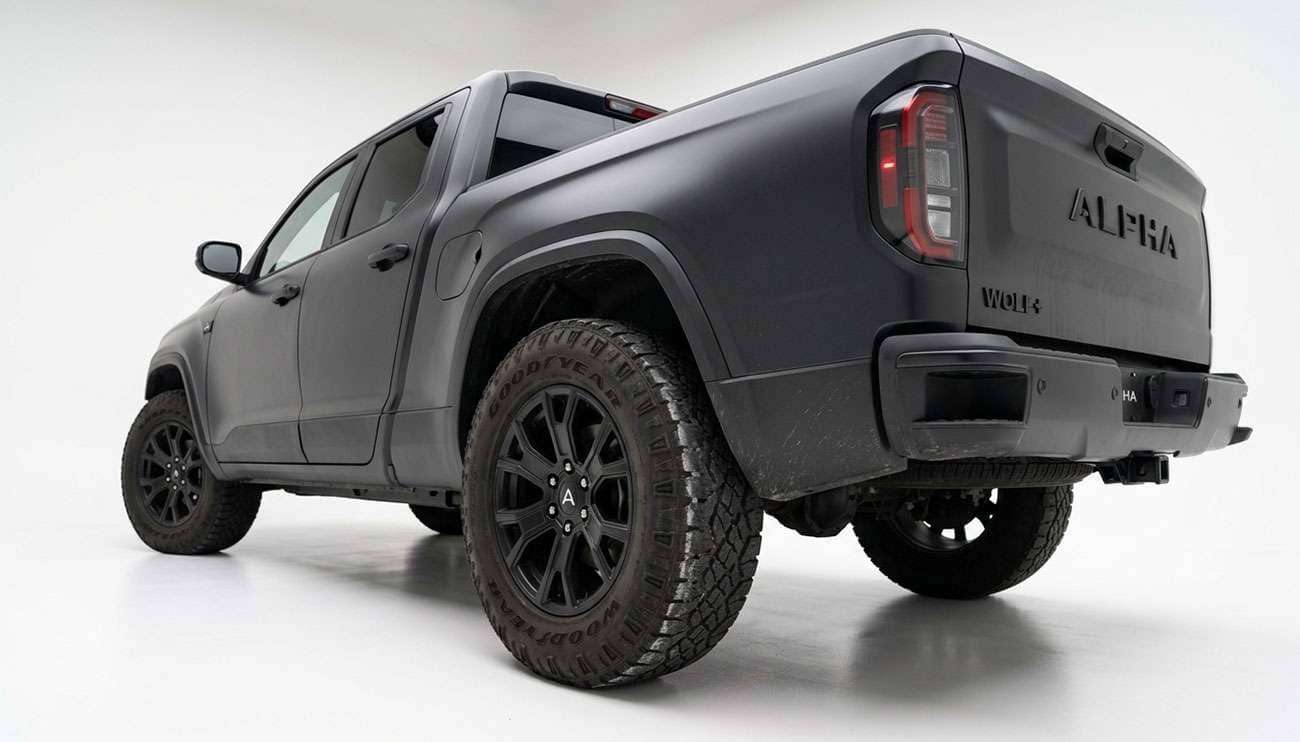
EV trucks eat tires because most replacements sold in the original size carry less load capacity than the tire that came off. Weight and torque get blamed everywhere, and both are real, but neither is the variable you control at the counter. Load index is. In 275/50R22, a size that leaves the factory rated at 2,679 lb per tire, the replacement market runs down to 1,819 lb. Nothing about the size printed on the sidewall stops you from buying it.
Most guides stop at "EVs are heavy and torquey, so tires wear faster." True, and not actionable. It does not explain why two owners of the same truck, driving the same way, get 18,000 miles and 45,000 miles out of the same size. The number that separates them sits on the sidewall right after the size, and federal rules do not require it on your door placard at all.
A gas half-ton pickup in a comparable configuration lands in the 4,700 to 5,700 lb range at the curb. The electric versions do not. The Ford F-150 Lightning runs 6,015 to 6,893 lb depending on battery and trim. The Rivian R1T carries a Gross Vehicle Weight Rating of 8,532 lb, which puts it in EPA Class 2b, the same federal weight class as a three-quarter-ton pickup. That is not a small truck carrying a battery. That is a heavy truck wearing half-ton bodywork.
Mass alone would shorten tire life, but it is the first of three factors stacked on each other, and they compound rather than add.
Mass raises the baseline load. Every pound of curb weight is a pound the four contact patches carry every second the truck is on the ground. The battery pack does not come out when you unload the bed.
Electric torque arrives without a ramp. A combustion engine has to spin up, and a transmission smooths what reaches the axle. An electric motor delivers peak twist from a standstill. Tread blocks react that twist in shear, and rubber in shear abrades. Every launch from a light is a small machining operation on your tread.
Regenerative braking puts that same shear through the same tires in the opposite direction. On a gas truck, friction brakes at all four corners handle deceleration. On an EV, the motor handles a large share of it, which routes it through the driven axle only. Those tires do the accelerating and much of the stopping.
All three are fixed by the truck you bought. You cannot make the battery lighter or ask the motor to be gentler. What you can change, once every 20,000 to 40,000 miles, is which tire you bolt on, and that decision has a wider range of outcomes than any of the three above.
Federal Motor Vehicle Safety Standard 110 sets the floor. Section S4.2.2.1 states that "the sum of the maximum load ratings of the tires fitted to an axle shall not be less than the GAWR of the axle system." In plain terms: the two tires on your rear axle, added together, have to be rated for at least as much weight as that axle is rated to carry. Not the weight it usually carries. The weight it is rated to carry.
That rule matters more on an EV truck, because EV trucks sit closer to their axle ratings in ordinary use. A gas half-ton driving around empty uses maybe 60 percent of its rear axle rating. An electric truck of the same footprint, pack under the floor and motor on the axle, uses far more before you put anything in the bed.
The same standard has a second detail that explains why owners get this wrong. FMVSS 110 requires the placard to show the OE tire size, cold inflation pressures, seating capacity, and vehicle capacity weight. Load range, load index, and speed rating are listed as optional placard content. So on many trucks the sticker in your door jamb tells you the size and never tells you the capacity. You match the size, you feel like you did your homework, and you may have just dropped several hundred pounds of rated capacity per corner.
Find your OE size in the first column, then look at what the replacement market actually offers in that same size.
OE Size and Load Index |
OE Capacity Per Tire |
Lowest Rating Sold in That Size |
Capacity You Lose Per Tire |
|---|---|---|---|
275/50R22 load index 115 XL |
2,679 lb |
Load index 101 (1,819 lb) |
860 lb |
275/65R18 load index 116 |
2,756 lb |
Load index 113 (2,535 lb) |
221 lb |
275/60R20 load index 115 |
2,679 lb |
Load index 114 (2,601 lb) |
78 lb |
285/65R20 load index 123 |
3,417 lb |
Load index 123 (3,417 lb) |
None. Nothing below OE is offered |
Two things jump out. The exposure is not uniform: if your truck wears 285/65R20, the market has no downgrade to sell you, because every tire built in that size is heavy-duty construction. If it wears 275/50R22, the exposure is enormous. Four tires at load index 101 total 7,276 lb of rated capacity, below the Gross Vehicle Weight Rating of every electric pickup on the road. They would be legal on a crossover. They are not adequate under a truck.
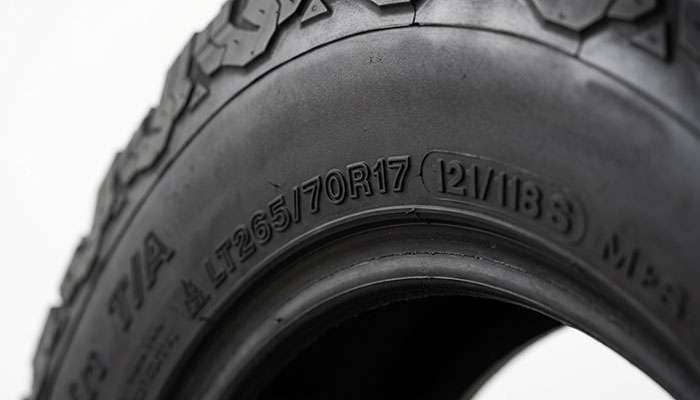
If the difference between load range and load index is fuzzy, they are two different systems describing related things, and our guide to load range vs load index walks through how they map to each other. For the letter grades specifically, the breakdown of E load rating and what it really means for your weight limit covers the ply-rating side.
A tire size is a set of dimensions. It says nothing about how the casing underneath those dimensions is built. Two tires measuring 275/60R20 can use completely different internal architecture, and the market sells both.
P-metric and Euro-metric passenger construction is the lighter build. It uses a thinner casing, fewer or lighter belt plies, and it is optimized for ride quality and low rolling resistance. In standard load form, it is the softest-riding, most efficient option. In Extra Load form, marked XL, the same architecture is reinforced to carry more at higher inflation pressure.
LT-metric light truck construction is the heavier build. Thicker sidewalls, more belt material, higher inflation pressures, substantially more capacity, and a meaningful weight and rolling-resistance penalty. Our explainer on what light truck means on tires goes into the construction detail.
In 275/60R20, passenger-construction options top out at load index 119. To get past that you have to move to LT construction, where the same size is offered at 123 and 126. Capacity is a function of how the tire is built, not how the size is written. That creates a fork no size chart shows you:
Standard load options dominate the shelf in these sizes. In 275/60R20 they outnumber Extra Load by nearly four to one; in 275/65R18, by more than eight to one. Filter by size and sort by price and the standard load tires are what you see first, cheaper precisely because there is less tire there.
Gas pickups eat front tires, because the engine sits over the front axle and the fronts do the steering. Electric trucks do not follow that pattern, and if you rotate on the gas-truck assumption you will get it backwards. Where the wear shows up depends on which axle is driven and which handles regen.
Drivetrain Layout |
Where Wear Shows First |
Why It Happens There |
What to Prioritize |
|---|---|---|---|
Single motor, rear drive |
Rear tires, shoulders first |
Rear pair handles acceleration and most regen deceleration |
Load index at or above OE, rotate every 5,000 miles |
Dual motor, all-wheel drive |
Front outer shoulders |
Fronts steer and take a share of regen at the same time |
Match all four, never mix LT and passenger construction |
Tri or quad motor |
All four, fastest overall rate |
Highest torque and highest mass working every contact patch |
Extra Load or LT construction only, no standard load |
Air suspension used in a lowered mode |
Inner shoulders at both ends |
Lowering adds negative camber and changes toe |
Alignment check at every rotation, not every other one |
That last row has produced the most dramatic wear reports in the segment. Electric trucks with adaptive air suspension lower themselves at highway speed to cut drag and recover range, and lowering a suspension changes its geometry. Owners running consistently in the lowest setting have reported tires finished in as little as 6,000 miles, wear concentrated on the inside edges in a pattern consistent with added negative camber and a toe change. That is a geometry problem on top of a load problem, and no tire purchase fixes it. If your wear is on the inner edges only, read how to read tire wear patterns first.
Aftermarket wheels add a third variable. Changing offset moves the contact patch relative to the steering axis and alters scrub radius, which shows up as accelerated shoulder wear on a truck this heavy. Understand wheel offset and tire wear before ordering wheels for an electric truck.
Yes, but not in the way the question usually implies, and the nuance matters for what you buy.
Regen does not create more total deceleration than friction braking would. It moves where that deceleration is reacted. Friction brakes at four corners spread the work across four contact patches. Regen puts it through the driven axle. On a rear-drive electric truck, the rear tires do the acceleration shear and the majority of the deceleration shear while the fronts mostly steer and coast.
Regen also changes the character of the load. Friction braking is intermittent and sharp. Regen applies sustained, moderate force over long stretches, a more continuous thermal and mechanical input to the tread. The result reported consistently is more uniform wear across the tread face, at a faster overall rate, on the driven axle.
This is exactly why load index headroom matters more on an EV than the raw weight comparison suggests. A tire operating near its rated capacity deflects more per revolution. More deflection means more sidewall flex, more hysteresis heat generated inside the casing, and a contact patch whose pressure distribution is skewed toward the shoulders. Heat softens the compound, and a softer compound abrades faster. Add a driven axle that is putting shear through that already-hot, already-deflected tire in both directions, and the wear rate compounds rather than adds.
That is the mechanism behind the sticker shock. An underrated tire does not fail immediately. It runs hot, wears from the shoulders in, and gives up a third of its expected life while looking fine from ten feet away.
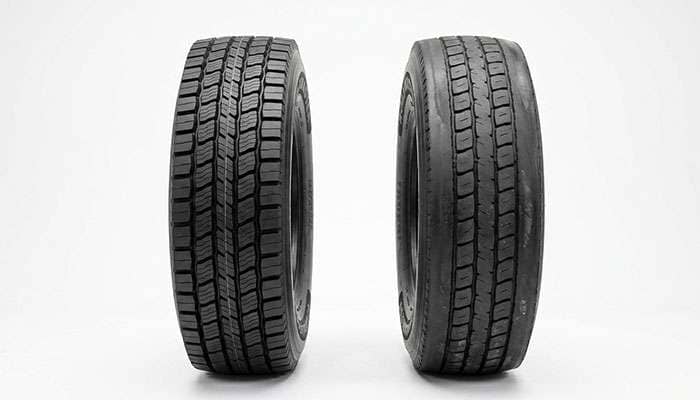
You need adequate tires. Whether they are marketed as EV tires is a separate question. The label generally signals some combination of three things: a low-rolling-resistance compound to protect range, foam inside the casing to damp noise a quiet drivetrain no longer masks, and a higher load rating for pack weight. Only the third has a safety dimension, and it is available on plenty of tires with no EV branding at all.
Where the EV lines earn their keep is when they combine the capacity with the efficiency. A Hankook Ion HT in 275/65R18 carries load index 116 in passenger construction, which matches OE capacity on trucks that wear that size without moving to a heavier LT casing. That is the combination worth paying for: OE capacity, passenger ride, low rolling resistance.
Where the EV label is not required is when you have decided capacity matters more than range. A Michelin Defender LTX M/S 2 in LT-metric construction reaches load index 119 in 275/50R22, well above the OE 115, with no EV branding anywhere on it. If you tow with your electric truck, that tradeoff is the correct one even though it costs you range.
The wrong move in either direction is buying on the label rather than the number. An EV-branded standard load tire is still a standard load tire, and a tire with no EV branding at load index 119 carries more than an EV-branded one at 114. For what the designation does and does not change, see why EV tires are different.
An underrated tire does not announce itself. It works. It holds air. It passes a visual check. The cost accrues in stages, and each stage is more expensive than the last.
Stage one is tread life. The tire runs hotter than designed and gives up wear rate for it. A set that should have delivered 45,000 miles delivers 28,000, which is most of a second set spread across the life of the first.
Stage two is efficiency. A tire deflecting more than designed has higher rolling resistance regardless of compound. On an electric truck, rolling resistance is range. The tire you bought partly to protect efficiency is costing you miles per charge.
Stage three is wet and emergency performance. Shoulder-first wear means the outer tread ribs, which do the work in a hard corner or a swerve, go shallow first. The tire still has depth in the center, so it reads as serviceable. Its ability to stop a 7,000 lb truck on a wet road has already dropped.
Stage four is casing fatigue. Continuous operation near rated capacity works the sidewall and belt edges harder every mile, and heat accelerates the aging of the rubber and the bonds between belt layers. Damage at this stage is internal and not visible from outside.
Stage five is failure under load. It does not come on the commute. It comes with the bed loaded, the trailer connected, and the ambient temperature high, because that is when demand finally exceeds what the fatigued casing can deliver. If you are already seeing bulges, cracking, or deformation, stop and read whether sidewall damage is safe to drive on before your next trip. On a vehicle this heavy it is not a wait-and-see condition.
The fix at any stage is the same and it gets more expensive the longer you wait: put the correct load index back under the truck.
You need the door jamb and one tire. Do this before you order anything.
Electric trucks wear tires faster than gas trucks for reasons you cannot change: they are heavier, their torque arrives instantly, and their regen puts deceleration through the driven axle. Those factors set a baseline. What sets your actual mileage is the tire you bolt on at replacement time, and in several of the most common EV truck sizes the replacement market will happily sell you less capacity than the truck left the factory with.
The size on the sidewall does not protect you. The placard is not required to print the load index. The cheapest option in your size is cheapest because there is less tire in it. Find your rear GAWR, divide by two, read your current load index, and buy to that number. It is five minutes of work that is worth tens of thousands of miles.
A correctly rated tire on a well-aligned electric truck should deliver 30,000 to 45,000 miles depending on construction and driving style. Owners reporting 15,000 or less usually have one of two problems: a replacement rated below the original equipment load index, or an alignment issue, commonly from running air suspension in a lowered mode. Both are diagnosable before you buy another set.
Yes, provided the load index meets or exceeds the original equipment rating and your rear axle math. EV branding is not a legal or safety requirement. What matters is capacity, and plenty of tires without it carry more than tires with it. The mistake is buying on the marketing without checking whether the load index clears your truck's requirement.
On a rear-drive electric truck this is expected. The rears handle acceleration torque and most regenerative deceleration, so they do roughly twice the longitudinal work of the fronts. Rotating every 5,000 miles is the standard fix. If the rears are wearing on the shoulders rather than evenly, check load index and inflation pressure as well.
Only if the capacity you need is unavailable in Extra Load passenger construction in your size, or if you tow regularly. LT construction buys capacity headroom at the cost of ride comfort, unsprung weight, and higher rolling resistance, which on an electric truck is lost range. For a truck that mostly commutes, an Extra Load tire at or above the original equipment load index is the better tradeoff.
It needs to meet or exceed the original equipment rating, never fall below it. Going higher is fine and sometimes advisable if you tow, though a much higher index usually means a heavier casing, firmer ride, and more rolling resistance. Going even one number below removes capacity the manufacturer accounted for, and on a vehicle this heavy that margin is not spare.
It does not damage them, but it concentrates wear. Regen routes deceleration through the driven axle instead of spreading it across four friction brakes, so those tires absorb both acceleration and deceleration shear. The wear is uniform across the tread face rather than patchy, but the overall rate is higher. Shortening your rotation interval addresses it better than reducing regen.



