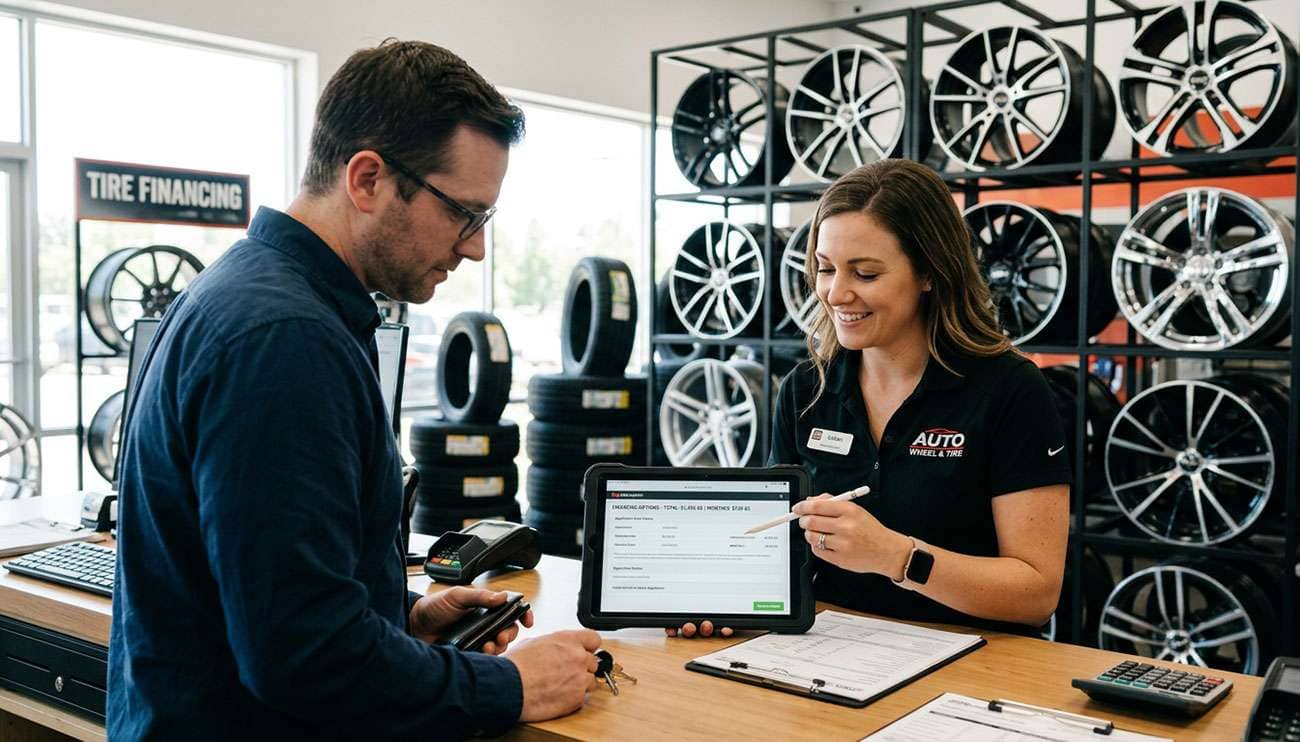
It depends on which button you click at checkout, and the difference is legal, not marketing. Affirm is an installment loan that furnishes data to Experian and TransUnion. Progressive Leasing, Acima, and Snap's lease-to-own plans are lease-purchase agreements, which are not credit at all and generally report nothing. That creates an asymmetry almost nobody explains: on the lease plans, your on-time payments cannot help your score, but a default sent to collections can still hurt it.
I have watched customers spend forty minutes agonizing over offset and load rating, then pick a payment plan in nine seconds because all four logos sat in a row and looked interchangeable. They are not interchangeable. Two of those buttons put a tradeline on your credit file. Two of them put a rental agreement in a filing cabinet. Same cart, same wheels, same total at the top of the screen, completely different consequences twelve months later.
Most of what is written about this topic hedges. Articles tell you financing "may" affect your credit without saying which product, which provider, or which direction. Worse, several widely circulated credit blogs state flatly that Snap Finance routinely reports payment data to Equifax, TransUnion, and Experian. Snap's own customer help page says something different. When third-party summaries contradict a provider's published policy, go with the provider. That is what this guide does throughout.
This is the variable that determines everything else, so it is worth getting precise about it the same way you would get precise about a bolt pattern.
An installment loan means a lender advances you money, you owe that money back, and the debt is a credit obligation. It generates a tradeline. It has an APR. It is governed by lending law, and the lender typically furnishes your payment behavior to the credit bureaus.
A lease-purchase agreement, also called lease-to-own or LTO, works on an entirely different mechanism. The leasing company buys the wheels and tires from the retailer and then rents them to you. You are not borrowing money. You are making rental payments on merchandise the leasing company owns, with an option to acquire ownership by completing the term or exercising an early purchase option. There is no APR because there is no loan. There is a "cost of lease" instead, which functions like interest but is not legally interest.
Progressive Leasing states this directly in its own help documentation: it provides a lease-to-own purchase program, not credit. That single sentence is the reason your on-time lease payments do not build your score. There is no credit account to report on.
At Performance Plus Tire, the four checkout options split cleanly along that line. Affirm is the installment product. Progressive Leasing and Acima are lease-purchase. Snap is the complicated one, and it gets its own section below, because Snap is not a single product.
Checkout Option |
What It Legally Is |
Application Inquiry |
Reports On-Time Payments |
Can It Damage Your Score |
|---|---|---|---|---|
Affirm |
Installment loan (credit) |
Soft check |
Yes, to Experian and TransUnion |
Yes, missed payments are reportable |
Progressive Leasing |
Lease-purchase (not credit) |
Soft inquiry to the big three |
No, will not build credit |
Yes, defaults may be reflected |
Snap (lease-to-own) |
Lease-purchase (not credit) |
No FICO impact at application |
To Clarity and DataX only, not the big three |
Yes, if it goes to collections |
Snap (loan products) |
Installment loan (credit) |
Varies by product and state |
Yes, Snap reports loan payment activity |
Yes, missed payments are reportable |
Acima |
Lease-purchase (not credit) |
Soft pull |
No, neither positive nor negative |
Yes, if it goes to collections |
Read that fourth column again. Three of the five rows say the plan will not help you. Every row in the fifth column says it can still hurt you. That is the shape of this entire market, and it is the single most useful thing to understand before you pick.
Affirm is the only option in the lineup that is unambiguously a credit product, and it is the only one where responsible payment behavior has a realistic path to helping you.
Applying does not hurt you. Affirm performs a soft credit check to make an approval decision, and a soft check is visible only to you when you pull your own report. It does not generate the hard-inquiry ding people worry about. Approval amounts start around fifty dollars and scale with creditworthiness, in many cases well into five figures, which is why Affirm is usually the only realistic route for a large staggered package or a full big-diameter build.
Affirm furnishes loan data to Experian and TransUnion. That is the meaningful difference from the lease products. Your Affirm wheel and tire loan can appear on your credit file, and your payment history on it can be part of your record.
Here is the nuance that almost every 2025-vintage article got wrong, and it cuts against the hype. Furnishing data to a bureau and having that data move your score are two different things. Affirm's own public position, stated in late 2025, was that most buy-now-pay-later activity did not affect credit scores at that point, because other lenders could not yet see those loans factored into the scores they pull. The tradelines exist in the file but sit tagged and excluded from the legacy scoring models most lenders still run.
So the accurate 2026 answer for Affirm is this: the reporting pipe is connected, the upside is real and improving, but whether a given lender sees your Affirm history depends on which scoring model that lender pulls. Do not finance wheels specifically as a credit-building strategy. Do finance with Affirm if you want the option of that history counting as the models catch up.
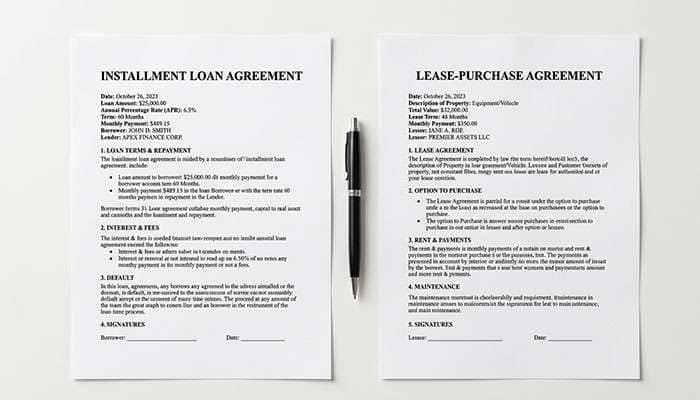
No, and Progressive says so plainly in its own help center, which is refreshing compared to the guesswork circulating elsewhere.
Progressive's published policy has three parts worth separating out. First, it does request credit bureau reports for all applicants, but only as soft inquiries to Experian, TransUnion, and Equifax, so applying should not move your FICO score. Second, it does not currently report lease-to-own agreements to the credit bureaus, because it provides a lease-to-own purchase program rather than credit. Third, and this is the part buried at the bottom of the page, late payments, missed payments, and defaults on your lease may still be reflected in your credit report.
Progressive also states, in its own consumer education material, that you will not build credit by using Progressive Leasing. That is unusually direct and you should take it at face value.
One practical note on the soft inquiry: Progressive says it makes soft inquiries to the big three, but that some secondary bureaus do not offer a soft inquiry option. Secondary bureaus are not the ones generating your FICO score, so this is a minor consideration, but it is the kind of detail that explains why an inquiry might show up somewhere you did not expect.
Snap is where most articles fall apart, because they treat Snap as one product. It is not. Snap's own materials describe three: lease-to-own, installment loans, and retail installment contracts. Which one you are offered depends on your state and what you are buying. The credit answer changes depending on which one you got.
For the lease-to-own product, Snap reports payment outcomes to Clarity Services and DataX. Those are secondary consumer reporting agencies, not Experian, TransUnion, or Equifax. Snap states that applying for its lease-to-own financing does not impact your FICO score, and that the lease activity is not reported to the major bureaus, meaning it neither builds nor directly damages your mainstream credit history.
For Snap's loan products, the answer flips. Snap reports payment activity on those, which means they behave much more like the Affirm scenario: real credit, real reporting, real consequences in both directions.
The failure mode here is assuming you know which product you signed. Before you accept, read the agreement header. If it says lease or lease-purchase, your on-time payments are not building anything at the big three. If it says loan or retail installment contract, they may be. This takes thirty seconds and it is the single highest-value thing you can do at that screen.
And regardless of which Snap product you have, a default that gets handed to a collections agency becomes a collections tradeline. Collections agencies report. That path exists no matter how the original agreement was structured.
Acima is the most straightforward of the lease-purchase options. It runs a soft pull at application, which does not affect your score, and because its model is lease-to-own rather than lending, it does not push payment data to the three major bureaus in either direction. It tracks your payment history internally for its own risk purposes.
The practical translation: an Acima lease on a set of wheels is close to invisible to your mainstream credit profile while it is performing normally. You will not build credit with it. You will also not see a new tradeline appear that changes your utilization or account mix.
The exposure is the same as everywhere else on this list. Stop paying, let the account default, and the matter can move to collections, at which point it becomes visible and damaging. The invisibility is a feature of the account performing, not a permanent shield.
This is the piece of genuinely new information that makes 2026 different from 2025, and it deserves a careful reading rather than a headline.
FICO launched two new scoring models, FICO Score 10 BNPL and FICO Score 10 T BNPL, built specifically to incorporate buy-now-pay-later data into credit scores. These are purpose-built new score versions rather than modifications of the existing models. FICO developed them off a year-long study using Affirm data covering more than 500,000 consumers, and built in an unusual mechanism: because BNPL users often open many small loans in a short window, the models aggregate separate BNPL loans together rather than treating each as a new account. Without that aggregation, a responsible borrower with several small plans would look like someone frantically opening accounts.
FICO's simulations suggested most users would see movement of roughly ten points in either direction, comparable to opening a new account.
Now the part that matters more than the launch itself. FICO's own position as of March 2026 is that these models become available to test and implement at the bureaus once BNPL data is furnished to the bureaus at scale, and that adoption of data furnishing has remained gradual. Some providers began furnishing, others held back. Meanwhile the most widely used FICO model in the market still dates to 2009, and BNPL tradelines currently sit tagged and excluded from those legacy scores.
On the regulatory side, the rule that would have treated BNPL providers like credit card companies had its planned enforcement dropped, so there is no mandate forcing providers to furnish data.
Put together, the honest 2026 summary is: the scoring machinery exists and is well designed, Affirm is furnishing, and the lender pulling your file is probably still running an older model that ignores it. That will change. It has not fully changed yet. Anyone telling you your tire loan is definitely moving your score right now is ahead of the evidence, and anyone telling you it can never matter is behind it.

Line up what we have established and a pattern emerges that should change how you think about these products.
On Progressive, Acima, and Snap's lease-to-own plan, twelve months of perfect on-time payments produces exactly zero improvement to your FICO score. The upside is switched off by design, because there is no credit account to report.
But the downside is not switched off. Progressive states defaults may be reflected in your credit report. Snap and Acima leases that go unpaid can be sold to collections, and collections agencies report to the major bureaus. So the negative outcome has a path to your credit file even though the positive outcome does not.
That is a genuinely lopsided deal, and it is not disclosed at the moment of decision. The marketing emphasizes "no credit needed," which is true and which people reasonably hear as "this is safe for my credit." What it actually means is "this cannot help your credit, and it can still hurt it if things go wrong."
None of which makes lease-to-own a bad choice. If your credit is genuinely thin or damaged and you need safe tread this week, a lease-purchase agreement may be the only route available, and getting roadworthy tires on your car matters more than a scoring model. If you are staring at cracked sidewalls right now, the risk calculus is not close. Our guide on tire sidewall damage and whether it is safe to drive covers why that particular failure mode does not wait for payday.
Just go in knowing what the product does and does not do, and pick it because it solves your access problem, not because you believe it is building something.
Credit impact is only half the picture. The other half is money, and here the lease products carry a real premium that gets disclosed in fine print rather than in the payment display.
Progressive's own required disclosure language states that ownership through a rental or lease agreement costs more than the retailer's cash price. That is the leasing company telling you, in writing, that you will pay a premium. Snap similarly notes that its hundred-day option may include a cost of lease above the merchandise price.
The mechanism to limit that premium is the early purchase option, and it is the most valuable thing on the entire agreement. Across the major providers, that window runs roughly ninety to one hundred and one days from the start of the lease. Buy out inside it and you pay the cash price plus a limited cost of lease. Ride the full term instead, typically ten to twelve months, and the total climbs substantially.
The escalation looks like this in practice, and it is worth walking through as a ladder:
Approval ceilings matter here too, and they push the decision more than people expect. Affirm's minimum is around fifty dollars with a maximum that scales with creditworthiness. Snap runs roughly two hundred and fifty to five thousand dollars. Acima runs roughly three hundred to five thousand. That five thousand dollar ceiling is a real constraint once you start pricing large-diameter packages, and it is a reason to understand your total before choosing a lane. Our breakdown of whether wheel and tire packages are actually cheaper is a good place to sanity-check your number, and what four new tires really cost covers the tire side.
One thing that works in your favor regardless of provider: installation, mounting, balancing, and alignment can go into the financed or leased total. Add the services to the cart before you check out rather than paying for them separately afterward.
Run your numbers on the Performance Plus Tire financing calculator before you commit to a lane. Comparing the total of payments across two offers takes about two minutes and is worth more than any advice in this article.

The right answer is genuinely different depending on where you are, which is why a single recommendation would be useless. Find your row.
Your Situation |
Best Lane |
Why |
Watch Out For |
|---|---|---|---|
Good credit, planned upgrade |
Affirm installment |
Disclosed APR, calculable total, and the only option that can eventually help your file |
Longer terms mean more total interest even at a modest rate |
Rebuilding credit deliberately |
Affirm if approved |
Lease products cannot build credit, so they do nothing for your goal |
Do not treat a tire loan as a credit-building tool on its own |
Thin or damaged credit file |
Progressive, Snap, or Acima |
Approval looks past the score, and soft inquiries will not cost you points |
Plan the early buyout window before you sign, not after |
Tires failed today, no cash |
Whichever approves fastest |
Unsafe tread is an immediate physical risk that outranks scoring concerns |
Refinance or buy out early once the emergency passes |
Large or big-diameter package |
Affirm |
Lease ceilings near five thousand dollars may not cover the build |
Price the complete package including services before applying |
If you are not sure where your score currently sits or what it needs to be, our guide on what credit score is needed for tire financing covers approval thresholds in detail, and financing wheels with bad credit or no credit walks through the no-credit routes specifically. For a side-by-side on the providers themselves, see our comparison of Affirm, Progressive, Snap, and Acima.
Whichever lane you pick, a handful of habits keep the downside closed.
Read the product name on the agreement. Lease, lease-purchase, loan, or retail installment contract. That one word tells you which set of rules you are under. Do not rely on the logo.
Set up autopay against a stable account. Almost every negative outcome described in this article starts with a missed payment, not with the product itself. Lease providers structure payments around paydays specifically because it reduces misses. Use that.
Calendar the early purchase deadline the day you sign. Ninety to one hundred and one days goes fast. Put the date in your phone with a reminder two weeks ahead, so the buyout is a decision rather than a thing you discover you missed.
Call before you miss, not after. Providers have far more flexibility with an account in good standing than with one already in collections. The gap between a rough month you communicated about and a default you went quiet on is the gap between nothing on your credit file and seven years of a collections mark.
Do not stack plans. Multiple simultaneous obligations across several providers is the exact pattern the new FICO models were built to detect and aggregate. It is also just difficult to track.
Compare totals, not payments. The monthly number is designed to be comparable and comfortable. The total of payments is where the products actually differ. If you take one habit from this article, take that one. Our piece on whether financing rims is a good idea goes deeper on the total-cost math.
The question "does financing wheels and tires hurt your credit" does not have one answer because "financing" is not one product. Affirm is a loan that reports to Experian and TransUnion and can eventually work in your favor. Progressive, Acima, and Snap's lease-to-own plan are lease-purchase agreements that will not build your credit but can still damage it through default and collections. Snap alone offers both shapes, so the agreement header decides your answer.
The 2026 development is that FICO built scoring models that finally account for this category, while adoption of those models remains gradual and most lenders still pull older versions. The direction of travel is clear even if the timing is not.
What has not changed is the practical advice: read the product name, compare the total of payments rather than the monthly, calendar your early purchase window, and never let a missed payment become a collections account. Get the right setup on your vehicle, then get the payment structure right too.
When you are ready, review the current wheel and tire financing and lease-to-own options at Performance Plus Tire, where terms are shown before you commit and our fitment team can match the plan to your build and your timeline.
One accuracy note worth stating plainly. Provider terms, reporting practices, approval ranges, and early purchase windows change over time and vary by state. Everything above reflects each provider's published policy as of publication, and the credit scoring landscape in particular is actively shifting. Confirm the current disclosures at checkout before you sign anything, and treat this as an informed starting point rather than financial advice.
Generally no. Affirm uses a soft credit check, Progressive Leasing states it makes only soft inquiries to Experian, TransUnion, and Equifax, and Acima performs a soft pull. Snap states that applying for its lease-to-own financing does not impact your FICO score, though it uses secondary agencies such as Clarity and DataX during the application process. Soft inquiries are visible only to you and do not reduce your score.
Only through an installment loan product such as Affirm, and even then the benefit depends on which scoring model your future lender pulls. Lease-to-own agreements from Progressive, Acima, and Snap's lease product do not report on-time payments to the major bureaus, so they cannot build your score. Progressive states this directly in its own materials. If credit building is your goal, use a product designed for it rather than a wheel and tire plan.
This is where the real risk sits. Progressive states that late payments, missed payments, and defaults may be reflected in your credit report. With any lease provider, a defaulted account can be referred to a collections agency, and collections agencies do report to the major bureaus. A collections mark can remain on your file for up to seven years. Contact the provider before you miss a payment rather than after.
It depends which Snap product you have, which is why answers to this question conflict online. For Snap's lease-to-own product, Snap reports payment outcomes to Clarity Services and DataX, which are secondary reporting agencies rather than the big three. For Snap's loan products, Snap reports payment activity. Check the agreement header to see whether you signed a lease or a loan.
Ranges vary by provider and applicant. Affirm starts around fifty dollars with a maximum that scales with creditworthiness and can reach well into five figures. Snap generally runs from about two hundred and fifty to five thousand dollars, and Acima from about three hundred to five thousand. Those lease ceilings can fall short of a large-diameter package, so price your complete build, including mounting and balancing, before choosing a provider.
Almost always, if you can manage it. The window typically runs about ninety to one hundred and one days from the start of the lease, and exercising it limits what you pay above the cash price. Progressive's own disclosure notes that ownership through a lease agreement costs more than the retailer's cash price, and the early buyout is the mechanism that caps that premium. Put the deadline in your calendar the day you sign.
Not dramatically yet. FICO Score 10 BNPL and FICO Score 10 T BNPL were built to incorporate this data, and FICO's simulations suggested most users would see movement of around ten points in either direction. However, FICO has said the models become implementable once BNPL data is furnished at scale, and adoption has been gradual. The most widely used FICO model still dates to 2009, and these tradelines are currently excluded from it.
Yes. Installation, mounting, balancing, alignment, and related services can be added to the cart and included in the financed or leased amount. It is worth doing, because paying for services separately after the fact tends to be the expense that catches people off guard. Add everything before you check out so the total you compare across providers is the real total.