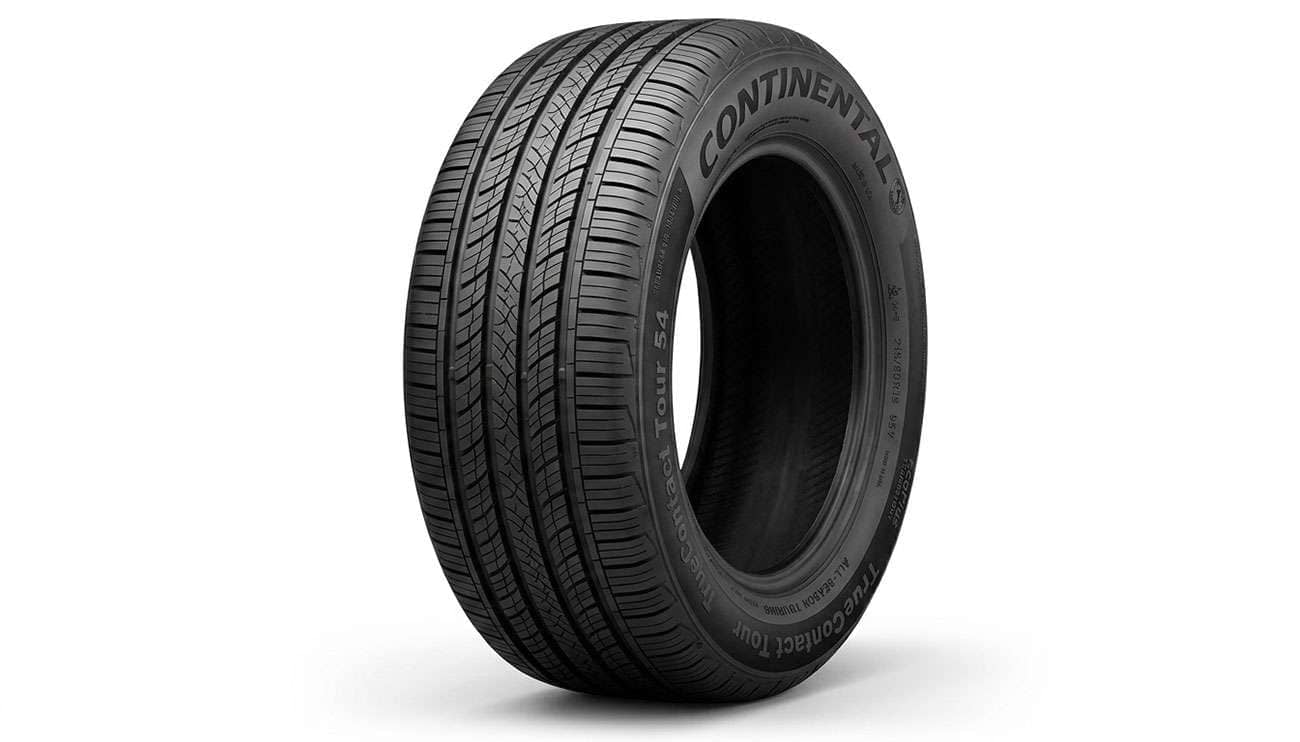
Short answer: yes, the Continental TrueContact Tour 54 is a good tire. It is one of the better all-season touring tires you can bolt to a sedan, minivan, or crossover right now, and the UTQG treadwear grade of 840 backs that up on paper before you ever drive on it.
But "good tire" is not the question that costs people money. The question that costs people money is which version of this tire ends up on their car, because Continental does not warranty all of them the same way. The treadwear coverage on the TrueContact Tour 54 changes based on a single letter stamped on the sidewall, and most buyers never look at it.
Here is the entire decision in one table. Find the letter that follows the load index in your size, and you know which warranty you are buying.
Speed Rating |
Maximum Rated Speed |
Treadwear Warranty |
Typical Fitment |
|---|---|---|---|
T |
118 mph |
80,000 miles |
Economy sedans, minivans, older crossovers |
H |
130 mph |
80,000 miles |
Mainstream sedans, hybrids, family crossovers |
V |
149 mph |
70,000 miles |
Sport sedans, larger wheel diameters, premium trims |
Every retailer in the country advertises this tire as an 80,000-mile tire. That number is real, but it applies only to the T and H sizes. Choose a V-rated size and Continental covers you for 70,000 miles instead. That is 10,000 miles of coverage that quietly disappears, and nobody at the counter is going to volunteer it.
Of the sixty TrueContact Tour 54 sizes we stock, thirty-two are V-rated. More than half of the buyers walking into this tire are buying the 70,000-mile version while reading 80,000-mile marketing. The rest of this review covers whether the tire is worth it either way, and what to do when your size gives you a choice.
The TrueContact Tour 54 is not a facelift. It is a merger. Continental took two separate touring lines and folded them into one, which is unusual for a manufacturer that normally protects its tiers.
The tire replaced both the original TrueContact Tour, which was the volume all-season touring option, and the PureContact LS, which sat above it as the luxury touring choice with a softer ride and a quieter tread. Bill Caldwell, Continental's senior vice president of marketing and sales, described it as taking two leading touring tires and making them into one better tire. That is marketing language, but the engineering behind it is real: the 54 inherits the wear life target of the TrueContact Tour and the comfort tuning of the PureContact LS.
Why this matters when you shop: the older TrueContact Tour is still in circulation. Discontinued does not mean gone. Warehouses across the country still hold inventory of the previous generation, and it often shows up at a lower price because distributors are clearing it. If you see a listing that says "TrueContact Tour" with no 54 on the end, that is the older tire, not a typo.
The older tire is not junk. It was a strong performer for years and we have written about how it stacks up in our Michelin Defender 2 versus Continental TrueContact Tour comparison. But Continental's own testing puts the 54 ahead of it in three areas that matter, measured in size 215/60R16 H against the outgoing tire: up to 18 percent better tread life, 6 percent better wet braking, and 5 percent better dry handling.
An 18 percent improvement in tread life on a tire already rated for 80,000 miles is not a rounding error. If you are choosing between the two and the price gap is under about forty dollars a tire, take the 54.
Continental's treadwear warranty on this line reads as follows: six years or 80,000 miles for T and H speed-rated sizes, six years or 70,000 miles for V-rated sizes. Both are backed by the Total Confidence Plan, which layers a customer satisfaction trial, road hazard coverage for the first year, roadside assistance, and trip interruption protection on top of the mileage number.
The split itself is standard industry practice. Higher speed ratings require stiffer construction and a compound tuned for heat resistance at sustained velocity, and that compound trades away some abrasion resistance. A V-rated tire genuinely does not wear as long as an H-rated tire of the same design, so the shorter warranty reflects physics, not stinginess.
What is not standard is how invisible the split is at the point of sale. The 80,000-mile figure appears in the headline of nearly every listing for this tire. The 70,000-mile figure appears in the fine print, if it appears at all. If you are shopping on price and clicking the cheapest listing for your size, there is a real chance you will land on a V-rated tire without ever registering the difference.
If the speed rating system itself is unfamiliar territory, our breakdown of H versus V rated tires and which speed rating is right for your car walks through what each letter actually governs and when it is safe to change.
This is the best case and it applies to a large share of ordinary fitments. If your vehicle came from the factory on a T or H rated tire, and the TrueContact Tour 54 offers your size only in T or H, you get the full 80,000-mile warranty with no decision to make.
Sizes in our catalog that fall cleanly into this bucket include 205/65R16 95H, 215/65R16 98H, 215/65R17 99H, 225/60R17 99H, 225/60R18 100H, 225/65R17 102T, 235/55R17 99H, 235/60R17 102T, 235/60R18 103H, 235/65R16 103T, and 235/65R17 104T. These cover a great many Camrys, Accords, Odysseys, RAV4s, CR-Vs, Highlanders, and similar family vehicles.
If you are in this group, the buying decision is simple. You are getting the longest warranty Continental writes on this line, on a tire graded 840 A A with 11/32nds of tread depth to start. Buy it, rotate it on schedule, and keep your receipts.
One caveat that catches people: the warranty requires documented rotation. Continental, like every manufacturer offering mileage coverage, will ask for service records showing the tires were rotated at reasonable intervals before it pays a claim. Skipping rotations does not just shorten the tire's life, it can void the coverage entirely. Our guide to how tire mileage warranty proration actually works covers what documentation you need and how the payout is calculated.
If your vehicle's original fitment is V-rated and the TrueContact Tour 54 offers your size only in V, you are getting the 70,000-mile warranty. That is the deal, and there is no legitimate way around it.
Sizes in this bucket include 195/55R16 87V, 205/50R17 93V, 215/45R17 87V, 215/50R17 95V, 225/40R18 92V, 225/45R18 91V, 225/55R19 99V, 235/40R19 96V, 235/45R17 97V, 235/45R18 94V, 235/50R17 96V, 235/50R18 97V, 235/55R18 100V, 245/40R18 97V, 245/40R19 98V, 245/40R20 99V, 245/45R17 99V, 245/45R18 100V, 245/45R19 102V, 245/45R20 99V, 245/50R17 99V, 245/50R18 100V, 245/55R18 103V, and 255/45R19 100V.
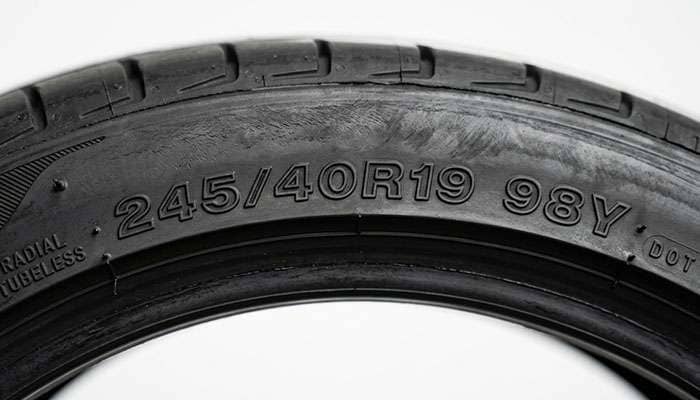
Here is where people get themselves in trouble. Looking at that list, a buyer notices that the 245/45R19 is only offered in V with 70,000 miles of coverage, and wonders whether dropping to an H-rated tire in the same size would buy back the extra 10,000 miles.
Do not do this. Fitting a tire with a lower speed rating than the vehicle's original equipment specification is a downgrade to the vehicle's certified capability, not a warranty hack. The speed rating is not just about top speed; it reflects the tire's construction and its ability to shed heat under sustained load. A tire rated below the manufacturer's specification can run hotter in normal highway use, particularly on a heavy vehicle or in summer heat, and heat is what kills tires.
Beyond the engineering, there is a liability dimension. The Tire Industry Association's service guidance is consistent on this point: replacement tires should meet or exceed the original equipment speed rating. Some insurers and many state inspection regimes treat an underrated tire as a defect. If you are ever in a crash and an adjuster pulls the tire specs, an underrated tire is an easy finding against you.
The 70,000-mile warranty on a V-rated Tour 54 is still competitive. Most premium touring tires in this class write 60,000 to 70,000 miles on their V-rated sizes. Continental is not shorting you; it is simply not the 80,000 headline.
This is the case that makes this article worth writing, and it is the one nobody covers.
There are six sizes where we stock the TrueContact Tour 54 in both an H-rated and a V-rated version. In four of them, the price is identical. In the other two, the gap is one dollar. Same tire family, same size, same tread, same money, and a 10,000-mile difference in warranty coverage.
Size |
H-Rated Price, 80,000 Miles |
V-Rated Price, 70,000 Miles |
Price Difference |
|---|---|---|---|
P205/55R16 |
USD 148.99 (91H) |
USD 148.99 (91V) |
None |
P205/60R16 |
USD 157.99 (92H) |
USD 157.99 (92V) |
None |
P225/50R18 |
USD 201.99 (95H) |
USD 201.99 (97V) |
None |
P225/55R17 |
USD 185.99 (97H) |
USD 185.99 (97V) |
None |
P215/55R17 |
USD 177.99 (94H) |
USD 178.99 (94V) |
USD 1.00 |
P225/45R17 |
USD 190.99 (91H) |
USD 191.99 (91V) |
USD 1.00 |
Look at P225/55R17. Both versions carry load index 97. Both cost USD 185.99. The H-rated tire comes with 80,000 miles of coverage and the V-rated tire comes with 70,000. If your vehicle's placard calls for an H-rated tire in that size, buying the V version costs you nothing at the register and 10,000 miles at the back end.
The decision rule is straightforward. Check the tire placard in your driver's door jamb, which lists the original equipment size and speed rating. If the placard says H and the size is available in H, buy the H. Going up to V is permitted from a safety standpoint, since a higher rating always meets the lower requirement, but there is no reason to pay the same money for less warranty.
The reverse also holds. If your placard says V, buy the V even though the H sits right next to it at the same price. The extra 10,000 miles is not worth fitting a tire below your vehicle's specification.
Two more sizes offer a T and H pairing: P195/65R15 comes in 91H at USD 146.99 and 91T at USD 145.99, and P225/60R16 comes in 98H and 98T at USD 168.99 each. Both ratings carry the full 80,000-mile warranty, so the choice there is purely about matching your placard. P215/60R16 is the outlier, offered in 95T, 95H, and 95V, all at USD 157.99, which means the V version in that size is the only one of the three that drops to 70,000 miles.
Warranty structure aside, the tire has to earn its keep on the road. Here is where it lands.
Tire Rack ran the TrueContact Tour 54 in its Touring All-Season test in November 2025 and returned an overall score of 7.27 out of 10. The summary noted sharp steering, controllable behavior in winter conditions, and a composed ride, with slower recovery on wet surfaces as the main criticism. Aggregated across the wet braking tests it has appeared in, the tire stops roughly 2.4 percent shorter than the category average.
That profile is exactly what you want from a touring tire. It is not a tire that wins any single category outright. It is a tire without a weak spot, which matters far more over 80,000 miles of commuting than a headline number in one discipline.
Specification |
Continental TrueContact Tour 54 |
|---|---|
Category |
All-season touring, passenger |
UTQG Grade |
840 A A |
Starting Tread Depth |
11/32 inch |
Tread Pattern |
Symmetric, twin center ribs |
Casing |
Single-ply polyester, dual steel belts, polyamide overlay |
Compound Technology |
EcoPlus with Tg-F polymers |
Sizes Available |
60 sizes, 15 to 20 inch rim diameter |
Severe Snow Rated |
No, M+S rated for light snow |
The UTQG treadwear grade of 840 deserves a note. That number is a manufacturer-run comparative index, not a mileage prediction, and grades are only strictly comparable within a single brand. Still, 840 is high even by premium touring standards, and it is consistent with the warranty Continental is willing to write. Our explainer on how to read tire treadwear ratings covers what the number does and does not tell you.
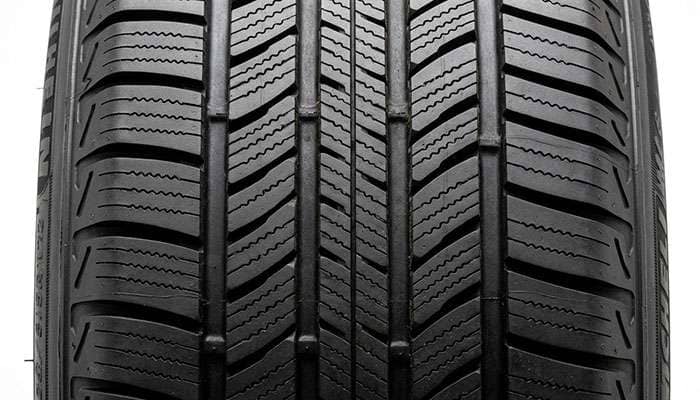
On the compound side, Continental uses what it calls Tg-F polymers, which improve bonding within the rubber matrix. The practical effect is lower rolling resistance without the usual penalty in wear or wet grip. Three wide circumferential grooves work with angled lateral grooves to evacuate water, and a dense siping network multiplies the biting edges available in slush and light snow.
Note the last row of that table carefully. The Tour 54 is M+S rated, not severe snow rated, and it does not carry the three-peak mountain snowflake symbol. It handles light snow competently for an all-season. It is not a winter tire, and in a region that sees real accumulation you still want a dedicated winter set.
Continental borrowed the best feature of the ExtremeContact DWS06 Plus and put it on a touring tire, which is the single most useful thing about owning this tire day to day.
Molded into the tread surface are the letters D, W, and S, standing for dry, wet, and snow. Each letter is cut to a different depth. As the tire wears, the letters disappear in sequence. When all three are visible, the tire performs as designed in all three conditions. When the S is gone, the tire should no longer be trusted for snow. When the W disappears and only the D remains, you are down to a dry-weather tire.
This is a substantial upgrade over conventional tread wear indicator bars, which only tell you when the tire has hit the 2/32nds legal minimum. By that point you have been driving on compromised wet traction for tens of thousands of miles without any warning. The DWS system tells you when performance degrades, not just when the tire is legally finished.
The tire also carries Continental's Alignment Verification System: indicators on both shoulders that wear evenly when the alignment is correct and unevenly when it is not. Glance at both shoulders during a rotation. If one side is scrubbing faster than the other, you have an alignment problem eating your warranty before you have any other symptom.
Both of these features exist for the same reason: a mileage warranty is only worth what your maintenance habits allow you to claim. Continental built the diagnostics into the tread so you have no excuse.
Noise is the most common question about this tire, and the honest answer is that it is quiet for its category but not silent.
Continental randomizes and computer-tunes the tread pitch sequence, which spreads the acoustic energy across a range of frequencies rather than concentrating it into a single tone. The result is that the sound the tire does make is broadband and easy to tune out, instead of the drone that makes a cheap tire exhausting on a long drive.
The comfort tuning inherited from the PureContact LS shows up in impact absorption. Expansion joints and broken pavement arrive as a muted thud rather than a sharp crack. Tire Rack's testers described the ride as firm but composed, which matches what we hear from customers: it is not a pillow, but it does not beat you up either.
Where the Tour 54 gets loud is where any tire gets loud. Uneven wear from a missed rotation, cupping from worn shocks, or an alignment problem will turn a quiet tire into a noisy one within a few thousand miles. If a set gets louder over time, the tire is telling you something about the vehicle, not about itself. Our breakdown of what actually causes tire noise walks through how to tell the difference between tread noise and a mechanical problem.
Compared with the tires it replaced, the 54 sits between them. It is marginally louder than a PureContact LS was and noticeably quieter than most tires at this price point. If absolute silence is the priority above all else, there are quieter options, but you will give up wear life to get them.
The TrueContact Tour 54 was the first Continental tire to carry the company's EV-compatible logo stamped into the sidewall, which is worth understanding rather than dismissing as a badge.
Electric vehicles put demands on tires that combustion vehicles do not. They are heavier because of the battery pack, they deliver peak torque from zero rpm, and they have no engine noise to mask tread sound. On top of that, rolling resistance translates directly into range, so a tire that costs you two percent in efficiency costs you real miles on every charge.
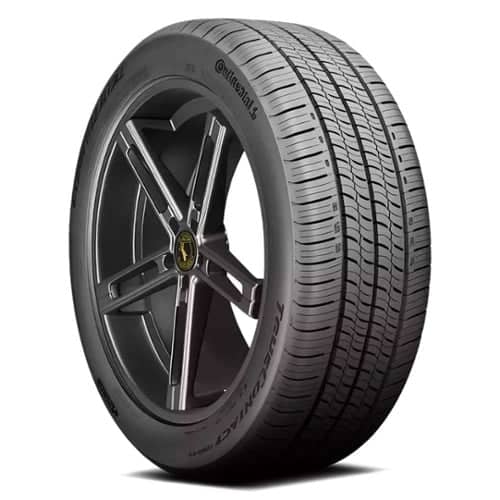
The Tg-F polymer compound addresses the rolling resistance side, the reinforced shoulder construction handles the added weight and torque, and the tuned pitch sequence addresses the noise that an EV cabin no longer hides. That combination is why Continental put the logo on this line first.
A practical caution: the EV badge does not mean the Tour 54 is the right tire for every electric vehicle. Many EVs come from the factory with load-rated or extra-load fitments and specific rolling resistance targets, and some carry acoustic foam in the original equipment tire that the Tour 54 does not replicate. Check your placard for the exact load index and speed rating before assuming a match. Our guide to why EV tires are different covers the fitment traps in more detail.
For hybrids and lighter EVs on standard passenger fitments, the Tour 54 is a strong and cost-effective replacement for expensive original equipment rubber.
Let us put actual numbers on the warranty gap, because abstractions do not motivate anybody.
Step one: the coverage you lose. Take P225/55R17, where both ratings cost USD 185.99. A set of four runs USD 743.96 either way. Buy the V when your placard called for H and you have handed back 10,000 miles of coverage for free.
Step two: what that means at claim time. Mileage warranties pay out on a prorated basis. If your tires wear out at 55,000 miles, an 80,000-mile warranty credits you for 25,000 unused miles, or 31.25 percent of the coverage. A 70,000-mile warranty credits you for 15,000 unused miles, or about 21.4 percent. On a USD 743.96 set, that is roughly USD 232 in credit versus roughly USD 159. The V-rated choice cost you about USD 73 in real money.
Step three: skipped rotations. Now assume you also let rotations slide. Continental requires documented rotation to honor a mileage claim. Without records, the prorated credit is not reduced, it is denied. Your USD 232 becomes zero, and the warranty you paid for was decorative.
Step four: the alignment you ignored. Uneven wear from an untreated alignment problem is an exclusion under every manufacturer treadwear warranty in the industry, including this one. A set that should have gone 75,000 miles goes 40,000 instead, and the claim is refused because the wear pattern shows the cause. You are now buying a second set of tires at full price, roughly USD 744, on a schedule you did not budget for.
Step five: driving them past the indicators. Once the W has worn away, wet stopping distances have degraded materially from where they started. Continental put that letter in the tread specifically so you would not have to guess. Ignoring it moves this from a money problem to a safety problem, and it is the only step on this ladder that can hurt somebody.
The through-line is that this tire is designed to reward attention and punish neglect. The 840 treadwear grade and the 80,000-mile warranty are both achievable numbers, but only for an owner who rotates on schedule, keeps the alignment honest, and reads the letters in the tread.
Here is the sequence that gets you the right tire with the maximum coverage.
1. Open the driver's door and read the placard. It lists the original equipment tire size, load index, and speed rating. Write down the full string, including the letter at the end. This is your baseline and it overrides whatever is currently mounted on the car, since a previous owner or shop may have fitted something else.
2. Check the tire that is on the car now. Compare it to the placard. If they do not match, find out why before you order. Somebody made a substitution and you need to know whether it was intentional.
3. Look up your size in the Tour 54 range. Sixty sizes span 15 through 20 inch diameters. Confirm your size exists before you get attached to the tire.
4. Check whether your size comes in more than one speed rating. Six sizes come in both H and V, three come in multiple ratings including T. If yours does, this is the decision point.
5. Match the placard, and prefer the higher warranty when the placard allows it. If the placard says H and the H is available, take the H and its 80,000 miles. Never go below the placard rating to chase a longer warranty.
6. Verify the load index too. Note that in P225/50R18 the H version is 95 and the V version is 97. The speed rating is not the only thing that changes between the two. Your replacement must meet or exceed the placard load index.
7. Buy all four together. Mixing a new pair with a worn pair changes the rolling circumference across the axles and compromises the stability control system's assumptions. It also splits your warranty across two purchase dates.
8. Set up the maintenance from day one. Get an alignment with the new set, put rotations on a calendar at every oil change or roughly every 5,000 to 7,500 miles, and keep every receipt in one folder. The warranty is a document you have to earn.
You can browse the full size range and current pricing on the Continental TrueContact Tour 54 product page, where every size lists its speed rating and load index up front. If you want to see how it stacks up against the other options in this segment before committing, our roundup of the best touring tires for daily commuters puts it in context.
The Continental TrueContact Tour 54 is a good tire and, for most sedan and crossover owners, one of the smartest all-season buys available. It merges two proven touring lines into one, grades 840 A A, carries genuinely useful wear diagnostics in the tread, and posts competitive numbers in independent testing without a meaningful weakness anywhere on the scorecard.
The catch is not in the tire. It is in how it is sold. The 80,000-mile warranty that anchors every advertisement applies only to T and H rated sizes. More than half the sizes in this line are V-rated and carry 70,000 miles instead. And in six sizes we stock, the two versions sit side by side at the same price, which means a buyer picking on price alone can give up 10,000 miles of coverage without ever knowing there was a choice.
Read your door placard, read the letter after the load index, and match them. That single check is the difference between a very good tire purchase and a very good tire purchase with an extra 10,000 miles of coverage attached to it.
Yes. The TrueContact Tour 54 is a strong all-season touring tire with an 840 A A UTQG grade, 11/32 inch of starting tread depth, and an overall score of 7.27 out of 10 in Tire Rack's November 2025 touring all-season test. Its strength is balance rather than any single standout result, which is what matters most over a long commuting life. The one thing to check before buying is the speed rating on your size, because T and H sizes carry an 80,000-mile treadwear warranty while V-rated sizes carry 70,000.
They are close enough that fitment and price should decide it. The Defender 2 generally holds an edge in outright tread life, while the Tour 54 brings sharper steering response, the DWS wear indicators, and EV-specific tuning that the Defender 2 does not advertise. Compare the exact size you need rather than the models in the abstract, since warranty coverage on both lines varies by speed rating. Our full comparison covers the test results in detail.
The original TrueContact Tour was a well-regarded touring tire and remains a reasonable buy if you find it discounted. Continental has discontinued it in favor of the Tour 54, and its own testing puts the newer tire ahead by up to 18 percent in tread life, 6 percent in wet braking, and 5 percent in dry handling. If the price gap between the two is under roughly forty dollars per tire, the 54 is the better value.
The TrueContact Tour 54 is warranted for 80,000 miles in T and H speed ratings and 70,000 miles in V ratings, both with a six-year limit. Real-world life depends heavily on rotation discipline, alignment, and inflation. Owners who rotate every 5,000 to 7,500 miles and keep the alignment correct commonly reach or approach the warranted figure, while a neglected alignment can cut it nearly in half and void the claim at the same time.
In the touring all-season category, yes. Both are premium manufacturers with comparable engineering and test results, and the gap between their flagship touring tires is smaller than the gap between either one and a budget brand. Michelin tends to price higher and often edges ahead on outright wear life, while Continental typically delivers more feature content per dollar. Choose by the specific model and size you need rather than by the badge.
No. The Tour 54 uses a randomized, computer-tuned tread pitch sequence that spreads acoustic energy across frequencies instead of producing a single drone, and independent testers describe the ride as composed with low noise levels. It is quieter than most tires at its price point, though not silent. If a set becomes noticeably louder over time, the cause is almost always uneven wear from a missed rotation, an alignment problem, or worn shocks rather than the tire itself.