
Uneven tire wear on one edge, a car that pulls left or right on a straight road — those are camber problems, and they're telling you something important. Camber is one of those alignment specs most drivers ignore until a perfectly good set of tires is already destroyed. But here's what you need to know: understanding camber, catching it early, and setting it correctly will save you real money, extend your tire life, and make your vehicle handle the way it was built to. It doesn't matter if you're a daily commuter, a weekend canyon runner, or a track-day regular — camber is fundamental to how your car behaves and how long your tires last.
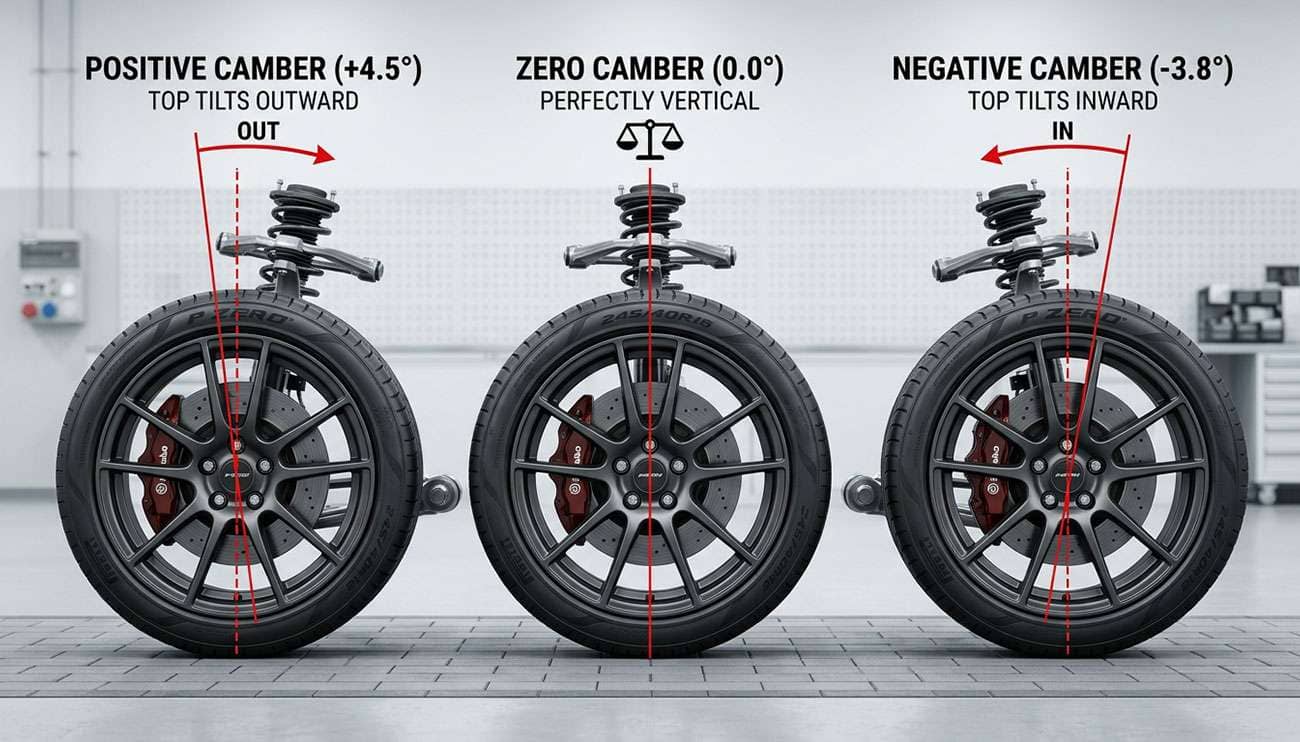
Wheel camber is the vertical tilt of your tire and wheel assembly when viewed from the front or rear of the vehicle. Top of the wheel leaning outward? That's positive camber. Leaning inward toward the car? That's negative camber. Perfectly straight up and down? Zero camber. Simple concept — but the consequences of getting that angle wrong, or intentionally dialing it in for a specific purpose, are anything but small. Most modern passenger vehicles leave the factory with a slight negative camber, typically between 0° and -1.5°, built in to account for how the suspension geometry shifts under load.
Camber is measured in degrees, and every degree matters. At 0°, your wheel sits perfectly perpendicular to the road. Negative values like -0.5° or -1.5° mean the top of the wheel tilts inward. Positive values like +0.5° or +1.0° mean it leans outward. Factory specs for most passenger cars land between -0.5° and -1.5° of negative camber on the front axle. Performance vehicles and dedicated track cars often run far more aggressive settings — anywhere from -2° to -4° or beyond up front. Camber doesn't work in isolation, either. It interacts with two other alignment angles: caster and toe. Toe controls whether your wheels point inward or outward from above; caster governs the angle of your steering axis. All three work together to determine how your vehicle drives and how evenly your tires wear.
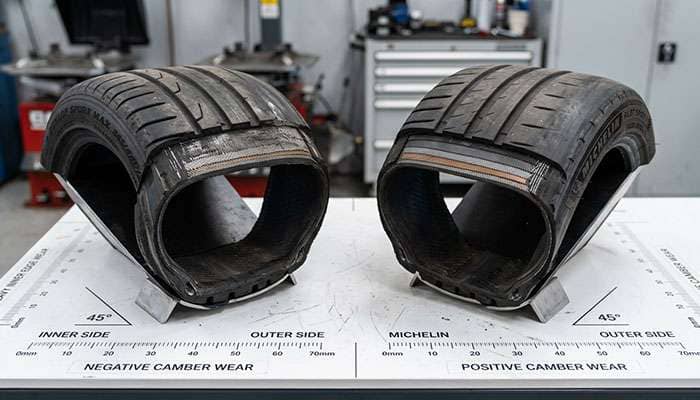
The biggest mistake drivers make is waiting for visible tire wear to force the issue — by then, you've already burned through the inner or outer tread edge on an otherwise healthy tire. Another costly error is assuming more negative camber automatically means better performance. Negative camber does improve cornering grip by keeping the contact patch flatter through turns, but too much on a street car accelerates inner tread wear and kills straight-line braking. Running -3° or more on a daily driver is counterproductive unless you're also mounting wider, stickier tires specifically designed to handle aggressive camber loads. And don't make the mistake of evaluating camber on its own — always have all three alignment angles checked together. They're interdependent, and correcting one without the others can make things worse.
Think about camber numbers this way. At 0°, your tire's contact patch distributes load evenly across the full tread width during straight-line driving. At -1°, the inner edge carries slightly more load — which is exactly what you want to compensate for the outward lean that happens when your suspension compresses in a corner. At -2°, that compensation becomes more pronounced, which is great for autocross or spirited street driving but starts costing you inner edge life on regular roads. Beyond -3°, you're in track-only territory for most tire types — those tires are built specifically for the lateral loads and camber angles that would destroy a street tire. Positive camber, common on older rear-wheel-drive cars with solid rear axles, is almost always bad news on a modern vehicle. It causes outer edge wear, hurts cornering stability, and on a modern independent suspension it nearly always signals worn or damaged components that need immediate attention.
There is no universal camber setting that works for every car and every driver. Your ideal angle depends on your suspension design, how you actually use your vehicle, the tires you're running, and any modifications you've made. The goal is always the same: maximize your tire's contact with the road under your real driving conditions. For most drivers, that means staying close to factory spec. For enthusiasts, it means making a deliberate, informed departure from those specs — and knowing exactly why you're doing it.
Your suspension design sets the boundaries of what's possible. A front-wheel-drive sedan with MacPherson strut suspension typically offers very limited camber adjustability — you're usually working within ±0.5° of the OEM setting. A rear-wheel-drive sports car with double-wishbone suspension gives you far more range and can genuinely benefit from more aggressive negative camber. Trucks and SUVs introduce a different challenge: add a lift kit and you've changed the suspension geometry, which almost always pushes the wheels into positive camber. If your truck or SUV is running a lift, budget for a camber correction kit as part of that build — it's not optional if you want your tires to wear properly and your vehicle to handle safely.
Your driving habits should drive your camber decision — literally. If 95% of your miles are highway and surface street commuting, stay at factory spec or push no further than -1° to -1.5° of negative camber. That range gives you a real handling benefit without cutting into tire longevity. If you run autocross events or attack canyon roads on weekends, target -1.5° to -2.5° up front and pair that with performance tires built for asymmetric load distribution. Dedicated track cars running slick or semi-slick tires can go beyond -3° because those tires are engineered for the kind of lateral loads and aggressive camber angles that would shred a street tire in a few laps. The bottom line: your camber and your tires need to work as a matched system. Choose one, then choose the other accordingly.
Running more negative camber than your driving demands doesn't just underperform — it costs you money directly, through accelerated tire wear. A set of quality performance tires will have its life significantly shortened if you're running -2.5° on a daily driver. Keep your alignment within spec and your tires will reach their full rated mileage. Camber adjustment kits for vehicles with limited factory adjustability run $50 to $300 depending on your platform. A professional alignment typically costs $75 to $150. Compare that to a single replacement tire on a performance vehicle — easily $200 to $400 or more — and the math becomes obvious. Spend a little on alignment, protect a lot in tires.
The right camber setting works best when paired with the right tire for your use case. No alignment spec compensates for a tire that isn't matched to your vehicle or your driving demands. Here are practical recommendations broken down by driver type, with the camber ranges that pair best with each scenario. The table below gives you the key differences at a glance.
Driver Type |
Recommended Camber Range |
Best Tire Category |
Primary Priority |
|---|---|---|---|
Daily Commuter |
0° to -1.0° |
All-Season / Touring |
Tire longevity, fuel economy |
Enthusiast / Spirited Driver |
-1.0° to -2.0° |
Ultra High Performance |
Cornering grip, balanced wear |
Autocross / Track Day |
-2.0° to -3.5° |
Summer / Performance |
Maximum lateral grip |
Truck / SUV (Stock) |
0° to -0.5° |
All-Season / All-Terrain |
Load stability, even wear |
Lifted Truck / SUV |
Corrected to 0° to -0.5° |
All-Terrain / Mud-Terrain |
Camber correction, off-road capability |
If you want predictable handling, solid fuel economy, and tires that go the distance, the answer is clear: keep your camber at or very close to factory spec. Factory engineers put serious time into optimizing camber for each vehicle's suspension geometry, tire sizes, and load ratings. For most passenger cars, that means 0° to -1.0° of negative camber. Pair that with a quality all-season or touring tire and you get even, predictable wear across the full tread width, mile after mile. Touring tires are especially well-matched to this setup — they're engineered for even contact patch pressure at factory camber settings. Brands like Michelin and Continental deliver outstanding options in this category, with strong mileage warranties that hold up when your vehicle stays properly aligned.
Enthusiasts who drive hard on public roads or hit the track on weekends need a more deliberate camber strategy. A setting between -1.5° and -2.5° on the front axle — and typically -1.0° to -1.5° at the rear — gives you the lateral grip and sharp turn-in response that aggressive driving demands. At those angles, your tire needs to be built for asymmetric load distribution. Ultra high performance tires are the right call here — stiffer sidewall construction and high-silica tread compounds that hold up under the camber loads performance driving generates. Keep a close eye on your inner tread any time you're running more than -1.5° on a street car. If you're seeing significant feathering on the inner edges, either dial back the camber or increase your rotation frequency — every 4,000 to 5,000 miles instead of the typical 6,000 to 8,000.
The most cost-effective camber strategy is also the simplest: get a professional alignment to factory spec and keep it there. A single alignment check every 12,000 to 15,000 miles — or any time you hit a serious pothole or curb — protects your tire investment better than any other maintenance item at that price point. If your suspension doesn't offer enough factory adjustment range, aftermarket camber correction bolts or eccentric bolt kits are available for most common platforms in the $30 to $80 range. These bolt-in components let the shop dial in proper camber without expensive plates or suspension overhauls. For budget-conscious tire choices on a properly aligned vehicle, brands like Hankook deliver solid all-season performance and real value when your alignment is dialed in correctly.
Camber separates drivers who truly understand their vehicles from those who just react when something breaks. Whether you're running factory alignment on a daily commuter or dialing in -2.5° for autocross competition, knowing what camber does and what the right setting is for your situation puts you in control of your tire wear, your handling, and your safety. The core principle never changes: your tire's contact patch needs to work efficiently against the road under the conditions you actually drive in. Camber is the primary lever that makes that happen.
Don't wait for uneven tire wear to tell you something is wrong. Have your alignment checked on a regular schedule, understand what the numbers mean when the shop hands you that printout, and make deliberate decisions based on your actual driving habits. If you've modified your suspension — lift kit, lowering springs, aftermarket control arms — a post-modification alignment isn't something you can skip. It's essential. The right camber setting combined with the right tire for your driving style is one of the most impactful and cost-effective combinations in all of vehicle maintenance.
At Performance Plus Tire, we carry a massive selection of tires across every category — from touring and all-season options engineered for factory camber settings to ultra high performance and summer tires built for aggressive alignment setups. Browse our full inventory to find the right tire for your vehicle and driving style, and use our tire size tools to make sure you're shopping the correct fitment.
Here are the most important points to remember about wheel camber.
• Camber is a vertical angle measurement: It describes how much your wheel and tire tilt inward (negative) or outward (positive) when viewed from the front or rear of the vehicle, measured in degrees.
• Most street cars run slight negative camber from the factory: Typically between 0° and -1.5°, this compensates for suspension geometry changes under load and improves cornering stability without sacrificing tire life.
• Too much negative camber on a street car costs you tire life: Running -2.5° or more on a daily driver will cause accelerated inner edge wear and reduced straight-line braking performance — savings in handling are offset by losses in tire longevity.
• Positive camber on a modern vehicle usually signals a problem: If your independent suspension is showing positive camber, worn or damaged suspension components are the likely cause and should be inspected immediately.
• Regular alignment checks protect your tire investment: An alignment check every 12,000 to 15,000 miles — or after any significant impact — is the single most cost-effective maintenance step you can take to extend tire life and maintain safe handling.
Wheel camber is the angle of your tire and wheel assembly relative to vertical, measured in degrees when viewed from the front or rear of the vehicle. It matters because it directly controls how your tire's contact patch interacts with the road surface. Get it wrong and you'll see uneven tire wear, degraded braking performance, and unpredictable handling. Get it right and your tire works efficiently across its full tread width, delivering the grip, wear, and safety performance it was designed to provide.
A small amount of negative camber — typically between 0° and -1.5° — is normal and beneficial for street driving. It compensates for the suspension geometry changes that happen under cornering loads and helps keep your tire flat against the road through turns. Push beyond -2° on a daily driver, though, and you start paying for it in accelerated inner edge tire wear and reduced straight-line braking grip. The right amount of negative camber depends on your suspension design and how you actually use your vehicle.
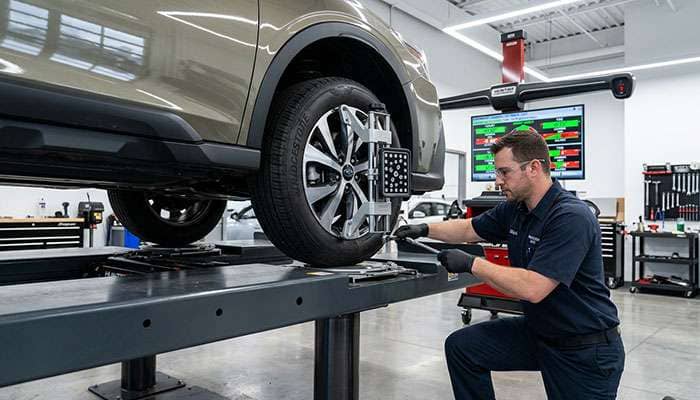
Excessive wear on one edge of your tires and a vehicle that pulls to one side during straight-line driving are the two clearest signs. You might also notice reduced handling responsiveness or a change in steering feel. The only accurate way to measure camber is on an alignment machine at a professional shop — visual inspection alone won't cut it. If you've recently hit a large pothole, clipped a curb, or been in even a minor collision, get your alignment checked right away, even if you're not noticing obvious symptoms yet.
Some vehicles with adjustable components — eccentric cam bolts, adjustable control arms, camber plates — can technically be adjusted at home with the right tools. But accurate camber adjustment requires precise measurement equipment to verify the angle, and getting it wrong can significantly worsen handling or destroy tire life faster than the original problem. Have your camber set and verified on a professional alignment machine by a qualified technician, especially after any suspension modification. The cost of a professional alignment is far less than the cost of prematurely worn tires.
Installing a lift kit changes your suspension geometry, and that change almost always pushes your wheels into positive camber — tops leaning outward. Positive camber causes outer edge tire wear and reduces cornering stability. After any lift installation, a proper alignment is non-negotiable. In many cases you'll also need a camber correction kit — upper control arms with increased caster/camber range or ball joint offset spacers — to bring your alignment back within safe, even-wearing specs. Skip that step and you'll be buying new tires far sooner than you should.



