
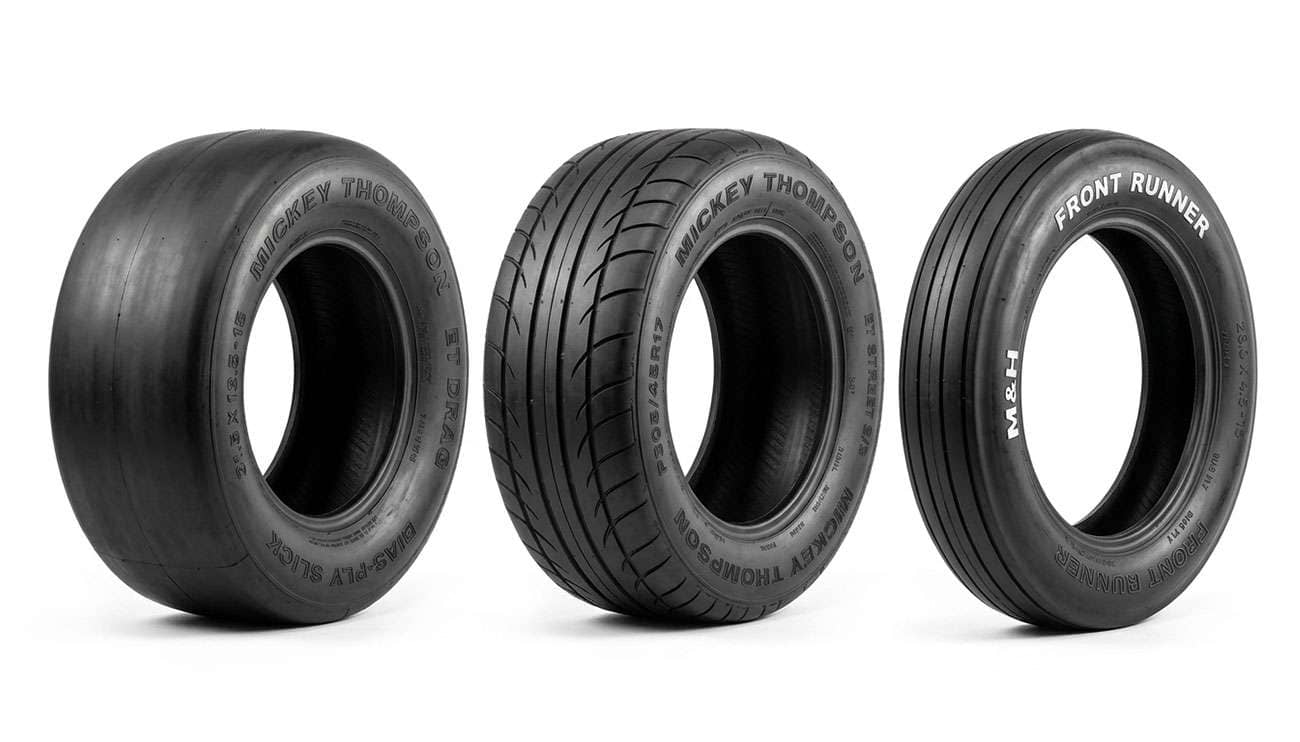
The best drag racing tire is decided by two variables almost nobody names: what your class rulebook permits, and how much power actually reaches the tire. Most guides stop at "it depends" without telling you what it depends on. Here it is. Under roughly 400 horsepower at the rear wheels on a car you drive to the track, a DOT drag radial. Above that on a trailered car, a slick. In a heads-up class, the rulebook chooses before you ever get an opinion.
That is the whole answer, and it is why the question of brand comes last rather than first. I have watched racers spend three months arguing over Mickey Thompson versus M&H, then show up with a tire their class does not permit or a tire two inches too wide for the wheel they own. Get the category right and the brand decision becomes easy. Get it wrong and no brand on the shelf will save the pass.
Run down this table before you look at a single product page. Find the row that describes your car and how it gets to the track. That row is your tire category. Everything after this section is detail inside that category.
Your Setup |
Power at the Rear Wheels |
Tire Category That Fits |
Why It Fits |
|---|---|---|---|
Daily driver, test and tune nights |
Under 400 |
Street performance radial, no change needed |
Below this level a good street tire is not your limiting factor. Suspension and launch technique are. |
Street-strip car, driven to the track |
400 to 650 |
DOT drag radial, entry tier |
Soft compound and shallow tread give slick-adjacent bite while keeping the DOT stamp that lets you drive home. |
Street-strip car, tubbed or big power |
650 to 1,200 |
DOT drag radial, race tier |
Race-compound DOT radials tolerate the drive home but are built to plant serious power on a prepped surface. |
Trailered bracket or sportsman car |
Any |
Radial slick or bias-ply slick |
No street compromise required. Pick radial for repeatability, bias-ply for forgiveness on marginal prep. |
Heads-up or index class competition |
Any |
Whatever the class rulebook mandates |
Small-tire and radial-only classes specify construction and maximum size. The rulebook overrides preference. |
NHRA professional category |
11,000 and up |
Spec tire, no choice offered |
Top Fuel, Funny Car and Pro Stock run a single mandated supplier. Selection is not part of the sport at that level. |
Notice what the table does not ask about. It does not ask your brand loyalty, your budget, or what your buddy runs. Those are downstream decisions. The upstream decisions are class and power, and once those are settled the field of appropriate tires narrows to a handful of models.
If your row landed you in the slick-versus-radial territory and you want the construction argument in full, we went deep on that in drag slicks vs. drag radials. This article is about which category you belong in. That one is about what happens once you are in it.
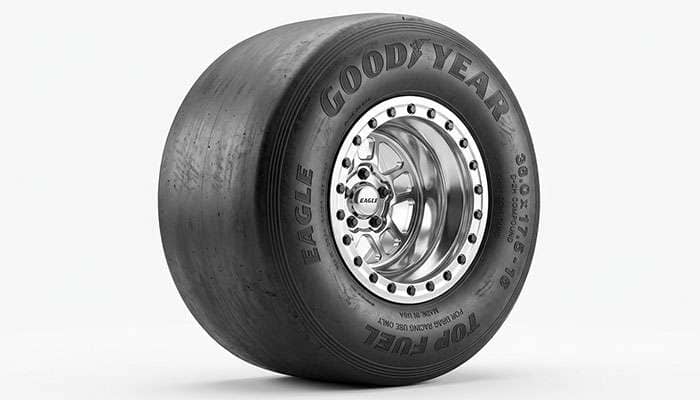
This question gets asked constantly and almost always gets a vague answer. Here is the specific one. A Top Fuel dragster and a Funny Car run the same rear tire: a bias-ply Goodyear Racing Eagle measuring 36 inches tall and 17.5 inches wide on a 16-inch rim. Each one weighs about 48 pounds and runs between roughly 6 and 9 psi. That pressure figure is not a typo. Single-digit inflation is what lets the carcass do its job.
What that job is matters more than the numbers. At the hit of the throttle, an 11,000-horsepower nitro car does not put power to the ground through a rigid tire. The sidewall folds, the tread grows in diameter as centrifugal force takes hold, and the contact patch flattens and lengthens under load. The tire is functioning as a torque converter and a shock absorber at the same time. A stiff tire would either shred the tread or spin the car sideways. The wrinkle is not a side effect. It is the design.
The wheel underneath is regulated just as tightly as the tire. Sanctioning bodies require rear beadlock wheels certified to SFI Spec 15.4 with a minimum inner bead diameter, and front wheels certified to SFI Spec 15.2. Beadlocks exist because at those inflation pressures a conventional bead would simply unseat itself under launch torque. Rules also require all four tires on the car to come from the same manufacturer, and require that the tire be one any competitor can actually buy, which stops teams from running one-off development rubber nobody else can get.
Up front, dragsters run narrow spindle-mount tires with almost no rolling resistance and very little weight. That is the same logic weekend racers apply with front runners, just taken to the extreme. If you want the manufacturing side of all this, how drag racing tires are made walks through the process from compound mixing to the mold.
Goodyear is the exclusive tire supplier to NHRA's top three car categories: Top Fuel, Funny Car and Pro Stock Car. That relationship goes back to the early years of the organization, and 2026 marks the NHRA's 75th anniversary, celebrated at the season-opening Gatornationals with specially marked sidewalls on the Racing Eagle line. Pro Stock Motorcycle runs Mickey Thompson rubber, and Pro Modified runs Continental. So the honest answer to "what tire does NHRA use" is that it depends on which class you are watching, and in every one of those classes the racer has no say.
This is the part that surprises people who assume the pros are picking the grippiest tire money can buy. They are not picking at all. A spec tire is a cost-control and parity measure: it stops teams from buying an advantage in rubber and forces the competition back onto tune-up, clutch management and driving. It also lets the sanctioning body certify a single known quantity for safety at 330-plus miles per hour.
Where it matters for you is the sportsman ranks, which is where nearly every reader of this article actually races. NHRA sportsman and bracket classes are broadly open on tire brand, which is exactly why Mickey Thompson, M&H, Phoenix and others all have full catalogs aimed at that racer. But open on brand does not mean open on everything. Individual classes still specify maximum tire size, and heads-up small-tire classes specify construction as well. Read your class rules before you read a product page. A tire that fails tech is slower than any tire that passes it.
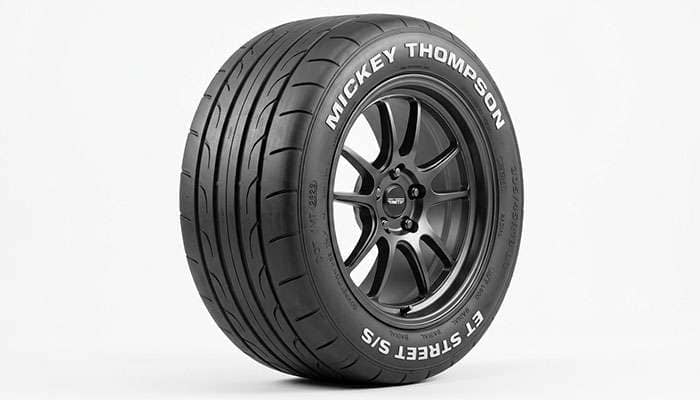
There is no single best drag radial, but there is a clear best-in-tier, and the tiers sort by how much street duty the tire has to survive. Ranked by how far they lean toward the strip:
Mickey Thompson ET Street S/S is the benchmark for a car that sees real street miles and regular track time. It carries a genuine DOT tread pattern with usable water evacuation, which most race-compound radials do not, and it is available across an unusually wide size range from 15-inch classics up to 20-inch modern muscle. If you want one recommendation for a driven car, this is it.
Mickey Thompson ET Street R steps the compound toward the strip. It hooks harder than the S/S and gives up wet-weather manners and tread life to do it. This is the tire for a car that is driven to the track and then asked to run hard, and it is the most common answer in the 500-to-900 horsepower street-strip range.
Mickey Thompson ET Street Radial Pro sits at the top of the DOT ladder. It is a race tire wearing a DOT stamp, and it should be treated that way. Excellent on a prepped surface, unhappy anywhere else.
Nitto NT555RII is the value play and a legitimately good tire. It gives up some ultimate bite to the Mickey Thompson race-compound options, but it is more livable on the street, more affordable, and covers modern big-diameter fitments that older drag radial lines skip entirely.
Toyo Proxes TQ Drag is the one people forget, and it should not be. It launches well and its construction is more tolerant of imperfect track prep than most, which makes it a smart pick if your local surface is inconsistent.
Atturo AZ850 DR Drag Radial covers the 19- and 20-inch late-model crowd at a lower price than the premium lines. It is the practical answer for a modern Challenger, Mustang or Camaro owner who is not going to re-wheel the car just to go drag racing.
The honest ranking, then: Mickey Thompson owns the category on depth and on ultimate performance, Nitto and Toyo are the value and drivability picks, and Atturo covers the big-wheel gap. Our full breakdown of the street-strip side lives in the drag radials street and strip buyer's guide.
Stop thinking in miles. Drag tire life is measured in runs and heat cycles, and the difference matters because a tire can have visible tread left and be completely finished as a racing tire.
At the top of the sport, a Top Fuel or Funny Car rear tire is good for roughly eight runs. That works out to something on the order of a mile and a half of total service life, on a tire that costs several hundred dollars each. Teams throw them away not because the rubber is gone but because the compound has been heat-cycled past its useful window.
Tire Type |
Typical Service Life |
What Ends It |
|---|---|---|
Nitro category rear slick |
About 8 runs |
Heat cycling and compound degradation, not tread wear |
Bias-ply sportsman slick |
One to three seasons of bracket racing |
Compound hardening, sidewall fatigue from repeated wrinkle cycles |
Radial slick |
Longer than an equivalent bias-ply |
Compound hardening; carcass outlasts the rubber |
DOT drag radial, race compound |
A season of mixed street and strip use |
Street miles consuming the shallow tread depth |
DOT drag radial, street compound |
Several thousand street miles |
Conventional tread wear, plus grip falloff well before the tread runs out |
The mechanism behind heat cycling is worth understanding because it explains why a tire that looks fine is not. Every time a soft race compound is brought up to temperature and cooled, some of the oils and softening agents in the rubber migrate and cure off. The rubber gets progressively harder and its coefficient of friction drops. The tread depth gauge tells you nothing about this. Your 60-foot time does. When a set that used to cut consistent short times starts slipping by a few hundredths with no other change, the compound is telling you it is done.
Two practical rules follow. First, store race tires out of sunlight and away from ozone sources, because UV and ozone accelerate the same aging process heat cycling causes. Second, do not run them on a chassis dyno, which subjects the compound to sustained heat with none of the cooling a pass provides. If you specifically want street mileage numbers for a driven car, we tracked that in detail in how many miles Mickey Thompson ET Street drag radials last.
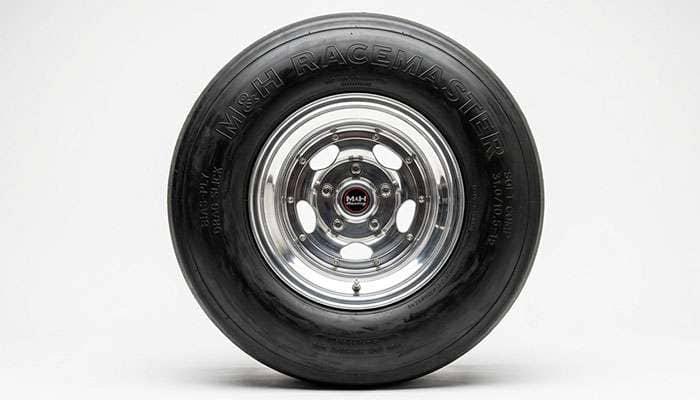
Here is the constraint that quietly eliminates most of your options before brand ever enters the conversation, and it is the single most common reason a drag tire order gets returned.
Every drag tire has a measuring rim width and an approved rim width range, and those ranges are narrower than street tire ranges. Mount a slick on a rim too narrow and the sidewall bulges outward, the contact patch crowns, and you lose the outer edges of the tread on launch. Mount it on a rim too wide and you stretch the carcass, stiffen the sidewall, and destroy the controlled wrinkle you paid for. Either error costs you exactly the traction the tire was designed to deliver.
Then there is the wheelwell. A 29.5-inch tall slick does not fit a car that clears 28 inches, and a 12.5-inch wide tire does not fit a factory wheelwell that clears 10.5. Measure three things before ordering: available height from the axle centerline at ride height with the suspension compressed, available width between the frame rail and the inner fender lip, and the backspacing of the wheel you intend to run. Get those numbers first and the tire catalog filters itself.
The wheel itself matters beyond fitment. Drag wheels are built light and built to hold a bead at low pressure, which is a different engineering problem than a street wheel solves. We covered why in the purpose of drag racing wheels, and if you are shopping brands, our roundup of the 5 best drag racing wheel brands in 2026 is the place to start.
One more fitment note that catches people. Tire pressure on a drag tire is a tuning tool, not a fill-and-forget number, and the adjustment increments are small. Sportsman racers commonly adjust in half-pound steps and see measurable changes in 60-foot time. That level of sensitivity is only possible if the tire is on the correct rim width to begin with.
Running the wrong drag tire is not a neutral choice that simply leaves performance on the table. It escalates, and each stage costs more than the last.
Stage one: elapsed time. The tire spins instead of hooking. You lose two or three tenths in the 60-foot and never get it back down track. This is the cheap stage, and most racers stop here because it only costs them rounds.
Stage two: tire shake. When a radial loses traction on a marginal surface, it does not spin smoothly. It grabs and releases in rapid succession and sets up a violent oscillation. Shake is uncomfortable at best and genuinely dangerous at worst, because it can blur your vision at the exact moment you need to steer.
Stage three: driveline damage. That oscillation transmits straight into the drivetrain. Shake breaks axles, splits rear gears, cracks yokes and destroys U-joints. A set of correct tires costs less than one rear-end rebuild, and a broken axle at speed is a safety event, not a repair bill.
Stage four: the tire itself. A drag radial pushed past its window flat-spots, blisters or delaminates. And once a race tire has been abused on a marginal track, it is compromised even for the passes it might otherwise have had left.
Stage five: the drive home. This is the one that puts people in a ditch. A soft race compound with shallow tread on wet pavement has almost no water evacuation capability, and a slick has none at all. Add to that the fact that any race tire is running near the edge of its structural limits by design, and sidewall damage that a street tire would shrug off becomes a failure risk. If you are unsure whether a tire is still safe to drive on, our guide to tire sidewall damage and whether it is safe to drive lays out what is repairable and what is not.
Every one of those stages ends in the same place: buying the tire you should have bought at the start, plus whatever you broke getting there.
These are pulled from current stock and organized by the table at the top of this article. Prices shift, so treat these as a starting point and call our Fitment Team to confirm sizing against your actual wheel and wheelwell.
Street-strip, driven to the track. The Mickey Thompson ET Street S/S P275/60R15 at $291.69 is the default answer for a 15-inch muscle car, and the Nitto NT555RII P275/60ZR15 at $269.00 is the value alternative in the same fitment. For 16- and 17-inch cars the Toyo Proxes TQ Drag P275/40R17 at $266.57 is a strong performer on inconsistent prep.
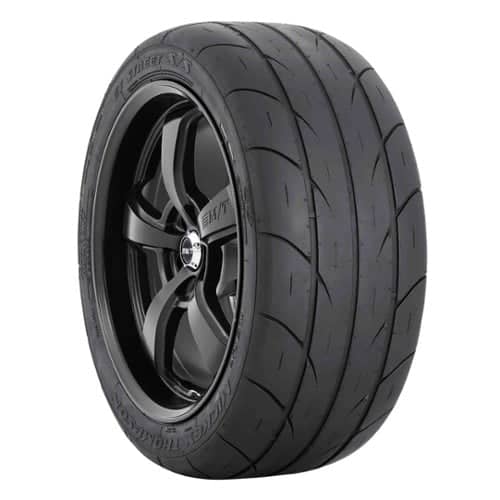
Street-strip, big power. Step up to the Mickey Thompson ET Street R P275/50R15 at $315.49, or the Mickey Thompson ET Street Radial Pro P315/60R15 at $367.39 when the car is closer to a race car than a street car.
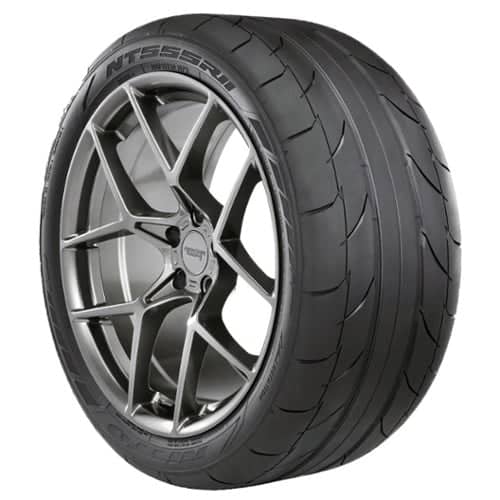
Modern big-wheel builds. The Atturo AZ850 DR Drag Radial 305/35ZR20 at $389.87 covers late-model Challenger, Charger, Mustang and Camaro fitments without re-wheeling the car.
Trailered bracket car. For repeatable passes the Mickey Thompson Pro Bracket Radial 29.5/10.50R15 at $352.59 is purpose-built for consistency. On the bias-ply side, the Mickey Thompson ET Drag 29.5x10.50-15 at $301.29 and the M&H Rear Drag Race Slick 10.5/28-15 at $383.00 are both proven workhorses.
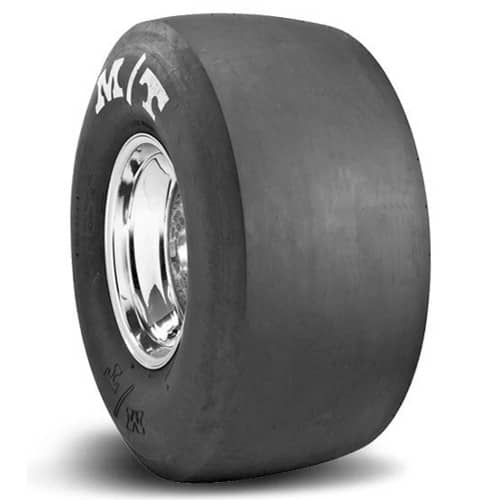
Radial slick for the sportsman car. The M&H Radial Rear Drag Race 275/60R15 at $436.00 splits the difference between slick grip and radial stability.
Small tire and cheater classes. The M&H Cheater Slick 26/10.50R15 at $366.00 is the classic answer where class rules cap tire size.
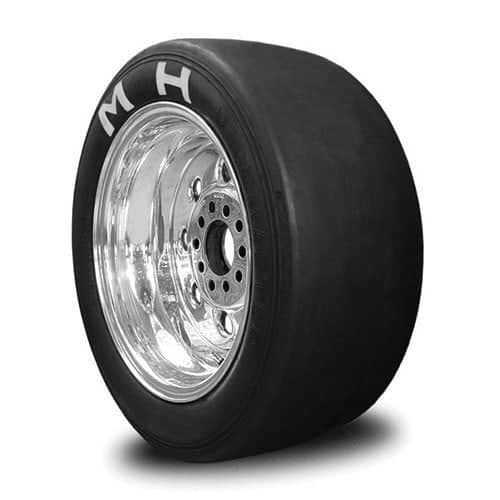
Front tires. Do not skip these. The Mickey Thompson ET Front 28x4.50-15 at $213.69 and the M&H Bias Ply Front Runner 3.5/22-15 at $263.00 cut rolling resistance and nose weight on a dedicated car. For a street-driven build that still needs DOT front rubber, the Mickey Thompson ET Street Front 27/60R17 at $296.99 is the right compromise.
Our full racing tire selection covers every size in these lines plus fitments not listed here.
Work these in order. Skipping a step is how people end up with the wrong tire.
1. Read your class rules first. If you race anything other than pure test and tune, the rulebook constrains construction, maximum diameter and maximum width. Everything downstream happens inside those limits.
2. Decide how the car gets to the track. Driven means DOT. Trailered means you are free to run a slick. This single question eliminates half the catalog.
3. Establish power at the rear wheels. Estimate honestly, not optimistically. Overtiring a low-power car adds rotating mass with no traction benefit.
4. Measure the car. Height from the axle centerline with suspension compressed, width between frame rail and inner fender, and current wheel width and backspacing. Write the numbers down.
5. Match tire to approved rim width. Confirm the tire's approved rim range includes the wheel you own. If it does not, you are buying wheels too, and that changes the budget conversation.
6. Choose the model inside the category. Only now does brand matter, and by this point there are usually two or three valid answers rather than fifty.
The best tire for drag racing is not a product, it is a category, and the category is set by your class rules and the power reaching your rear wheels. Under 400 horsepower on a driven car, a street performance radial is not holding you back. From 400 to roughly 1,200 on a car you drive to the track, a DOT drag radial is the answer, with Mickey Thompson leading on depth and performance and Nitto, Toyo and Atturo covering value and modern fitments. On a trailered car, a slick, with radial construction for consistency and bias-ply for forgiveness. In a heads-up class, whatever the rulebook says. And at the professional level, a mandated spec tire with no selection at all.
Get the category right, measure the car before you order, and confirm the tire matches the rim width you actually own. Do those three things and the tire will do exactly what it was engineered to do. Our Fitment Team at Performance Plus Tire will walk your numbers with you if you want a second set of eyes before you commit.
It depends on two things: what your class rulebook permits and how much power reaches the rear wheels. Under about 400 horsepower on a driven car, a street performance radial is adequate. From 400 to roughly 1,200 horsepower on a car driven to the track, a DOT drag radial is correct. On a trailered car, a slick. In heads-up competition, the rulebook specifies construction and size for you.
Top Fuel dragsters and Funny Cars run a bias-ply rear slick measuring 36 inches tall and 17.5 inches wide on a 16-inch beadlock wheel, weighing roughly 48 pounds and inflated to about 6 to 9 psi. The extremely low pressure allows the sidewall to fold and the tread to grow under launch load, letting the tire absorb driveline shock. Front tires are narrow, lightweight spindle-mount units built to minimize rolling resistance.
Goodyear is the exclusive tire supplier to NHRA's top three car categories: Top Fuel, Funny Car and Pro Stock Car, running the Goodyear Racing Eagle line. Pro Stock Motorcycle uses Mickey Thompson and Pro Modified uses Continental. Sportsman and bracket classes are generally open on brand, though individual classes still specify maximum tire size and sometimes construction.
Mickey Thompson leads the category on both depth and performance, with the ET Street S/S for street-driven cars, the ET Street R for harder-launching street-strip builds, and the ET Street Radial Pro at the top of the range. Nitto's NT555RII is the value pick with better street manners, Toyo's Proxes TQ Drag handles inconsistent track prep well, and Atturo's AZ850 DR covers modern 19- and 20-inch fitments.
A professional nitro category rear tire lasts about eight runs, roughly a mile and a half of total service. Sportsman bias-ply slicks typically last one to three seasons of bracket racing, radial slicks somewhat longer, and DOT drag radials about a season of mixed street and strip use. Life is limited by heat cycling rather than tread wear, so a tire can look nearly new and still have lost its grip.
Sometimes. Every drag tire has an approved rim width range that is narrower than a street tire's range. If your existing wheel falls outside that range, mounting the tire anyway will either crown the contact patch or over-stiffen the sidewall, costing you the traction you paid for. Measure your wheel width and backspacing before ordering, and confirm the tire's approved range covers it.
Reviewed by Dennis Feldman, Vice President, Performance Plus Tire



