
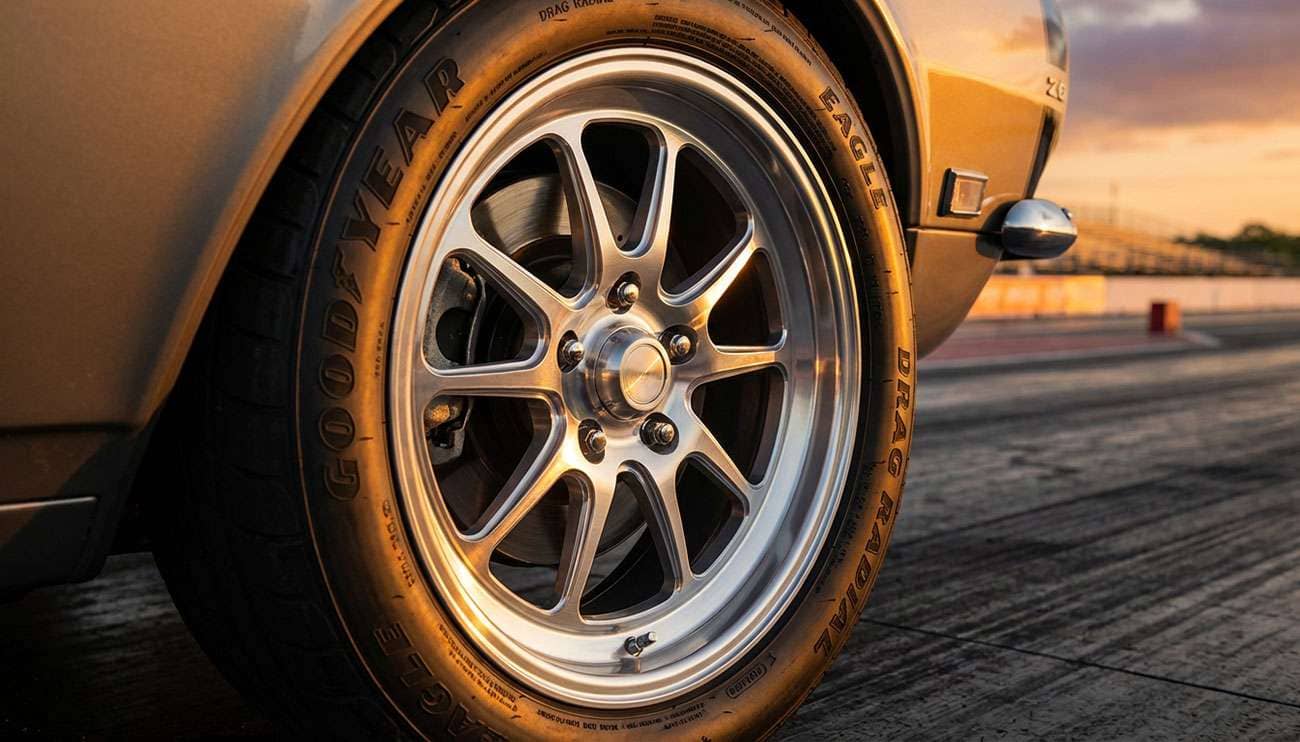
Drag racing wheels have come a long way since CJ 'Pappy' Hart organized the first commercial race at Orange County Airport in 1950. The sport exploded from those early days on Southern California roads and Utah's Bonneville Salt Flats into the nationwide phenomenon we see today.
Strength and weight matter more than anything else when selecting drag racing wheels. The National Hot Rod Association (NHRA) requires beadlocks for Nitro Funny Car, Top Fuel, Pro Stock, and Factory X classes, plus any vehicle running over 210 mph. Today's manufacturers use advanced technologies like flow-forming and pressure casting to create wheels that deliver incredible strength with significant weight savings. The celebrated Weld Draglite wheels feature distinctive lightening holes, while ENKEI brings their legendary JDM heritage to flow-formed options. The market offers specialized solutions for every drag racer.
We carry the best selection of drag racing wheels from the top manufacturers in the industry. Our expert team has tested and analyzed these leading drag wheel brands to help you make the right choice for your track machine. Whether you need budget-friendly options like KONIG with their proven flow-formed designs or the bold styles of MOTEGI with rotary-forged construction, we break down the best performers for when those Christmas tree lights drop.

Enkei has built a reputation for engineering excellence since 1950 in Hamamatsu, Japan. Their commitment to motorsport innovation earned them partnerships with top-tier racing teams, including serving as the Official Supplier to the McLaren F1 team since 1995. Enkei wheels deliver the lightweight construction and exceptional strength that serious drag racing demands, where every fraction of a second counts on the strip.
Enkei's racing wheels excel through proprietary technologies that maximize performance while maintaining structural integrity. The twin spokes on models like the RPF1 distribute stress more effectively during hard acceleration and braking – essential for consistent drag racing performance.
The pocket design around the bolt circles increases rigidity and improves heat dissipation during intense racing conditions. This feature becomes particularly valuable during back-to-back drag runs when brake temperatures soar and wheel integrity is crucial.
Enkei's unique roulette pattern grooved into the rim reduces tire slippage during extreme acceleration – the same technology used in their Formula One wheels. For drag racers, this means better launch grip and more consistent 60-foot times.
Popular Enkei racing series wheels include:
RPF1: Legendary for extreme lightweight properties and track credibility
PF01: Racing-friendly design with competitive pricing
NT03+M: Engineered for maximum strength under demanding conditions
GTC01RR: Racing masterpiece balancing style and performance
Enkei's most significant advantage comes from their remarkable weight reduction capabilities. Their MAT process reduces wheel weight by 10-15% compared to conventional casting methods. Each pound of unsprung weight reduction effectively removes about 20 pounds elsewhere on the vehicle.
Independent testing confirms MAT-manufactured wheels are not only 10-15% lighter but also 15-20% stronger than comparable cast alternatives. This combination delivers noticeable acceleration improvements – the primary concern for drag racers.
Consider the Enkei RPF1 in 17x9 configuration, weighing just 15.9 pounds. Many stock wheels in similar sizes weigh 4+ pounds more per corner. Over a quarter-mile, this weight difference translates to measurable time improvements through reduced rotational mass and improved throttle response.
Enkei wheels offer excellent value within the premium wheel market, delivering near-forged performance characteristics at prices considerably below fully-forged alternatives. Here's current pricing for popular Enkei drag racing wheel models:
Model |
Size |
Price Range (USD) |
|---|---|---|
RPF1 |
17-inch |
Starting at $301.50 per wheel |
RPF1 |
18-inch |
Starting at $368.10 per wheel |
PF01 |
17-inch |
$1,184.40 per set |
PF01 |
18-inch |
$1,460.16 per set |
NT03+M |
18-inch |
$1,508.40 per set |
For drag-specific applications, the RPF1 remains the most cost-effective option. Specialized models like the PF01 offer additional benefits for serious competitors willing to invest more. Complete sets of Enkei Raijin wheels range from $1,036.00 to $1,436.00 depending on size and finish.
Enkei offers extensive fitment options ideal for drag racing applications. For rear drag setups, the 17x9 ET45 size paired with 275-40-17 Nitto NT555rII drag radials provides excellent traction while maintaining proper fitment. Front fitments commonly use 18x9.5 ET38 with 245-40-18 performance street tires for stability and steering response.
Enkei also produces the 17x9.5 with an offset of 18mm, weighing 16.5 pounds each – slightly heavier than their 17x9 counterparts but offering greater width for wider drag tires.
Many drag racers choose Enkei wheels for Japanese performance platforms (Nissan GT-R, Subaru WRX/STI, Honda Civic Type R), European sports cars (BMW M-series, Porsche), and domestic muscle cars seeking weight reduction. Their wide range of bolt patterns accommodates most popular drag racing platforms.
Enkei's superior performance centers on their proprietary MAT (Most Advanced Technology) manufacturing process. MAT combines casting with a rim-forming technology called the spinning process. This hybrid approach delivers strength similar to forged wheels while maintaining manufacturing cost advantages and greater design flexibility.
The process begins with Durville die casting, where molten aluminum is poured into the mold from the inner rim side with the disk facing downward. This creates rapid quenching and solidification starting at the disk side, resulting in a finer metallic structure with significantly enhanced tensile strength, yield strength, and elongation.
Following casting, the rim section undergoes high-pressure flow-forming. During this stage, rollers apply intense pressure to stretch and compress the aluminum, fundamentally realigning its molecular structure. This replicates the internal characteristics found in forged wheels, delivering exceptional durability where it matters most – the rim barrel that takes constant abuse from tire mounting and hard landings.
Enkei maintains exclusive partnerships with raw material suppliers for custom alloy compositions. Their aluminum features specialized metallurgical properties designed specifically for performance wheel applications, creating a foundation for superior wheel construction.
Weld Racing has defined American drag racing performance since 1967. The company started in Kansas City when Greg Weld, a drag racer himself, couldn't find wheels strong enough for his needs. Today, Weld's reputation for manufacturing the strongest and lightest drag racing wheels on the market remains unmatched. Their forged aluminum wheels have become synonymous with professional drag racing at the highest levels.
Weld's revolutionary "hubless" design eliminates the traditional raised center hub found on most wheels. This engineering innovation serves multiple purposes for drag racing applications – it allows for larger brake rotors, improves weight distribution, and provides better clearance for big brake kits commonly found on high-powered drag cars.
Their signature Draglite wheel features iconic lightening holes strategically placed to maximize weight reduction while maintaining structural integrity. These weren't just aesthetic choices – Weld engineers calculated precise hole placement to remove material without compromising strength where stress concentrations occur during hard launches.
Weld's beadlock technology stands as an industry benchmark. True beadlocks mechanically clamp the tire bead to the wheel, preventing tire slippage under extreme torque loads. The NHRA mandates beadlocks for cars running over 210 mph, and Weld's designs meet or exceed all sanctioning body requirements.
Key Weld Racing drag wheel models include:
RT-S S71: Forged monoblock design with optimized spoke geometry
Alumastar 2.0: Modern interpretation of the classic Alumastar
V-Series: Track-proven design for serious competitors
Magnum: Forged drag racing wheels with front and rear options
Weld's forged aluminum wheels deliver performance advantages measured in real-world racing results. Their forged monoblock construction creates wheels up to 40% lighter than traditional cast alternatives while maintaining superior strength characteristics.
The weight savings translate directly to improved acceleration. Each pound of rotational mass reduction has a multiplied effect on performance – your engine works less hard to spin lighter wheels, freeing power for forward momentum. Top Fuel and Funny Car teams choose Weld precisely for this reason.
Weld wheels undergo rigorous testing that exceeds both DOT and JWL/VIA standards. Their in-house testing includes radial fatigue testing, rotary bending tests, and impact testing. This commitment to validation ensures reliability under conditions far more severe than typical street use.
The company's controlled grain structure from the forging process creates consistent material properties throughout the wheel. Unlike cast wheels where porosity and inconsistent material density can create weak spots, forged Weld wheels maintain uniform strength from hub to rim lip.
Weld Racing positions itself in the premium segment, reflecting their forged construction and racing heritage. Here's current pricing for popular Weld drag racing wheels:
Model |
Size |
Price Range (USD) |
|---|---|---|
RT-S S71 |
17-inch |
Starting at $815.00 per wheel |
RT-S S71 |
18-inch |
Starting at $880.00 per wheel |
Alumastar 2.0 |
15-inch |
Starting at $642.00 per wheel |
V-Series Front Runner |
15-inch |
Starting at $427.00 per wheel |
Magnum Drag 2.0 |
15-inch |
Starting at $558.00 per wheel |
While Weld's pricing exceeds budget brands, the investment reflects true forged construction, American manufacturing, and decades of professional racing validation. Serious drag racers consider Weld wheels a long-term investment that delivers measurable performance returns.
Weld offers comprehensive fitment coverage for domestic muscle cars, import performance vehicles, and purpose-built drag cars. Their double-beadlock options accommodate massive drag slicks while their skinny front runners minimize rotational mass where traction isn't the priority.
Popular drag racing fitments include 15x10 rear wheels for big tire applications paired with 15x3.5 front runners for traditional drag setups. Modern muscle car applications often use 17x10 or 18x10 rear wheels with 17x5 or 18x5 fronts to maintain a more streetable appearance while still maximizing traction.
Weld's Direct Mount and Anglia spindle mount options accommodate dedicated drag cars using tube front ends. Their bolt patterns cover virtually every domestic and popular import application, with custom drilling available for unique applications.
The company also offers wheel widths and backspacing combinations specifically designed to clear factory brake components on modern muscle cars like the Mustang GT, Camaro SS, Challenger Hellcat, and Corvette – allowing racers to maintain street functionality between track days.
Weld wheels begin as solid billets of aerospace-grade 6061-T6 aluminum alloy. This material offers an ideal combination of strength, corrosion resistance, and machinability for wheel applications. The T6 temper indicates the aluminum has been solution heat-treated and artificially aged for maximum hardness and durability.
The forging process subjects this billet to extreme pressure – over 18,000 tons of force – within precision dies. This pressure fundamentally realigns the aluminum's grain structure, creating continuous grain flow that follows the wheel's contours. The result is a molecular structure with no weak points, porosity, or inconsistent density.
After forging, Weld machines each wheel using multi-axis CNC equipment for dimensional precision. Their Kansas City facility maintains complete vertical integration, controlling every step from raw material to finished wheel. This allows unprecedented quality control and consistency across production runs.
Weld's heat treatment protocols follow aerospace standards, with documented processes for each alloy specification. Final finishing includes surface treatments and coatings that protect against corrosion while maintaining the striking appearance drag racers expect.

Race Star Industries emerged in 2013 with a focused mission: create high-quality drag racing wheels at accessible prices without compromising performance. Their "Direct-Fit" philosophy simplified wheel selection by offering application-specific wheels that bolt directly to popular muscle cars without spacers or adapters. This approach disrupted the traditional drag wheel market and earned Race Star a devoted following among grassroots racers.
Race Star's defining innovation is their Race Grip technology – a specialized surface treatment applied to the bead seat area that improves tire bead retention under extreme torque loads. This allows racers to use standard tires without beadlocks in many applications while maintaining secure tire seating during hard launches.
Their modular two-piece construction on select models allows racers to customize width and offset combinations. The outer ring and center section bolt together, enabling future modifications as racing needs evolve – a cost-effective approach for racers progressing through different power levels.
Race Star's spoke designs incorporate flow-through ventilation patterns that improve brake cooling. This becomes particularly important for street/strip applications where braking performance remains essential between drag passes.
Core Race Star drag wheel models include:
Drag Star: Entry-level cast wheel with direct-fit convenience
92 Drag Star: Dark Star finish with open-lug design
Pro Forged: Premium forged option for serious competitors
Front Runner: Lightweight skinny wheels for dedicated drag setups
Race Star wheels deliver measurable weight savings over factory wheels. Their 17x7 Drag Star weighs approximately 21 pounds – compared to factory wheels often exceeding 28-30 pounds in similar sizes. This 7-9 pound reduction per corner significantly improves acceleration.
The direct-fit design eliminates the need for hub-centric rings, specialized lug nuts, or wheel spacers that add rotating mass and potential failure points. This simplicity also makes swapping between track and street wheels faster – a genuine benefit for weekend warriors who drive to the track.
Race Star's wide tire compatibility accommodates everything from DOT-legal drag radials to full slicks, depending on the model. Their rear wheels accept backspacing variations that allow proper fitment of sticky rubber while maintaining fender clearance on vehicles running stock or mildly modified suspensions.
Load ratings and safety factors on Race Star wheels meet SFI specifications where applicable. Their testing protocols include radial fatigue, cornering fatigue, and impact resistance evaluations that validate performance under real-world racing conditions.
Race Star positions itself as the value leader in drag racing wheels, delivering quality construction at prices significantly below premium forged options. Current pricing for popular Race Star models:
Model |
Size |
Price Range (USD) |
|---|---|---|
Drag Star |
17-inch |
Starting at $177.95 per wheel |
Drag Star |
18-inch |
Starting at $209.95 per wheel |
92 Drag Star |
17-inch |
Starting at $193.95 per wheel |
Pro Forged |
17-inch |
Starting at $649.95 per wheel |
Front Runner |
17x4.5 |
Starting at $159.95 per wheel |
This pricing structure makes drag racing wheel upgrades accessible to racers at every level. A complete set of Drag Stars costs less than a single premium forged wheel from some competitors, democratizing access to purpose-built drag racing equipment.
Race Star specializes in domestic muscle car applications with exhaustive coverage for Ford, GM, and Mopar platforms. Their direct-fit approach means purchasing wheels specifically designed for your application – a 2024 Mustang GT uses different wheels than a 2018 Camaro SS, even if the dimensions appear similar.
Popular Ford Mustang fitments include 17x9.5 rear wheels with 17x4.5 front runners for dedicated drag setups, or matched 17x9.5 front and rear combinations for street/strip use. Camaro and Corvette applications follow similar patterns with application-specific bolt patterns and offsets.
Challenger and Charger owners benefit from Race Star's comprehensive Mopar coverage, including both five-lug and six-lug patterns depending on model year. Their fitment database includes specifications for high-offset factory brake clearance requirements on Hellcat and Demon models.
Race Star also offers import applications for Nissan 350Z/370Z and various JDM platforms, though their primary focus remains domestic muscle. Each wheel listing includes detailed fitment notes specifying tire size limits, backspacing requirements, and any potential clearance concerns.
Race Star utilizes different construction methods across their product line to balance performance and price. Their entry-level Drag Star wheels use aluminum alloy casting with computer-optimized spoke designs that minimize weight while maintaining required strength factors.
The casting process used for Drag Star wheels incorporates modern techniques including vacuum-assist casting to reduce porosity and improve material consistency. Post-casting machining creates precise mounting surfaces and ensures dimensional accuracy.
Their Pro Forged line employs true forging processes using 6061-T6 aircraft-grade aluminum. These wheels undergo the same pressure-forming process as premium competitors, creating the aligned grain structure that delivers maximum strength-to-weight ratios.
All Race Star wheels receive surface treatments appropriate to their intended environment. Chrome and polished finishes address cosmetic preferences while powder coating and specialized clear coats protect against the corrosion that drag racing environments – with tire rubber, brake dust, and track prep compounds – can accelerate.
American Racing holds the distinction of creating the original aftermarket wheel in 1956. When they introduced magnesium wheels that weighed 75% less than steel alternatives, they revolutionized both street performance and racing. Over seven decades later, American Racing remains an industry cornerstone, combining heritage designs with modern manufacturing capabilities. Their Torq Thrust family became the most imitated wheel design in aftermarket history.
American Racing's engineering innovations span decades of development. Their two-piece and three-piece construction methods allow infinite combinations of width, offset, and backspacing that accommodate everything from narrow front runners to wide drag slick applications.
The company's "SureFit" system ensures precise hub-centric mounting that eliminates vibration and stress concentration at the lug points. This becomes particularly important under the repetitive shock loads of drag racing launches where slight imbalances compound into potential failures.
American Racing wheels incorporate reinforced mounting areas designed for high-torque applications. Their spoke-to-hub transitions feature increased material thickness where stress analysis indicates maximum loads during acceleration – the exact conditions drag racing creates.
Notable American Racing drag-appropriate wheels include:
Torq Thrust II: The iconic five-spoke design updated for modern vehicles
VN515: Classic Torq Thrust aesthetic with one-piece construction
AR61 Outlaw I: Traditional slot mag styling for classic muscle
Forged VF528: Premium forged construction for maximum performance
American Racing's original magnesium wheels achieved a 75% weight reduction versus steel – a revolutionary improvement that changed automotive performance forever. While modern wheels use aluminum for practicality and corrosion resistance, American Racing continues pursuing aggressive weight reduction.
Their forged options deliver strength-to-weight ratios competitive with any manufacturer. The VF series forged wheels use aerospace-grade materials processed through precision forging operations that optimize material density and eliminate casting defects.
The company's extensive validation testing includes procedures developed through decades of motorsport involvement. American Racing wheels have appeared in everything from drag racing to circle track to road racing, accumulating real-world durability data across diverse applications.
Design refinements incorporated through seven decades of feedback from racers and enthusiasts create wheels that perform as intended. Seemingly minor details – spoke radius, rim lip profiles, valve stem positioning – reflect generations of learning that newer manufacturers cannot easily replicate.
American Racing spans a broad price range from accessible cast wheels to premium forged offerings. This variety allows buyers to choose their balance between budget and ultimate performance. Current pricing for drag-appropriate American Racing wheels:
Model |
Size |
Price Range (USD) |
|---|---|---|
Torq Thrust II (VN215) |
17-inch |
Starting at $215.00 per wheel |
VN515 Classic Torq Thrust |
17-inch |
Starting at $158.00 per wheel |
AR61 Outlaw I |
15-inch |
Starting at $178.00 per wheel |
Forged VF528 |
17-inch |
Starting at $985.00 per wheel |
AR23 |
15-inch |
Starting at $125.00 per wheel |
The entry-level pricing makes American Racing accessible to budget-conscious racers while their forged offerings satisfy those demanding absolute performance. This range positions American Racing as a one-stop solution for customers who may start with cast wheels and upgrade to forged as their racing progresses.
American Racing's seven decades of production mean unmatched fitment coverage for classic muscle cars. Whether you're building a period-correct 1960s drag car or modifying a modern muscle car, American Racing likely offers appropriate options.
Classic Mustang, Camaro, and Mopar applications benefit from the company's deep catalog of vintage-appropriate styles in period-correct sizes like 14x7 and 15x8. These sizes accommodate the bias-ply and early radial tire sizes that maintain authentic appearance on restored drag cars.
Modern applications receive equal attention with staggered fitments for late-model muscle cars. Their wheel programs include specific offsets and backspacing designed for factory Brembo brake clearance on high-performance variants like the Mustang GT Performance Pack and Camaro 1LE.
American Racing's custom wheel division handles unique requirements for dedicated race cars. Custom bolt patterns, specialized offsets, and unusual width combinations can be manufactured for applications beyond their standard catalog.
American Racing employs multiple manufacturing methods matched to specific product requirements. Their cast wheels use gravity or low-pressure casting processes with proprietary aluminum alloys developed through decades of metallurgical refinement.
Quality control begins at raw material inspection – incoming aluminum ingots must meet chemical composition specifications before entering production. This consistency ensures predictable material behavior throughout manufacturing and finished wheel performance.
Their forged wheel production mirrors aerospace practices. Starting from certified billet stock, progressive die operations gradually form final wheel shapes through multiple forging stages. Each stage refines grain structure while approaching finished dimensions, minimizing machining requirements that could disrupt optimized grain flow.
Post-manufacturing inspection includes X-ray examination for internal defects, dimensional verification through CMM (Coordinate Measuring Machine) equipment, and surface finish evaluation. Wheels failing any inspection stage get recycled rather than shipped – a commitment to quality that protects both American Racing's reputation and their customers' safety.

Konig wheels entered the North American market in 1983 with a clear mission: deliver lightweight performance at attainable prices. Through strategic manufacturing partnerships and efficient design practices, Konig carved a reputation for value-oriented wheels that don't compromise on quality. Their flow-formed technology democratized access to lightweight wheel performance, previously available only through expensive forged options.
Konig's flow-forming manufacturing process creates the foundation for their performance reputation. This technique starts with a cast center section, then applies intense roller pressure to the rim barrel while spinning at high temperature. The pressure stretches and compresses the aluminum, realigning its grain structure similar to forging.
The flow-formed rim barrel achieves significantly higher strength than traditional casting, allowing Konig engineers to use thinner material without sacrificing durability. This directly translates to weight savings – the primary advantage drag racers seek from premium wheels.
Konig's hub-centric machining ensures precise centering on the vehicle hub rather than relying solely on lug nuts for wheel positioning. This accuracy reduces vibration, improves balance consistency, and distributes stress more evenly across the mounting interface.
Popular Konig drag-appropriate models include:
Hypergram: Ultra-lightweight flow-formed design
Ampliform: Aggressive concave styling with flow-formed construction
Dekagram: Maximum weight reduction through flow forming
Freeform: Ten-spoke design optimized for brake cooling
Konig's weight advantage becomes immediately apparent when comparing their wheels to factory equipment. Their 18x9.5 Hypergram weighs approximately 21.7 pounds – many factory wheels in similar sizes exceed 27-30 pounds. This 5-8 pound per corner reduction significantly impacts acceleration.
The reduced rotational mass means your engine wastes less power spinning heavy wheels. During drag racing, where every horsepower contributes to elapsed time, this efficiency gain translates directly to performance improvement.
Flow-formed construction also improves wheel resilience. The grain alignment created during the flow-forming process makes the rim barrel more resistant to impact damage than cast alternatives. For drag racers who occasionally encounter track surface imperfections or rough pit lane conditions, this durability provides peace of mind.
Konig designs incorporate finite element analysis (FEA) to optimize spoke placement, thickness variations, and material distribution. This engineering approach ensures that weight reduction comes from areas that don't compromise structural integrity – smart engineering rather than arbitrary lightening.
Konig positions itself as the value leader in flow-formed wheel technology. Their pricing undercuts many competitors while delivering equivalent manufacturing sophistication. Current pricing for popular Konig performance wheels:
Model |
Size |
Price Range (USD) |
|---|---|---|
Hypergram |
17-inch |
Starting at $219.00 per wheel |
Hypergram |
18-inch |
Starting at $270.00 per wheel |
Ampliform |
18-inch |
Starting at $276.00 per wheel |
Dekagram |
17-inch |
Starting at $153.40 per wheel |
Freeform |
18-inch |
Starting at $264.00 per wheel |
These prices make flow-formed technology accessible to racers who previously settled for heavier cast wheels due to budget constraints. A complete set of Konig Dekagrams costs less than many single forged wheels, opening performance improvement possibilities for budget-conscious competitors.
Konig prioritizes import performance applications while maintaining coverage for domestic muscle. Their fitment charts emphasize Japanese sports cars (Honda Civic/Accord, Nissan 350Z/370Z/GT-R, Subaru WRX/STI, Mazda Miata/RX-7), Euro performance platforms (BMW 3/4-Series, VW GTI/R, Audi S/RS models), and increasingly popular Korean imports (Hyundai Veloster N, Genesis G70).
For front-wheel-drive drag racing, Konig offers specific fitments optimized for traction with aggressive offset designs. Their 17x8 wheels with +35mm offset work well for FWD applications seeking sticky rubber without fender modification.
Domestic applications receive solid coverage with proper bolt patterns and offsets for Mustang, Camaro, and Challenger platforms. Their wheel-specific fitment data specifies brake clearance, suspension geometry compatibility, and recommended tire sizes for each application.
Konig's most extreme weight reduction designs like the Dekagram target dedicated track vehicles where every gram matters. These ultra-light options may sacrifice some sidewalk presence for pure performance – ideal priorities for drag racing duty.
Konig wheels begin with aluminum alloys selected for their combination of castability, flow-forming response, and finished mechanical properties. Their specifications account for the unique demands of their manufacturing process rather than generic industry formulations.
Initial casting creates the center section – the hub, spoke areas, and inner rim barrel – through low-pressure die casting. This method provides better material density than gravity casting while maintaining design flexibility for complex spoke shapes.
The signature flow-forming stage follows casting and heat treatment. Specialized rolling equipment applies precisely controlled pressure to the heated rim barrel, stretching it to final width while dramatically improving material properties. The process can achieve rim barrels up to 30% thinner than cast equivalents while exceeding their strength ratings.
Post-production quality control includes balance verification, dimensional inspection, and visual examination for surface defects. Konig's quality systems follow ISO certification standards, documenting processes and maintaining traceability from raw material through finished product.
Understanding the key differences between these top drag racing wheel brands helps you make the right choice for your specific application. Each manufacturer brings unique technologies and value propositions to the table. Here's how they stack up against each other:
Brand |
Primary Construction Method |
Entry Level Price (USD) |
Key Technology/Feature |
Material |
Notable Performance Benefit |
|---|---|---|---|---|---|
Enkei |
MAT (Most Advanced Technology) |
$301.50/wheel |
Pocket design around bolt circles; Roulette pattern grooves |
Aluminum with MAT process |
10-15% lighter and 15-20% stronger than conventional cast wheels |
Weld Racing |
Forged Monoblock |
$815.00/wheel |
Hubless Design; Beadlock Technology |
Forged 6061-T6 Aluminum |
Up to 40% lighter than traditional cast wheels |
Race Star |
Cast/Forged (varies by model) |
$177.95/wheel |
Race Grip Technology; Direct-fit style |
6061-T6 Aircraft Aluminum |
Reduced rotational mass; improved brake ventilation |
American Racing |
Cast/Forged (varies by model) |
$158.00/wheel |
SureFit system; Two-piece construction |
Cast/Forged Aluminum |
Original magnesium wheels were 75% lighter than steel |
Konig |
Flow Forming/Rotary Forging |
$153.40/wheel |
Flow forming technology; Hub-centric machining |
Aluminum with flow forming |
4-6 pounds lighter per corner vs stock wheels |
When choosing between these brands, consider your budget, performance requirements, and intended use. Professional racers often gravitate toward Weld Racing for maximum strength, while budget-conscious enthusiasts find excellent value in Konig and American Racing options. Race Star bridges the gap with direct-fit convenience, and Enkei delivers proven track technology at competitive prices.
Selecting the right drag racing wheels makes a real difference in your quarter-mile times. Each of these five industry-leading brands offers distinct advantages for serious racers. Enkei delivers MAT technology that creates wheels both lighter and stronger than conventional options. Weld Racing maintains its position as the gold standard for hardcore drag applications where absolute strength matters most, backed by decades of American racing heritage. Race Star provides exceptional value without compromising quality - perfect for racers working within budget constraints. American Racing continues its legacy as the original innovator in lightweight wheel design. Konig delivers flow-formed performance at competitive price points.
Weight reduction stands as the most critical factor when choosing drag wheels. Each pound saved translates directly to measurable acceleration improvements. Proper construction methods ensure your wheels maintain structural integrity under extreme launch conditions. The right fitment maximizes traction when every thousandth of a second counts on the strip.
Your specific racing application, budget, and performance goals determine which brand belongs on your vehicle. Today's market offers solutions for every level of competition - from professional-grade forged monoblock designs to affordable flow-formed options. Explore our complete collection of racing wheels at Performance Plus Tire to find the perfect match for your drag racing machine.
These five manufacturers lead the industry through their commitment to innovation, quality control, and racing heritage. Whether you compete professionally or hit the strip on weekends, investing in quality wheels from these trusted brands will shave precious time off your quarter-mile runs while enhancing safety and reliability under extreme conditions.
These five drag racing wheel brands represent the pinnacle of performance engineering, each offering distinct advantages for serious racers seeking competitive edge on the strip.
• Weight reduction is everything: Premium wheels like Enkei's MAT technology deliver 10-15% weight savings, translating directly to faster acceleration and improved quarter-mile times.
• Construction method determines performance: Flow-formed and forged wheels significantly outperform cast alternatives, with brands like Weld Racing offering up to 40% weight reduction over traditional options.
• Budget-friendly options exist without compromise: Race Star and Konig prove you don't need to break the bank, offering professional-grade performance starting under $200 per wheel.
• Proper fitment maximizes traction: Direct-fit designs from manufacturers like Race Star eliminate modification headaches while ensuring optimal tire contact during launches.
• American heritage meets modern innovation: Established brands like Weld Racing and American Racing combine decades of racing pedigree with cutting-edge manufacturing technologies.
The right wheel choice depends on your specific racing application, budget constraints, and performance goals. Whether you're running professional Top Fuel or weekend bracket racing, these manufacturers offer proven solutions that can shave crucial milliseconds off your times while maintaining the structural integrity needed for safe, consistent performance under extreme conditions.
The most important factors are weight reduction, construction method, and proper fitment. Lightweight wheels improve acceleration, while forged or flow-formed construction ensures strength and durability. Proper fitment maximizes traction during launches.
Some of the leading brands for drag racing wheels include Weld Racing, Enkei, Race Star, American Racing, and Konig. Each offers unique technologies and performance benefits tailored for drag racing applications.
Prices vary widely based on construction and brand. Entry-level options from reputable manufacturers start around $150-$200 per wheel, while premium forged wheels for professional applications can exceed $5,000 per wheel.
Forged wheels offer superior strength-to-weight ratios compared to cast wheels. They can be up to 40% lighter than traditional cast alternatives, improving acceleration and overall performance while maintaining structural integrity under extreme conditions.
Yes, brands like Race Star and Konig offer high-performance wheels at more accessible price points. These manufacturers use advanced technologies like flow forming to deliver near-forged performance characteristics at a fraction of the cost of fully forged wheels.



