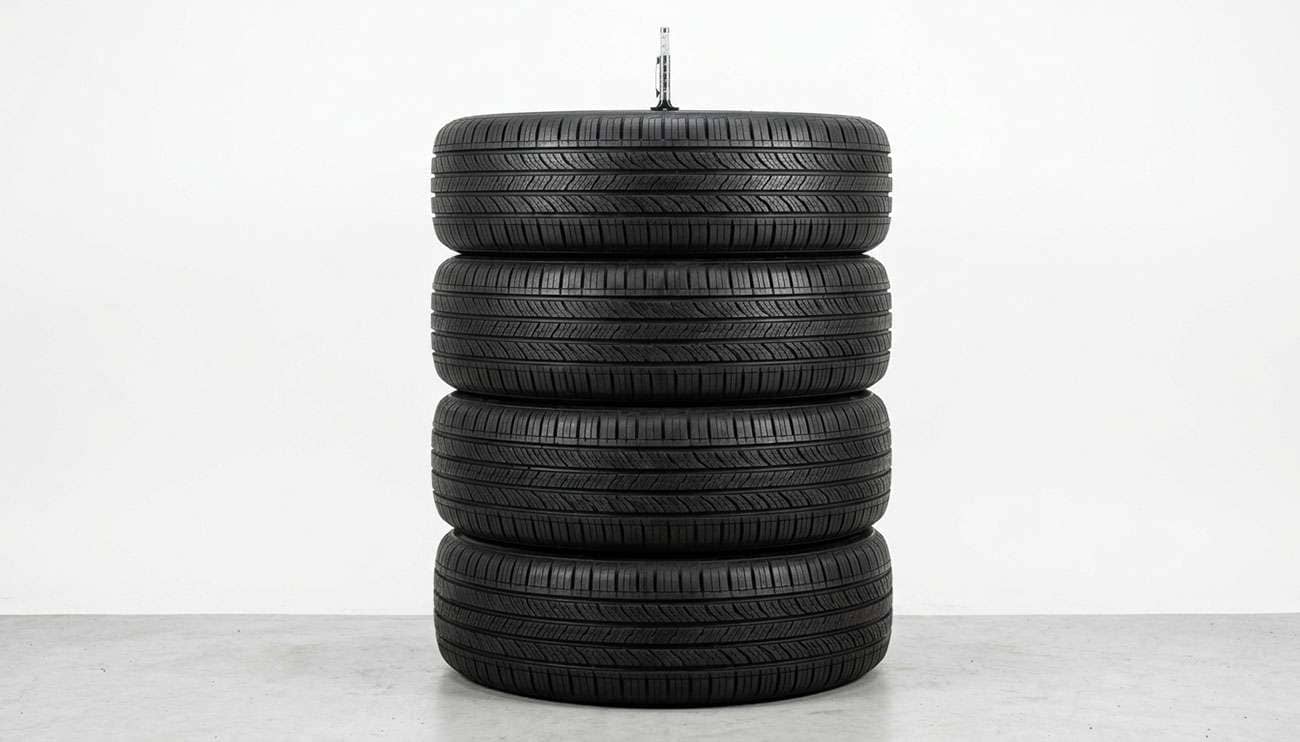
Short answer: the best time to buy tires is the first rebate program you can catch once your tread reaches 5/32 of an inch, and no later than 4/32. Spring and fall are when most programs run, but the calendar only tells you when the deals are. Your tread tells you whether you can reach one. The variable most guides skip is how many months of tread you have left and what each 32nd is worth. On an average set, one 32nd is about six months of driving and about $100 of tire.
I'm Dennis Feldman, and I run fitment at Performance Plus Tire. Ask around about when to buy tires and you'll hear spring, fall, and Black Friday. That's a fair read of the calendar. You'll also hear "it depends," usually without much on what it depends on. It depends on your tread. A sale only helps if you can reach it on the rubber you have left, and it only pays if you aren't giving up more tread than the rebate gives back. So I ran the numbers.
Measure your shallowest groove and find your row. This chart assumes an all-season touring tire, average mileage, and a set of four at about $850. The sections below show you how to swap in your own numbers.
Tread Depth Now |
Months Until 4/32 |
Tread Value Above 4/32 |
What to Do |
|---|---|---|---|
8/32 or more |
26 or more |
$420 or more |
Nothing to buy yet. Measure again in six months. |
7/32 |
About 20 |
About $320 |
Keep driving. Buying now wastes more than any rebate pays. |
6/32 |
About 13 |
About $210 |
Start shopping. Pick your tire and price it, but don't buy for a rebate yet. |
5/32 |
About 6 |
About $105 |
Best time to buy. Take the next rebate program you can catch. |
4/32 |
0 |
$0 |
Buy this month. Take the best offer that's live. |
3/32 |
Past it |
$0 |
Buy this week. No rebate is worth waiting for here. |
2/32 or less |
Past it |
$0 |
Replace now. You're at the wear bars. |
Three numbers answer this: your tread depth, how fast you wear it, and how far away the next sale is. Most advice stops at the first number. The second one is the piece nobody puts in front of you, so I worked it out.
Every tire has a starting tread depth, a wear-out point at 2/32, and usually a mileage warranty. Divide the warranty by the usable tread and you get miles per 32nd. Across current all-season touring lines, the typical tire starts at 10/32 and carries a 60,000-mile warranty. That comes to about 7,400 miles per 32nd. The Federal Highway Administration puts the average driver at 13,482 miles a year, or about 1,125 miles a month. Divide again and one 32nd lasts about 6.5 months.
That number turns tread depth into a countdown. At 6/32 you have about 13 months before you reach 4/32. At 5/32 you have about six. Now you can look at the calendar and see which sales you can actually reach.
Say you measure 5/32 on July 1. The fall programs opened around September 1 in 2026, so you can wait two months with room to spare. Say you measure 5/32 on December 1 and nothing good is live. Goodyear's spring program opened March 1 in 2026, so you still have the runway to wait. Now say you measure 4/32 on October 1. You're at the deadline, the fall programs are live, and there's nothing left to think about.
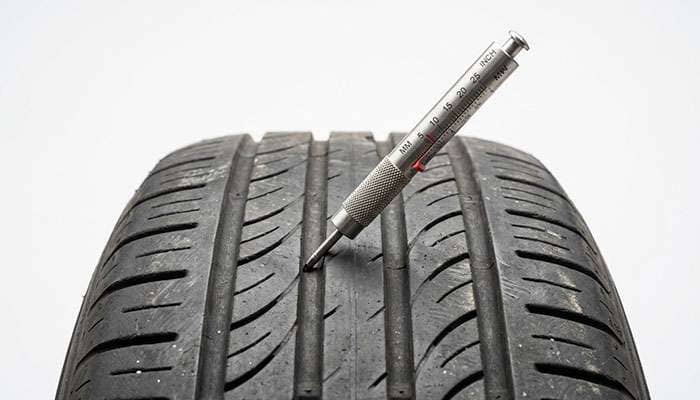
You need a real measurement for this. The penny test only shows you 2/32 and the quarter test only shows you 4/32. Neither one can tell you 5/32, and 5/32 is the reading that matters most here. A tread gauge costs $5 to $15. Check the inside, center, and outside grooves on all four tires and use the lowest reading. My guide to replacing tires by the 32nd walks through what each reading means.
One caution on the 6.5-month figure. A mileage warranty is a maker's promise, not a measurement of your car. Treat it as the optimistic end. A heavy vehicle, a heavy right foot, low pressure, and skipped rotations all shorten it. The better number is your own: measure today, measure again in three months, and you have your personal wear rate.
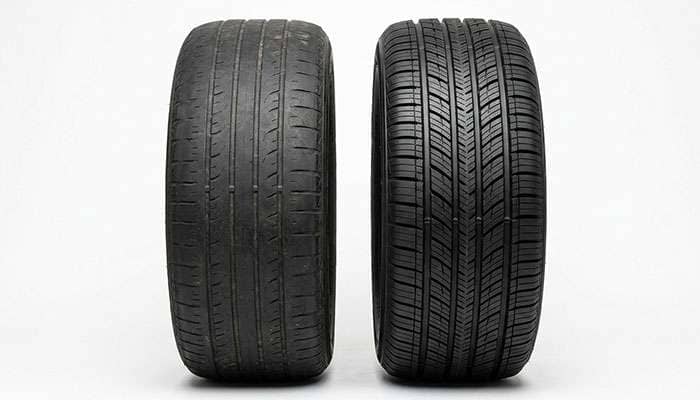
Because 2/32 is the legal floor, and 4/32 is where wet braking has already fallen off. Federal standard FMVSS 139 requires wear indicators that show when a tire reaches 1/16 of an inch, which is the 2/32 mark, and most states treat that as the limit. California's Vehicle Code sits lower at 1/32. Neither number tells you how the tire stops in the rain.
AAA tested that. All-season tires worn to 4/32 took an average of 43 percent longer to stop on wet pavement than new tires. In AAA's 60 mph comparison, that's about 87 extra feet in a passenger car, close to six car lengths. Handling dropped by 33 percent. AAA's recommendation is to replace at 4/32.
The mechanism is groove volume. Your grooves carry water out from under the contact patch. As tread wears, those channels shrink, water can't clear fast enough, and the tire starts riding on a film of water instead of the road. Bridgestone's Matthew Thomas told Modern Tire Dealer in April 2026 that hydroplaning is possible near 4/32, depending on the tire, and "almost inevitable" at 2/32 on substantially wet roads.
Federal regulators already draw this line for commercial vehicles. FMCSA rule 49 CFR 393.75 requires 4/32 on the front tires of trucks and buses, and 2/32 on most other tires. The industry hasn't settled on one number for passenger cars. The Tire Industry Association follows the 2/32 guideline, while the Safe Tread Alliance pushes for 4/32.
My position: treat 4/32 as your deadline and 2/32 as the cliff. If you almost never see rain or snow, you can stretch a few months past 4/32. If you see either one regularly, you can't.
About one 32nd of tread. That's the math that keeps you from buying too early.
Consumer Reports surveyed more than 47,000 members in 2024 and found an average of $212 per tire, so call a set about $850. A tire that starts at 10/32 and wears to 2/32 gives you 8/32 of usable tread. Divide $850 by 8 and each 32nd costs you about $106.
Now look at the rebates. Fall 2026 manufacturer programs ran from $60 to $120 on a set of four, and the big names sat between $70 and $100. So a rebate pays back roughly one 32nd of tread, and that gives you a clean rule:
This is why 5/32 is the sweet spot instead of 6/32 or 7/32. "Buy before you need them" is good advice with a limit on it, and the limit is the tread you already paid for. Run this with your own price. A pricier set makes each 32nd worth more, and that pushes your buy point closer to 4/32.
Then check the real price. A seller charging $25 more per tire erases a $100 rebate. Rebates also don't touch your installation bill, and Consumer Reports found a median of $31 per tire among members who paid for it. Compare the out-the-door total, not the headline offer.
In long blocks, not single days. I lined up the 2026 rebate forms, and the pattern shows up fast:
Goodyear's two programs alone covered seven months of the year, and other brands add shorter offers like Kumho's. Consumer Reports' advice is that if nothing is live for your tire, check again at the start of next month, because new rebates appear regularly. That matches what you see on the forms. From 5/32, you have the runway to wait for one. Hank mapped the seasons month by month in his guide to the cheapest month to buy tires, and it's a good companion to this one.
Read the fine print before you count on the money:
Only if your tread can afford the wait. Black Friday falls on November 27 in 2026. That year's Goodyear, Michelin, and Cooper rebates all opened in early September and run through November 30. The rebate you'd be waiting for on Black Friday was already live on Labor Day. For those brands, Black Friday is the last lap of the fall program, not a new one.
What Black Friday can add is the retailer's own promotion on top of the manufacturer's rebate. That's real money when it shows up, but you can't know the amount in advance. So use your tread. At 5/32 in early November, waiting three weeks costs you almost nothing, so wait. At 3/32 in September, buy now and take the rebate that's already running.
The other holidays work the same way. Memorial Day fell inside Goodyear's spring program in 2026, and Labor Day fell inside the fall one. The holiday adds a retailer promotion to a rebate that's already there. December clearance can be a good buy too, but look at the date code. Clearance stock is often the oldest stock on the shelf.
Whichever one comes first after you reach 5/32. If you're choosing between them with tread to spare, fall has the edge for most drivers, for a simple reason: you want your deepest tread on the car when the weather turns.
The usual reasoning for spring and fall sales comes from the winter tire changeover, when shops move seasonal stock. That logic fits snow-belt markets well. It fits less well everywhere else. In the 2011 numbers the Rubber Manufacturers Association published, winter tires were 9.5 million of about 200 million replacement passenger tires. That's an old figure, but it shows how small that slice has been. We're in Long Beach, and nobody here swaps to winter tires in October.
Your climate still picks your side. In a snow state, you want new tread on before the first storm. In Southern California, our rain tends to show up between November and March, and that's when worn tread hurts you. Either way, fall puts fresh rubber on in time. On the 2026 forms, Goodyear's fall program also ran up to $100 against up to $80 in the spring. That's one brand in one year, so don't read too much into it, but it didn't hurt the case for fall.
Yes, because tires wear at different speeds. I pulled new tread depth and mileage warranties across current tire lines and ran the same math for each type at 13,482 miles a year. Faster wear means less runway, so you start watching sooner.
Tire You're Buying |
Typical New Tread |
Months per 32nd |
Best Window |
Watch For |
|---|---|---|---|---|
All-season touring |
10/32 |
About 6.5 |
First rebate program after 5/32 |
The most forgiving case. You have time. |
Highway truck or SUV |
12/32 |
About 5.5 |
First rebate program after 5/32 |
Match your load range. A sale never justifies dropping one. |
Ultra high performance |
10/32 |
About 5 |
Spring, ahead of driving season |
About half carry no mileage warranty. Track your own wear. |
All-terrain |
14/32 to 15/32 |
About 4 |
Start watching at 6/32 |
Less runway per 32nd, but each 32nd costs less. |
Summer |
9/32 |
About 3.5 |
Spring, or fall clearance if you can store them |
Shortest runway here. Check the date code on clearance stock. |
Winter |
10/32 |
Seasonal use |
September or October |
Size selection thins out once cold weather arrives. |
Classic or vintage |
Varies |
Age decides, not wear |
When your size is in stock |
Rebate programs rarely cover these sizes. |
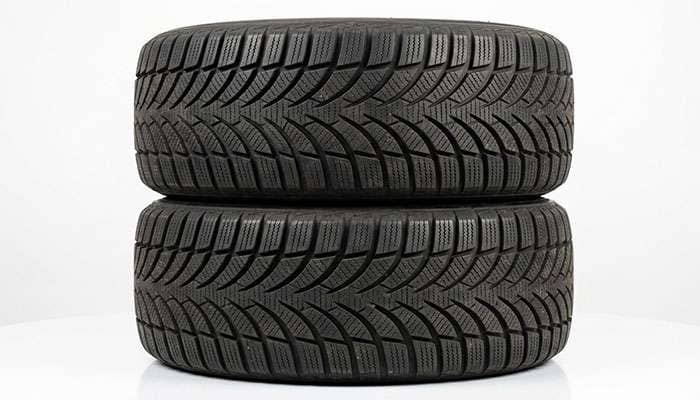
Buy them in September or October, before you need them. Winter tires run on a different rule because the deadline is the weather. Install them when temperatures hold around 45 degrees F, as I laid out in my winter tire timing guide, which means you want them in hand before that week arrives.
The tread math changes too. Winter tires give up their grip well before an all-season gives up its wet braking. Nokian's guidance is to replace winter tires at 5/32, and my number for snow and ice is 6/32. California's Vehicle Code backs that up: snow tires used in place of chains in posted control areas need 6/32 in all major grooves. A winter tire that starts at 10/32 only has about 4/32 of useful life, so measure before the season, not during it.
Rebates on winter lines can arrive late. Bridgestone's $80 offer on its Blizzak line ran November 1 to 30 in 2026, which is after plenty of drivers already need the tires. Don't hold out for it if your size is in stock now. Spring clearance can cost less, but the tire then sits for six months, so check the date code and store it cool, dry, and out of the sun.
Start watching sooner. A typical all-terrain starts around 14/32 to 15/32, which sounds like a long life, but it usually carries about a 50,000-mile warranty. That works out to about 4,200 miles per 32nd, or roughly four months. That's about 40 percent less time per 32nd than a touring tire. From 5/32, you have about four months to reach 4/32 instead of six, so begin shopping at 6/32.
The upside is that each 32nd costs you less. A $1,000 set with 13/32 of usable tread runs about $77 per 32nd. A $100 rebate covers about 1.3 of those, which means buying a little early hurts less than it does on a car. Mud-terrains are harder to call, since most carry no mileage warranty at all. Measure them and use your own rate.
If you drive 5,000 miles a year, tread stops being your deadline. At that pace, a touring tire takes about 18 months to lose one 32nd. You'd need almost nine years to reach 4/32 from new, and age gets there first.
Several automakers, including Ford, Nissan, and Mercedes-Benz, tell owners to replace tires six years after the production date. Continental and Michelin say no later than 10 years. NHTSA hasn't set a limit, so your owner's manual and tire maker are the guides. Your runway here comes from the sidewall, so learn to read your DOT date code. Give yourself about a year of notice before your limit, then buy in the next rebate program.
Classic cars run on the same clock with one difference. Rebate programs cover mainstream lines, so vintage sizes rarely show up on the forms, and specialty sizes tend to come in smaller production runs. If your tires are at their age limit and your size is in stock, buy it. Waiting for a sale that may never apply to your tire gains you nothing.
For a manufacturer rebate, usually yes. Buying two doesn't earn half a rebate. That changes your timing. If your fronts are at 4/32 and your rears still have 7/32, there's no rebate to wait for, so buy the two you need at the best out-the-door price and move on.
If all four are within a 32nd or two of each other, buying the set makes sense, and that's when the rebate calendar matters. On some drivetrains the choice isn't yours anyway. Hank covers that in do you need 2 or 4 tires.
I wouldn't plan on it. Modern Tire Dealer reported in June 2026 that most manufacturer increases that year ran 1 to 4 percent, with some reaching 8 percent in select lines. JP Brooks of Fitment Group described it as "gradual pricing pressure, rather than sharp industry-wide increases," and expected retail prices to trend modestly higher through the end of 2026.
On an $850 set, 1 to 4 percent is $9 to $34. That's less than a typical rebate, so a small increase is no reason to pull tires at 7/32. Nothing points to a drop either, so don't stretch a set past 4/32 hoping for one. Hank covered the bigger picture in how tariffs are moving tire prices.
Past 4/32, you're paying for that rebate in other ways, and the bill climbs as the tread drops:
You're buying the set either way. Waiting past 4/32 doesn't save you $100. It trades stopping distance for $100.
The calendar tells you when tire deals run. Your tread tells you which one you can use. Rebate programs run for months at a time, so you rarely need one specific weekend. You need a reading of 5/32 and a live offer, and from there the choice is straightforward.
Don't buy much earlier than that. One 32nd is worth about what a rebate pays, so pulling good tires for a sale loses money. Don't buy much later either. At 4/32, wet stopping distance has already grown by 43 percent, and no rebate covers that. Measure today, and you'll know exactly how many sales you have left.
No single month owns it. In 2026, major manufacturer rebates ran from March through June and from September through November, with shorter offers from other brands mixed in. Memorial Day, Labor Day, and Black Friday all landed inside those windows. Buy in the first program you can catch once your tread reaches 5/32.
Both seasons have rebate programs, so go with whichever comes first after you reach 5/32. If you have tread to spare, fall usually has the edge because it puts your deepest tread on the car before snow or winter rain arrives.
They can be, but mostly through retailer promotions added to rebates that are already running. In 2026, the Goodyear, Michelin, and Cooper rebates opened in early September and ran through November 30. If your tread is at 4/32 or below in September, don't wait for Black Friday.
Regularly enough that you can plan around them. Big brands run programs that last three to four months, and other brands add one-month offers. If nothing is live for your tire, check again at the start of next month. Most rebates require a set of four and a form filed after the purchase.
At average mileage on an all-season touring tire, about 13 months before you reach the 2/32 wear bars. That doesn't mean you should use all of it. AAA found tires at 4/32 already take 43 percent longer to stop on wet pavement than new tires, so treat 4/32 as the time to buy.
Yes, if you'll be at 5/32 or less when the weather turns, or if you need dedicated winter tires. Buy winter tires in September or October, while size selection is at its best. For snow and ice, plan on replacing tread at 6/32 instead of waiting for 4/32.