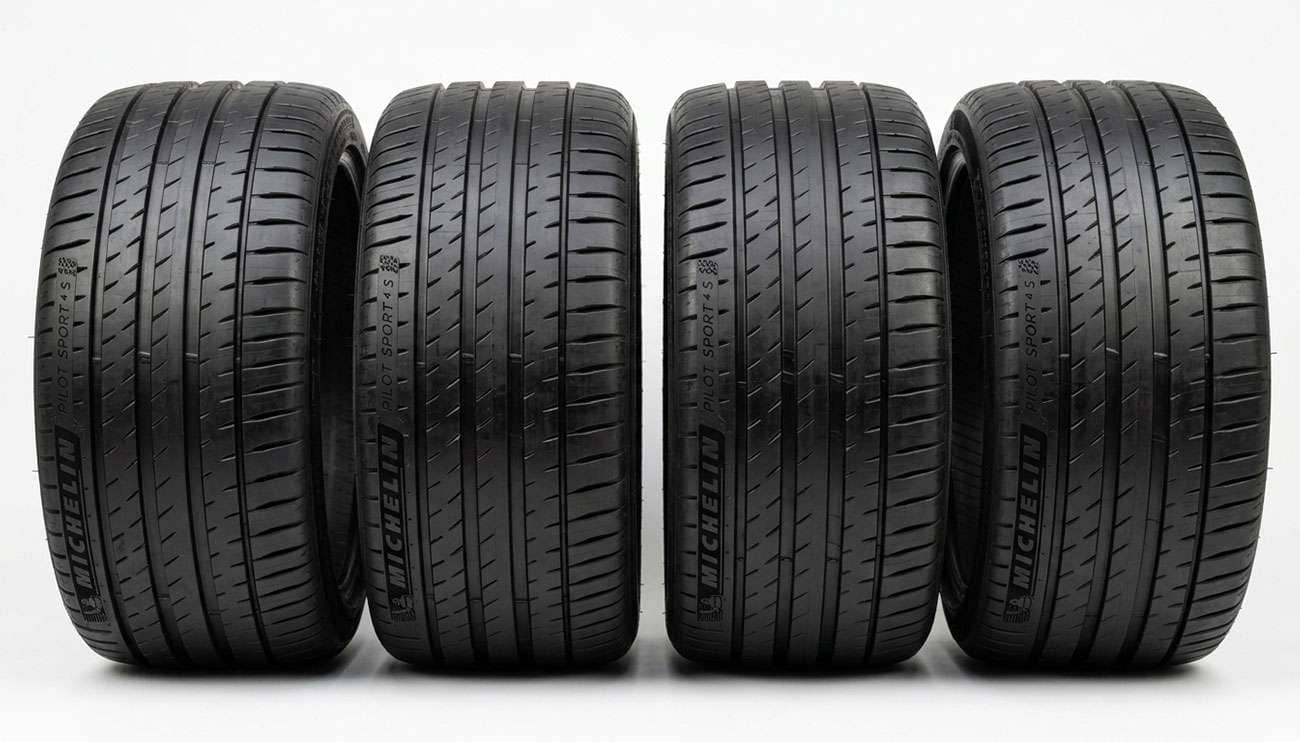
The Continental ExtremeContact DWS06 Plus and the Michelin Pilot Sport All Season 4 are the two highest-rated 245/40R19 tires overall, and both are load index 98 XL. That last part is the piece almost nobody puts in front of you. This size ships in two completely different load ratings, 94 standard load and 98 extra load, and they are not interchangeable. Before you compare ratings, find out which one your door placard calls for. If it says 98, roughly a third of the "best rated" tires you will see recommended are not legal replacements for your car.
I sell tires in this size every week, and the load index is the single most common thing buyers get wrong. Two tires can carry the identical size marking, the identical brand, even the identical tread pattern, and still differ by 176 pounds of rated capacity per corner. Across four corners that is 704 pounds. On a 4,400-pound German sedan, that is not a rounding error.
So the honest answer to "which one is best rated" is: best rated for what load index, in what season, on what construction. Here is the short version.
If your situation is... |
Best-rated pick |
Load index |
Price |
|---|---|---|---|
Year-round driving, some snow, want the highest all-around rating |
Continental ExtremeContact DWS06 Plus |
98 XL |
USD 269.99 |
Year-round driving, want maximum dry and wet grip |
Michelin Pilot Sport All Season 4 |
98 XL |
USD 301.99 |
Warm climate, summer-only set, highest performance rating |
Michelin Pilot Sport 4 S |
98 XL |
USD 309.64 |
Car has no spare tire, needs run-flat construction |
Bridgestone Driveguard Plus |
98 XL |
USD 317.99 |
Real winter, ice and packed snow |
Michelin X-Ice Snow |
98 XL |
USD 387.54 |
Best rating per dollar, all-season |
Yokohama Advan Sport A/S Plus |
98 XL |
USD 221.99 |
Placard says 94, lighter car, want the cheapest correct fit |
Michelin Primacy Tour A/S 94V |
94 SL |
USD 268.45 |
Prices shown are per tire and move with the market. Everything below explains why these won, and where each one gives something up.
Pull up any 245/40R19 listing and you will see the service description at the end of the size: 98Y XL, or 94Y SL. The number is the load index. The letters are the speed rating and the load classification.
Load index 94 is rated for 1,477 pounds per tire. Load index 98 is rated for 1,653 pounds per tire. That is a 176-pound difference at each corner. The reason both exist in the same size is that 245/40R19 spans a wide range of vehicles, from a 3,400-pound coupe to a 4,600-pound executive sedan with adaptive dampers and an all-wheel-drive transfer case.
In the current market for this size, load index 98 XL is by a wide margin the more common build, and 94 SL is the minority. That matters practically: if your car needs 94 and you accidentally buy 98, you are fine. If your car needs 98 and you buy 94, you have under-specified the tire.
Here is the mechanical detail that gets skipped. An extra load tire earns its higher rating by being certified at a higher reference inflation pressure. A standard load passenger tire is rated at its maximum load at roughly 35 to 36 psi. An extra load tire is rated at roughly 41 to 42 psi. The construction is reinforced to survive that pressure, but the rating and the pressure are locked together.
Which means an XL tire inflated to 35 psi carries no more weight than an SL tire at 35 psi. The reinforcement is there. The rated capacity is not, because you have not brought it up to the pressure where the rating applies. If your placard specifies an XL tire and a pressure in the low 40s, and someone sets them at 33 psi "because low-profile tires ride hard," you have quietly given away the capacity you paid for and added heat into a sidewall that is already short.
This is also why swapping between the two is not just a paperwork issue. Sidewall stiffness on a 40-series tire is doing a lot of structural work. There is only 3.86 inches of sidewall between your wheel lip and the pavement. Get the pressure or the rating wrong and the first thing you lose is turn-in response, the second thing is wheel protection over potholes, and the third thing is tread life at the shoulders.
If you want the deeper breakdown of how these ratings are built and how load range differs from load index, we walk through it in load range vs load index.
This size fits an unusually broad slice of the market. Wheel fitment databases list 245/40R19 across roughly 162 car models from more than 50 manufacturers, which is why the "best rated" lists you find are so scattered. They are averaging feedback from drivers of very different cars.
The heaviest concentration sits in three groups.
German executive sedans and coupes. BMW 5 Series from 2009 through 2020, 6 Series, 8 Series, 4 Series Gran Coupe, and the i4. Audi A6, A5, S5, and A4 Allroad. On many of these the 245/40R19 is the front half of a staggered setup with a wider rear, and a good number left the factory on run-flats with no spare in the trunk.
American performance sedans. Cadillac CT5 and CT5-V, older CTS-V and STS, Chevrolet Caprice, Buick Regal and Regal GS, Buick LaCrosse. These skew toward square setups, all four corners the same size, which changes the rotation math considerably.
Japanese luxury and sport sedans. Acura RL, RLX, TL, TLX and TSX. Infiniti Q50 and Q60, where 245/40R19 is a very common 19-inch upgrade over the factory 18s. Various Lexus and Genesis applications depending on trim and year.
If your 245/40R19 is the front of a staggered setup and the rear is a 275/35R19 or 265/35R19, you cannot rotate front to back. That single fact reshapes the buying decision. On a rear-drive staggered car, the rears do the accelerating and wear roughly twice as fast as the fronts. You will replace rears twice for every front set.
So on a staggered car, treadwear rating on the front tire is worth less to you than grip and steering feel, because the front will time out on age before it wears out. On a square car where you can rotate all four, treadwear rating translates directly into money saved. That is a real reason two people can buy the same car and correctly reach different conclusions about the best-rated tire.
We break down the handling and wear consequences of both layouts in our guide to a square vs staggered setup.
This is where most 245/40R19 buyers land, and it is the most competitive category in the size. All-season here does not mean winter capable. It means the compound stays workable below 45 degrees Fahrenheit instead of turning to hockey puck, and there is enough siping to handle cold rain and the occasional slush.
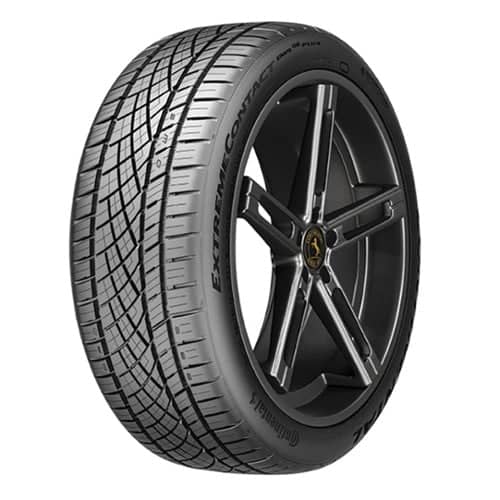
Continental ExtremeContact DWS06 Plus, USD 269.99, 245/40ZR19 98Y XL. This is the tire that shows up at the top of nearly every rating aggregate for the size, and it earns it. The UTQG reads 560 A A with a 50,000-mile treadwear warranty, which is unusually long for a genuine ultra high performance all-season. The DWS in the name refers to the dry, wet and snow indicators molded into the tread, which wear away as the tire ages so you can see at a glance when the snow capability is gone. It is not the sharpest steering tire in this group. What it is, is the one that does the fewest things badly, which is exactly what a rating average rewards. View this tire.
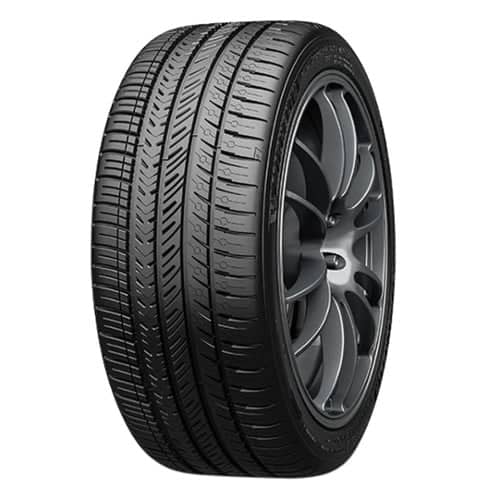
Michelin Pilot Sport All Season 4, USD 301.99, 245/40ZR19 98Y XL. Google's own summary for this size names this tire alongside the Continental, and the two really are the front runners. The Michelin trades treadwear for grip: UTQG 300 AA A against the Continental's 560 A A. That AA traction grade is the top wet grade issued, and you feel it on a cold wet on-ramp. If your car is staggered and the fronts will age out before they wear out, the lower treadwear number costs you nothing and the grip is free. If you rotate all four and drive 20,000 miles a year, the Continental is the smarter buy. We covered this tire in depth in our Michelin Pilot Sport All Season 4 review. View this tire.
Pirelli P Zero All Season Plus 3, USD 289.23, 245/40ZR19 98Y XL. UTQG 560 AA A with a 50,000-mile warranty. On paper this is the most interesting spec sheet in the category, because it holds the Continental's 560 treadwear while carrying the Michelin's AA wet traction grade. In practice it rides slightly firmer than both. Worth a hard look if you want long life and top-grade wet numbers in the same tire. View this tire.
Yokohama Advan Sport A/S Plus, USD 221.99, 245/40ZR19 98Y XL. UTQG 440 AA A and a 55,000-mile warranty, which is the longest mileage warranty of any AA-traction tire in this size. At roughly 80 dollars per tire less than the Michelin, this is the best rating-per-dollar buy in the category and the one I recommend most often to people who want premium behavior without the premium badge. View this tire.
Tire |
UTQG |
Treadwear warranty |
Service description |
Price |
|---|---|---|---|---|
Continental ExtremeContact DWS06 Plus |
560 A A |
50,000 miles |
98Y XL |
USD 269.99 |
Michelin Pilot Sport All Season 4 |
300 AA A |
Not published in this size |
98Y XL |
USD 301.99 |
Pirelli P Zero All Season Plus 3 |
560 AA A |
50,000 miles |
98Y XL |
USD 289.23 |
Yokohama Advan Sport A/S Plus |
440 AA A |
55,000 miles |
98Y XL |
USD 221.99 |
Nitto Motivo |
560 A A |
60,000 miles |
98Y XL |
USD 232.25 |
Bridgestone Potenza Sport AS |
500 AA A |
50,000 miles |
98Y XL |
USD 293.99 |
One note on reading that table. Treadwear numbers are only comparable within a manufacturer, because each brand runs its own reference test. A Continental 560 and a Nitto 560 are not promises of identical mileage. The mileage warranty column is the more honest comparison, because that is a number the manufacturer has to pay out against. If you want the full explanation of what those three UTQG values actually measure, see UTQG tire ratings decoded.
If you live somewhere that does not see sustained temperatures below 45 degrees Fahrenheit, or you keep a second set of wheels for winter, a dedicated summer tire is a significant step up in every performance metric that matters. The compound is built to work in a narrower and hotter window, and inside that window nothing all-season touches it.
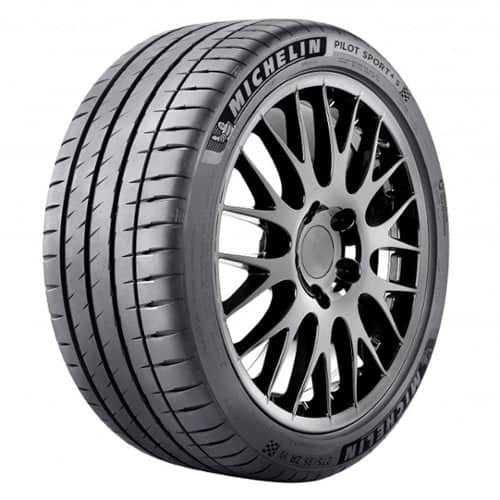
Michelin Pilot Sport 4 S, USD 309.64, 245/40ZR19 98Y XL. The reference point for the entire category and the tire other summer tires get measured against. UTQG 300 AA A with a 30,000-mile warranty, which is generous for a max performance summer tire. What separates it from the pack is that it does not punish you for daily driving. Steering is precise without being nervous, and it handles standing water better than its grip level suggests it should. There is also a 94Y standard load build in this size at USD 363.99 if your placard calls for 94, though most 4 S buyers need the 98. View this tire.
Continental ExtremeContact Sport 02, USD 270.99, 245/40ZR19 98Y XL. UTQG 340 AA A with a 30,000-mile warranty. The value play in this category. Braking and turn-in are within a whisker of the Michelin on a dry road, and you save around 40 dollars per tire. Where it gives ground is in the wet at speed and in noise on coarse pavement. View this tire.
Goodyear Eagle F1 Asymmetric 6, USD 277.99, P245/40R19 98Y XL. UTQG 300 AA A, 30,000-mile warranty. The newest of the Eagle F1 Asymmetric line and noticeably quieter than the 3 it replaced. Strong wet performance. Good pick if you want summer-tire grip on a car you also use for long highway trips. View this tire.
Hankook Ventus S1 Evo3 K127, USD 306.99, 245/40ZR19 98Y XL. UTQG 400 A A. A genuine OE-homologated tire on several European applications, which means it was developed against a specific manufacturer's chassis targets rather than sold purely as aftermarket replacement. Longer wearing than the Michelin at a similar price.
The honest trade with any of these: below about 45 degrees Fahrenheit the compound stiffens and grip falls off sharply, and they should not see snow at all. If your car sits outside through a real winter, the all-season picks above are the correct call even though the summer tires rate higher on paper. We lay out where the crossover point sits in summer vs all-season tires.
A meaningful share of the cars wearing 245/40R19 left the factory with run-flats and no spare, no jack and no lug wrench. If that is your car, this section is not optional reading. Run-flats are a small minority of what is built in this size, roughly one tire in nine, so the field narrows fast.
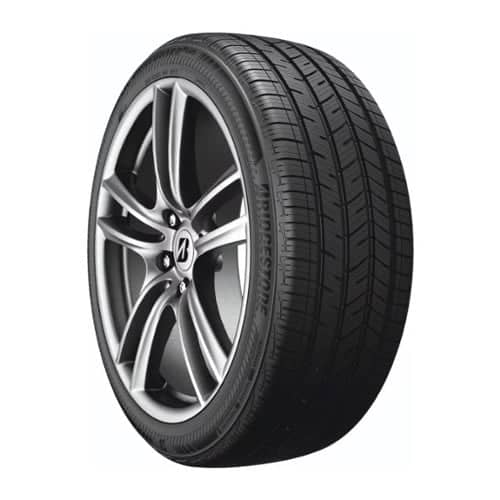
Bridgestone Driveguard Plus, USD 317.99, 245/40ZR19 98W XL. The standout in the category and the highest treadwear grade of any tire in this size, run-flat or not, at UTQG 640 A A with a 65,000-mile warranty. Bridgestone built the Driveguard line specifically to fix the two complaints people have about run-flats, which are harsh ride and short life. It rides better than the original-equipment run-flats it usually replaces and lasts far longer. It is W speed rated rather than Y, so confirm your placard before ordering. View this tire.
Pirelli PZero PZ4 Sport Runflat, USD 368.53, 245/40ZR19 98Y XL. UTQG 280 AA A. This is the performance answer rather than the comfort answer. Y speed rated, AA wet traction, and it is the run-flat that best preserves the steering feel your car had when it was new. Shorter life is the cost. View this tire.
Pirelli Cinturato P7 All Season Runflat, USD 425.74, 245/40R19 98H XL. UTQG 500 A A. The quiet touring option. H speed rating limits it to 130 mph, which is a derate on most of the cars this size fits, so check that your application allows it.
You can, and a lot of people do, but understand what you are trading. The car has no spare and probably no room for one. Going to conventional tires means a puncture at night on the freeway becomes a tow rather than a slow drive to the next exit. The upside is real: better ride, more tire choice, lower cost per tire, and usually a couple pounds less unsprung weight per corner. If you go this route, buy a plug kit and a 12-volt compressor the same day, and put them in the trunk before you drive the car. We go through the full trade in run-flat tires pros and cons.
Winter tires are a small slice of what sells in 245/40R19, which makes sense given where these cars live. But if you park outside in a cold climate, a winter set on the correct size is the single largest safety improvement available to you, and it is not close.
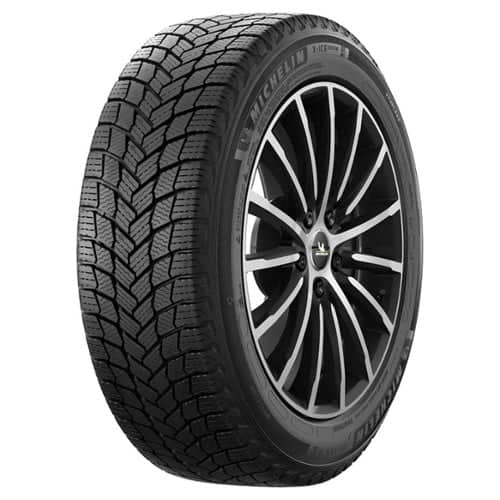
Michelin X-Ice Snow, USD 387.54, 245/40R19 98H XL. The best-rated ice tire available in this size and the one to buy if your winter includes actual ice rather than just cold rain. It carries a 40,000-mile warranty, which almost no winter tire does. View this tire.
Bridgestone Blizzak LM005, USD 343.45, 245/40R19 98V XL. The performance winter answer. V speed rated at 149 mph, so it derates your car far less than the H-rated options, and it handles dry cold pavement with much more composure than a pure ice tire. If most of your winter miles are cold and dry with occasional snow, this is the better pick than the X-Ice. View this tire.
Continental Viking Contact 7, USD 286.51, 245/40R19 98T XL. Strong ice and slush performance at a lower price. The T speed rating caps at 118 mph, which is a significant derate, so treat it as a genuine winter-only tire on a second set of wheels.
Toyo Observe GSi-6, USD 248.59, 245/40ZR19 98V XL. The value pick, V rated, and a real studless winter tire rather than an all-weather compromise.
Notice that every winter tire above is H, V or T rated while your summer or all-season set is probably Y. That is normal and expected. Winter compounds cannot survive Y-rated sustained heat. But it does mean your vehicle's handling limit changes with the season, and on some European cars the manufacturer publishes a specific winter speed limitation to go with it. Some insurers and some state inspection regimes care about this. We explain how the letters map to speeds and when a derate is acceptable in tire speed rating explained.
Not everyone driving a 19-inch low-profile setup wants to spend 1,200 dollars on a set. The good news is that the mid-tier in this size has gotten genuinely competent over the last few years, and there are several tires under 250 dollars that carry proper 98 XL ratings and AA traction grades.
Tire |
Type |
UTQG |
Warranty |
Price |
|---|---|---|---|---|
Kumho Ecsta PA51 |
UHP all-season |
500 AA A |
45,000 miles |
USD 170.99 |
Toyo Proxes Sport A/S |
UHP all-season |
440 AA A |
50,000 miles |
USD 182.08 |
General G-Max AS-05 |
UHP all-season |
500 AA A |
50,000 miles |
USD 222.13 |
Yokohama Advan Sport A/S Plus |
UHP all-season |
440 AA A |
55,000 miles |
USD 221.99 |
Nitto Motivo |
UHP all-season |
560 A A |
60,000 miles |
USD 232.25 |
Falken Azenis FK460 A/S |
UHP all-season |
500 A A |
50,000 miles |
USD 239.00 |
The Kumho Ecsta PA51 is the standout on paper: AA wet traction and a 500 treadwear grade at 171 dollars. It is W rated rather than Y, so check your placard. The Toyo Proxes Sport A/S at 182 dollars is Y rated with AA traction and a 50,000-mile warranty, and it is probably the best all-around value in the entire size.
Below roughly 150 dollars per tire in this size you start seeing brands with limited crash-test history in independent wet braking comparisons, thinner sidewall construction, and warranties that are short or absent. On a car heavy enough to require a 98 XL rating and fast enough to have come with Y-rated tires from the factory, that is a poor place to economize. Pothole resistance and wet braking are the two things a 40-series sidewall is asked to do hardest, and they are precisely where the cheapest tires give ground.
A 245/40R19 stands 26.72 inches tall, is 9.65 inches wide at the section, has 3.86 inches of sidewall, and turns roughly 755 revolutions per mile. Any substitute needs to land inside about 3 percent of that overall diameter or your speedometer, odometer, ABS and stability control calibration all start reading wrong.
Size |
Overall diameter |
Difference |
Revs per mile |
Practical note |
|---|---|---|---|---|
245/40R19 (reference) |
26.72 in |
Baseline |
755 |
Your factory size |
255/40R19 |
27.03 in |
Plus 1.2 percent |
746 |
Widest safe step up, check fender and strut clearance |
235/40R19 |
26.40 in |
Minus 1.2 percent |
764 |
Narrower, cheaper, slightly less dry grip |
225/45R19 |
26.97 in |
Plus 0.9 percent |
748 |
More sidewall, better ride and wheel protection |
265/35R19 |
26.30 in |
Minus 1.6 percent |
767 |
Common staggered rear pairing, not a front substitute |
275/35R19 |
26.58 in |
Minus 0.5 percent |
759 |
The usual staggered rear on BMW applications |
245/45R19 |
27.68 in |
Plus 3.6 percent |
729 |
Outside tolerance, expect speedometer error |
Two things worth saying plainly about that table. First, the practical winner as a substitute is 225/45R19. It is within 1 percent on diameter, it adds a tenth of an inch of sidewall, and on a car that lives on broken city pavement that extra rubber is real wheel insurance. You give up a little dry cornering grip you were probably never using.
Second, 265/35R19 and 275/35R19 appear on this list because they are the rear halves of common staggered setups, not because they substitute for the front. If your rears are 275/35R19, that is by design and you should keep it that way. Squaring up a factory-staggered car changes the handling balance the chassis engineers tuned, and on some all-wheel-drive applications it will confuse the center differential.
Any substitution also has to carry the same load index or higher. A 235/40R19 in 96 XL does not replace a 245/40R19 in 98 XL, no matter how close the diameter lands.
Yes. Walmart carries this size online and can install at any of its 2,500-plus Auto Care Centers nationwide, and their installation pricing is competitive with independent shops.
There are two things worth knowing before you go that route, and neither is a knock on the retailer.
The first is selection. National retail assortments in a low-profile ultra high performance size skew toward whatever moves in volume, which tends to mean the touring and budget end of the range rather than the specific 98Y XL summer or run-flat build your car may require. If you need a particular construction, verify the exact service description on the listing rather than just the size.
The second is their fitment policy, which is actually helpful to you. Walmart's stated standard is that the tire size must match the vehicle's door placard and the load rating must meet or exceed it. Some locations enforce that more tightly than others. If your car came on 98 XL and you order a 94 SL because it was cheaper, expect the appointment to go sideways. Their policy exists for the same reason this article opened with load index: it is the failure mode that actually shows up.
For run-flats, staggered fitments, or anything requiring a TPMS sensor relearn on a European car, call ahead and confirm the location handles it. Straightforward, close-to-factory-spec jobs are where any high-volume installer performs best.
Asked at the brand level, this question does not have a clean answer, and anyone who gives you one is simplifying. Michelin, Continental, Bridgestone, Goodyear and Pirelli all build excellent tires and all build ordinary ones. What matters is the specific model in the specific size, because a single brand's lineup spans a huge quality range.
What you can do is judge reliability by evidence rather than reputation. Three signals actually predict it.
The mileage warranty is the strongest signal. It is the only number on the sheet the manufacturer has to write a check against. A 60,000-mile warranty on a Nitto Motivo means Nitto has run enough validation to accept that liability. A tire with no published mileage warranty in this size is telling you something too.
The UTQG traction grade is the second. The grades run AA, A, B and C, measured as wet coefficient of friction on standardized surfaces under a Department of Transportation test procedure. AA is the top grade and it is not handed out casually. In 245/40R19 the AA-rated tires include the Michelin Pilot Sport All Season 4, Pilot Sport 4 S, Pirelli P Zero All Season Plus 3, Yokohama Advan Sport A/S Plus, Toyo Proxes Sport A/S, Kumho Ecsta PA51 and General G-Max AS-05. That list crosses price tiers, which tells you the grade is measuring something real rather than tracking brand prestige.
Original equipment homologation is the third. A tire developed to a specific automaker's specification carries a marking on the sidewall: MO or MOE for Mercedes-Benz, AO for Audi, a star for BMW, N0 through N5 for Porsche, RO1 for Audi Sport. Those tires went through the manufacturer's own validation program on that chassis. If your car came with a marked tire, buying the same marking is the closest thing to a guarantee that the car will behave the way it was signed off to behave.
Practically: pick the model, not the badge. In this size, the Continental ExtremeContact DWS06 Plus and the Michelin Pilot Sport All Season 4 are the two most consistently well-reviewed tires across every rating source, and both back it with AA or long-warranty credentials.
Nineteen-inch is a big category, and 245/40R19 sits toward the performance end of it. The question of what is best for your specific car comes down to four inputs, in this order.
Run those four filters and the 217 models available in this size collapse to maybe six real candidates. At that point the ratings actually mean something, because you are comparing tires that could genuinely go on your car.
The most common mistake I see is people starting with the ratings and working backward. They find a highly reviewed tire, then discover at the installer that it is the wrong load index or the wrong construction. Start with your placard, not with a review.
The Continental ExtremeContact DWS06 Plus and the Michelin Pilot Sport All Season 4 are the two best-rated 245/40R19 tires by consensus, and either is a defensible buy for most drivers. But the rating is the last thing you should look at, not the first. This size splits into 94 standard load and 98 extra load builds that carry a 176-pound difference in capacity per corner, and it splits again into run-flat and conventional construction depending on whether your car has a spare. Get those two filters right and any of the tires in this article will serve you well. Get them wrong and it does not matter how many stars the tire has.
Check your placard, note the load index, then shop the full range of 245/40R19 tires filtered to what your car actually calls for.
The Continental ExtremeContact DWS06 Plus and the Michelin Pilot Sport All Season 4 are the two highest-rated 245/40R19 tires overall, both in 98Y XL. The Continental wins on treadwear at UTQG 560 with a 50,000-mile warranty, while the Michelin wins on grip with an AA wet traction grade. Which one is right for you depends on whether your car is staggered, since a staggered front tire ages out before it wears out and grip is worth more than treadwear.
Roughly 162 models across more than 50 manufacturers use this size. The largest groups are German executive cars including the BMW 5 Series, 6 Series, 8 Series, 4 Series Gran Coupe and i4, plus Audi A5, A6, S5 and A4 Allroad; American performance sedans including the Cadillac CT5 and CT5-V, Buick Regal and Chevrolet Caprice; and Japanese luxury sedans including the Acura RL, RLX, TL and TLX and the Infiniti Q50 and Q60. On many German applications it is the front of a staggered setup rather than a square set of four.
Yes, Walmart carries this size online and installs at more than 2,500 Auto Care Centers nationwide. Two caveats: national retail selection in a low-profile ultra high performance size tends toward touring and budget models rather than the specific 98Y XL summer or run-flat builds many of these cars require, and Walmart's stated policy is that the size must match your door placard with a load rating that meets or exceeds it. Verify the full service description on the listing, not just the size.
A 245/40R19 stands 26.72 inches tall and turns about 755 revolutions per mile. The closest substitutes inside a 3 percent diameter tolerance are 225/45R19 at plus 0.9 percent, 255/40R19 at plus 1.2 percent and 235/40R19 at minus 1.2 percent. The 225/45R19 is the most practical swap because the extra sidewall improves ride and wheel protection. Sizes like 265/35R19 and 275/35R19 are staggered rear pairings rather than front substitutes. Any alternative must carry the same load index or higher.
Reliability lives at the model level, not the brand level, because every major manufacturer builds both excellent and ordinary tires. Judge it on three signals: the mileage warranty, which is the number the manufacturer has to pay out against; the UTQG traction grade, where AA is the top wet grade issued under Department of Transportation test procedure; and original equipment homologation markings such as MO, AO, a BMW star, N-spec or RO1, which mean the tire was validated on that specific chassis. In 245/40R19, Continental and Michelin lead the consensus ratings.
Filter in this order: load index from the door placard, construction (run-flat or conventional), season, and layout (square or staggered). Those four filters cut the 217 models available in 245/40R19 down to about six real candidates for your car. Only then do ratings become meaningful, because you are comparing tires that can actually go on the vehicle. Starting with a highly rated tire and working backward is how people end up with the wrong load index at the installer.
Load index 94 is rated for 1,477 pounds per tire and load index 98 for 1,653 pounds, a 176-pound difference per corner or 704 pounds across four. The 98 build is an extra load construction certified at a higher inflation pressure, roughly 41 to 42 psi versus 35 to 36 psi for standard load. Critically, an XL tire only delivers its higher rating when inflated to that higher pressure, so running an XL tire at standard load pressure gives away the capacity you paid for.