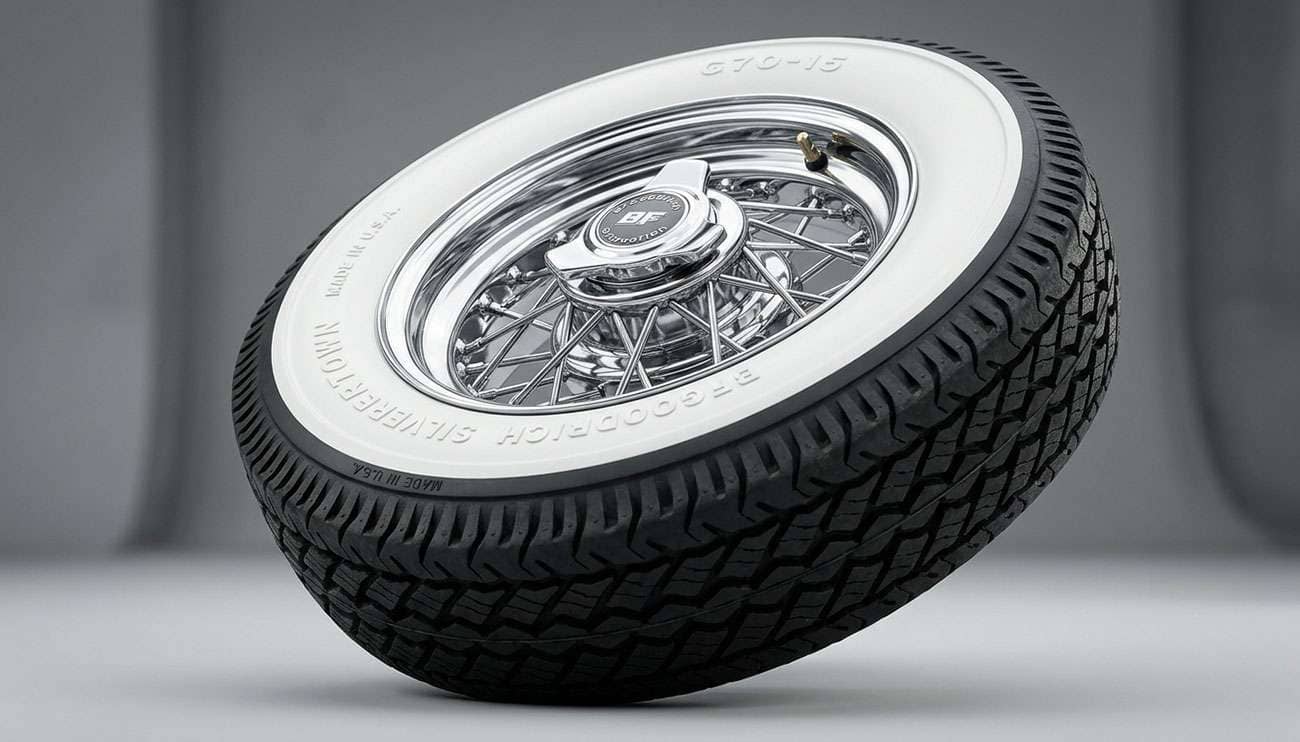
Customer walked into my shop a couple months back, gorgeous '66 Mustang coupe sitting out front, looking for a set of period-correct whitewalls. I gave him the quote. His face did that thing — the slow blink, the second look at the receipt, the "I'm sorry, for how many tires?" He wasn't being rude. He just could not figure out how four tires for his grandmother's car cost about what he'd paid for a set of all-season radials on his F-150 a month earlier. And his F-150 tires were newer, wider, and built with more advanced technology.
I get this reaction from three or four customers a month. Sometimes more during car show season. Every single time, the explanation is the same, because the reasons vintage-correct tires cost what they cost haven't changed in fifty years. There's no price gouging going on. There's no conspiracy between the specialty tire shops. The actual manufacturing and supply economics of producing low-volume period-correct rubber means a set of Coker whitewalls, American Classic bias-look radials, or Diamond Back redlines will always cost multiples of what standard passenger car tires cost at the corner shop.
Let me walk you through where the money actually goes.
Before we talk price, we need to be clear about what we're pricing. "Vintage-correct tires" is a broad category that covers several different products, each with different cost structures.
Authentic bias-ply construction. True bias-ply tires built the way they were built in the 1960s — diagonal cord construction, period-correct tread patterns, authentic sidewall profiles. These are as close to the original as modern DOT law allows. Coker Tire's Bias-Look line, some Firestone and Goodyear reproductions. Priciest end of the market for an honest reason: the construction process hasn't been updated to modern efficiency, because updating it would eliminate the whole point.
Radial construction with vintage styling. Modern radial tire construction underneath, period-correct sidewall appearance on top. The American Classic Bias Look Radial line, Diamond Back radial whitewalls, Coker Classic Radial. These ride and handle like modern tires but look right on a classic. Still costly, but somewhat less than pure bias-ply reproductions. For the construction difference, see our breakdown on bias-ply vs. radial tires for classic cars.
Period-correct-sized modern tires. Standard modern tires that happen to come in sizes and styles that fit classic cars — narrow whitewalls, raised white letter rubber, tall-sidewall truck tires. These can be more reasonably priced because the tire is a current production piece that happens to cross into the classic market.
Whitewall, redline, gold line, and blue line variants. Specialty appearance upgrades applied to any of the above. Each colored sidewall treatment adds significant cost to the base tire.
The pricing ranges I'm going to walk through hit all four of these categories, because a customer shopping for vintage-correct tires is rarely comparing within just one category.
Here's the context that makes the sticker shock make sense. A modern all-season tire for a commuter sedan typically runs $120 to $200 per tire at mainstream tire shops. A performance all-season for a sports sedan might hit $250 to $350. Premium winter rubber, $300 to $400.
Vintage-correct tires run the gauntlet from about $180 per tire at the affordable end to $500 and up for wide whitewall bias-ply reproductions on large luxury cars. A set of four can easily hit $1,800 to $2,200 installed, sometimes more.
The customer comparing that to his daily driver's rubber bill is doing fair math on unfair comparisons. These aren't the same product produced by the same process at the same scale. The modern all-season came off an automated production line that spits out tens of thousands of identical tires per shift. The vintage-correct reproduction came off a much smaller line that might produce a few hundred tires per day across dozens of sizes and styles. Every economic factor that keeps modern tires affordable — massive scale, automated quality control, standardized compounds, high-volume logistics — works in reverse for vintage-correct rubber.
Six specific cost drivers do the work.
This is the single biggest cost driver, and everything else flows from it. A mainstream tire model — say, a Michelin Defender 2 — sells millions of units per year across dozens of sizes. That production volume spreads every fixed cost (engineering, molds, DOT testing, equipment amortization) across a huge number of tires, which drives the per-tire fixed cost down to pocket change.
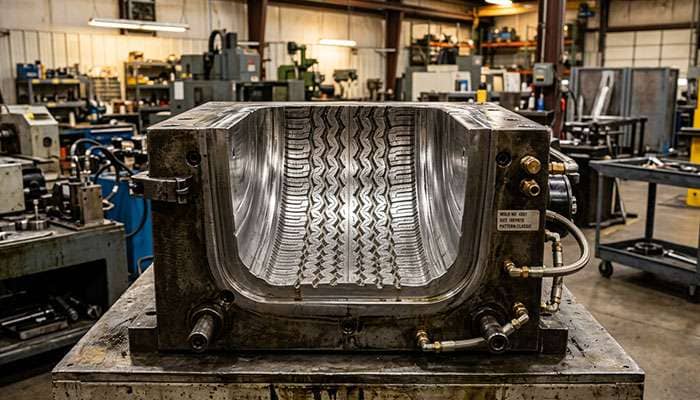
A vintage-correct tire reproduction might sell a few hundred to a few thousand units per year across all sizes combined. The same fixed costs — engineering, mold, testing, equipment — spread across dramatically fewer tires, which means each individual tire carries a much bigger share of the fixed overhead. That fixed-cost load alone can add $100 to $200 to the price before you've touched rubber or labor.
This isn't a temporary market condition that will fix itself. It's baked into the definition of "vintage-correct." There's no version of the market where sales volumes of period-correct tires ramp up enough to amortize the fixed costs the way mainstream tire production does. The classic car owner base is what it is, and it's not growing fast enough to change the economics.
Every tire size and style requires its own steel or aluminum mold — a precision-machined set of cavities that gives the tire its shape, sidewall detail, tread pattern, and sidewall markings. A production mold for a modern passenger tire costs anywhere from $40,000 to $120,000 depending on complexity.
A period-correct vintage tire typically has its own dedicated mold, and that mold only serves one size. There's no efficiency in reusing a 1970s Firestone Wide Oval mold for any other application. The mold exists, it was expensive to build or retool, and it has to pay for itself through sales of one specific tire size.
When a specialty tire company decides to reproduce a long-out-of-production classic tire, the mold cost is often the single largest expense of the whole project. That cost is amortized over the expected life of the reproduction, and the expected sales volume. You can do the math — if a $100,000 mold has to be paid for by selling 5,000 tires across its service life, that's $20 per tire in mold amortization alone.
Every size added to a product line means another mold. Which is why specialty tire companies tend to stay conservative about offering new sizes in a reproduction line — each additional size is a major capital commitment.
Tire rubber isn't one material. It's several — a tread compound, a sidewall compound, inner liner compound, bead-area compound, and on some tires specialty compounds for whitewalls, raised lettering, or colored stripes. Each compound is a formulated recipe of natural and synthetic rubbers, carbon black, silica, antioxidants, antiozonants, and vulcanization agents.
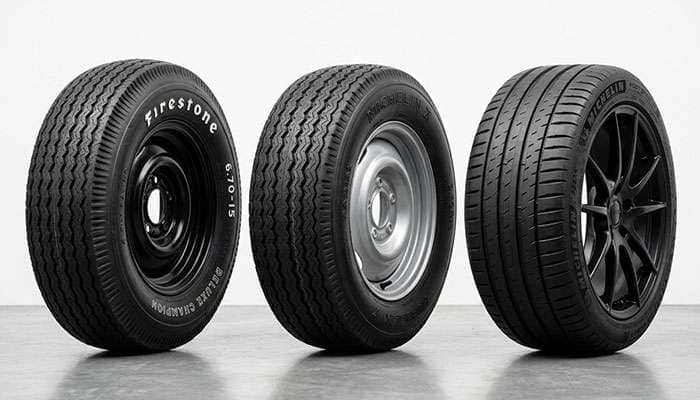
Modern mainstream tires use compounds engineered for maximum tread life, fuel efficiency, and wet-weather grip. Vintage-correct tires use compounds engineered to deliver the period-correct ride quality, appearance, and driving characteristics. Sometimes that means matching specific period traits — the softer sidewall flex of a 1960s bias-ply, the narrower noise signature of a vintage tread pattern, the specific black-rubber tone that photographs right alongside polished chrome.
Custom compound batches cost more than standard ones. Small-batch rubber mixing, separate compounding runs, and quality control that verifies the compound against period specifications all add cost. A specialty whitewall tire may require three or four different rubber compounds in a single tire — white rubber for the sidewall face, black rubber for everything else, specialty cover compound between them, bead compound at the rim contact area.
Multiply those compound costs by the low-volume production we already discussed, and the material cost per tire climbs substantially above what a single-compound modern radial would run.
Automated modern tire production minimizes human labor. A single worker might oversee multiple machines producing hundreds of tires per shift. Vintage-correct tire production can't be automated to the same degree because the details that make a tire "vintage-correct" are often the details that resist automation.
Whitewall tire production is the textbook example. The white rubber strip has to be assembled into the tire during the build process — typically by hand or with semi-automated equipment that still requires operator attention. After the tire is cured, the white sidewall area often requires hand-finishing to remove mold flash, trim any excess rubber, and achieve the pristine appearance that customers expect. Quality control for whitewall tires is particularly stringent — any stain, blemish, or inconsistency that would be invisible on a blackwall tire is grounds for rejection on a whitewall. Entire production runs can be rejected for issues that would have passed on mainstream production.
Bias-ply reproduction tires require similar manual attention. The cord assembly process in bias construction is different from radial construction, and the equipment that does it may be older and more operator-dependent. Inspection tolerances are tighter because these tires will be installed on vehicles that their owners have spent years restoring — any visible defect goes back to the production line.
All of that manual labor and rigorous quality control costs money that modern automated tire production doesn't incur.
Every tire sold for highway use in the United States has to meet Department of Transportation safety standards. DOT compliance testing is mandatory, expensive, and recurrent — it's not a one-time expense at product launch.
A full DOT compliance test for a new tire size runs into the tens of thousands of dollars. That's destructive testing — actual tires get destroyed in the process of verifying that they meet high-speed, load, and endurance requirements. A specialty tire manufacturer producing a low-volume reproduction has to amortize those testing costs across a much smaller production run than a mainstream manufacturer does.
The period-correct bias-ply and bias-look radial tires produced today often have to be re-tested when compound formulations change, when production facilities change, or on a periodic basis mandated by DOT rules. That's another recurring cost borne entirely by a small customer base.
This is also why some long-out-of-production classic tire designs are never reproduced at all — the math on DOT testing for an ultra-narrow-market tire simply doesn't work. The owner who wants the exact original spec for his 1938 Packard may have to settle for the closest modern equivalent, or accept used vintage rubber with all the risks that carries. Our guide on whether vintage tires are safe to use covers that decision.
A significant percentage of vintage-correct tires are produced outside the United States. Specialty tire manufacturers in places like the U.K., Mexico, and various Asian countries service the global classic car market. Import duties, shipping costs, and domestic distribution all stack on top of the base manufacturing cost.
For American classic car owners, this means the tire that leaves a specialty factory at $200 in manufacturing cost may arrive at the domestic distributor at $280, move through distribution to a retailer at $340, and hit the shop at $400 before markup and installation labor. Every step in the supply chain takes its margin, and low-volume specialty distribution doesn't have the scale efficiencies that mainstream tire distribution has.
Tariff shifts make this worse. Any change in trade policy that affects tire imports produces immediate pricing impact on vintage-correct tires because the supply base is narrow and not easily shifted. A 10 percent tariff adjustment on imported tires translates directly to a 10 percent price increase on vintage-correct rubber within weeks.
The domestic production of vintage-correct tires exists — Coker Tire manufactures in the U.S., Diamond Back distributes domestically — but the raw material supply, specialty compound sourcing, and aftermarket parts for specialty tire production equipment often come from international suppliers whose costs flow through to the finished product.
On top of the baseline vintage-correct pricing, specialty sidewall treatments add their own premium. Understanding this premium helps buyers decide where to spend.
Whitewall tires. Typically 25 to 40 percent more than the equivalent blackwall. A classic whitewall Radial T/A runs noticeably above a blackwall Radial T/A in the same size. For the deep dive on this specific premium, see our article on why whitewall tires are so expensive.
Redline tires. Specialty red stripe sidewalls popularized by Pontiac GTO, Firebird Trans Am, and Mustang applications. Similar or slightly higher premium than whitewalls because production volumes are even lower. Expect to pay 30 to 50 percent more than blackwall equivalents.
Gold line tires. The Vogue Tyre signature with a thin gold stripe at the whitewall edge. Used on Cadillac, Lincoln, and luxury Ford products. Typically pricier than standard whitewalls because of the additional production step for the gold compound.
Blue line tires. Diamond Back specialty product offered in various widths. Priced similar to redlines, lower volumes than whitewalls.
Raised white letter variants. On tires like the BFGoodrich Radial T/A, the raised white letter version typically carries a modest premium over a plain blackwall but much less than a full whitewall — usually 5 to 15 percent more. For the full picture on RWL tires, see our companion article on raised white letter tires and which way they face.
Here's what the pricing actually looks like across the vintage-correct tire market as of 2026. Numbers are approximate — they shift with raw material costs, supplier changes, and demand — but these ranges hold across most sizes.
Category |
Typical Price Per Tire |
What You're Getting |
|---|---|---|
Modern blackwall in classic size |
$150–$280 |
Standard modern radial that happens to come in a size fitting a classic car. Affordable entry point, but cosmetically obvious as a non-period tire. |
Raised white letter modern classic (BFG T/A, Mickey Thompson, Cooper Cobra) |
$180–$320 |
Modern radial construction with period-correct raised white lettering. The standard choice for 1970s-1980s muscle car applications. |
Narrow whitewall radials (American Classic, Coker Classic Radial, Diamond Back) |
$200–$370 |
Radial construction with period-correct narrow whitewall styling. Popular for 1950s–1970s cruisers and luxury classics. |
Wide whitewall radials |
$275–$450 |
Radial construction with wide 2.5" to 3.5" whitewall styling. Standard for 1940s–1950s luxury cars and custom builds. |
Authentic bias-ply reproduction |
$250–$500 |
Period-correct bias-ply construction. Concours-quality authentic reproduction. Highest authenticity, shortest service life, requires careful maintenance and storage. |
Specialty sidewall treatments (redline, gold line, blue line) |
$275–$500+ |
Base radial or bias construction with specialty colored sidewall stripes. Lower production volumes push pricing higher than standard whitewalls. |
A full set of four tires plus mounting, balancing, and new valve stems typically adds another $100 to $200 to these numbers. Expect total out-the-door pricing for a quality vintage-correct installation to hit $1,200 at the low end and $2,500 at the authentic-bias-ply concours end.
Not every classic car owner needs to spend top-dollar on period-correct rubber. The decision comes down to how you use the car and what you value.
Concours and investment cars. Authentic bias-ply reproductions with correct sidewall markings and period-correct construction. The extra authenticity protects resale value and scores at judged events. For these owners, the premium is part of the investment math.
Show cars that drive occasionally. Radial-construction vintage-styled tires with whitewall, redline, or gold line treatments. Combines period-correct appearance with modern safety and ride quality. Middle of the road on price, most popular category for serious classic owners.
Weekend drivers and cruisers. Modern radial with vintage styling (narrow whitewall, raised white letters). Matches the look well enough at cruise nights and Cars and Coffee without hitting the wallet as hard. Good longevity, modern handling and safety.
Daily-driven classics. Modern blackwalls in classic sizes, or the most affordable radial-with-vintage-styling options. Prioritize safety, longevity, and budget over period-correct appearance. A classic that gets driven to work every day needs tires that perform more than they need tires that photograph perfectly.
Longevity math matters here too. Vintage-correct tires age on the calendar, not just the odometer. A $450-per-tire set of authentic bias-ply whitewalls that sees 2,000 miles a year will need replacement in six to eight years based on age alone, regardless of tread depth. That works out to considerably more per-mile cost than a modern radial with a 50,000-mile tread warranty. Our guide on when classic car tires should be replaced covers this in detail.
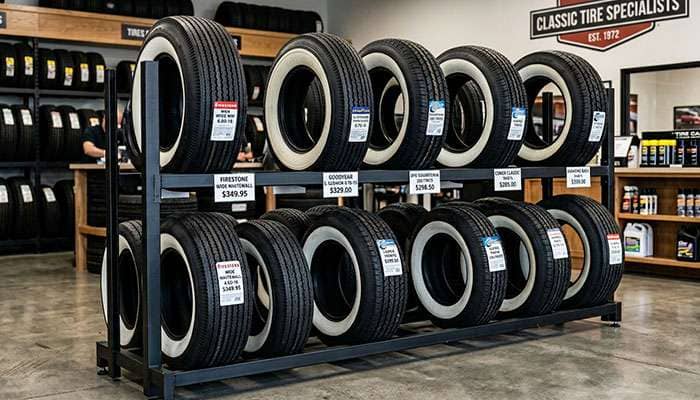
The price of vintage-correct tires has always shocked new classic car owners, and it's going to keep shocking them because the economics that produce those prices aren't changing. Low production volumes, specialized molds, period-correct compounds, manual labor, DOT compliance testing, and narrow supply chains stack together to produce pricing that looks steep compared to mainstream tire shopping. None of that is gouging. That's just what it costs to make a few hundred thousand tires per year across dozens of specialty SKUs for an enthusiast market.
The good news is that the vintage-correct tire market offers choices at every price point. A budget-conscious classic owner can get into radial-with-vintage-styling tires for not much more than premium modern rubber. Show-car owners who want the full effect can get it — they just pay more for the privilege. And authentic concours-grade bias-ply reproductions exist at the top of the market for owners who demand it.
If you're shopping for a set of vintage-correct tires and trying to figure out where to spend and where to save, come see us at Performance Plus Tire. We stock the full range — Coker, American Classic, Diamond Back, BFGoodrich, Cooper, Mickey Thompson — and can match the right level of authenticity to how you actually use the car.
Six specific factors drive the price: low production volumes that spread fixed costs across fewer tires, specialized single-purpose molds, period-correct rubber compounds in multiple formulations per tire, manual labor and rigorous quality control that resist automation, recurring DOT compliance testing costs, and narrow import supply chains. The combined effect produces pricing that runs 2 to 4 times the cost of mainstream tires in comparable sizes.
Vintage-correct tires use period-correct construction (often bias-ply), period-correct compounds, and authentic sidewall detail. Modern tires with vintage styling use modern radial construction and modern compounds but add period-correct appearance elements like narrow whitewalls or raised white lettering. The vintage-correct category costs significantly more but delivers the full authentic look; the vintage-styled category offers 80 percent of the visual effect at 60 to 70 percent of the cost.
Yes, typically 25 to 40 percent more than equivalent blackwall tires. Whitewall production requires a separate white rubber compound, additional manufacturing steps to integrate the white sidewall into the tire build, stringent quality control that rejects tires with blemishes invisible on blackwalls, and hand-finishing work after curing. These factors combined make whitewall tires meaningfully pricier across every construction type.
For concours-level restorations, investment-grade classics, or owners who value maximum authenticity, yes. For owners who drive their classics regularly, radial-construction tires with vintage styling typically deliver better safety, longer service life, and more consistent performance at a meaningfully lower price. The authentic bias-ply premium mostly rewards judging criteria and resale value in specific markets, not everyday driving.
Vintage-correct tires age on the calendar, not just the odometer. Most tire manufacturers recommend replacement at six years from the DOT date code regardless of tread depth, and mandatory replacement at ten years. A low-mileage classic driven 2,000 miles a year will need tire replacement based on age long before the tread wears out. Factor calendar lifespan into the per-mile cost calculation when comparing vintage-correct pricing to mainstream tire pricing.
Raised white letter modern radials from BFGoodrich, Cooper, or Mickey Thompson typically offer the best combination of affordable pricing, modern performance, and period-correct appearance for 1970s and 1980s muscle cars. For 1950s and 1960s cruiser applications, narrow whitewall radials from American Classic or Diamond Back entry-level lines deliver authentic looks at the lower end of the vintage-correct tire market. Modern blackwalls in classic sizes are the absolute cheapest option but sacrifice the vintage visual effect.