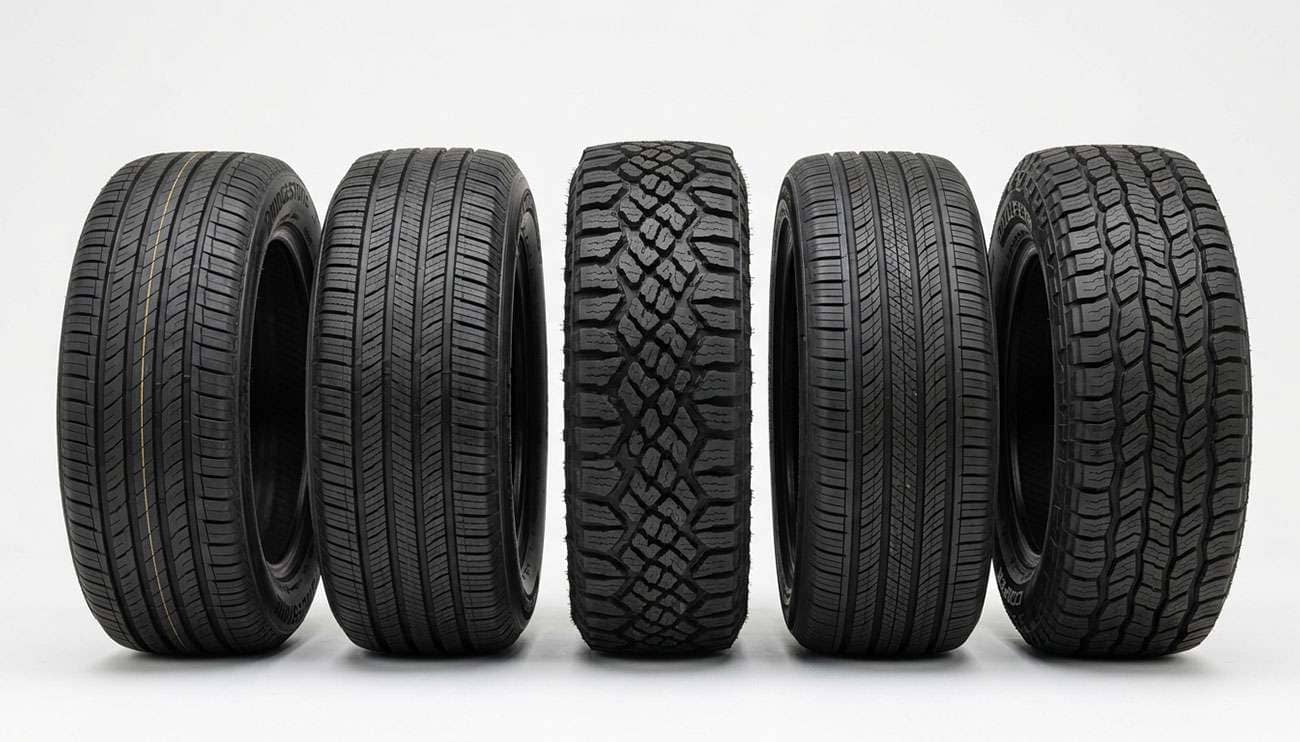
Short answer: Every major brand sold in America imports some of its tires, including Goodyear, Michelin, Bridgestone, and BFGoodrich. Meanwhile, several "foreign" brands build tires in Tennessee, Georgia, and South Carolina. Brands with no U.S. tire plant at all in 2026 include Falken, Nexen, Kenda, Maxxis, Federal, Westlake, Sailun, and Linglong. But the brand is the wrong place to look. Tire companies assign production size by size, so one model can come from Ohio in a 17-inch size and from Mexico or Thailand in a 20-inch. The plant code molded into your specific tire is the only answer that holds.
Most lists stop at "it depends on the size." That's where the useful part starts. I spend my days on fitment at Performance Plus Tire, and the origin question always comes back to one thing: which factory got the mold for your size. Below is how that works, how to read it off the sidewall in under a minute, and why the code changed format in April 2025.
Start with what you're buying. Category and size predict where a tire is built far better than the brand name does.
What You're Buying |
Where It's Usually Built |
Does the Brand Tell You? |
What to Check |
|---|---|---|---|
Mainstream all-season, 15 to 18 inch, major brand |
Often a North American plant (U.S., Canada, or Mexico), with some sizes from Asia |
Partly |
"Made in" line and plant code on your exact size |
LT all-terrain or highway truck tire |
U.S., Mexico, Canada, Japan, and Southeast Asia, often split within one model |
No, it varies by size |
Plant code on your size, plus load range |
19 inch and up performance or summer tire |
Frequently Europe, Japan, Korea, or Southeast Asia |
Rarely |
Plant code and four-digit date code |
Winter or studdable tire |
Nordic Europe, Japan, and Korea, with a few North American plants |
Partly |
Plant code and the Three-Peak Mountain Snowflake symbol |
Value or economy brand |
Mostly Asia: Thailand, Vietnam, Cambodia, Indonesia, China |
Usually, since few have U.S. plants |
Date code and UTQG grades |
ST trailer tire |
Mostly Asia |
Usually |
Load range and max load versus loaded trailer weight |
Vintage bias-ply or reproduction tire |
Small U.S. specialty plants and overseas plants using reproduction molds |
No, the box name is the mold owner |
Plant code, or ask the maker directly |
As of October 2026, these brands sold in America have no U.S. tire plant. Every one of their tires is imported.
Now the part most brand lists leave out: several brands people assume are imported build a real share of their U.S. tires right here. Hankook builds in Clarksville, Tennessee. Kumho builds in Macon, Georgia. Toyo and Nitto come out of White, Georgia. Yokohama builds in Salem, Virginia. Nokian builds all-season and all-weather tires in Dayton, Tennessee. Giti builds GT Radial tires in Richburg, South Carolina.
Here's the 2026 footprint by brand family. Use it when the question is "could my brand even be U.S.-built?"
Brand Family |
U.S. Tire Plants (2026) |
Also Ships U.S. Tires From |
Bottom Line |
|---|---|---|---|
Goodyear, Cooper |
Lawton, OK; Findlay, OH; Tupelo, MS; Texarkana, AR; Fayetteville, NC (closing by end of 2027) |
Canada, Mexico, Latin America, Asia |
Check your size |
Michelin, BFGoodrich |
Several South Carolina plants; Fort Wayne, IN; Tuscaloosa, AL (BFGoodrich winding down by end of 2028) |
Canada, Mexico, Europe, Thailand |
Check your size |
Bridgestone, Firestone |
Wilson, NC; Aiken County, SC |
Canada, Mexico, Japan, Asia |
Check your size |
Continental, General |
Mount Vernon, IL; Sumter, SC |
Mexico, Europe, Thailand |
Check your size |
Hankook |
Clarksville, TN |
Korea, Hungary, Indonesia, China |
Some sizes U.S.-built |
Kumho |
Macon, GA |
Korea, China, Vietnam |
Some sizes U.S.-built |
Toyo, Nitto |
White, GA |
Japan, Malaysia, Serbia |
Many sizes U.S.-built |
Yokohama |
Salem, VA; West Point, MS (truck tires) |
Japan and other Asian plants |
Some sizes U.S.-built |
Nokian |
Dayton, TN |
Finland, Romania |
All-season lines often U.S.-built; winter lines mostly imported |
Giti, GT Radial |
Richburg, SC |
China, Indonesia |
Some sizes U.S.-built |
Pirelli |
Rome, GA (small, high-performance) |
Mexico, Europe, Brazil |
Mostly imported |
Falken, Sumitomo |
None since the Tonawanda, NY closure |
Japan, Thailand, Turkey, Brazil |
Imported |
Nexen |
None (U.S. plant on hold) |
Korea, Czech Republic, China |
Imported |
Kenda, Maxxis, Federal |
None |
Taiwan, China, Southeast Asia |
Imported |
Westlake, Sailun, Linglong |
None |
China, Thailand, Vietnam, Cambodia, Serbia |
Imported |
Treat this as a 2026 snapshot. Plant footprints are moving fast, even for brands with deep American roots.
Yes, routinely. An American headquarters, or a big American plant footprint, doesn't mean your size came from it.
Goodyear, headquartered in Akron, bought Cooper in 2021. Its U.S. consumer tires come from Lawton, Oklahoma and the former Cooper plants in Ohio, Mississippi, and Arkansas, and Goodyear plans to close its Fayetteville, North Carolina plant by the end of 2027. It also builds in Canada, Mexico, Latin America, and Asia, and sizes sold here come from those plants too.
Michelin is French but one of the largest tire manufacturers in the U.S. It ended production at Ardmore, Oklahoma in 2025, and in June 2026 announced that BFGoodrich production in Tuscaloosa, Alabama will wind down by the end of 2028, consolidating into Fort Wayne, Indiana. Michelin also supplies the U.S. from Canada, Mexico, Europe, and Thailand.
This isn't new. When Consumer Reports traced its 2020 test tires, BFGoodrich tires had come from Canada, China, and the U.S., and Firestone's from five countries on three continents. For the brands with the deepest U.S. footprint, see our ranking of the best tires made in the USA. Even on that list, the plant varies by size.
The practical consequence: when a plant closes or gets reassigned, its sizes move. A customer whose last set said "Made in USA" can reorder the identical model and size and get a sidewall that says Mexico. Nothing went wrong with the order. The mold moved.
If your first guess is China, the numbers point somewhere else. According to Modern Tire Dealer's 2025 Facts Issue, these were the ten largest sources of passenger and light truck tires shipped into the U.S. in 2024.
Rank |
Country |
Consumer Tires Shipped to U.S. (2024) |
|---|---|---|
1 |
Thailand |
41.0 million |
2 |
Mexico |
24.4 million |
3 |
Vietnam |
16.7 million |
4 |
Indonesia |
15.4 million |
5 |
Canada |
14.3 million |
6 |
South Korea |
13.9 million |
7 |
Japan |
11.3 million |
8 |
Cambodia |
6.6 million |
9 |
Chile |
5.9 million |
10 |
Philippines |
5.0 million |
Those ten countries alone account for about 154.5 million tires. For scale, the U.S. Tire Manufacturers Association (USTMA) counts roughly 307 million passenger and light truck tires shipped in the U.S. in 2025, original equipment and replacement combined. So the top ten import sources supply something on the order of half the consumer market by themselves.
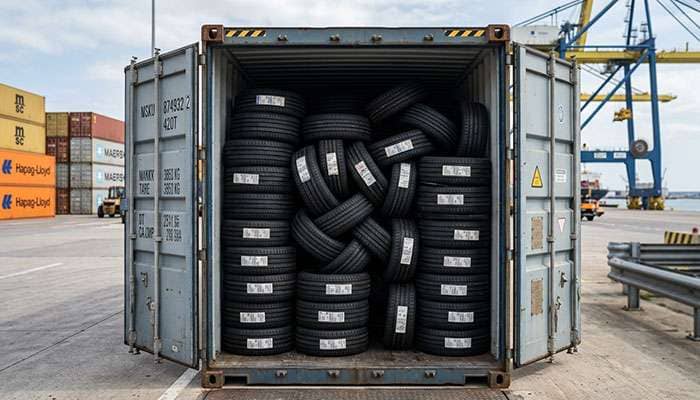
China isn't in that top ten, and the reason is trade law, not tire technology. The U.S. placed duties on Chinese passenger and light truck tires in 2015, and production shifted to Thailand and Vietnam. In 2021, the U.S. International Trade Commission approved duties on tires from South Korea, Taiwan, Thailand, and Vietnam, and production shifted again. Cambodia's passenger tire shipments to the U.S. jumped about 225 percent in 2024 alone. For how duties are showing up at the register, see our breakdown of whether tire prices are going up due to tariffs.
The country name also hides ownership. Thailand's tire plants are run by Japanese, French, American, and Chinese companies. "Made in Thailand" could mean Michelin, Bridgestone, Goodyear, Sumitomo, or a Chinese-owned maker. The country gives you the plant's address, not whose engineering the tire was built to.
Because a tire "model" is a design specification, and a size is a physical mold sitting in one press in one building.
Every size in a lineup needs its own mold. A popular all-terrain can run 60 to 100 sizes, from a 15-inch P-metric to a 22-inch Load Range E. The manufacturer decides which plant gets which molds, and it makes that call size by size based on four things:
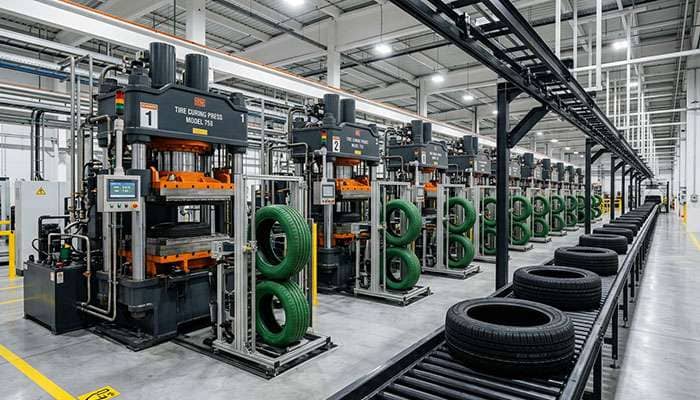
Picture a single all-season model: the 225/65R17 might come from Ohio, the 255/55R20 from Mexico, and the 275/50R22 from Thailand. Same tread, same name, three sidewall origins.
The category pattern shows up in the data. In Consumer Reports' 2020 review, about a third of its SUV and truck test tires were U.S.-made, versus roughly one in five ultra-high-performance tires. High-volume truck and SUV sizes tend to get North American molds. Low-profile, big-rim performance sizes more often come from Europe and Asia.
What stays constant is the specification. Each size is built to the same design and certified to the same federal standard, wherever the press sits.
The tire tells you. You just need to know which two markings to read and which side to read them on.
Imported tires must be marked with their country of origin under federal customs law, and U.S.-built tires typically carry "Made in USA" too. Look for small raised lettering near the bead. For most shoppers, this is the only answer they need.
Every tire certified for U.S. highway use carries "DOT" followed by its Tire Identification Number (TIN), required by NHTSA under 49 CFR Part 574. On current tires, the TIN is 13 characters in three groups:
Federal rules only require the full TIN on one sidewall. If the side facing you shows a shorter code or no date, the full number is on the other side, which is often the side facing the car. Our guide on how to read DOT tire date codes covers the date portion in detail.
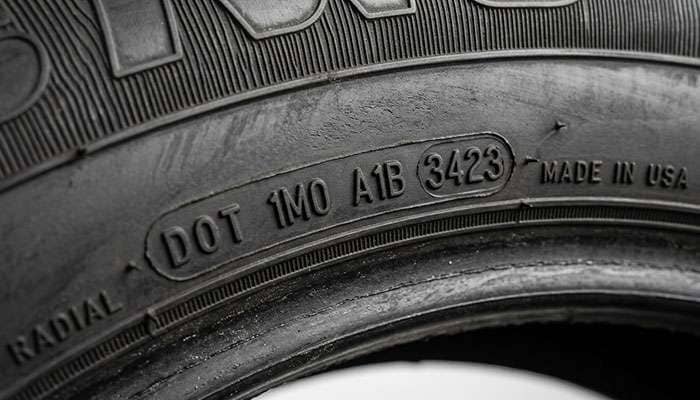
This is the detail that trips people up. Plant codes used to be two characters. NHTSA, running out of unique combinations, assigned a new three-character code to every plant that had a two-character one and allowed the old codes only until April 13, 2025. Tires built before that date can carry either format. Tires built after it carry three.
So if a 2025 or 2026 tire doesn't show up on a two-character lookup chart, the plant isn't unknown. The chart is older than the tire.
One precision note: TINs never use the letters G, I, O, Q, S, or Z, so an "O" in a plant code is always a zero and an "I" is always a one.
An online listing can't show you the sidewall of the tire that ships. Read both markings when the tires arrive, before they go on the rims, and look for cuts and bubbles while you're down there. Our guide on tire sidewall damage and whether it's safe to drive shows what to look for.
Not the natural rubber. The U.S. imports essentially all of its natural rubber, well over a million metric tons a year, mostly from Southeast Asian plantations in Thailand, Indonesia, Vietnam, and Malaysia. Every tire needs it, because its tear resistance and low heat buildup are hard to match with synthetics alone.
Synthetic rubber, carbon black, and steel cord can all be made domestically. But "Made in USA" on a sidewall means the tire was mixed, built, and cured in a U.S. plant. It describes where the tire was manufactured, not where every raw material grew. Bridgestone has grown guayule, a desert shrub that yields natural rubber, in Arizona as a research program, but it isn't supplying mainstream tires at volume.
If you want the very short list of brands that build every tire they sell on U.S. soil, start with our guide to tires that are 100 percent made in America.
Not by rule, and not by default. Every tire sold for highway use in the U.S. has to meet the same Federal Motor Vehicle Safety Standards no matter where it was built:
The DOT symbol is the manufacturer's certification that the tire meets the applicable standard. NHTSA runs its own compliance testing and enforces recalls, and foreign manufacturers carry the same recall obligations as domestic ones.
Independent testing backs that up. Consumer Reports found no clear link between country of origin and track performance. A premium tire from Japan and one from South Carolina compete on design and compound, not postal code.
Where the real differences live:
This is where the gap between the name on the box and the factory gets widest, and it's the corner of the market Performance Plus Tire has worked in since 1971.
Most collector tires come from reproduction programs. A company owns or licenses the original molds or drawings, then has the tire built by a plant that can run that construction. Coker Tire in Chattanooga holds the rights to Firestone, BFGoodrich, and U.S. Royal vintage lines. Specialty Tires of America builds bias-ply tires in Indiana, Pennsylvania. Kontio tires come from Finland. Other reproductions are cured overseas in plants that still run bias-ply equipment, which most modern radial factories no longer have.
For a vintage tire, the brand tells you who owns the mold. The plant code tells you who cured it. Bias-ply passenger reproductions still have to meet FMVSS 109 wherever they're built.
Lucas Classic Tires is now part of the Performance Plus Tire family. For a maker-by-maker breakdown by era, see our guide to who makes vintage car tires.
Shopping by brand origin instead of by tire costs you something at every step, and the stakes climb:
The fix at every rung is the same: choose the tire by size, load index, speed rating, and grades first, then verify origin on the sidewall if it matters to you.
If where your tires are built is part of the decision, here's the order that gets you there without giving up anything on fitment:
No brand list can fully answer "what tires are not made in the USA." Falken, Nexen, Kenda, Maxxis, Federal, Westlake, Sailun, and Linglong have no U.S. plant in 2026, so they're always imported. Everyone else, Goodyear and Michelin included, builds some sizes here and imports others, while Hankook, Toyo, Giti, and others build more of their U.S. tires in America than most people assume.
What settles it is your size and the plant that holds its mold, read straight off the sidewall from the "Made in" line and the plant code. Then judge the tire the way it should be judged: by load, speed rating, grades, and age.
Goodyear, Cooper, Michelin, BFGoodrich, Bridgestone, Firestone, Continental, General, Hankook, Kumho, Toyo, Nitto, Yokohama, Nokian, Giti, and GT Radial all build tires in U.S. plants. None of them builds every size here, so check the "Made in" line and the DOT plant code on the specific tire.
Many are. Michelin operates several plants in South Carolina and a BFGoodrich plant in Fort Wayne, Indiana. It also supplies the U.S. from Canada, Mexico, Europe, and Thailand, so the origin depends on the size you buy.
Goodyear runs plants around the world, including in Asia, and some sizes sold in the U.S. can come from overseas. Its U.S. consumer tires are built in Oklahoma, Ohio, Mississippi, Arkansas, and North Carolina, with more from Canada and Mexico. The sidewall "Made in" line tells you which applies to your tire.
Read the "Made in" line molded near the bead, then find the DOT code. The first three characters after "DOT" are the plant code, which identifies the exact factory. The full code is only required on one sidewall, so check the inboard side if you don't see it.
No. Every tire sold for U.S. highway use must meet the same FMVSS safety standards, and independent testing has found no clear link between country of origin and performance. Compare tires by load index, speed rating, UTQG grades, and age instead.
Indirectly. The plant code at the start of the DOT number identifies the factory, and NHTSA assigns every code. Since April 13, 2025, new tires use three-character plant codes, so make sure any lookup chart you use includes them.