
Stock Mazda MX-5 Miata wheels typically weigh between 10-15 pounds per corner for NA/NB models. When it comes to selecting Mazda MX-5 Miata aftermarket wheels, you're making a decision that impacts both your vehicle's appearance and driving performance.
Both NA and NB Miata models feature a 4x100 bolt pattern with a 54.1mm hub bore, making wheel compatibility straightforward for these generations. Factory wheel sizes varied across different trims, ranging from 14" to 17" in widths of 6" or 7". For aftermarket miata rims, experts recommend staying between 15"-17" while maintaining your overall rolling diameter.
Width is a crucial consideration when selecting the best wheels for Miata. The typical width choices range between 6-9 inches, with 8 inches being the most popular option for aftermarket miata wheels. Understanding PCD (pitch circle diameter) is essential—for the MX-5 NA, this is 4×100, meaning it has 4 holes spaced 100mm apart.
Custom wheels can improve both the appearance and performance of your Miata. Whether you're looking to reduce weight for better handling or create a more aggressive stance, the right wheel selection makes a significant difference. This guide will help you understand the key factors for finding the perfect Mazda Miata aftermarket wheels for your roadster.
Understanding these essential considerations will help you select aftermarket wheels that enhance your Miata's performance and appearance while avoiding costly fitment mistakes.
• Verify specifications first: All Miata generations use 4×100 bolt pattern with 54.1mm hub bore, but brake clearance varies—ND 2.0L models may need modifications for 15" wheels.
• Match wheels to your driving style: Daily drivers should choose 7"-7.5" wide wheels with ET20-ET40 offset, while track builds benefit from 15×9 +35 with 225/45 tires.
• Plan for necessary modifications: Aggressive fitments often require fender rolling, negative camber adjustments (-1.5° to -2°), or hub-centric spacers for proper clearance.
• Focus on weight savings: Lightweight options like Enkei RPF1 or flow-formed Konig Hypergram deliver better performance than heavy cast wheels for spirited driving.
• Safety comes first: Always torque lug nuts to 80-108 ft-lb, use proper spacer thickness with extended studs, and test clearance thoroughly before aggressive driving.
The right wheel setup balances your performance goals, aesthetic preferences, and budget while maintaining safety standards. Take time to research specifications and plan modifications—your investment will reward you with improved handling and distinctive style for years of driving enjoyment.
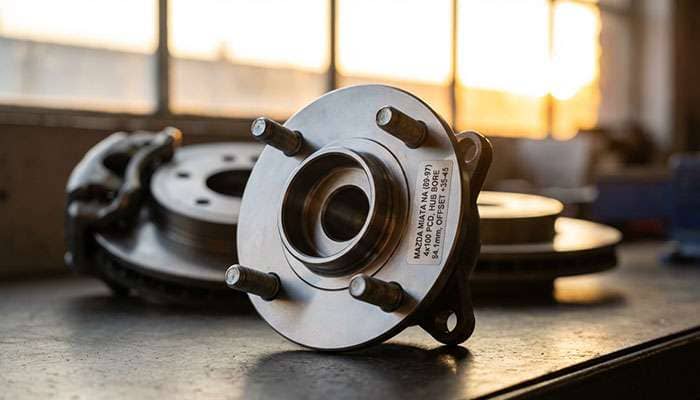
Selecting aftermarket wheels for your Miata requires understanding several technical specifications that directly impact both performance and appearance. Before you start shopping, mastering these fundamentals will save you from costly fitment mistakes.
PCD (Pitch Circle Diameter) refers to the number of bolt holes and the distance between them on your wheel. For the Miata NA, this specification is 4×100, meaning it has 4 holes positioned 100mm apart. This measurement is critical because wheels with incorrect PCD simply won't mount on your vehicle. PCD is the first specification you must verify before considering any wheel purchase.
The wheel diameter (measured in inches) affects not only your car's appearance but also its handling characteristics. Larger wheels generally allow for bigger brake installations, although this creates a trade-off between stopping power and increased unsprung weight. Brake caliper clearance becomes a significant concern when selecting wheels. For instance, ND Miatas with 2.0L engines have modern-sized brakes that may not accommodate 15" wheels without modifications. Always check brake clearance specifications before making a wheel purchase.
Wheel width (expressed as a number before "J", such as 8J for 8 inches wide) determines what tire sizes you can run. Wider wheels allow wider tires and more road contact, but excessive width leads to fender interference.
Offset is equally important - measured as the distance between the wheel's centerline and hub mounting face. Expressed as "ET" followed by a number (in millimeters), positive offset means the mounting face is closer to the wheel's outer edge. Lower offset pushes the wheel away from the car, potentially causing rubbing against fenders during turns. Most Miata enthusiasts find 15×8 with +25mm offset provides an ideal balance.
Despite design changes across generations, Mazda maintained consistency with wheel specifications. Both NA and NB models feature the 4×100 bolt pattern with 54.1mm hub bore. The modern ND generation keeps this same 4×100 pattern, though factory wheels increased to 16×6.5 +45 and 17×7 +45 specifications.

Before selecting Mazda MX-5 Miata aftermarket wheels, you need to decide what you want to achieve with your setup. Your driving style and goals will determine the best wheel and tire combination for your roadster.
Daily driving prioritizes comfort and reliability over maximum performance. König offers a helpful framework with three fitment levels: "No Hassle," "Slight Flex," and "All The Wheel".
For commuting and casual driving, the "No Hassle" approach works best. This means wheels between 7"-7.5" wide with offsets in the ET20-ET40 range. You get better wheel well fill than stock without rubbing issues or required modifications.
Track-focused builds need maximum grip and performance. Good-Win Racing specialists recommend their "sweet spot" setup: 15x9 +35 wheels with 225/45 tires. This combination requires coilovers with 2.5" or smaller springs and rolled fenders on both NA and NB chassis.
Moderate stance improvement without major modifications fits the "Slight Flex" category. 8" wide wheels with offsets from ET25-ET40 provide a bolder look while avoiding suspension or body modifications.
Maximum aggression calls for a squared setup with 8.5" wide wheels in the ET32-ET38 range. Wider wheels positioned farther outward typically require fender modifications and suspension adjustments.
Tire stretch happens when mounting tires narrower than ideal for your wheel width. Some stretching works fine, but track-focused setups should follow recommended tire-to-wheel width ratios for optimal performance.
Negative camber helps maintain tire contact during cornering by keeping the tread flat when the car leans. Track cars typically benefit from -1.0° to -2.0° front camber. More aggressive fitments often need additional negative camber to prevent rubbing.
Wider wheels with lower offsets require one of three solutions: skinnier tires with more stretch, additional camber adjustment through aftermarket arms, or fender modifications to accommodate the setup.

Finding the perfect aftermarket Miata wheels involves balancing style with performance requirements. We offer an extensive selection of custom wheels designed specifically for your Miata's needs.
NA/NB Miatas offer the widest variety of aftermarket wheel options. The Ultralite ULF1.2 15×7.5 ET30 delivers a classic F1-inspired look that fits perfectly without modifications. For track enthusiasts, the Enkei RPF1 15×8 ET28 stands out as the lightest 8J wheel available, providing excellent clearance for big brake kits. The Rota Grid 15×8 ET20 offers bold styling with flush fitment, though you may need slight fender modifications with square-sidewall tires.
NC owners should consider the Enkei RPF1 in 16×8 +38 configuration. The Konig Hypergram in 17×9 +25 delivers excellent value for performance-minded drivers. ND Miatas come with factory sizes of 16×6.5 +45 and 17×7 +45, but many enthusiasts upgrade to Konig Freeform in 17×8 +45 or the popular Advanti Storm S1. ND owners seeking 15" wheels should note that 2.0L models may require caliper modifications.
Aftermarket wheels fall into three categories based on construction and purpose. Cast alloy wheels are affordable with wide finish varieties but heavier. Flow-formed wheels like Konig Hypergram offer near-forged performance at moderate cost—ideal for spirited driving. Forged wheels provide maximum strength and minimum weight for serious track use. Looking for premium options? Check out Performance Plus Tire's Miata selection for quality aftermarket wheels at competitive prices.
Your suspension setup directly influences ideal wheel selection. Standard suspension works best with conservative fitments like 15×7 +35. Lowering springs typically accommodate up to 16×8 +38 without rubbing issues. Track-oriented coilovers allow more aggressive setups—Good-Win Racing recommends 15×9 +35 wheels with 225/45 tires, requiring 2.5" or smaller spring perches.
Custom wheels can dramatically improve your Miata's appearance and performance when properly selected for your driving style and suspension setup.

Even with properly sized aftermarket Miata wheels, achieving optimal fitment often requires additional modifications to prevent rubbing against fenders or suspension components.
Fender modifications become necessary when running wider wheel and tire combinations. Rolling flattens the inner fender lip against the vertical face, whereas pulling actually stretches the metal outward. For aggressive setups like 15×10 wheels with 245/40R15 tires, both techniques may be required.
Always use a heat gun to keep the paint flexible during the process. Work gradually and avoid rushing to prevent paint cracking. Professional fender rolling tools provide the most consistent results, though many enthusiasts successfully use baseball bats with careful technique.
Adding negative camber tilts the top of the wheel inward, creating additional clearance during suspension compression. Track-oriented builds often utilize -3.2° to -4.2° front camber and -2.8° rear camber. For street-driven Miatas, more conservative settings like -1.5° front and -2° rear provide improved handling while maintaining reasonable tire life.
Camber adjustments require either adjustable control arms or camber bolts. The modification improves cornering performance while solving clearance issues with aggressive wheel setups.
Wheel spacers create additional clearance between wheels and brake components. Always use hub-centric spacers to prevent vibrations and ensure at least 12mm of thread engagement with your wheel studs. Spacers thicker than 10mm absolutely require extended wheel studs for safety.
Avoid stacking multiple spacers, as single spacers of the correct thickness provide better reliability. Quality spacers from reputable manufacturers ensure proper hub centering and long-term durability.
For safe installation, torque ND MX-5 lug nuts to 80-108 ft-lb (108-147 N·m). Check torque specifications after 50-100 miles of driving to ensure proper seating.
At Performance Plus Tire, we carry properly fitting aftermarket wheels for all Miata generations. Our Miata wheel selection ensures correct fitment specifications, reducing the need for extensive modifications while delivering the performance and style you want.
Selecting the perfect aftermarket wheels for your Mazda MX-5 Miata requires careful consideration of multiple factors. Therefore, understanding the technical specifications like PCD, diameter, width, and offset becomes essential for achieving optimal fitment without compromising performance or esthetics.
Your driving style significantly influences wheel selection. Daily drivers benefit from conservative setups that prioritize comfort and reliability, while track enthusiasts should focus on lightweight options that maximize grip and handling. Additionally, your desired stance—whether subtle or aggressive—dictates necessary modifications like fender rolling, camber adjustments, or spacer installation.
Each Miata generation presents unique fitment challenges and opportunities. Though the 4×100 bolt pattern remains consistent across most models, brake clearance and suspension configurations vary significantly. Consequently, what works perfectly for an NA might require modifications on an ND.
Above all, safety must remain paramount when installing aftermarket wheels. Proper torque specifications, appropriate spacer usage, and careful fender modifications prevent dangerous failures during spirited driving. Until you've confirmed proper clearance through thorough testing, approach your new setup with caution.
Ultimately, the best Miata wheel setup balances your performance goals, esthetic preferences, and budget constraints. Whether you choose lightweight RPF1s for track days or stylish Konig Hypergrams for street cruising, your wheels represent both a personal statement and a critical performance component. Take time to research, measure, and plan before making this important investment—your Miata will thank you with improved handling, distinctive looks, and countless miles of driving enjoyment.
For aftermarket wheels, it's generally recommended to stay between 15" to 17" in diameter. The most popular width for aftermarket Miata wheels is 8 inches, but options range from 6" to 9" wide depending on your specific goals and fitment requirements.
For daily driving, comfort and reliability are priorities, with wheel widths of 7"-7.5" and offsets between ET20-ET40 being ideal. Track-focused setups often use more aggressive fitments like 15x9 +35 wheels with 225/45 tires, which may require additional modifications.
Consider factors such as wheel weight, diameter, width, offset, and bolt pattern. Ensure compatibility with your Miata's generation, brake clearance, and desired stance. Also, think about your driving style and whether you prioritize performance, esthetics, or a balance of both.
Depending on the wheel and tire combination, you may need to roll or pull fenders, adjust camber, or use spacers for proper fitment. More aggressive setups often require suspension modifications or fender work to prevent rubbing.
Popular choices include the Enkei RPF1 for its lightweight design, Konig Hypergram for value, and Advanti Storm S1 for modern styling. For NA/NB models, the Ultralite ULF1.2 offers a classic look, while ND owners often prefer the Konig Freeform in 17x8 +45 configuration.