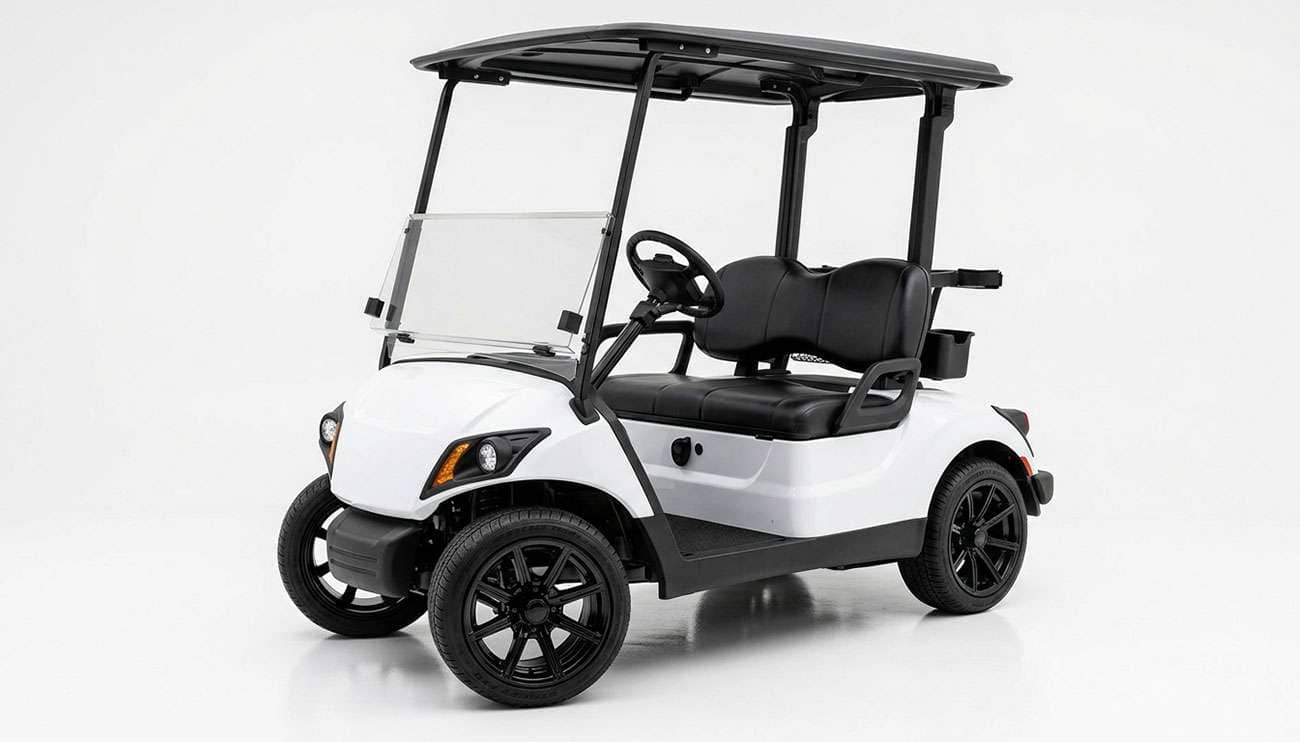
On a golf cart without a lift, the tire's overall height has to stay under your cart's clearance ceiling: about 18.5 inches on Club Car and older Yamaha G-series carts, and about 20 to 20.5 inches on 2007-and-newer EZGO TXT and RXV models and the Yamaha Drive and Drive2. Wheel size doesn't decide it. An 8-, 10-, 12-, or 14-inch wheel all work if the tire around it lands under that number. Two catches most guides skip: the size on the sidewall isn't the height you'll measure, and the low-profile sizes that fit the tightest carts often carry the least weight.
You'll read "it depends on your cart" everywhere. It depends on three numbers: your cart's clearance ceiling, the tire's published overall diameter (not its nominal size), and the tire's max load at the pressure you'll actually run. Here's the first one.
Cart |
Max Height, No Lift |
Sizes That Typically Fit |
What Eats Your Clearance |
|---|---|---|---|
Club Car DS, Precedent, Onward, Tempo |
About 18 to 18.5 in |
18x8.50-8, 205/50-10, 205/35-12, 215/35-12 |
Front body and inner fender at full steering lock |
Yamaha G-series (G1 through G22) |
About 18 to 18.5 in |
Same as Club Car |
Tight wheel wells; 20-inch tires usually need about a 3-inch lift |
EZGO TXT, ST, PDS, RXV (2007 and newer) |
About 20 to 20.5 in |
20x10-10, 205/65-10, 215/50-12, 215/35-14 |
Rear weight and tired leaf springs; some RXVs rub above about 19 in |
EZGO Marathon, Medalist, TXT (1975 to 2006) |
About 20 in with a slight inner fender trim |
20x10-10 and 18.5-inch sizes |
Inner fender lip |
Yamaha Drive (G29) and Drive2 |
About 20 to 20.5 in |
20x10-10, 205/65-10, 215/50-12 |
Added rear weight |
Any cart with a rear seat kit, cargo box, or sagging springs |
Stay near 18.5 in |
18x8.50-8, 205/50-10, 215/40-12 |
Rear squat under load |
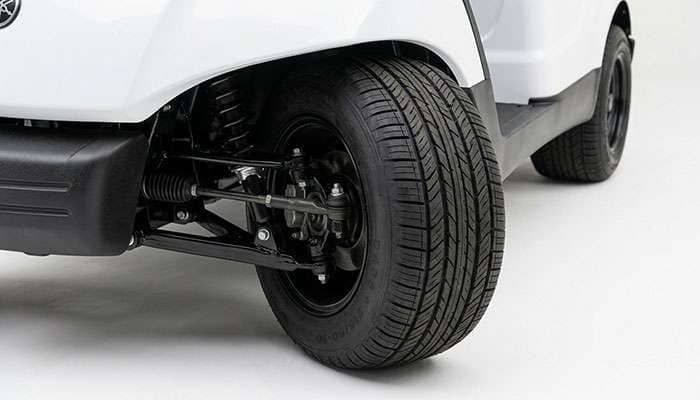
A tire can be as tall as the tightest point in your cart's wheel well allows, and that point is set by the body, not the suspension. The front tire has to clear the bodywork while it sweeps through full steering lock. The rear tire has to clear the fender with the springs compressed under passengers and cargo. Every brand draws that line in a different place.
Club Car carts are the tightest of the big three. Plan on about 18 to 18.5 inches of overall height. A 20-inch tire will usually hit the front bodywork or inner fender when you turn the wheel, and clearing it takes a lift of roughly 1 to 3 inches. On a Club Car, a no-lift upgrade is a wheel and tread upgrade, not a height upgrade.
EZGO's 2007-and-newer carts give you the most room: about 20 to 20.5 inches with nothing heavy on the back. That's enough for a 20x10-10 all-terrain or a 205/65-10 or 215/50-12 comfort tire. Older Marathon, Medalist, and pre-2007 TXT carts can usually take 20 inches with a slight trim of the inner fender. RXV models are less forgiving than the TXT, and some rub above about 19 inches.
The Yamaha Drive (G29) and Drive2 match EZGO at about 20 to 20.5 inches. The older G-series, G1 through G22, behaves like a Club Car: about 18.5 inches without a lift, and roughly a 3-inch lift for 20-inch tires.
Golf cart tires use two sizing systems, and only one of them tells you the height directly. If you need a refresher on the passenger car version, our guide on how to read tire size covers the basics. Here's how the golf cart formats work.
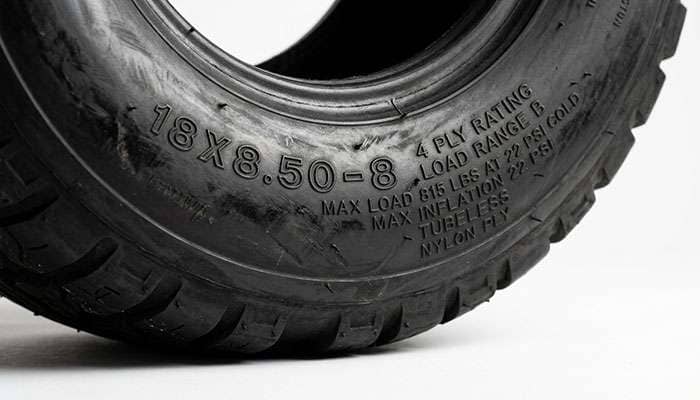
A flotation size like 18x8.50-8 reads as overall height, section width, then wheel diameter, all in inches. That's an 18-inch-tall tire, 8.5 inches wide, on an 8-inch wheel. It's the size nearly every cart rolls out of the factory on. The 20x10-10 all-terrain works the same way: 20 inches tall, 10 wide, on a 10-inch wheel.
A metric size like 205/50-10 gives width in millimeters, then sidewall height as a percentage of that width, then wheel size in inches. To get overall height, multiply width by the aspect ratio, convert to inches, double it, and add the wheel. For 205/50-10: 205 x 0.50 = 102.5 mm, or 4.04 inches. Double that and add 10, and you get about 18.1 inches.
Run the same math across the common no-lift sizes and they fall into two groups. The 18-inch group: 205/35-12 (about 17.7), 215/35-12 (17.9), 205/50-10 (18.1), 215/40-12 (18.8), and 205/30-14 (18.8). The 20-inch group: 215/35-14 (19.9), 215/50-12 (20.5), and 205/65-10 (20.5).
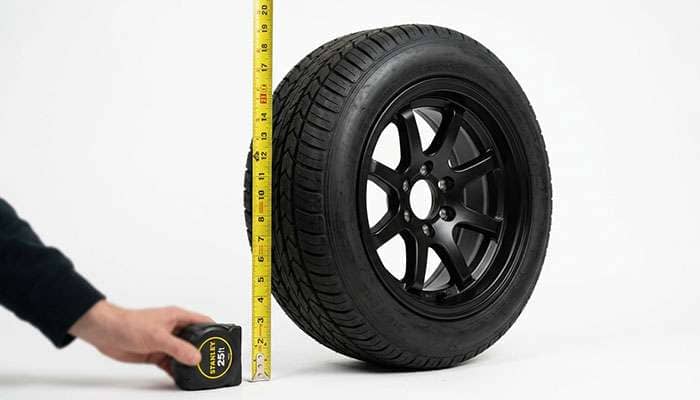
Here's where precision matters. The math gives you a nominal height. The tire you buy gives you a measured one, and the two don't always agree. A typical 4-ply 18x8.50-8 measures about 17.7 inches inflated, not 18. Vision's own spec sheet for its W825 Journey Golf lists the 215/40-12 at 18.9 inches and the 215/50-12 at 21.1 inches. Most charts call those 18.5 and 20.5. Another maker lists its 215/50-12 at 20.5. Same size, 0.6 inch apart.
On a cart with 20.5 inches of room, 0.6 inch is the difference between clearing and rubbing. So before you buy, find the manufacturer's published overall diameter for the exact tire and compare that number to your cart's ceiling.
A tire that matches the chart can still rub because three things eat clearance the chart doesn't account for: weight on the rear, width at full lock, and wheel offset.
Clearance numbers assume an unloaded rear end. Bolt on a flip-down rear seat or a cargo box, load it, and the rear squats toward the tire. Old leaf springs do the same thing permanently. On an EZGO with a rear seat kit or sagging springs, stay at a 215/40-12-class height, around 18.5 to 18.9 inches, unless you replace the springs first.
The front tire doesn't just spin. It swings through an arc every time you turn, and its outer shoulder is what finds the body first. A 20x10-10 is 10 inches wide. A 215/50-12 is about 8.5. They're about the same height, but the wider tire has more rubber to swing into the fender at full lock. If you're right at your cart's ceiling, the narrower tire is the safer bet.
Aftermarket golf cart wheels don't all share the factory offset. A wheel that pushes the tire outward moves the shoulder closer to the fender lip, and one that pulls it inward moves it closer to the suspension. Either can turn a clean fit into contact at full lock. Our explainer on what wheel offset does covers the geometry.
Often, yes, and this is the number almost nobody puts next to the height chart. A tire carries load with air. A shorter sidewall holds less air, so many low-profile sizes are rated for less weight than the 18x8.50-8 they replace, even at the same 4-ply rating. The carts with the least room, the Club Cars and older Yamahas, are the ones pushed toward the lowest-capacity sizes.
Size |
Measured Height |
4-Ply Max Load (Published Specs) |
Fits Without a Lift On |
|---|---|---|---|
18x8.50-8 |
About 17.7 in |
About 815 lbs |
Every major cart |
205/35-12 |
17.7 to 17.9 in |
545 to 739 lbs |
Every major cart |
215/35-12 |
About 17.9 in |
As low as 450 lbs |
Every major cart |
205/50-10 |
18.3 to 18.5 in |
About 665 lbs (6-ply: about 1,015) |
Every major cart |
215/40-12 |
18.8 to 18.9 in |
739 to 760 lbs |
EZGO and Yamaha Drive; borderline on Club Car |
20x10-10 |
19.5 to 20.0 in |
800 to 1,170 lbs |
2007+ EZGO, Yamaha Drive and Drive2 |
205/65-10 |
20.5 to 20.8 in |
About 910 lbs |
2007+ EZGO, Yamaha Drive and Drive2 |
215/50-12 |
20.5 to 21.1 in |
937 to 950 lbs |
2007+ EZGO and Yamaha Drive, if the exact tire measures 20.5 in or less |
Club Car publishes a 1,070-pound curb weight for the electric, non-lifted Onward 4 Passenger, with an 800-pound load capacity. Fully loaded, that's 1,870 pounds. Split perfectly evenly, it's about 468 pounds per tire. That's already past a 450-pound rating, and it isn't split evenly in real life: the battery pack and the rear passengers sit over the back axle, so the rear tires carry more than their share.
Compared with the stock 18x8.50-8, the low-profile sizes in that table give up anywhere from about 18 percent (205/50-10) to 45 percent (the weakest 215/35-12) of rated capacity. The height chart never shows you that.
The load on the sidewall is the load at the tire's maximum pressure. A typical 18x8.50-8 reaches its 815-pound rating at 22 psi. Several low-profile sizes need 28 to 35 psi to reach theirs. Run a low-profile tire at 20 psi like your old turf tires and you're carrying less than the number on the sidewall. Our guide to tire load range and ply ratings explains how ply rating and pressure tie together.
The fix for a heavy cart is a higher ply rating. A 6-ply 205/50-10 is rated around 1,015 pounds against roughly 665 for the 4-ply. In the low-profile 12- and 14-inch sizes, 4-ply is what you'll mostly find, so a four-seater with a lead-acid pack or a loaded cargo box is often better served by a 10-inch wheel with a 6-ply tire. Some golf cart tires print a load index instead of a ply rating; our breakdown of load range vs. load index shows how to translate one into the other.
Yes, and in direct proportion to the height change. A cart's speed limiter caps motor RPM, not ground speed, so a taller tire covers more ground per revolution at the same capped RPM. Going from 18 to 20 inches raises top speed about 11 percent. Going from 18 to 20.5 raises it about 14 percent. A cart governed at 19 mph on stock tires runs about 21 mph on 20-inch tires.
Those two speeds are federal lines. NHTSA's Federal Motor Vehicle Safety Standard No. 500 defines a low-speed vehicle as a four-wheeled vehicle whose top speed is more than 20 mph and not more than 25 mph, and it requires equipment like headlamps, turn signals, mirrors, a windshield, seat belts, and a VIN. Most golf carts sit under 20 mph and outside that standard. A taller tire can push one over the line. And a 25-mph street-legal LSV on 20.5-inch tires instead of 18s would run about 28.5 mph, past the ceiling of its own class.
NHTSA has also said that modifying a golf cart for public-road use creates a motor vehicle that has to meet the applicable federal standards, with the person doing the modifying treated as its manufacturer. Oversize tires were on the list of speed modifications the agency was asked about. If your cart is registered for the street, check your state's rules before you go taller.
Many golf cart tires carry low speed ratings, and some carry none at all. A "B" rating means 31 mph. Some utility 20x10-10 tires are rated for just 10 mph. If your cart is fast, check the letter after the load index before you buy.
The speed you gain costs torque in the same proportion, which you'll feel on hills and with a full load. And if your cart has a speedometer, it'll read low, by the same 11 to 14 percent. Our article on bigger tires and speedometer error walks through the correction.
On a golf course or private property, no. Turf tires are built with shallow, rounded tread to protect grass, and many aren't DOT-marked at all. If your cart is a registered LSV that runs on public streets, choose DOT-marked tires and confirm what your state requires. DOT-marked golf tires usually also publish a load index and speed rating, which gives you the numbers you need for everything above.
A tire that's a little too tall or a little too weak doesn't fail all at once. It costs you in steps.
Every step ends with the same purchase: a set of tires that fits the cart and the load, plus a fender repair or a lift kit you didn't plan on.
Here's the whole sequence, in order. It takes about ten minutes and a tape measure.
The no-lift answer is a height, not a wheel size: about 18.5 inches on Club Car and older Yamaha carts, and about 20 to 20.5 inches on newer EZGO and Yamaha Drive carts. Hit that number with the tire's published diameter, not the nominal size, and leave room for a loaded rear end. Then check the load rating, because the low-profile tires that fit the tightest carts can carry a lot less than the stock 18x8.50-8.
About 20 to 20.5 inches tall on 2007-and-newer EZGO TXT and RXV carts and the Yamaha Drive and Drive2, with an unloaded rear. Club Car and older Yamaha G-series carts top out near 18.5 inches. Check the tire's published overall diameter, not just its size.
On a 2007-or-newer EZGO TXT or a Yamaha Drive or Drive2, usually yes, as long as the rear isn't loaded down. On Club Car DS, Precedent, Onward, and Tempo models and older Yamaha G-series carts, 20-inch tires usually rub at full steering lock and need a lift of about 1 to 3 inches.
Not by themselves. Wheel size doesn't set clearance; overall tire height does. Low-profile 12-inch sizes like 215/35-12 and 205/35-12 measure under 18 inches and fit nearly every cart. A 215/50-12 measures 20.5 to 21.1 inches and needs a roomy EZGO or Yamaha Drive, or a lift.
Most carts leave the factory on 18x8.50-8 tires: 18 inches tall nominally, 8.5 inches wide, on 8-inch wheels. Measured inflated, a typical 4-ply 18x8.50-8 is closer to 17.7 inches tall, and it's commonly rated around 815 pounds at 22 psi.
Yes. Top speed rises in proportion to tire height because the speed limiter caps motor RPM, not ground speed. Moving from 18 to 20 inches adds about 11 percent, so a 19 mph cart runs about 21 mph. You give up torque in the same proportion.
Usually not. A 215/50-12 measures 20.5 to 21.1 inches depending on the maker, well above the roughly 18.5-inch ceiling on a stock Club Car. For a no-lift Club Car on 12-inch wheels, look at 215/35-12 or 205/35-12 instead.