
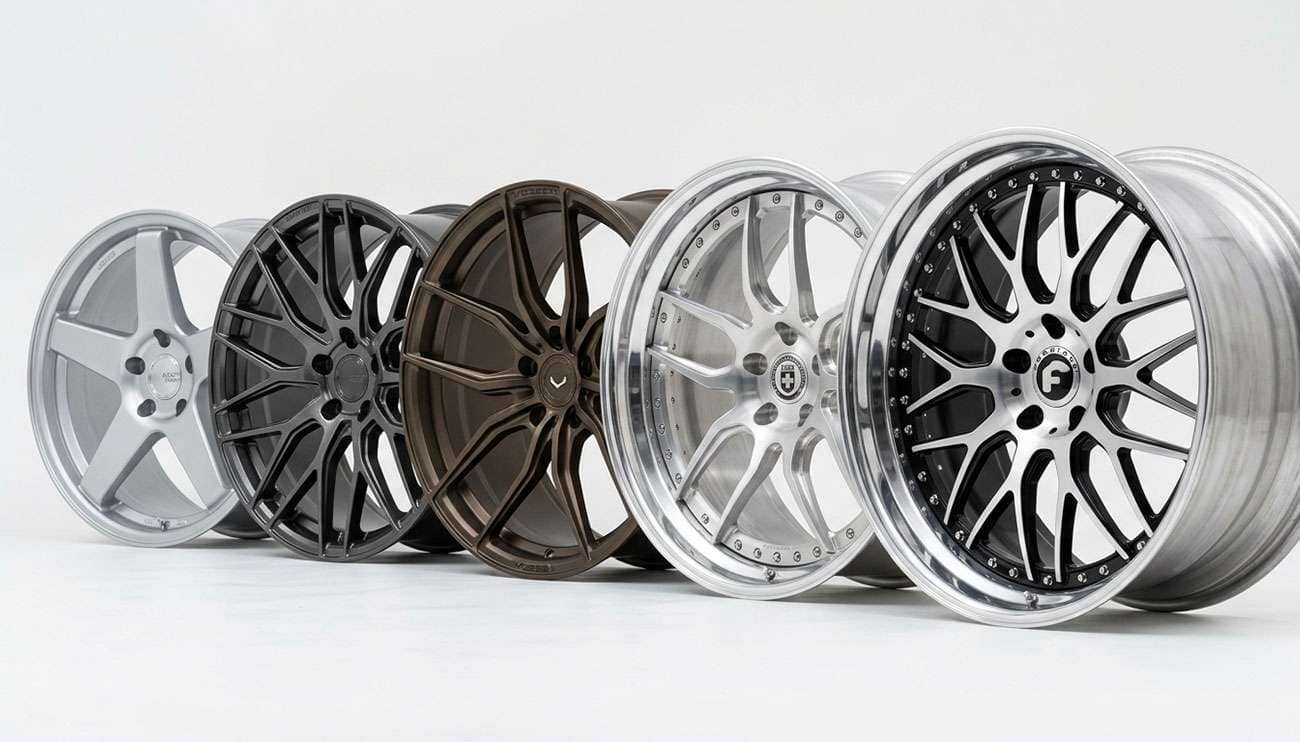
Search this question and you get a list of names. Forgiato, Vossen, HRE, ADV.1, Brixton, BBS, Vorsteiner, Rotiform. Every article hands you the badges and then hedges with "prices vary." None of them tell you the one thing that actually determines the number on the invoice: how the wheel was made. A brand name is not a price tier. Construction is. Across our live catalog of more than 149,000 wheel SKUs, a cast wheel runs a median of $329 each and a three-piece forged wheel runs $2,150 each, and there are brands that sell both. Find the construction line before you judge the brand.
Here is the table nobody publishes, built from actual per-wheel pricing across every construction type we stock. Find your row first, then go shopping.
Construction |
Typical Price Per Wheel |
What the Money Buys |
Who Needs This Tier |
|---|---|---|---|
Cast, one-piece |
$246 to $450 |
Mold tooling, finish quality, design |
Daily drivers, stock-size replacement, most street builds |
Flow-formed, one-piece |
$254 to $425 |
Spun and work-hardened barrel, less rotating weight |
Street performance, autocross, anyone chasing weight on a budget |
Monoblock forged |
$594 to $850 |
Grain-aligned billet, single-piece strength |
Track use, European fitments, drivers who want forged without multi-piece cost |
One-piece forged |
$922 to $1,646 |
Full forging, high load ratings, custom widths |
Heavy trucks, dually applications, 24 inch and larger diameters |
Billet |
$1,016 to $1,867 |
Machining time out of solid aluminum |
Show cars, hot rods, one-off finishes |
Two-piece forged |
$1,126 to $1,914 |
Forged center bolted to a separate barrel, offset built to order |
Staggered setups, wide-body cars, exact offset requirements |
Three-piece forged |
$2,100 to $2,250 |
Center plus inner and outer barrel halves, fully bespoke |
Exotics, show builds, fitments that do not exist off the shelf |
Two rows in that table should stop you. Flow-formed costs almost exactly what cast costs. And three-piece forged has a floor of $1,099 per wheel in our entire catalog, with nothing available underneath it at any brand. Those two facts explain most of what people get wrong about expensive wheels.
Aluminum costs roughly the same no matter whose logo goes on the face. What changes the price is the process used to turn that aluminum into a wheel, and the amount of human labor that process requires.
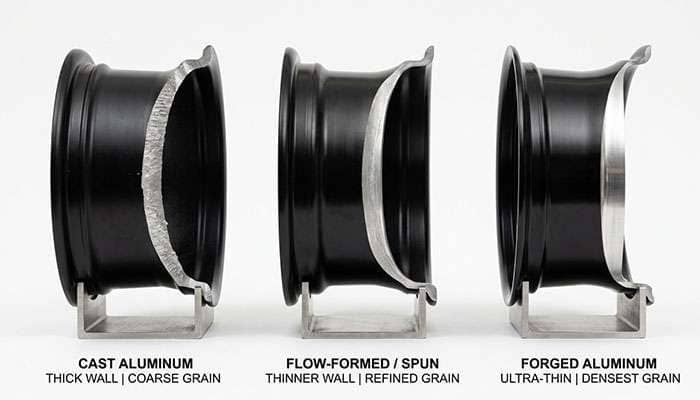
A cast wheel starts as molten aluminum poured or pressure-fed into a mold. It cools with a dendritic grain structure, meaning the metal crystals grow in random branching patterns with small pockets of porosity between them. That structure is perfectly adequate for the loads a passenger car puts through a wheel, and it is cheap because one mold produces thousands of identical parts. The tooling gets amortized across the run. That is why the cast tier holds a median of $329 per wheel across our catalog.
Forging is a different animal. A solid aluminum billet gets squeezed under thousands of tons of pressure while heated, which compresses the grain structure and forces the crystals to align with the shape of the part. Aligned grain flow means the metal resists cracking along its length instead of splitting across random boundaries. The result is a denser, stronger material, so the engineer can remove more of it and still meet load requirements. That is where the weight savings come from. It is also why the forged tier costs three to four times what cast costs: the press is enormous, the cycle time is long, and every wheel needs extensive CNC machining afterward to cut the spoke design out of a rough forging.
Multi-piece construction stacks more labor on top. A two-piece or three-piece wheel is a forged center bolted to a separately manufactured barrel, with sealant and hardware holding the assembly together. Every barrel half is spun, every bolt is torqued, every seam is sealed and pressure-checked by hand. If you want the full breakdown of why that assembly labor drives the number so high, we covered it in detail in Why Are 3-Piece Wheels So Expensive.
SAE J2530 is the aftermarket wheel performance standard most reputable manufacturers test to, covering radial fatigue, cornering fatigue, and impact resistance. A wheel passing J2530 has demonstrated it survives a defined number of load cycles. Construction method is what determines how much material a manufacturer needs to pass that test, and material plus process is what you pay for.
Cast is the volume tier, and it is where the overwhelming majority of wheels sold in this country live. Across our catalog, one-piece cast wheels span $28 at the absolute bottom to $4,562 at the top, but the middle half of that population sits between $246 and $450 per wheel. That is the real price of a good aftermarket wheel for a normal vehicle.
Do not read "cast" as "cheap." A cast wheel from a manufacturer that tests to SAE J2530 and publishes a load rating is a fully engineered part. Our cast one-piece population carries a median load rating of 2,500 pounds per wheel, which covers essentially every passenger car, crossover, and half-ton truck on the road with margin to spare.
What you are paying for inside this tier is finish and design, not strength. A polished or chrome finish adds real cost because of the labor involved in getting the surface to that state. A machined face with a contrasting accent requires a second CNC operation. A brand with a well-developed design language charges more than a brand pumping out generic mesh patterns. None of that changes what is happening structurally.
The people who overpay in this tier are the ones who assume a $600 cast wheel is meaningfully stronger than a $300 cast wheel. It usually is not. Check the load rating and the J2530 claim, and if both are comparable, you are paying for looks. Our guide to how to tell if rims are good quality walks through the specific marks and specs to check before you spend.
This is the most underused fact in the wheel business. Flow-formed wheels in our catalog run a median of $330 per wheel. Cast runs $329. The middle half of the flow-formed population sits between $254 and $425, which is actually slightly tighter and slightly cheaper than the cast band.
Flow forming starts with a cast center, then spins the barrel against rollers under heat while stretching it into final width. The process work-hardens the barrel section and aligns the grain in that area, so you get much of the strength benefit of forging in the part of the wheel that takes the most abuse, without the cost of a full forging press. Manufacturers market it under a pile of names: rotary forged, flow formed, hybrid forged, spun rim. It is the same process.
A flow-formed wheel typically comes out several pounds lighter per corner than an equivalent cast wheel in the same design. That weight is rotating and unsprung, which means it affects acceleration, braking, and how quickly the suspension can respond to a bump, all at once. Getting that for the same money as cast is the single best value in the entire wheel market right now.
The catch is availability. Flow-formed represents only about 2,600 SKUs in our catalog against more than 105,000 cast SKUs. The fitments are concentrated in performance-car sizes. If you drive a Mustang, a Civic, a BMW, or a Miata, you have real options. If you drive a dually, you probably do not.
ADV.1 is the clearest example of a brand people assume is unaffordable that actually lives here. The ADV08 Flowspec is a flow-formed wheel, and our pricing on it starts at $181. The same badge that shows up in every "most expensive wheels" listicle sells a wheel in the same price band as a mainstream cast option.
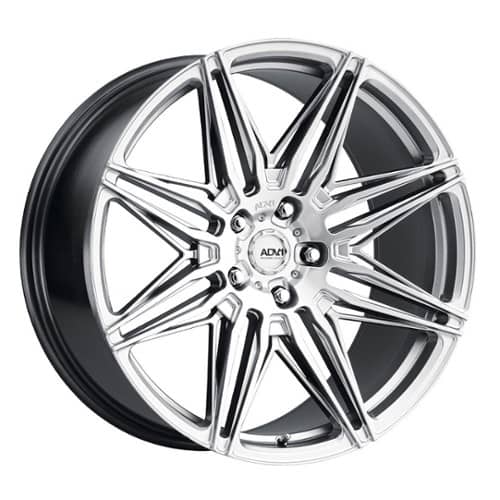
Monoblock forged means the entire wheel, center and barrel, is machined from one forged piece. No bolts, no seams, no sealant. Our monoblock forged population runs $594 to $850 through the middle, with a ceiling near $1,079.
This is the tier where the money starts buying performance instead of appearance. A monoblock forged wheel has no assembly hardware to loosen, no seam to weep air, and the highest strength-to-weight ratio available in a single-piece design. Rotiform's LTN and TUF lines are monoblock forged and top out around $887 per wheel in the widest sizes. That is real forged construction from a recognized name, and it is less than half what most people assume a forged wheel costs.
Step up to full one-piece forged and the range widens considerably: $922 to $1,646 through the middle, topping out at $5,170 for the largest drag racing sizes. The reason that band is so wide is that this tier serves two very different customers. On one end, performance cars wanting light wheels. On the other, heavy trucks and duallies that need load capacity a cast wheel cannot deliver.
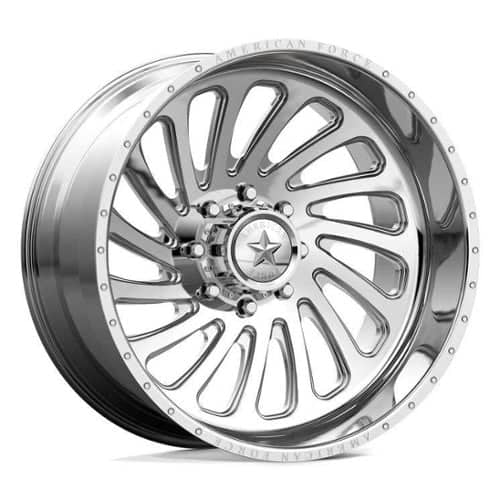
The load numbers tell that story clearly. One-piece forged wheels in our catalog carry a median load rating of 3,640 pounds per wheel against 2,500 pounds for cast. If you are running a three-quarter ton or one-ton truck loaded to its gross axle weight rating, that difference is not a luxury. It is the reason forged exists in the truck market at all, and it is why American Force rims cost what they do. Their catalog is almost entirely one-piece forged, running $410 to $4,549 per wheel.
Here is where the expensive brands genuinely live, and here is the number that matters: there is no three-piece forged wheel in our catalog under $1,099. Not one, across more than 10,000 three-piece SKUs from multiple manufacturers. The middle half of that population sits between $2,100 and $2,250 per wheel, topping out at $3,300.
That floor exists because the labor floor exists. Every three-piece wheel requires a forged center, an inner barrel half, an outer barrel half, a ring of assembly hardware, sealant, and a pressure test. No volume can make that cheap.
Two-piece forged sits a step below: $1,126 to $1,914 through the middle, with a floor of $456 and a ceiling of $4,060. The extra flexibility is the point. Because the barrel is a separate component, the manufacturer can build a specific offset, a specific lip depth, and a specific width for your car rather than picking from a list. That is what people are actually buying when they buy a multi-piece wheel: fitment that does not exist off the shelf. If you are deciding between the two, our breakdown of the different types of forged wheels from monoblock to multi-piece covers the trade-offs in depth.
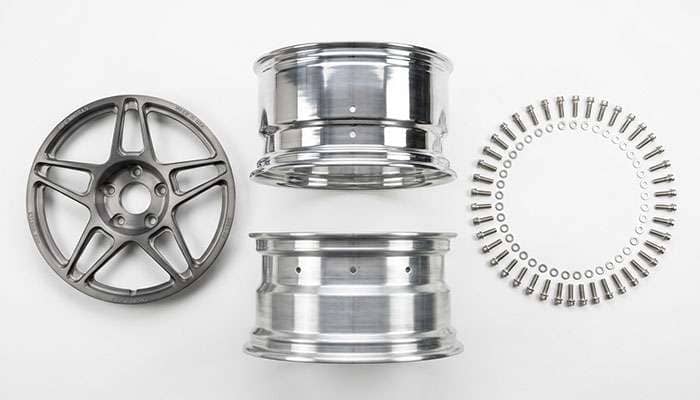
There is also a repair argument that rarely gets made. Curb a monoblock forged wheel badly enough to bend the lip and the wheel is a candidate for repair or replacement as a whole unit. Curb a three-piece and you can often replace just the damaged barrel half. On a $2,150 wheel, that difference is not trivial.
Billet is the tier most people have never priced. Our billet population is small, just 46 SKUs, and it runs $1,016 to $1,867 through the middle with a ceiling of $3,387. Every one of those wheels carries a 1,870 pound load rating.
A billet wheel is cut from a solid block of aluminum, with the machine removing everything that is not the wheel. It is the most wasteful process in the industry and the most flexible. Any design a CNC program can describe can be cut, which is why billet dominates high-end hot rod and show car builds where the wheel needs to match a specific body line or a specific era.
Boyd Coddington's Boydster in 28x12 polished is the clearest example we stock, at $3,387 per wheel. Billet Specialties runs a full billet line as well, with the Street Lite Double Bead Lock at $1,964. These are not mass-market numbers, and they are not meant to be. You are paying for machine time and for a finish that is cut, not cast.
This is the trap. Almost every well-known "expensive" wheel brand runs multiple construction lines under one badge, and the price spread between them is enormous. Reading a brand name and assuming a price is how people end up disappointed in both directions.
Brand |
Entry Line |
Premium Line |
Price Spread |
|---|---|---|---|
Asanti |
One-piece cast, from $84 |
Three-piece forged, from $1,750 |
Roughly 20x |
Fuel |
One-piece cast, from $99 |
One-piece forged, to $2,890 |
Roughly 29x |
Boyd Coddington |
Smoothie two-piece, from $75 |
Possessed two-piece, to $3,707 |
Roughly 49x |
American Racing |
One-piece cast, from $50 |
VF307 three-piece forged, $1,099 |
Roughly 22x |
ADV.1 |
ADV08 Flowspec, from $181 |
ADV08 Flowspec custom, to $1,060 |
Roughly 6x |
Billet Specialties |
One-piece billet, from $305 |
Crossover Extreme two-piece, to $4,060 |
Roughly 13x |
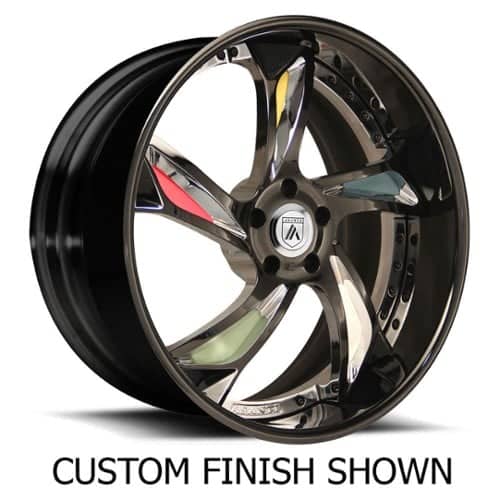
Asanti is the cleanest illustration. The ABL-12 Orion, a one-piece cast wheel in 22x9, sells for $348.50. The AF113 three-piece forged in 30x10 sells for $3,300. Same logo on the cap. Nearly ten times the price. Both are legitimate wheels for their intended buyer. We went through the brand in detail in our honest look at whether Asanti wheels are any good.
The practical lesson: when someone tells you a brand is expensive, ask which line. When you shop, filter by construction before you filter by badge.
Most articles answering this question list brands you cannot buy from the site you are reading. Here is what the genuine premium tier looks like in stock, with real per-wheel pricing.
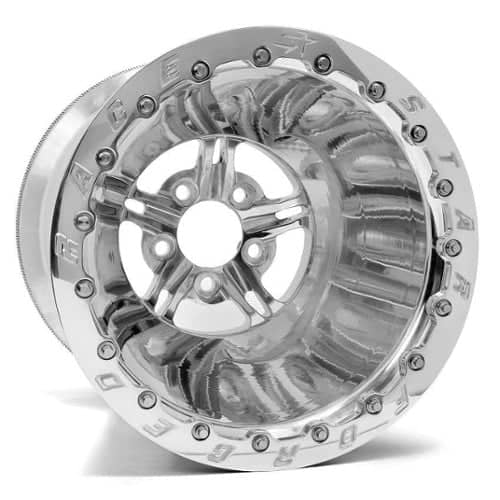
Racestar runs from $200 to $5,170, with the 63 Pro Forged holding the top of our entire wheel catalog. This is drag racing hardware in one-piece forged construction, and the 15x15 polished at $1,935.95 is a common street-strip choice.
Intro Custom spans $906 to $4,562. The Route 66 Series in 32x12 polished sits at the ceiling. The Hollywood Covered in 19x11 polished at $1,300 is a more typical build. Every wheel is made to order in one-piece construction with a custom offset range.
American Force runs $410 to $4,549, almost entirely one-piece forged, built for trucks that actually carry weight. The CK19 Blur CC in 22x14 at $1,386 is representative of the heart of the line.
Billet Specialties 2-Piece covers $472 to $4,060 across nearly 6,900 SKUs. The Accelerator Concave Deep in 19x12 at $1,466.10 is a common pro-touring choice.
Boyd Coddington 2-Piece runs $720 to $3,707. The Blaster in 20x10.5 polished at $1,272 is the volume seller. The Possessed in 28x12 at $3,707 is where the line ends.
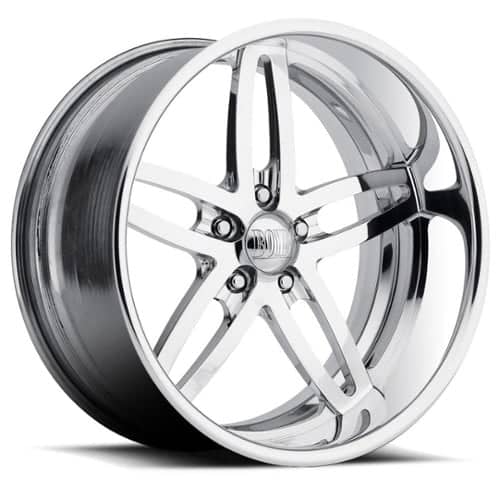
Schott 2-Piece has the highest entry point of any brand we carry at $1,170, running to $3,385. There is no budget Schott. The Drift Concave in 19x9 at $1,900 sits at the middle of the line.
Asanti 3-Piece spans $1,750 to $3,300 across nearly 9,900 SKUs, all three-piece forged. The DA181 in 22x12.5 at $2,150 is the median wheel in the line.
Fuchs covers $1,122 to $2,337 in one-piece forged, aimed squarely at air-cooled Porsche fitments. The Retro in 19x11 with a 5x130 bolt pattern tops the line at $2,337.03.
Look closely at the top-priced SKU in almost any premium line and you will see the same two entries in the spec sheet: "Blank 5 Lug" for bolt pattern and "Custom - Call for Details" for finish. That combination is doing a lot of work on the price.
A blank wheel arrives from the manufacturer with no bolt holes drilled. The center is solid. It gets drilled to your vehicle's exact pattern, and often to a specific hub bore, as a separate machining operation after you order. That is why these SKUs quote a wide offset range rather than a single number: the offset is set during finishing, not during casting.
Two things follow from that. First, a custom-drilled wheel is not returnable in any practical sense, because it has been machined to your car specifically. Second, lead times run weeks rather than days. If you are planning a build around a show date or a track weekend, order these first, not last.
The upside is real. A blank lets you dial a bolt pattern that no production wheel offers, which matters on swapped axles, vintage cars, and anything with a bolt circle the aftermarket abandoned. It also lets you set an offset that clears a big brake kit without a spacer, which is a genuine engineering improvement over stacking hardware behind the wheel. For a broader look at how these variables move the total, see our breakdown of how much custom wheels cost.
Strip the marketing away and premium wheel pricing buys four things. Understanding which ones you need is how you decide what tier to shop.
Weight reduction. Forged and flow-formed wheels are lighter than cast in the same design and size. Wheel weight is unsprung and rotating, so a pound saved at the wheel does more for acceleration, braking, and ride quality than a pound saved anywhere else on the car. On a heavy 22 inch or larger wheel, the difference between cast and forged can be several pounds per corner.
Load capacity. Forged construction supports higher ratings in the same package. Our one-piece forged median sits at 3,640 pounds per wheel against 2,500 for cast. If your gross axle weight rating divided by two exceeds what a cast wheel is rated for, this is not a preference. It is a requirement.
Fitment precision. Multi-piece and blank-drilled wheels let you specify offset, width, and bolt pattern rather than choosing the closest available. This is the reason most people who buy three-piece wheels buy them.
Finish and exclusivity. Polished, chrome, brushed, and multi-stage custom finishes cost real labor. So does a design that only a few hundred people will ever run. This is a legitimate thing to spend money on. It just is not a performance upgrade, and you should know which one you are buying.
If your honest answer is that you want the fourth item on that list, buy a well-finished cast wheel and put the difference into tires. If your answer is the first three, the premium tier is doing something a cheaper wheel cannot. Our comparison of cast versus forged versus flow-formed construction gets deeper into where each one wins.
Buying the wrong tier is expensive in both directions, and the damage compounds.
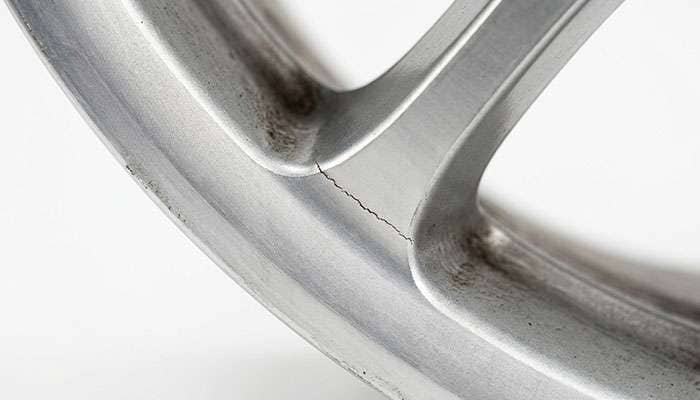
Buy too little wheel for the load and the failure sequence is predictable. A cast wheel run past its rating flexes more than it was designed to under cornering and impact. Repeated flex concentrates stress at the spoke-to-barrel junction. You get a hairline crack that weeps air, so the tire runs chronically low. A chronically underinflated tire builds heat in the sidewall, which shortens tire life and, at highway speed on a loaded truck, can end in a sudden failure. The wheel that saved you $400 has now cost you a set of tires and put you on the shoulder.
Buy too much wheel for the use and the loss is slower but just as real. A $2,150 three-piece forged wheel on a daily-driven car parked on city streets is a wheel that will meet a curb. Repairing a multi-piece barrel means disassembly, a replacement half, resealing, and a pressure test. On a set of four, one bad parking job can run into four figures. There is a reason people who commute in traffic run cast wheels and save the forged set for weekends.
The third mistake is the quiet one: paying forged money for a cast wheel because the badge implied forged. That is a pure loss. Nothing about the wheel is better, and you have spent the premium on a logo. Check the construction line on the spec sheet before you check out. It is listed on every product page we run.
Work through this in order and you will land in the right tier without guessing.
Find your load requirement first. Open the driver's door and read the tire and loading placard. Take the gross axle weight rating for the heavier axle and divide by two. That number is the minimum per-wheel load rating you can accept. If it is over 2,500 pounds, you are shopping forged whether you wanted to or not.
Decide whether the fitment exists off the shelf. If a production wheel is available in your bolt pattern, diameter, width, and an offset within a few millimeters of what you need, you do not need multi-piece construction. If it does not exist, or if you need clearance for a big brake kit, multi-piece or a blank-drilled wheel is the answer and the price floor comes with it.
Then, and only then, look at brands. Filter by construction type, not by name. Compare load ratings and confirm the manufacturer tests to SAE J2530. If two wheels match on both, the difference between them is design and finish, and you should buy the one you like better at the lower price.
Budget the tires in the same conversation. A premium wheel on a mediocre tire is a worse-driving car than a mid-tier wheel on a good tire. The contact patch does the work.
Ready to shop the tier your build actually needs? Browse our full forged wheels selection, or call our fitment desk at Performance Plus Tire and we will pull the load ratings and offsets for your specific vehicle before you spend a dollar.
The honest answer to "what are some expensive wheel brands" is that the question is aimed at the wrong target. Racestar, Intro Custom, American Force, Billet Specialties, Boyd Coddington, Schott, Asanti, and Fuchs all sell wheels above $2,000 each, and most of them also sell wheels under $500 each. The badge is not the price. The construction line is.
Once you know whether you need cast, flow-formed, forged, or multi-piece, the price becomes predictable and the shopping becomes easy. Cast for most drivers. Flow-formed when you want weight savings at cast money. Forged when the load rating or the diameter demands it. Multi-piece when the fitment does not exist any other way. Everything above that is finish, exclusivity, and taste, which are fine things to buy as long as you know that is what you are buying.
By ceiling price, Racestar tops our catalog at $5,169.95 per wheel for the 63 Pro Forged in 16x18. By entry price, Schott has the highest floor of any brand we stock at $1,170 per wheel, meaning there is no inexpensive way into the line. Intro Custom reaches $4,562.50 and American Force reaches $4,549. Brands like Forgiato, Vossen, and HRE that dominate search results for this question price similarly but are not part of our catalog.
They are better at specific measurable things: lower weight, higher load rating, and fitment precision. They are not automatically safer or longer-lasting for normal use. A cast wheel with a 2,500 pound load rating that passes SAE J2530 is a fully adequate wheel for a passenger car. The premium buys performance margin you may or may not need, plus finish quality and exclusivity you may or may not care about.
Because the brand runs multiple construction lines. Asanti sells one-piece cast wheels starting at $84 and three-piece forged wheels starting at $1,750 under the same name. Fuel spans $99 cast to $2,890 forged. The logo on the center cap tells you nothing about how the wheel was manufactured. Always read the construction spec on the product page before you judge the price.
For a typical passenger car or half-ton truck, budget $246 to $450 per wheel for a quality cast or flow-formed option, which is roughly $1,000 to $1,800 for a set of four. Heavy trucks needing forged construction should budget $922 to $1,646 per wheel. Multi-piece forged starts around $1,100 per wheel and commonly lands near $2,150. Add mounting, balancing, and tires to any of those figures.
No. Forged is worth it when your per-wheel load requirement exceeds what cast can deliver, when you are running diameters of 24 inches or larger, or when you are chasing weight for track use. For a daily-driven car in stock sizes, forged buys margin you will never use. In that case, flow-formed gives you most of the weight benefit at cast pricing, which is a far better trade.
It means the wheel ships undrilled and gets machined to your exact bolt pattern and hub bore after you order. That is why those listings show a wide offset range instead of a single number and why they carry the highest prices in a line. Expect a multi-week lead time and understand that a custom-drilled wheel cannot practically be returned, since it has been machined specifically for your vehicle.
You can, but it undercuts the reason you bought the wheel. The tire is what actually contacts the road and does the work of accelerating, braking, and turning. A forged wheel paired with a low-grade tire will drive worse than a cast wheel paired with a quality tire. If the budget is fixed, spend on the tire first and the wheel second.



