
A 265 65R17 measures about 30.6 inches in overall diameter, 10.4 inches in section width, with a 6.8-inch sidewall on a 17-inch wheel. Circumference is roughly 96.0 inches and it turns about 660 revolutions per mile. Those numbers come off a spec sheet, and the spec sheet assumes one thing most guides never mention: the tire was measured on an 8.0-inch rim. Mount the same tire on a 9.5-inch rim and the section width grows by roughly three quarters of an inch. Mount it on a 7.5-inch rim and it shrinks. Same size marking, different tire on the ground.
That is the first variable. The second one is load index, and it moves further than the width does. A 265 65R17 is sold with load indexes from 109 all the way to 120. That is a spread of more than 800 pounds of carrying capacity per corner, all wearing the identical size stamp. Two tires can both say 265/65R17 and be built for genuinely different jobs.
Here is the part nobody puts in front of you when you search this size: the inches are the easy half. Getting the right 265 65R17 means matching the rim you are mounting to and the load index on your door placard. This guide covers both, then works through the comparison questions that come up every time someone shops this size.
The metric size code breaks into three pieces, and each one converts cleanly.
265 is the section width in millimeters. That is the widest point of the inflated tire, measured sidewall bulge to sidewall bulge, not tread edge to tread edge. Divide by 25.4 and you get 10.43 inches. This is not the contact patch. On most all-terrain and highway tires in this size the actual tread that touches pavement runs about 8.5 to 9 inches, with the rest of the width taken up by the shoulder blocks and the sidewall curve.
65 is the aspect ratio. The sidewall height equals 65 percent of the section width. Multiply 265 by 0.65 and you get 172.25 millimeters, or 6.78 inches, from the bead seat to the top of the tread. That number matters more than people expect, because sidewall height is what absorbs impacts and what determines how much the tire rolls over during a hard corner or a loaded turn.
17 is the wheel diameter in inches. Straightforward. The bead seats on a 17-inch wheel and nothing else.
Stack them and the overall diameter is 17 plus two sidewalls: 17 + 13.56 = 30.56 inches, published as 30.6. In millimeters that is roughly 776 mm. Circumference works out to 30.56 multiplied by pi, or 96.0 inches. Divide 63,360 inches in a mile by 96.0 and you get 660 revolutions per mile.
Those revolutions-per-mile figures are what your speedometer and odometer are calibrated against. Change the diameter and every speed and mileage reading in the vehicle shifts with it. That is why a size swap that looks harmless on paper is not always harmless in practice, which comes up again later in this guide.
One more conversion people ask for: in the high-flotation system used on off-road tires, a 265 65R17 is roughly equivalent to a 30.6x10.4R17. You will almost never see it marked that way, because flotation sizing is reserved for the taller light-truck sizes, but the math holds.
Every tire size published by the Tire and Rim Association has an approved rim width range and a single measuring rim inside that range. For 265 65R17, the approved range is 7.5 to 9.5 inches and the measuring rim is 8.0 inches. Every published spec you find for this size, including the 30.6 by 10.4 figures above, describes the tire mounted on that 8.0-inch rim.
Mount it anywhere else in the approved range and the tire changes shape. The industry rule of thumb is that section width moves about 5 millimeters, roughly 0.2 inches, for every half inch of rim width change. Pull the beads farther apart and the sidewalls stand up straighter and push out wider. Squeeze them together and the sidewalls bow inward and the tire gets narrower and slightly taller.
Rim Width |
Approx. Section Width |
Approx. Mounted Diameter |
What It Does on the Vehicle |
|---|---|---|---|
7.5 in (narrowest approved) |
10.2 in |
30.7 in |
Most sidewall bulge, softest ride, most rollover in hard corners, best protection for the wheel lip on trails |
8.0 in (measuring rim) |
10.4 in |
30.6 in |
The published spec; balanced ride and response, and the setup every tire review is written against |
8.5 in |
10.6 in |
30.5 in |
Slightly flatter contact patch, sharper turn-in, very common factory width on mid-size trucks |
9.0 in |
10.8 in |
30.4 in |
Stiffer sidewall behavior, more exposed wheel lip, check fender and control arm clearance |
9.5 in (widest approved) |
11.0 in |
30.3 in |
Tread pulled nearly flat, harshest ride, highest risk of shoulder wear and curb damage to the rim |
Across the full approved range, the same 265 65R17 goes from roughly 10.2 inches wide to roughly 11.0 inches wide. That is close to a three-quarter-inch swing on a tire whose size marking never changes. If you are checking fender clearance on a lifted truck or measuring how much tire will poke past the wheel arch, the rim width you are mounting to matters as much as the size code does. The same logic applies at every size, and it is worth understanding what putting the same size tire on different rim widths does before you commit to a wheel.
The diameter moves in the opposite direction and by a smaller amount, roughly a tenth of an inch per half-inch step. That is small enough to ignore for speedometer purposes but large enough to matter if you are chasing the last quarter inch of clearance at full lock.
Manufacturers publish their own measured specs per model, and they vary. Two different 265 65R17 all-terrains from two brands, both on the same 8.0-inch rim, can differ by a couple tenths in diameter and width because of tread depth and casing design. Treat 30.6 by 10.4 as the reference point, not a guarantee.
This is the number that separates a correct 265 65R17 from an expensive mistake, and it is printed right after the size on the sidewall as part of the service description.
The load index is a coded number that maps to a maximum load in pounds at the tire's rated inflation pressure. In 265 65R17, that code runs across a wide spread depending on how the tire is built and what prefix it carries.
Marking |
Load Index |
Max Load Per Tire |
Typical Application |
|---|---|---|---|
P265/65R17 110 SL |
110 |
2,337 lb |
Passenger-metric build for lighter SUVs and crossovers; load capacity is derated when fitted to a truck |
265/65R17 112 SL |
112 |
2,469 lb |
The volume replacement spec for this size; covers most factory mid-size truck and SUV placards |
265/65R17 116 XL |
116 |
2,756 lb |
Extra Load casing for heavier SUVs, roof loads, and regular towing without stepping up to a light-truck tire |
LT265/65R17 120/117 E |
120 single / 117 dual |
3,086 lb single |
Load Range E light-truck construction for heavy hauling, overlanding weight, and puncture resistance |
Read down that table and the point lands: from 110 to 120 is 749 pounds per tire, or nearly 3,000 pounds across four corners. That is the difference between a tire that carries your loaded truck and one that is working past its rating every time the bed is full.
Federal Motor Vehicle Safety Standard 110 requires every light vehicle to carry a tire and loading information placard, usually on the driver's door jamb, listing the original size and the load rating the vehicle was certified with. NHTSA's guidance is consistent on this point: the replacement tire's load index should meet or exceed the original. Going below it is a real reduction in the vehicle's safe capacity, not a technicality.
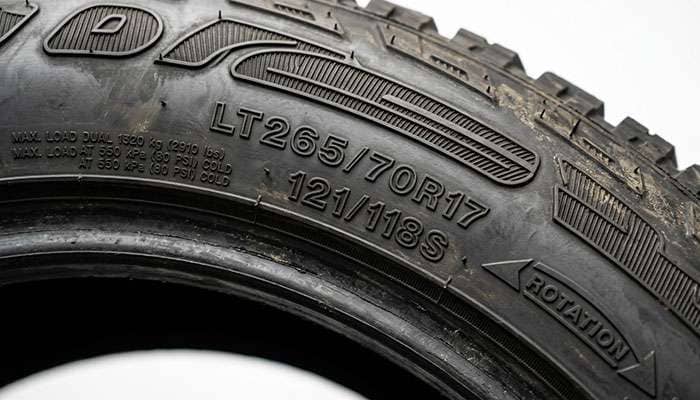
The prefix matters too. A tire marked P265/65R17 is built to passenger-car standards. When a P-metric tire is fitted to a truck, van, or SUV, its load capacity is divided by 1.10 before you compare it to the placard requirement. A 110 P-metric rated at 2,337 pounds only counts for about 2,125 pounds on a truck. A tire with no prefix is Euro-metric and does not take that reduction. A tire marked LT is light-truck construction with a stiffer casing, higher inflation pressures, and a load range letter such as C, D, or E. If the distinction between capacity codes is still fuzzy, our breakdown of load range versus load index walks through how the two systems relate.
Speed ratings in this size cluster around T (118 mph) and S (112 mph), with H (130 mph) on the more road-oriented highway tires and Q or R on winter and light-truck builds. For a truck or SUV on this size, T is more than adequate. What you should not do is drop below the rating on the placard, because speed rating correlates with casing construction and heat capability, not just top speed.
In rolling diameter, almost exactly. In everything else, no.
Run the math. A 265/70R17 has a 7.30-inch sidewall, giving 17 + 14.61 = 31.61 inches overall. A 265/65R18 has the same 6.78-inch sidewall as our 265/65R17, but on a one-inch-larger wheel: 18 + 13.56 = 31.56 inches. That is a difference of five hundredths of an inch, which is inside manufacturing tolerance. Both turn roughly 638 revolutions per mile. Speedometer-wise they are interchangeable.
They are not interchangeable on the vehicle, and this is where the question usually goes sideways. A 265/70R17 mounts on a 17-inch wheel. A 265/65R18 mounts on an 18-inch wheel. You cannot put one on the other's rim, full stop. If someone tells you the two sizes are "the same," they mean the truck sits at the same height and the speedometer reads the same, not that you can swap them onto the same set of wheels.
What that equivalence is actually useful for is plus-sizing. If you have a 17-inch wheel running 265/70R17 and you want to move to an 18-inch wheel without changing ride height, gearing feel, or speedometer calibration, 265/65R18 is the size that gets you there. The sidewall drops by half an inch, the ride firms up slightly, and everything else stays put. Our guide to 265/65R18 in inches covers that size in the same detail as this one.
Relative to the 265/65R17 you came here for, both of those sizes are a full inch taller. Neither is a drop-in replacement on a vehicle that came with 265/65R17 unless you have checked clearance first.
The wheel fits, so the swap is physically possible. Whether it is advisable depends on your clearance and how much speedometer error you are willing to live with.
Here is the arithmetic. 265/70R17 stands 31.61 inches against 30.56 inches for 265/65R17. That is 1.05 inches taller, a 3.4 percent increase in diameter. Ride height goes up about half an inch, since only half the diameter change shows up as lift.
The industry convention is to stay within plus or minus 3 percent of original diameter when substituting sizes, because that is roughly where speedometer error, ABS wheel-speed comparison, and transmission shift logic stay inside their designed tolerances. At 3.4 percent, 265/70R17 sits just outside that window. It is not a dramatic overshoot, and plenty of trucks run it, but it is far enough out that you should know what it does before you buy.
At an indicated 70 mph on a truck calibrated for 265/65R17, a set of 265/70R17 puts you at roughly 72.4 mph actual. Your odometer under-records by the same 3.4 percent, which quietly stretches maintenance intervals and shortens the recorded life of the truck. If you plan to make the change permanent, a speedometer recalibration through a tuner or a dealer-level scan tool is worth the cost.
Clearance is the other half. An extra half inch of static ride height sounds trivial, but the tire also grows about half an inch in radius at the front and rear of the arch, where the tire swings during suspension travel and steering lock. On stock mid-size trucks, 265/70R17 usually clears. On vehicles with aftermarket wheels pushed outward by a lower offset, or with mud flaps and running board brackets in the way, it sometimes does not. Full lock while articulating is where rubbing shows up first.
Two other consequences worth naming. The taller tire is effectively a taller gear, so acceleration softens slightly and the transmission may hold gears longer on grades. And the approved rim width narrows: 265/70R17 is generally approved for 7.0 to 9.0 inches for passenger-construction tires and a tighter range for LT builds, so a 9.5-inch wheel that works with 265/65R17 may fall outside the range for the taller size. We break down the full spec set in our guide to what size a 265 70R17 tire is in inches.
Short answer: yes, it fits, and it is a common upgrade. Go in knowing it is a 3.4 percent change, not a neutral one.
No. A 265 is a width, not a height, and the two only line up by coincidence.
The 265 in 265/65R17 tells you the tire is 265 millimeters wide. It says nothing about how tall the tire is. Height comes from the aspect ratio and the wheel diameter together. A 265/65R17 is 30.6 inches tall. A 265/70R16 is 30.6 inches tall. A 265/75R16 is 31.6 inches. A 265/60R18 is 30.5 inches. Same width designation, four different heights.
To hit a genuine 33 inches, you need considerably more sidewall or a bigger wheel. On a 17-inch wheel, the metric sizes that land near 33 inches are roughly 285/70R17 at 32.7 inches and 295/70R17 at about 33.3 inches. In the flotation sizing system, 33x12.50R17 says it outright: 33 inches tall, 12.50 inches wide, 17-inch wheel. That is a much wider tire than a 265 and generally needs a wider wheel and more fender room.
Against a 33, the 265/65R17 you are looking at is 2.4 inches shorter. That is not a marginal difference. It is roughly the gap between a stock mid-size truck and a lifted one. When a 265/65R17 gets called "basically a 33" around a shop or a forum, the size being pictured is a different one. Our breakdown of what size a 33x12.50R20 is, with metric equivalents shows how flotation and metric sizing translate across the board.
Where the confusion usually starts is the 16-inch world. A 265/75R16 measures 31.6 inches and is often loosely called a 32. A 285/75R16 measures 32.8 inches and genuinely is sold as a 33. Neither of those is a 265/65R17, and neither swaps onto a 17-inch wheel.
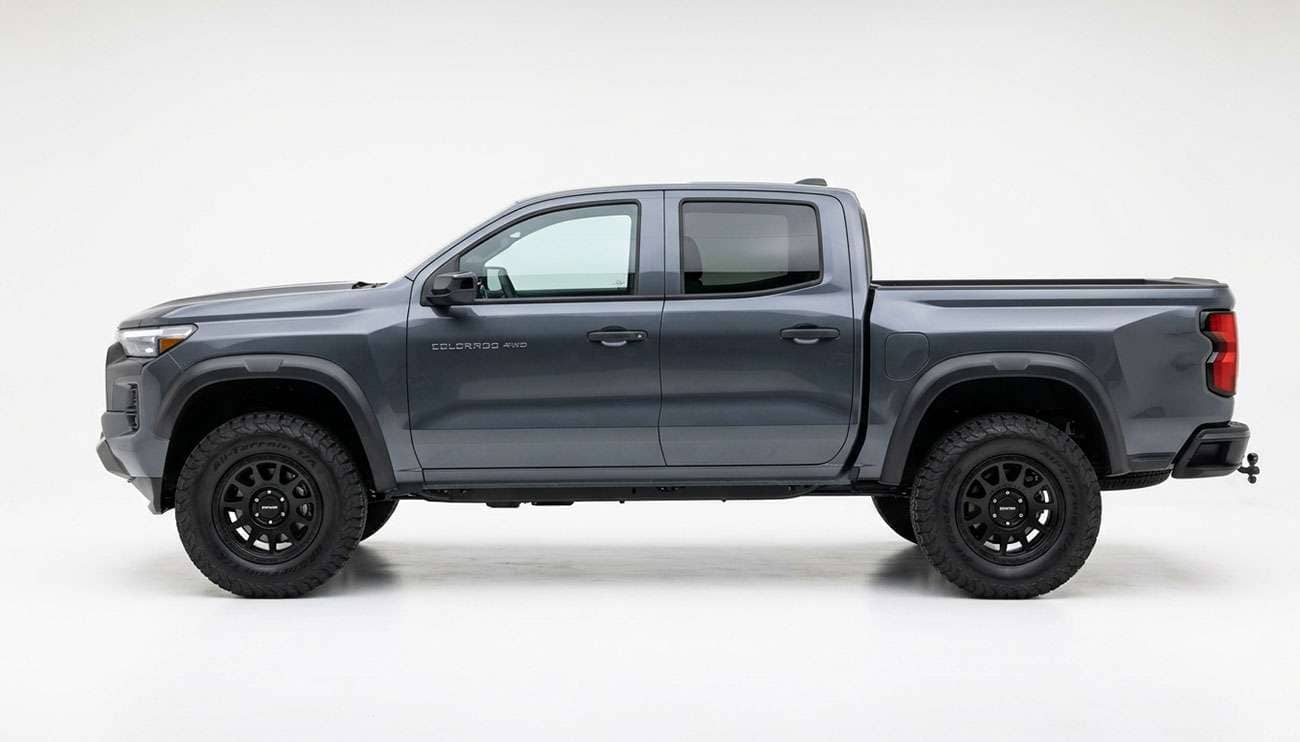
All-terrain is the dominant category in this size, which makes sense given where 265/65R17 shows up from the factory: Toyota Tacoma SR5, TRD Sport, TRD Off-Road and Limited trims, Toyota 4Runner SR5, Tundra and Sequoia, Chevrolet Colorado and GMC Canyon, Nissan Frontier, Xterra and Pathfinder, Ford Ranger, and the Lexus GX470. Those are vehicles that see gravel, tow something occasionally, and still spend most of their miles on pavement.
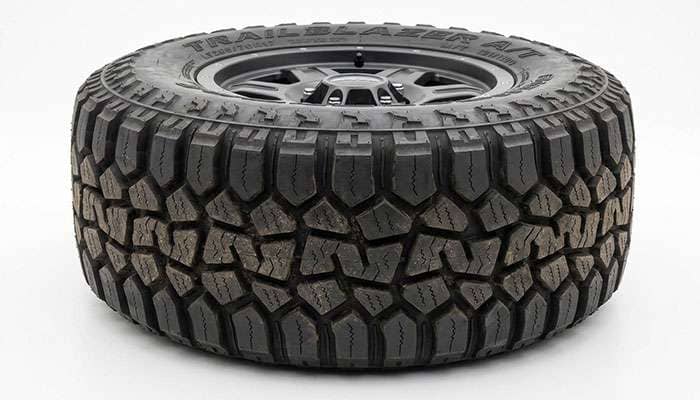
Rather than hand you a ranked list that ignores your truck, here is the filter that actually narrows the field in this size.
Start with load index, not brand. The all-terrain offerings in 265/65R17 split cleanly into three groups: standard-load 112 builds, Extra Load 116 builds, and LT-construction 120 Load Range E builds. A Falken WildPeak A/T4W in 116 XL and a BFGoodrich All-Terrain T/A KO3 in LT 116 D are aimed at different owners even though they look similar on a shelf. If your placard calls for 112 and you never tow, the LT-E tire adds weight, harshness, and rolling resistance you will pay for in fuel every day to buy capacity you never use.
Then decide about winter. The three-peak mountain snowflake symbol means the tire passed a standardized medium-packed-snow traction test. Many current all-terrains in this size carry it; older highway-terrain designs carry only the M+S marking, which is a tread-geometry designation rather than a performance test. If you see real snow, the 3PMSF symbol is the single most useful marking on the sidewall.
Then look at treadwear and warranty together. Mileage warranties in 265/65R17 run from roughly 40,000 to 80,000 miles, and the UTQG treadwear grades range from the mid-400s to the low 800s. Aggressive all-terrains sit at the low end of both. That trade is real and it is not a defect: the open shoulder blocks and softer compound that give you traction on loose surfaces are the same features that wear faster on hot pavement.
Finally, check noise tolerance honestly. The most aggressive all-terrains in this size produce a hum at highway speed that some owners never notice and others find intolerable after a month. If your truck is primarily a commuter that sees a fire road twice a year, a highway-terrain tire will be quieter, last longer, and cost less. Our comparison of the best all-terrain tire for daily driving works through that trade in detail.
265/65R17 is a high-volume size, which is good news for price. It is stocked broadly across the market, from entry-level brands through premium, and pricing generally spans from roughly $110 per tire at the budget end to over $300 for premium light-truck construction.
What drives that spread is not mostly brand prestige. It is construction. Passenger-metric builds sit at the bottom of the range, standard Euro-metric in the middle, and LT Load Range E at the top, and the gap between a P-metric and an LT version of the same nominal size can approach 50 percent. Before you shop on price, settle which of those three you actually need, because comparing a P-metric price against an LT price is comparing two different products.
Three things worth knowing when you are hunting for value in this size:
You can browse the full range of 265/65R17 tires filtered by load index, season, and construction to compare like against like.
Getting the inches right and the spec wrong is the most common way this size goes bad. The failure is gradual, which is exactly why it catches people.
Weeks one through eight: uneven wear you cannot see yet. An under-rated tire carrying more than it should runs at a higher operating temperature and deflects more in the sidewall. Shoulder wear starts before it becomes visible in a walkaround. A tire mounted at the far edge of its approved rim width does the same thing from the opposite direction, wearing the shoulders on a too-wide rim or the center on a too-narrow one.
Months two through six: heat accumulation in the casing. Every rotation, the sidewall flexes and releases. That flex generates heat, and heat is what degrades the bond between the rubber and the steel belts inside the tire. An overloaded casing flexes further per rotation. The damage is cumulative and it does not reverse when you unload the truck. The Tire Industry Association's service guidance treats sustained overload and chronic underinflation as the same failure mechanism for exactly this reason.
Months six through eighteen: the belt edge starts to separate. This is where a tire that has been running past its rating begins to show it. The symptom is usually vibration that comes and goes with speed, sometimes a visible bulge or a wave in the tread face. By the time you can feel it, the internal separation is well established.
Any point in that timeline: sudden failure under load. A casing that has been accumulating heat damage fails when it is worked hardest, which on a truck means loaded, at highway speed, in summer heat. That is the least forgiving moment for it to happen. Sidewall damage in particular is one of the failure modes where waiting to see if it gets worse is the wrong call, and our guide to tire sidewall damage and whether it is safe to drive covers how to judge what you are looking at.
None of this requires abuse. It requires one wrong number on a service description and enough miles.
A 265 65R17 is 30.6 inches tall, 10.4 inches wide, with a 6.8-inch sidewall, a 96-inch circumference, and 660 revolutions per mile. Those figures describe the tire mounted on an 8.0-inch measuring rim. On a 7.5-inch rim it is narrower and slightly taller; on a 9.5-inch rim it is nearly three quarters of an inch wider. And within that single size marking, load index runs from 109 to 120, a spread of more than 800 pounds per corner.
The inches answer the question you searched. The rim width and the load index answer the question you actually needed to ask. Check the placard, read the whole service description, and confirm your wheel width before you buy anything in this size.
A 265 65R17 measures approximately 30.6 inches in overall diameter and 10.4 inches in section width, with a 6.8-inch sidewall on a 17-inch wheel. Circumference is about 96.0 inches and it turns roughly 660 revolutions per mile. Those figures are measured on an 8.0-inch rim; the actual mounted width varies by about 0.2 inches for every half inch of rim width within the approved 7.5 to 9.5-inch range.
They have nearly identical overall diameters, 31.61 inches for the 265/70R17 and 31.56 inches for the 265/65R18, so they produce the same ride height and the same speedometer reading. They are not interchangeable, because one requires a 17-inch wheel and the other requires an 18-inch wheel. The pairing is useful for plus-sizing from 17s to 18s without changing how the vehicle sits or reads.
It mounts on the same 17-inch wheel, but it is 1.05 inches taller, a 3.4 percent diameter increase that sits just outside the plus-or-minus 3 percent substitution window. Expect about half an inch of added ride height, a speedometer that reads roughly 2.4 mph slow at an indicated 70 mph, and an odometer that under-records by the same percentage. Check fender and control arm clearance at full steering lock before committing.
No. The 265 is a width in millimeters and says nothing about height. A 265/65R17 is 30.6 inches tall, which is 2.4 inches shorter than a true 33. On a 17-inch wheel, the sizes that land near 33 inches are roughly 285/70R17 at 32.7 inches, 295/70R17 at about 33.3 inches, or the flotation size 33x12.50R17.
The Tire and Rim Association approved range for 265/65R17 is 7.5 to 9.5 inches, with 8.0 inches as the measuring rim. Widths of 8.0 and 8.5 inches are the most common factory and aftermarket setups. Mounting at either extreme of the range is legal but changes how the tire wears and rides, and individual tire models sometimes specify a narrower approved range than the general size standard.
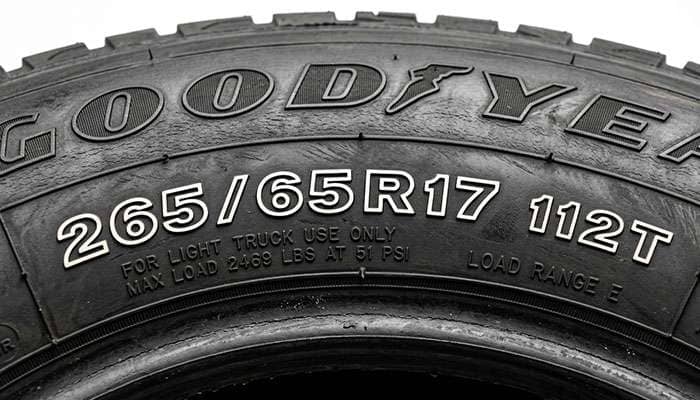
That is the service description. The 112 is the load index, which corresponds to a maximum load of 2,469 pounds per tire at rated inflation. The T is the speed rating, good for 118 mph. In 265/65R17 you will also see 110 at 2,337 pounds, 116 XL at 2,756 pounds, and LT builds at 120 for 3,086 pounds. Match or exceed whatever your door placard specifies.
It is a common original size on mid-size trucks and body-on-frame SUVs, including the Toyota Tacoma in SR5, TRD Sport, TRD Off-Road and Limited trims, the Toyota 4Runner SR5, Tundra and Sequoia, the Chevrolet Colorado and GMC Canyon, the Nissan Frontier, Xterra and Pathfinder, the Ford Ranger, and the Lexus GX470. Always confirm against your own door placard rather than a model-year generalization.



