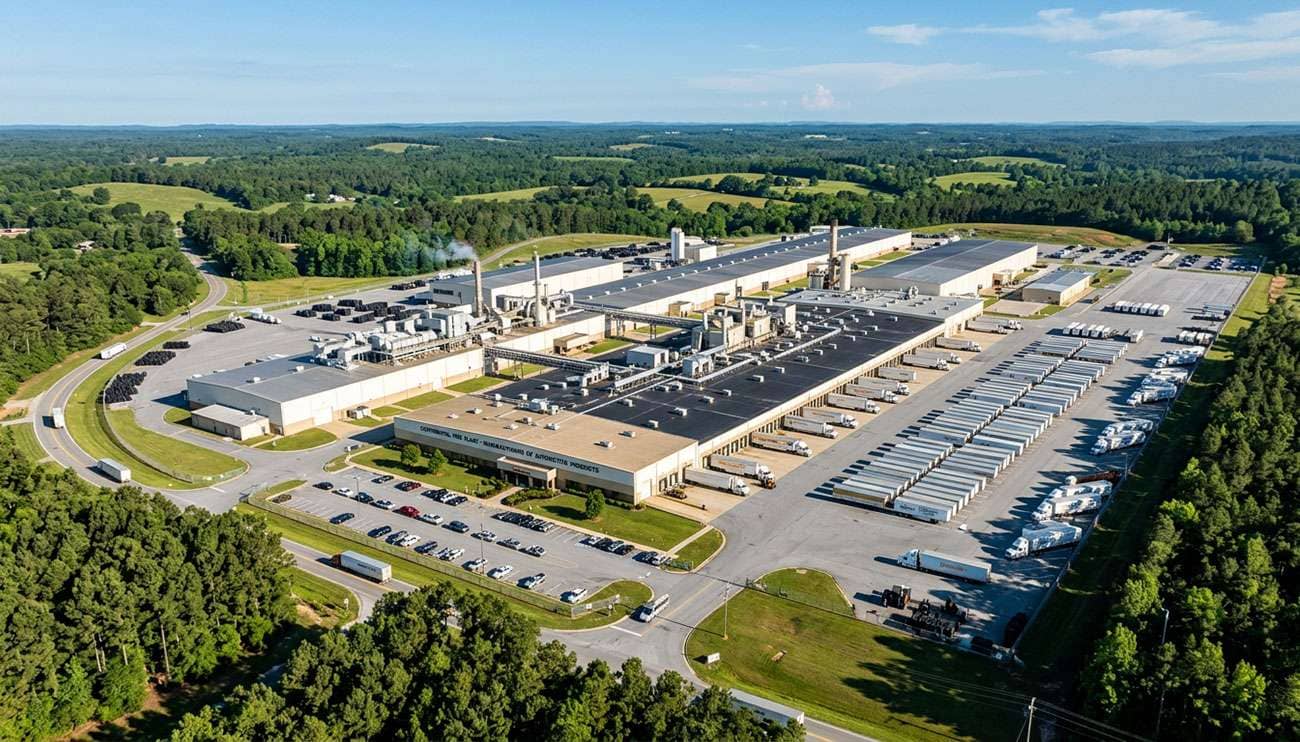
Short answer: South Carolina. It has more tire plants than any other state, 12 of them, and more daily capacity too, about 144,000 tires a day according to Modern Tire Dealer's 2023 Facts Issue. But counting plants is how most answers go wrong. Oklahoma ranked second with just two plants, while Tennessee had six and built far less. What decides where "most" tires come from is daily capacity per plant, and roughly 70 percent of that capacity sits in a Southeast tire belt running from Virginia down to Mississippi.
My dad got his start in this business behind the counter of a Firestone store, which is part of the history of Performance Plus Tire, and back then the answer to this question was one word: Akron. That's how long I've been watching where tires come from, and I've watched the map move south one plant at a time. Most lists you'll find name states and brands, sometimes including plants that stopped building tires years ago. Here's what the map actually looks like in 2026, ranked by how many tires each state can build in a day, what each one builds, and what's changing.
State |
Tire Plants (2023) |
Daily Capacity (2023) |
What's Changed Since |
|---|---|---|---|
South Carolina |
12 |
About 144,000 |
Still the leader by plants and output |
Oklahoma |
2 |
105,400 |
Michelin ended Ardmore production in 2025; Goodyear is expanding Lawton |
North Carolina |
2 |
65,500 |
Goodyear plans to close Fayetteville by end of 2027 |
Tennessee |
6 |
59,000 |
Bridgestone LaVergne truck plant closed 2025; Hankook expanding |
Georgia |
3 |
58,700 |
Toyo, Kumho, and Pirelli plants operating |
Illinois |
3 |
52,700 |
Continental Mount Vernon remains the anchor |
Mississippi |
3 |
47,800 |
Goodyear's Tupelo plant (former Cooper) leads the state |
Virginia |
2 |
39,800 |
Goodyear moving most Danville truck tire output elsewhere |
Alabama |
2 |
34,700 |
BFGoodrich Tuscaloosa winding down by end of 2028 |
Ohio |
2 |
23,300 |
Findlay builds consumer tires; Akron builds race tires |
Iowa |
3 |
15,100 |
Mostly farm tires; Bridgestone trimmed Des Moines capacity |
That table covers the states with two or more plants. Other states round out the map, including Arkansas (Goodyear's former Cooper plant in Texarkana), Kansas (Goodyear in Topeka), and Indiana (BFGoodrich in Fort Wayne and the Continental plant in Plymouth that builds Hoosier race tires), and Pennsylvania (Specialty Tires of America).
South Carolina, and it isn't especially close. Its roughly 144,000 tires a day in the 2023 count was about 37 percent more than runner-up Oklahoma and more than double every other state. It's also been the country's number one tire exporter, with more than $1.7 billion in tire exports in 2022, its seventh straight year on top.
Michelin is the reason. Michelin owns and operates six of South Carolina's twelve tire plants, building passenger, light truck, commercial, and giant earthmover tires, with its North American headquarters in Greenville. Bridgestone runs two plants in Aiken County. Continental builds passenger and light truck tires in Sumter. Giti builds GT Radial and Giti tires in Richburg.
Now look at the second row of that table again, because this is the part that gets skipped. Oklahoma had two plants and 105,400 tires a day. Tennessee had six plants and 59,000. If you rank states by how many factories they have, you get a very different, and wrong, picture of where tires come from.
Oklahoma's number came mostly from one building. Goodyear's Lawton plant, rated at about 65,400 tires a day, is the company's largest tire factory, and Goodyear announced a $320 million, four-year investment there in 2025 to add 10 million passenger tires a year of capacity, aimed at larger rim diameters. When Michelin ended production at Ardmore in 2025, Oklahoma's tire output became essentially a one-plant story.
Tennessee is the opposite case. Its six plants in that count included two Bridgestone truck tire plants and Nokian's plant in Dayton, and its passenger heavyweight is Hankook's Clarksville plant, expanding under a $1.6 billion investment announced in 2022. Lawton alone had more daily capacity than all six combined.
Because the industry rebuilt itself in the 1970s and 1980s, and when it rebuilt, it went south.
The mechanism was the radial tire. American plants had spent decades building bias-ply tires, and radials needed different building machines, different processes, and in many cases different buildings. When the conversion hit, companies faced a choice: retool an aging plant up north or build new. A lot of them built new.
Michelin, the company that brought the radial to market, opened its Greenville, South Carolina tire factory in March 1975 to feed growing American demand. It found a business climate that fit its style, and it kept building. Japanese, Korean, and European makers that came later followed the same path into the Carolinas, Georgia, Tennessee, and Mississippi.
Industry reporting from the 1990s points to a few other factors. Newer Southern plants avoided the shorter workdays and work rules that had cut into production time in older Northern plants. And as Akron's big names were bought by foreign companies with no hometown ties, many of the new owners wanted a fresh start somewhere else.
Add interstate access, ports for exporting, and state incentive packages, and you get today's tire belt. In the 2023 count, Virginia, North Carolina, South Carolina, Georgia, Tennessee, Alabama, and Mississippi together held about 449,500 tires a day of capacity. That's roughly 70 percent of the capacity in every state with two or more plants.
Yes, but not the kind on your car.
Akron was the Rubber Capital of the World. Goodyear, Firestone, General, and BFGoodrich all built tires there, and if you want the full story of who came first, our rundown of the oldest tire brands and their founding dates covers it. Then the radial conversion and everything that came with it emptied the city's tire floors. Firestone closed its last Akron passenger tire plant in 1981. General Tire's Plant 1, the city's last full-scale tire factory, shut down in 1982.
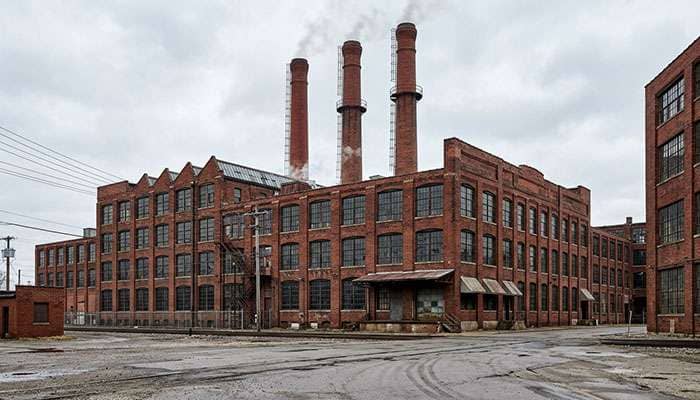
Here's what survives, and I love this part. Goodyear is still headquartered in Akron, and it still builds racing tires there. In 2022, Bridgestone opened its Advanced Tire Production Center in Akron to build Firestone IndyCar race tires. So the city that once put tires on Model As and muscle cars now builds the tires that run at Daytona and Indianapolis. It's a small output, but it's real, and it's some of the most demanding tire work in the country.
Different map. Truck and bus radials, the tires on semis and delivery trucks, come from a smaller set of plants, and that set is shrinking.
Imports fill the rest. Thailand alone shipped more than 6.5 million truck and bus tires to the U.S. in 2024, roughly double what Warren County can build in a year at full output.
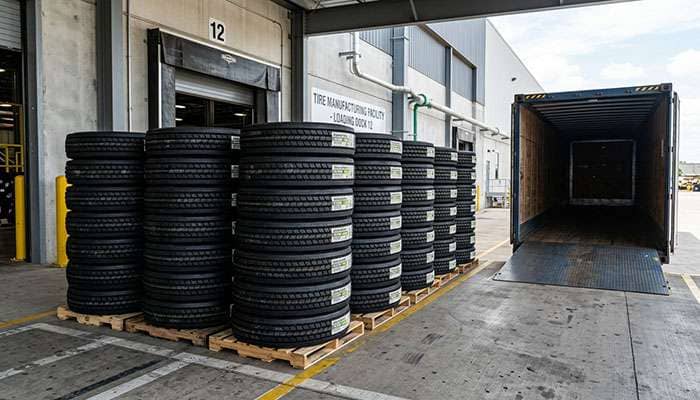
Farm and earthmover tires have their own map too. Iowa's plants, including Bridgestone's agricultural plant in Des Moines, build mostly farm and off-road tires. Michelin builds giant earthmover tires in South Carolina, and Goodyear's Topeka plant builds off-the-road tires.
Truck and SUV owners ask me this one more than anybody, and the answer has its own geography.
High-volume truck and SUV sizes are the sizes most likely to get a North American mold, which is good news if U.S. production matters to you. Big-diameter, low-profile performance sizes are a different story. Those more often come from plants in Europe and Asia.
This is the corner of the map I care about most, because it's where my customers live.
If you've ever wondered how a drag slick goes from raw rubber to the starting line, our guide on how drag racing tires are made walks through it.
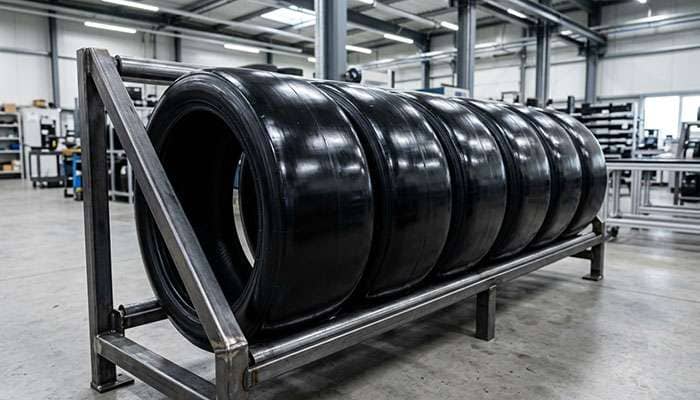
Classic and vintage tires are trickier. A lot of reproduction programs own or license the original molds and drawings, then contract a plant that can still build that construction, sometimes in the U.S. and sometimes overseas. The name on the box tells you who owns the look. The sidewall tells you who built it. For a maker-by-maker breakdown by era, see our guide on who makes vintage car tires. We know that world well; Lucas Classic Tires is part of the Performance Plus Tire family now.
This is where a lot of "made in USA" lists go stale. Several plants that still show up on brand-by-brand lists have stopped building tires, and more are on the clock.
Plant |
Company |
Status |
|---|---|---|
Albany, Georgia |
Cooper |
Closure announced December 2008 |
Gadsden, Alabama |
Goodyear |
Permanent closure announced April 2020 |
Tonawanda, New York |
Sumitomo (Falken) |
Production ended after November 2024 decision; site sold 2026 |
Ardmore, Oklahoma |
Michelin |
Tire production ended 2025 |
LaVergne, Tennessee |
Bridgestone |
Truck tire plant closed 2025 |
Fayetteville, North Carolina |
Goodyear |
Planned closure by end of 2027 |
Tuscaloosa, Alabama |
Michelin (BFGoodrich) |
Wind-down by end of 2028; production consolidating in Fort Wayne, Indiana |
It isn't all contraction. Goodyear is putting $320 million into Lawton. Hankook is putting $1.6 billion into Clarksville. Bridgestone is investing $550 million in Warren County. What's happening is consolidation into fewer, bigger, newer plants, and that pushes the map even further toward the states that already lead.
For scale, the U.S. Tire Manufacturers Association says its member companies operate 55 tire plants in 16 states. Those members accounted for 76 percent of the 336.3 million tires shipped in the U.S. in 2025, a share that includes tires those companies ship here from their own plants overseas.
Read the sidewall. Two markings tell you everything.
First, the "Made in" line, usually small raised lettering near the bead. Imported tires must carry their country of origin under federal customs law, and U.S.-built tires typically say "Made in USA."
Second, the DOT code, the Tire Identification Number NHTSA requires under 49 CFR Part 574. The first group after "DOT" is the plant code, which identifies the exact factory. Here's the wrinkle: a lot of guides still describe that plant code as two characters. NHTSA expanded plant codes to three characters, assigned new three-character codes to every plant that had a two-character one, and allowed the old codes only until April 13, 2025. Any tire built after that date carries a three-character plant code, so if a lookup chart only has two-character codes, it's older than your tire.
The last four digits are the build week and year. "1426" means the 14th week of 2026. Federal rules only require the full code on one sidewall, so if you only see a short version, check the side facing the car. Our guide on how to read DOT tire date codes covers the date portion step by step.
One thing to know before you shop: even a brand with big U.S. plants builds some sizes elsewhere. Production is assigned size by size, so the same tire model can come from Lawton in one size and from Mexico in another. The sidewall is the only place that tells you for sure.
I get it. I've been selling tires most of my life, and I like knowing a tire was built by people in Lawton or Greenville or Clarksville. But I've also watched customers make worse choices chasing a location, and the stakes climb fast:
Every tire sold for highway use here has to meet the same Federal Motor Vehicle Safety Standards, FMVSS 139 for passenger and light truck radials, wherever it was built. Get the right size, load, and speed rating first. Then, if a U.S. plant matters to you, pick from the tires that meet the spec and were built here.
Here's how I'd do it if you walked into the shop and asked:
Most tires made in the USA come from the South. South Carolina leads on both plant count and daily output, with Michelin at the center of it, and the tire belt from Virginia to Mississippi holds about 70 percent of the capacity in the states with multiple plants. But the plant count only tells half the story. One Goodyear plant in Lawton had more daily capacity than all six of Tennessee's plants combined in the last full count, and the map keeps consolidating as older plants close and the biggest ones expand.
Akron still builds tires, just the kind that run at Daytona and Indy. And for the tire on your own car, the only answer that counts is the one molded into the sidewall. Read it, then buy the tire that fits your vehicle right.
South Carolina. It had 12 tire plants and about 144,000 tires a day of capacity in Modern Tire Dealer's 2023 count, led by Michelin's six plants. It has also been the top U.S. tire exporter for years running.
Goodyear's U.S. consumer tires come from Lawton, Oklahoma, its largest plant, plus the former Cooper plants in Findlay, Ohio; Tupelo, Mississippi; and Texarkana, Arkansas. Fayetteville, North Carolina is slated to close by the end of 2027. Goodyear also builds race tires in Akron.
Mostly South Carolina, where Michelin runs six plants and its North American headquarters. BFGoodrich tires are built in Fort Wayne, Indiana, and in Tuscaloosa, Alabama until that plant winds down by the end of 2028.
Only race tires. Akron's last full-scale tire factory closed in 1982. Today Goodyear builds racing tires there, and Bridgestone builds Firestone IndyCar tires at a production center it opened in Akron in 2022.
The U.S. Tire Manufacturers Association says its members operate 55 plants in 16 states. A few smaller specialty plants run by non-member companies add to that total, and the count keeps shifting as older plants close.
Look for "Made in USA" molded near the bead, then read the DOT code. The plant code right after "DOT" identifies the factory, and it has been three characters on every tire built since April 13, 2025.