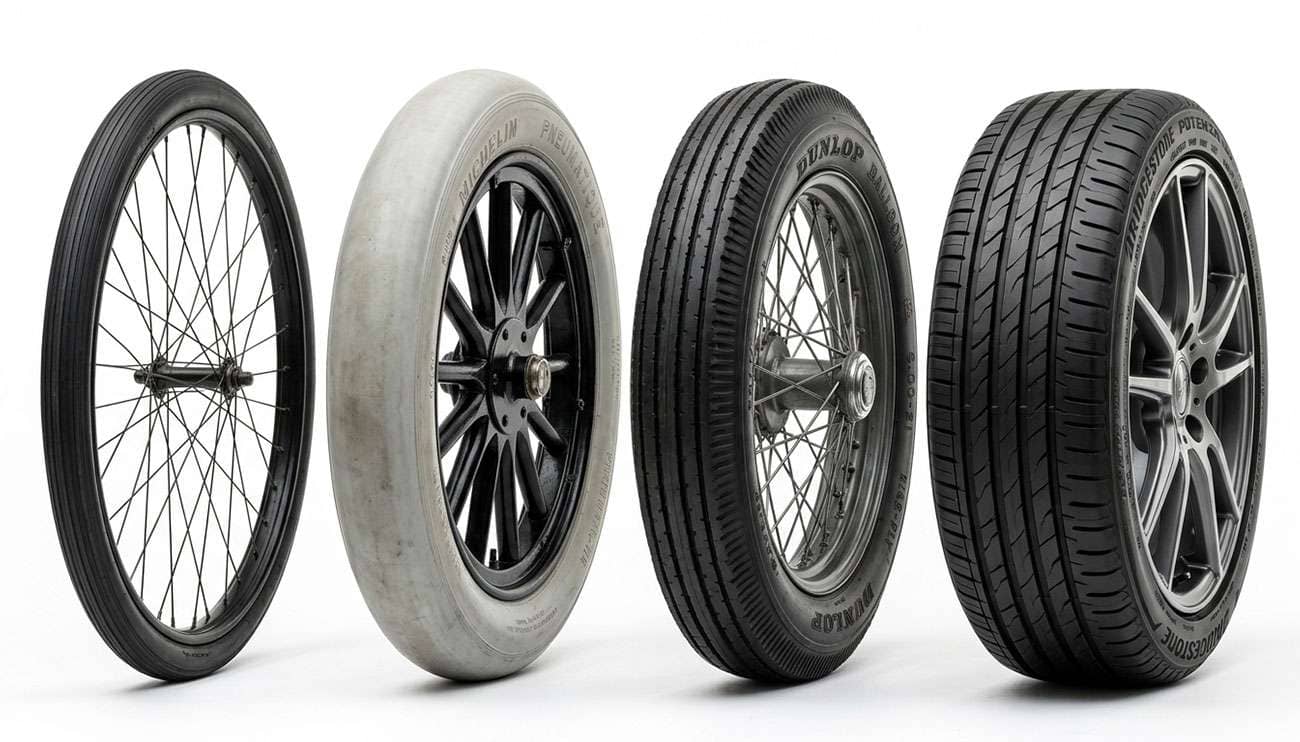
Continental, founded in Hanover, Germany, in 1871, is the oldest major tire maker still operating under the name it started with. But that's one answer to a question with four. Count company roots instead, and Michelin's business goes back to 1832. Count American brands, and BFGoodrich dates to 1870. Count the first company built around the pneumatic tire, and it's Dunlop in 1889. Most answers give you a single date. The variable they skip is which clock you're using: the company, the first tire, or the name on the sidewall today.
I'm Dennis Feldman, and I spend my days matching tires to cars by the numbers. Founding dates are numbers too, and they're messier than the marketing makes them look. Here's the clean version, sorted by what you actually mean when you ask.
If You Mean |
The Answer |
Year |
Still on Tires Today? |
|---|---|---|---|
Oldest major tire maker still using its founding name |
Continental |
1871 |
Yes, still an independent German company |
Oldest company roots behind a global tire maker |
Michelin (as Barbier-Daubrée) |
1832 |
Yes, renamed Michelin in 1889 |
Oldest roots behind a major European tire name |
Semperit |
1824 |
Yes, as a Continental brand in Europe |
Oldest American tire brand |
BFGoodrich |
1870 |
Yes, owned by Michelin |
Oldest Italian tire brand |
Pirelli |
1872 |
Yes |
First company built around the pneumatic tire |
Dunlop |
1889 |
Yes, owned by Sumitomo Rubber |
Oldest American brand founded to make tires |
Kelly-Springfield |
1894 |
Yes, as Goodyear's Kelly brand |
First dedicated winter tire |
Nokian |
1934 |
Yes, roots back to 1898 |
Every row in that table is correct. They just answer different questions. The sections below explain why the dates split, and why it matters less than you'd think when you're buying a set of tires.
Tire companies weren't born as tire companies. The pneumatic car tire didn't exist until the 1890s, and most of the oldest brands were already decades old by then, selling rubber hoses, belts, waterproof fabric and solid carriage tires. When a company says "since 1871," it's counting from its first rubber product, not its first tire.
Every founding date in this industry runs on one of three clocks:
Continental wins on the name clock. Michelin wins on the company clock among the big brands. Dunlop wins on the tire clock for being built around the pneumatic tire from day one. None of those claims cancel each other out.
Corporate history makes the clocks even harder to read. Continental started out under a much longer German name, the Continental-Caoutchouc- und Gutta-Percha Compagnie. The U.S. Rubber Company traded its name for Uniroyal. Kelly-Springfield ran as its own company under Goodyear for decades before Goodyear folded it into Goodyear North America in 1999, while keeping the Kelly name on the tires. Nokian's tire business grew out of the Finnish Rubber Works, spent years as part of the Nokia group, and only became Nokian Tyres Limited in 1988. So when two sources give two founding years for one brand, they're usually both right. One is counting the company, the other the name.
None of this works without vulcanization. Raw natural rubber turns sticky in heat and brittle in cold. Charles Goodyear's process of curing rubber with sulfur and heat, worked out in 1839, made it stable enough to use outdoors, and every company in this article was built on it. We covered the full story in when Charles Goodyear invented vulcanized rubber. The irony: the Goodyear Tire and Rubber Company was named for him, but he had nothing to do with it. It was founded in 1898, nearly four decades after he died.
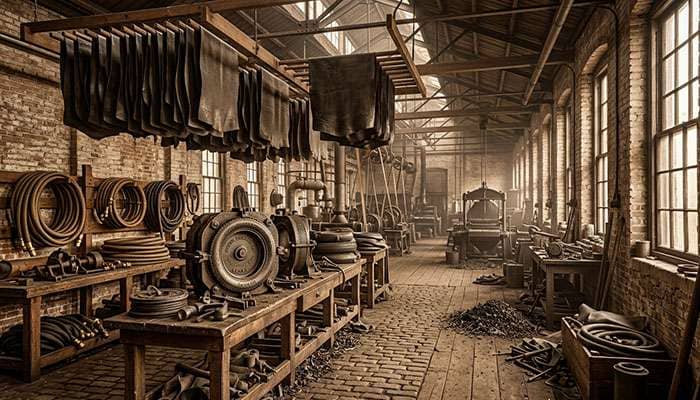
On the name clock, yes. Continental was founded on October 8, 1871, in Hanover as the Continental-Caoutchouc- und Gutta-Percha Compagnie. Its first products were rubber goods like toy balls, mats and rubberized fabric, along with solid tires for carriages and bicycles. It's still headquartered in Hanover, still independent, and still building tires under the same name 155 years later.
Continental was the first German company to build pneumatic bicycle tires, in 1892. Pneumatic car tires followed in 1898, and they were treadless. In 1904, Continental introduced what it calls the world's first car tire with a tread pattern. The company also filed a patent for the tubeless tire in 1943 and built its first dedicated winter tire in 1934.
Continental is also one of the industry's biggest collectors of old names. It bought General Tire, founded in Akron in 1915, in 1987, and Semperit's tire business in 1985. In Europe, it owns the Uniroyal tire brand. So when you ask for the oldest company, part of the answer is that Continental now owns a good share of the old names.
As a company, yes. As a name, no. Michelin's roots go back to 1832, when Barbier-Daubrée, a farm equipment business in Clermont-Ferrand, France, started making rubber parts like valves, gaskets and brake pads. In 1889, brothers Édouard and André Michelin took over the struggling firm and reincorporated it as Michelin. So the business is 39 years older than Continental, but the Michelin name is 18 years younger.
Where Michelin clearly led was the pneumatic tire as a product. In 1891, Michelin patented a removable pneumatic bicycle tire, and Charles Terront won the first Paris-Brest-Paris cycle race on it. In 1895, Michelin ran pneumatic tires on a car called L'Éclair in the Paris-Bordeaux-Paris race. That's three years before Continental's first car tire.
Michelin also patented the radial tire in 1946 and brought the Michelin X to market a few years later. The construction it introduced, with cords running straight across from bead to bead under steel belts, is what nearly every passenger car runs today. For the full arc from bias-ply to radial, see our history of the tire.
Same split. Giovanni Battista Pirelli founded G.B. Pirelli and C. in Milan on January 28, 1872, to make elastic rubber goods. That's 17 years before the Michelin name, but 40 years after Michelin's roots. Pirelli's first bicycle tire came in 1894, and car tire production started in 1901. Its first radial, the Cinturato, went on sale in 1953.
BFGoodrich. Dr. Benjamin Franklin Goodrich founded the company in Akron, Ohio, in 1870, one year before Continental. It started out making rubber hoses, mostly fire hoses, then moved into bicycle tires. In 1896, it became the first company in the United States to build pneumatic automobile tires. Later firsts include the first American tubeless tire in 1947 and the first American radial in 1965.
BFGoodrich started as a hose maker. Kelly-Springfield started as a tire maker. Edwin Kelly and Arthur Grant founded the company in Springfield, Ohio, in 1894, and when it marked its 100th anniversary in 1994, it was described as the oldest tire company in the United States. Goodyear bought Kelly-Springfield in 1935, and Kelly is still a Goodyear brand today, positioned as a value line. If you're weighing one, we tested them in are Kelly tires any good.
Akron, Ohio, became the rubber capital of the world because so many of these companies started there. Goodyear was founded in Akron in 1898 by Frank Seiberling. Harvey Firestone founded Firestone in Akron in 1900, which makes Goodyear the older of the two by two years. General Tire followed in Akron in 1915, and Cooper's roots go back to 1914. Outside Akron, the U.S. Rubber Company formed in 1892 and later became Uniroyal. For more on how Akron's rubber industry grew, see our brief history of tire making.
Two people get the credit, 43 years apart. Robert William Thomson, a Scottish engineer, patented the first pneumatic tire in 1845. It worked, but the rubber and manufacturing of the day couldn't make it practical, and it faded. In 1888, John Boyd Dunlop, a Scottish veterinarian living in Ireland, reinvented the idea for his son's tricycle. His version arrived just as the bicycle boom took off, and that timing changed everything.
In 1889, the Pneumatic Tyre and Booth's Cycle Agency was incorporated in Dublin to build Dunlop's tire. The Dunlop trademark and first tire plant in Dublin followed in 1890, and manufacturing moved to Coventry, England, in 1893. That makes Dunlop the first company in the world built specifically around the pneumatic tire. Every other brand on this list added pneumatic tires to an existing rubber business.
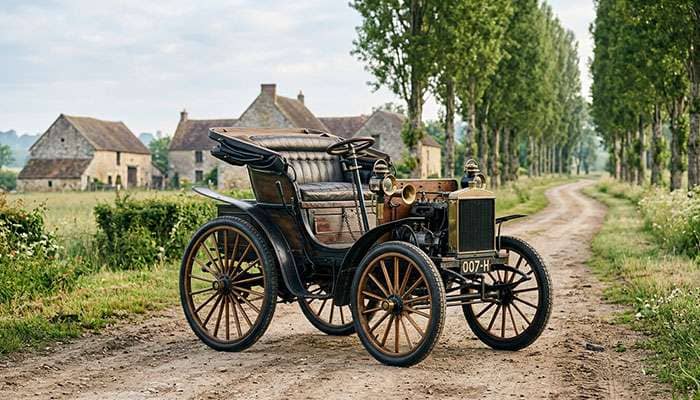
Here's how the first pneumatic tires line up by maker:
More than you'd guess. Most of the brands on a typical tire rack today were founded before 1920. The ones that weren't are mostly from Japan and Korea, where the modern tire industry took off later.
Semperit traces its roots to 1824 in Austria and started building car tires around 1900. Michelin goes back to 1832, BFGoodrich to 1870, Continental to 1871, Pirelli to 1872, Dunlop to 1889, U.S. Rubber and Uniroyal to 1892, Kelly-Springfield to 1894, Goodyear to 1898, Firestone to 1900, Cooper to 1914 and General to 1915. Nokian's roots date to the Finnish Rubber Works in 1898, though it didn't start building car tires until 1932. Two years later, in 1934, it introduced what it calls the world's first winter tire.
Among Japan's major tire makers, the oldest roots trace to 1909, when Dunlop Far East was established in Kobe. That company became Sumitomo Rubber Industries, which owns Falken and today holds the Dunlop brand. Yokohama Rubber followed in 1917, and Bridgestone was founded by Shojiro Ishibashi in 1931. Korea's Hankook began as Chosun Tire in 1941. Toyo dates to 1945, and Kumho to 1960. Bridgestone is younger than every major American and European name here, yet it became one of the world's largest tire makers, and it bought Firestone in 1988.
For perspective, Performance Plus Tire opened in 1971, and Lucas Classic Tires, which joined our family this year, dates to 1957. Next to Continental, we're both newcomers.
Here's the part nobody puts in front of you: most of the oldest tire names no longer belong to the company that founded them. Over the last 40 years, the industry consolidated into a handful of groups that collected heritage brands. The founding date on a brand tells you where the name came from, not who engineers the tire today.
Brand |
Founded |
Owned By Today |
Since |
|---|---|---|---|
BFGoodrich |
1870, Akron |
Michelin |
Around 1990 |
Semperit |
1824, Austria |
Continental |
1985 |
General |
1915, Akron |
Continental |
1987 |
Dunlop |
1889, Dublin |
Sumitomo Rubber Industries |
2025 for North America, Europe and Oceania |
Kelly |
1894, Springfield, Ohio |
Goodyear |
1935 |
Firestone |
1900, Akron |
Bridgestone |
1988 |
Uniroyal |
1892, as U.S. Rubber |
Michelin in North America, Continental in Europe |
Varies by region |
Cooper |
1914 |
Goodyear |
2021 |
Dunlop is the clearest case of how tangled this gets. After the British parent broke up in the 1980s and 1990s, the tire name split across regions. Goodyear and Sumitomo ran Dunlop together in North America and Europe from 1999, and in May 2025, Goodyear completed the sale of the Dunlop brand rights for North America, Europe and Oceania to Sumitomo. As of January 2026, Sumitomo's North American arm operates as Dunlop Tires North America. If you want the factory side of that story, read where Dunlop tires are made.
Of the brands founded before 1900, Continental, Michelin and Pirelli are still running under their own names as independent public companies. Goodyear is too. For a map of which parent owns which name across the whole market, see our breakdown of the major tire brands.
A long history means a company has survived recessions, wars and a century of competition. It doesn't mean the specific tire in front of you is the right one. Here's what it can cost you to shop on the founding date instead of the spec, from least to most expensive.
Heritage brands sit at every price level. Kelly is Goodyear's value line. BFGoodrich is engineered under Michelin today. Neither fact is bad, but the name alone tells you nothing about tread life or wet grip. The government's grading system does. NHTSA's Uniform Tire Quality Grading rates treadwear, traction and temperature resistance right on the sidewall of most passenger tires. Two tires from the same 150-year-old company can grade very differently.
The load index and speed rating on the sidewall are set by your vehicle maker, not by the tire brand's age. Pick an old, trusted name in a size with a lower load index than your door placard calls for, and you're running the tire past what it was built to carry. On a truck or SUV that tows, that's the difference between a tire that lasts and one that overheats.
The brand's age doesn't matter nearly as much as the tire's age. Every tire sold in the U.S. carries a DOT code, and the last four digits tell you the week and year it was built. A tire can sit in a warehouse for years before it's sold, and rubber ages whether it's driven or not. Here's how to tell how old your car tires are before you mount them.
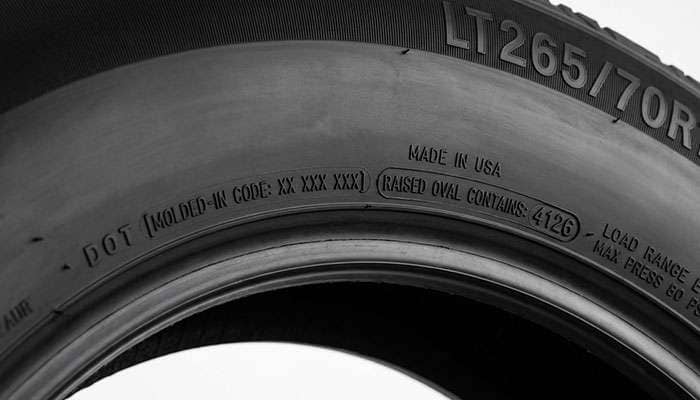
Aged rubber cracks, and a tire with a heavily aged sidewall can separate at highway speed. That's a tow, a ruined wheel, possibly body damage, and a full set of new tires anyway. The cheapest fix is to pick the right spec first and the brand second.
Brand history is a good tiebreaker. It's a poor starting point. Here's the order we use when we fit tires at Performance Plus Tire:
What is the oldest tire brand? Continental is the oldest major tire maker still using its founding name, dating to 1871. Michelin's business roots are older, going back to 1832. BFGoodrich is the oldest American tire brand at 1870, and Dunlop, founded in 1889, was the first company built entirely around the pneumatic tire. Each claim is accurate. The one that applies depends on which clock you're reading.
When you're shopping, use that history as a tiebreaker, not a starting point. Get the size, load index, speed rating and tire type right first, then pick from the brands that have earned your trust. You can compare the major names side by side on our tire brands page.
The short version:
BFGoodrich is the oldest, founded in Akron, Ohio, in 1870, and it built the first American pneumatic car tire in 1896. Kelly-Springfield, founded in 1894, is the oldest American brand that started out making tires. Both brands are still sold today.
It depends on what you count. Pirelli was founded in 1872, and the Michelin name dates to 1889, so Pirelli is the older name. But Michelin's business roots go back to 1832, which makes Michelin the older company.
Robert William Thomson patented the first pneumatic tire in 1845. John Boyd Dunlop reinvented it in 1888, and his version became the first practical, commercially successful pneumatic tire, leading to the founding of the Dunlop company in 1889.
Yes. Goodyear was founded in Akron, Ohio, in 1898, and Firestone was founded in Akron in 1900. Goodyear is still independent, while Firestone has been owned by Bridgestone since 1988.
Continental, founded in Hanover, Germany, in 1871, is the oldest major tire company still operating under its original name. Michelin's business is older, dating to 1832, but it took the Michelin name in 1889.
Not by itself. A tire's load index, speed rating, UTQG grades and DOT date code tell you more about how it will perform than the brand's founding year. Use brand history as a tiebreaker between tires that already fit your vehicle's specs.