
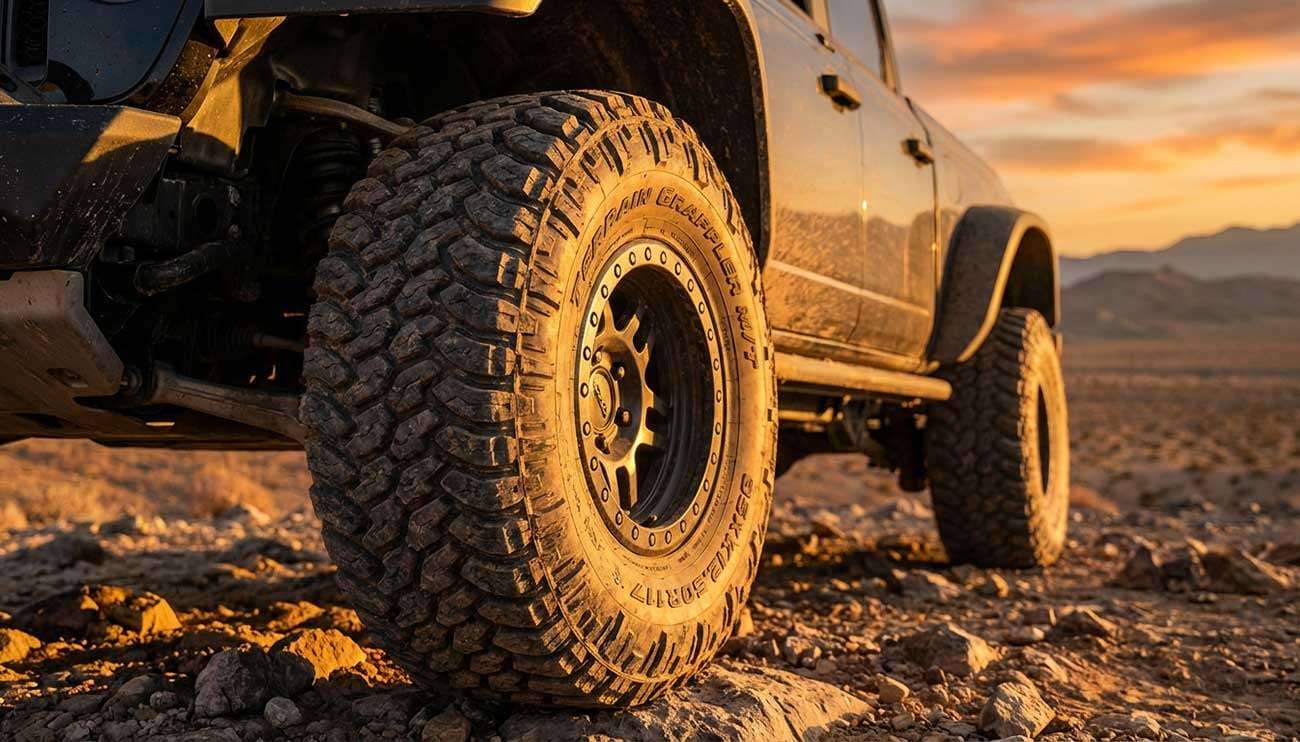
The 35x12.50r17 tire size delivers impressive dimensions that off-road enthusiasts and truck owners love. These robust tires measure exactly 35.0 inches in diameter, 12.5 inches in section width, and mount perfectly on 17-inch wheels. With a circumference of 109.9 inches and 577 revolutions per mile, they provide the enhanced ground clearance and traction that serious off-roaders demand.
You've probably wondered about the 35x12.50r17 equivalent in metric measurements or whether these tires will fit your current wheels. We get these questions constantly. The great news is that 35x12.50r17 tires work with wheels ranging from 8.5 to 11 inches wide, giving you plenty of flexibility for your vehicle setup.
We'll show you exactly what each number in this tire specification means and explain which wheel fitments work best. You'll also discover how this flotation size compares to metric equivalents and get the precise measurements you need for proper vehicle fitment. Whether you're planning an off-road upgrade or need replacement tire information, we have the detailed specifications and fitment data that will help you make the right choice for your vehicle.
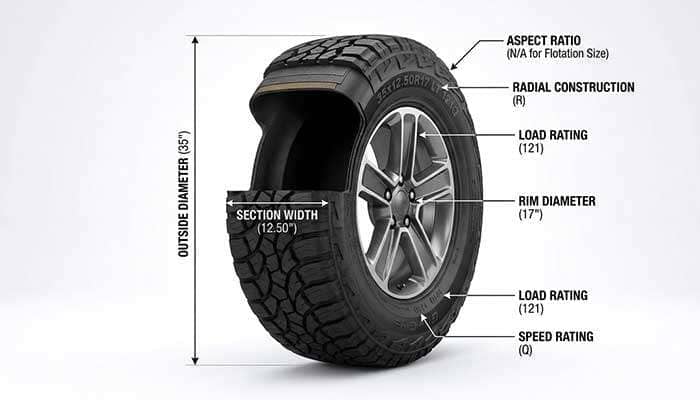
That "35x12.50R17" code stamped on your tire sidewall contains specific measurements and specifications that determine fitment and performance. Each number tells you something important about your tire's dimensions and capabilities. Here's what each component means for your vehicle.
The "35" represents the overall diameter of the tire measured in inches. This is the total height from ground to top when the tire is properly inflated to maximum pressure. Think of it as measuring the tire from one edge straight through to the other edge.
Your vehicle's ground clearance, speedometer readings, and gear ratios all depend on this measurement. Keep in mind that this dimension is measured when inflated but not under load—driving conditions may cause slight variations.
Some manufacturers produce tires that measure closer to 34.6 inches despite being marketed as 35-inch tires. These small differences usually don't impact performance, but they matter when you're calculating precise modifications for your vehicle.
The "12.50" specifies the section width in inches. This measurement spans from sidewall to sidewall, giving you exactly 12.5 inches of width on the 35x12.50R17.
The flotation sizing system measures total width from sidewall to sidewall, unlike metric tires that measure tread width. This wider profile delivers several off-road advantages:
Superior traction on loose surfaces like gravel and sand
Enhanced stability when cornering on uneven terrain
Better flotation on soft surfaces including mud and snow
Larger ground contact patch for improved grip
This width measurement also determines compatible wheel sizes. Manufacturers specify rim width ranges to ensure safe mounting and optimal tire performance.
The "R17" gives you two key specifications. The "R" stands for Radial construction, describing how internal cords are arranged to strengthen and shape the tire. Radial construction became the industry standard over 25 years ago because of its superior performance characteristics.
The "17" indicates the wheel diameter in inches. Your tire must match this exact wheel size—you can't mount a 17-inch tire on an 18-inch wheel or any other size.
This wheel diameter stays constant across different sizing systems. Whether you're looking at flotation sizes like 35x12.50R17 or metric equivalents, the R17 remains the same since wheel measurements always use inches regardless of the tire sizing system.
These three components give you everything needed to make smart decisions about tire replacements, upgrades, and compatibility with your vehicle's wheels and suspension setup.
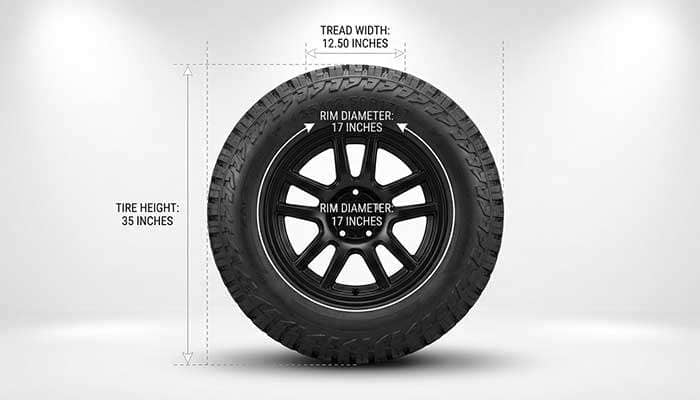
Precise specifications make all the difference when selecting the right 35x12.50R17 tire for your vehicle. These measurements determine how your tire will look, perform, and fit on your truck or SUV. Here are the exact dimensions that define this popular off-road tire size.
A true 35x12.50R17 tire measures exactly 35.0 inches in overall diameter. This represents the total height from ground level to the top of the properly inflated tire. However, different manufacturers may have slight variations - the Nitto Ridge Grappler measures 34.76 inches, while the BFGoodrich All-Terrain T/A KO2 comes in at 34.5 inches. These small differences between brands still qualify as "35-inch" tires but can affect ground clearance calculations and speedometer accuracy.
The section width measures precisely 12.5 inches from sidewall to sidewall. This width directly impacts traction performance, especially when you're tackling challenging off-road terrain. The Nitto Ridge Grappler offers a slightly wider 12.52-inch measurement, essentially matching the stated specification while providing maximum contact area for improved grip.
With a sidewall height of 9.0 inches, these tires provide substantial cushioning from the rim to the tread surface. This generous sidewall height helps absorb impacts from rocks, ruts, and rough terrain while improving ride comfort. The tall sidewall also allows the tire to flex and conform to obstacles, giving you better traction in technical off-road situations.
The 109.9-inch circumference means your tire travels this distance with each complete revolution. This measurement becomes crucial for speedometer calibration because most stock tires have a smaller circumference. Your vehicle actually covers more ground per revolution than your speedometer calculates, causing it to read slower than your actual speed.
These tires complete approximately 577 revolutions per mile. Brand variations exist - the Nitto Ridge Grappler makes 598 revolutions per mile, and the BFGoodrich KO2 makes 602 revolutions per mile. Larger circumference tires like these make fewer revolutions to travel the same distance compared to smaller tires.
This measurement matters for speedometer recalibration. Without adjustment, your speedometer will display a slower speed than you're actually traveling. For example, when your speedometer shows 55 mph with these tires, you could be traveling 58-60 mph depending on your original tire size.
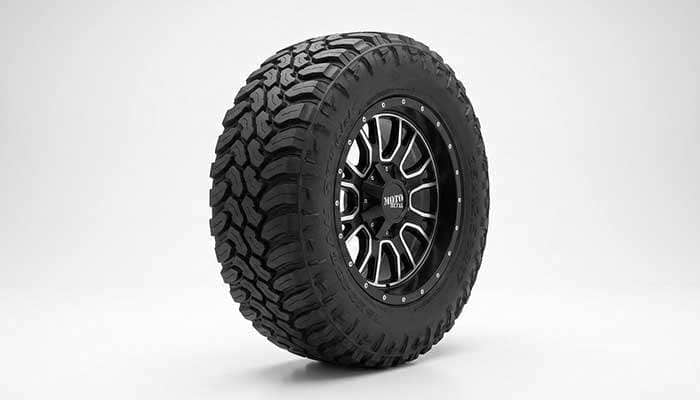
Proper wheel fitment makes the difference between optimal performance and potential problems with 35x12.50R17 tires. These massive off-road tires demand correct mounting specifications to deliver their full capability on any terrain.
Manufacturer specifications consistently approve 35x12.50R17 tires for wheels measuring 8.5 to 11 inches wide. Some manufacturers allow mounting on 8-inch wide wheels, though this varies based on specific tire construction and load requirements.
Popular off-road models like the Cooper STT Pro, BFGoodrich KO2, and Mickey Thompson KM3 all specify 8.5 inches as their minimum rim width for 35x12.50R17 sizing. This consistency across major brands reflects industry standards for safe mounting and optimal tire performance.
Experienced off-road enthusiasts often choose narrower wheels within this range. Many prefer 8-inch wide wheels over 10-inch options, believing the narrower width reduces bead separation risks during aggressive off-road use. While this advantage remains largely anecdotal except on the most technical trails, it demonstrates how wheel width affects tire performance characteristics.
Absolutely - mounting 35-inch tires on 17-inch rims represents one of the most popular off-road vehicles combinations available. The "17" designation directly indicates this tire's intended rim diameter.
This combination delivers several key advantages: increased ground clearance, larger contact patch for superior off-road traction, and an aggressive, commanding appearance. The critical factor isn't diameter compatibility - it's ensuring your wheel width stays within the approved 8-11 inch range.
Real-world experiences from Jeep owners show that mounting these tires on stock 17-inch wheels works well, though specialized tire shops often provide better service than large chain retailers. Some shops hesitate to mount 35x12.50R17 tires on stock 17x7.5" wheels, instead recommending the metric equivalent 315/70R17.
We see these tires primarily on 4x4 trucks and SUVs built for serious off-road capability. Common applications include:
Jeep models (Wrangler Rubicon and Gladiator with Xtreme 35 Tire Package)
Ford Broncos and F-150 Raptor
Tesla Cybertruck
RAM and Chevy pickup trucks
With proper suspension lift kits, many additional vehicles accommodate these tires effectively, including Toyota Land Cruisers, 4Runners, Tundras, Tacomas, Lexus GX and LX models, Mercedes G-Series, Chevy Silverados, and various Land Rovers.
Backspacing plays a crucial role in proper fitment. For Jeep TJs running 35x12.50 tires, optimal backspacing ranges from 3.75 to 4.0 inches, with 4.25 inches potentially working depending on specific tire models and air pressure during trail use.
Understanding tire size conversions becomes important when comparing flotation sizes to metric measurements. The 35x12.50R17 uses the flotation system, while metric equivalents provide similar dimensions using a different measurement approach.
When converting to metric sizing, the closest equivalent is 315/70R17. This conversion maintains similar performance characteristics while using the metric measurement system. The formula breaks down to tire width in millimeters (315), aspect ratio as a percentage of width (70), and rim diameter in inches (17). Both sizes mount on the same 17-inch wheels despite different notation systems.
These sizes are remarkably close but not identical. The 315/70R17 measures 34.36 inches in diameter and 12.4 inches in width, while the 35x12.50R17 measures 35.03 inches in diameter and 12.52 inches in width. This represents only a 0.67-inch height difference (1.9%) and 0.12-inch width difference (1%). Practically speaking, they perform similarly, with the 35x12.50R17 making 575.77 revolutions per mile compared to 586.93 for the 315/70R17.
The difference is significant. A 305/70R17 tire measures approximately 33.81 inches in diameter and 12.01 inches in width, making it 1.22 inches (3.6%) shorter than a 35x12.50R17. The 305/70R17 also makes 596.5 revolutions per mile versus 575.77 for the 35x12.50R17. Similarly, 295 tires are considerably smaller than true 35-inch tires, with some 295/70R17 tires measuring approximately 33.3 inches tall.
The size difference is substantial. A 275/65R20 tire measures about 34.09 inches in diameter and 10.98 inches in width. Compared to a 35x12.50R20 (equivalent height series with 20-inch rim), which measures 34.52 inches tall and 12.5 inches wide, the 35-inch tire provides nearly half an inch more height and 1.5 inches more width. Weight differences are also notable—275s typically weigh 55 pounds versus 66 pounds for 35s in equivalent load ratings.
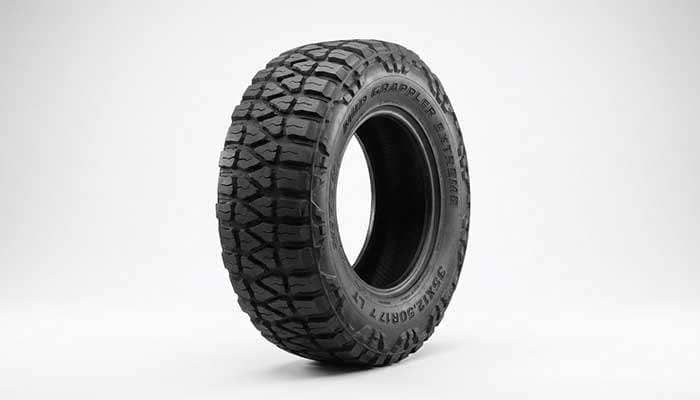
Choosing the right 35x12.50R17 tire comes down to matching your driving needs with the right specifications and budget. We carry an extensive selection of brands and load ratings designed for different applications and price points.
All-Terrain (AT) tires typically cost $200-$400 per tire, roughly $50 less than comparable Mud-Terrain (MT) options that range from $300-$500. These tire types deliver completely different performance characteristics. AT tires work best on mixed surfaces, providing balanced on-road comfort with moderate off-road capability. MT tires feature aggressive tread patterns with wide channels for superior performance in mud and challenging terrain.
Daily drivers who occasionally venture off-road benefit from AT tires with their longer tread life and quieter operation. MT options, while louder and less fuel-efficient, deliver unmatched off-road traction.
Load ratings for 35x12.50R17 tires typically range from C to F, indicating ply rating and load capacity:
C (8-ply): Supports approximately 2,045 lbs per tire at 35 psi
D (8-ply): Rated for around 3,000 lbs per tire
E (10-ply): The most common, supporting 3,195-3,197 lbs at 65 psi
F (12-ply): Heavy-duty rating supporting 3,748+ lbs per tire
Most 35x12.50R17 tires carry load index 121, though options range from 111 to 128.
Speed ratings indicate maximum sustainable velocity:
Q: 100 mph (most common for MT tires)
R: 106 mph (typical for AT tires)
S: 112 mph (found on premium AT options)
L: 75 mph (rare, for special applications)
Mileage warranties for 35x12.50R17 tires typically range from 40,000 to 65,000 miles. Cosmo offers 50,000 miles on their Mud Kicker and 55,000 on their El Tigre AT. Mickey Thompson provides 50,000-mile coverage on several models, while Yokohama offers 45,000-mile warranties.
Budget-friendly options like Americus ($186) and Cosmo ($210) represent the lower end. Mid-tier options include Cooper Evolution M/T ($359) and Hankook Dynapro MT2 ($390). Premium brands like BFGoodrich ($429), Yokohama ($421), and Toyo ($438) command higher prices. Find discount 35x12.50R17 Tires to save on your purchase while still getting quality options.
The 35x12.50R17 tire size delivers exactly what off-road enthusiasts need - aggressive capability combined with practical compatibility. We've covered the essential specifications that matter most for proper fitment and performance. These tires work with wheel widths from 8.5 to 11 inches, giving you flexibility for various setups while maintaining optimal performance.
The flotation sizing system and metric equivalents like 315/70R17 offer similar dimensions with slight variations. Both systems provide the enhanced ground clearance and robust stance that serious off-roaders demand. Load ratings from C to F ensure you can find the right capacity for your vehicle's weight requirements, while speed ratings match your driving needs.
All-Terrain options cost $200-$400 per tire, while Mud-Terrain versions range from $300-$500. The price difference reflects their specialized designs - AT tires offer balanced performance for mixed use, while MT options deliver maximum off-road traction. Your choice depends on where you drive most often and how aggressive your off-road adventures get.
We recommend exploring discount options to get excellent value without sacrificing quality. You can find discount 35x12.50R17 tires at Performance Plus Tire to save money while still getting top-quality options for your vehicle.
This tire size continues to be a favorite among truck and SUV owners for good reason. The combination of impressive dimensions, proven performance, and wide vehicle compatibility makes the 35x12.50R17 an excellent choice for enhancing both the appearance and capability of your off-road vehicle.
Understanding the 35x12.50R17 tire code is essential for proper vehicle fitment and performance optimization. Here are the critical measurements and compatibility details you need to know:
• 35x12.50R17 measures exactly 35.0" diameter, 12.5" width, and fits 17" rims - providing enhanced ground clearance for off-road vehicles.
• Compatible with rim widths from 8.5" to 11" - offering flexibility for various wheel setups while maintaining optimal tire performance and safety.
• Metric equivalent is 315/70R17 - nearly identical dimensions with only 0.67" height difference, making them interchangeable for most applications.
• Load ratings range from C to F (2,045-3,748 lbs capacity) - choose based on your vehicle's weight requirements and intended use.
• Price ranges $200-$450+ depending on brand and type - All-Terrain tires cost $50 less than Mud-Terrain options on average.
These measurements directly impact speedometer accuracy, ground clearance, and vehicle performance, making proper understanding crucial for safe upgrades and replacements.
The closest metric equivalent to a 35x12.50R17 tire is typically 315/70R17. While not exactly identical, they are very similar in dimensions and can often be used interchangeably.
35x12.50R17 tires are generally approved for use on rims with widths ranging from 8.5 to 11 inches. Some manufacturers may allow for slightly narrower 8-inch rims, but it's best to stay within the recommended range for optimal performance and safety.
The actual diameter of a 35x12.50R17 tire is 35.0 inches when properly inflated. However, there can be slight variations between manufacturers, with some tires measuring closer to 34.5 or 34.7 inches in actual diameter.
These tires are primarily used on 4x4 trucks and SUVs designed for off-road capability. Common vehicles include Jeep Wranglers, Ford Broncos, F-150 Raptors, and various full-size pickup trucks from manufacturers like RAM and Chevrolet.
Load ratings for 35x12.50R17 tires typically range from C to F, indicating their ply rating and load capacity. For example, an E-rated tire (10-ply) can support around 3,195-3,197 lbs per tire at 65 psi, which is the most common rating for this size. The load rating you choose should be based on your vehicle's weight and intended use.



