
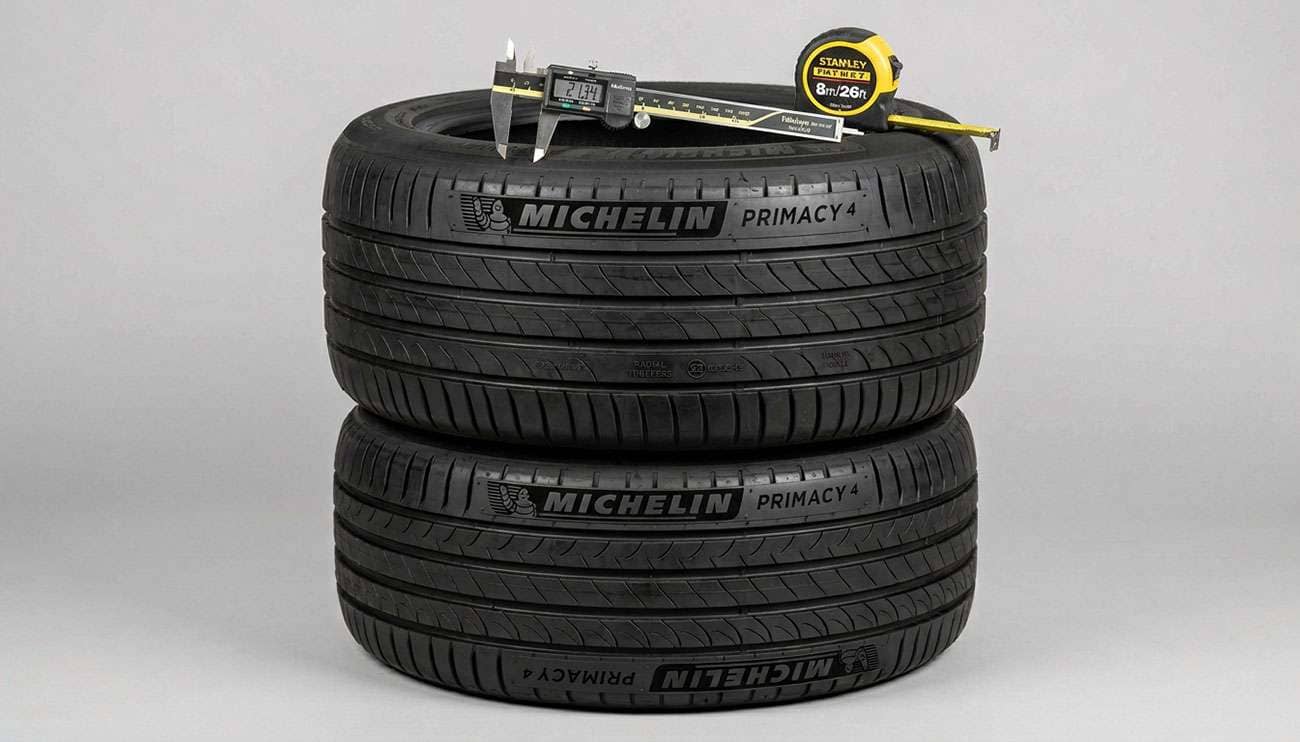
I get this question at the counter just about every week, and here's the funny part — three different customers will ask me about "the 3 tire rule" and they all mean three completely different things. One guy is upsizing his wheels and worried about clearance. Another wants to know if his rotation is still on schedule. A third heard from his cousin that you should slash three tires instead of four if you want to mess with somebody's car. Different question, different answer, every single time.
So let me cut through the noise. There's the 3% rule, which is real and matters. There's the Rule of 3X, which old-school shops like ours have used for decades. And there's the three-tires-slashed insurance thing, which is pure baloney. We're going to walk through all of them so you know what people are actually talking about — and which ones you can ignore.
This is the one Google's AI Overview pulls up when you type "3 tire rule" into the search bar, and for good reason — it's the only one with real engineering behind it. The 3% rule says your replacement tire's overall diameter should not differ by more than 3% from the original factory size. Bigger or smaller, doesn't matter. The clock starts at the size that came on the car from the dealer.
Why 3%? Because every system on a modern car — speedometer, odometer, ABS, traction control, transmission shift points, even the fuel economy readout — is calibrated around the wheel speed signal coming off your factory tires. Push the diameter too far in either direction and that signal lies to the computer. The computer makes decisions based on the lie. That's how you end up with an ABS warning light on a perfectly healthy car, or a speedometer that's reading 60 when you're really doing 64.
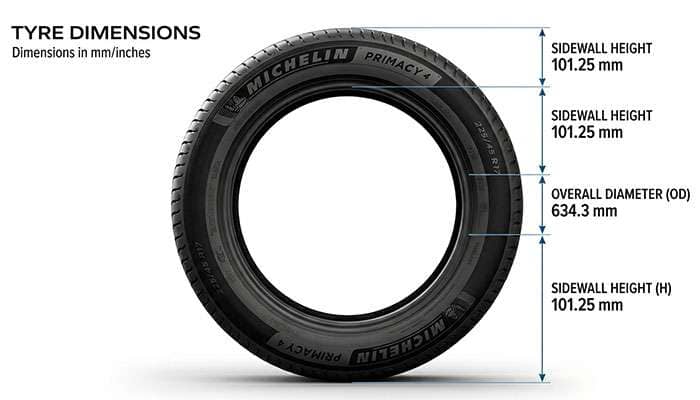
Let me show you with a stock 215/55R17 — common size on plenty of sedans. Here's how you get the diameter:
Take the section width in millimeters (215) and divide by 25.4 to get inches: 215 ÷ 25.4 = 8.46 inches. Multiply that by the aspect ratio as a decimal (55% becomes 0.55): 8.46 × 0.55 = 4.65 inches of sidewall. Double it because there's sidewall above and below the wheel: 4.65 × 2 = 9.30 inches. Add the wheel diameter (17 inches): 9.30 + 17 = 26.3 inches overall.
Now take 3% of 26.3, which works out to about 0.79 inches. Your safe replacement window is anywhere between 25.51 and 27.09 inches. A 225/50R17 measures right around 25.9 inches — well inside the range. Pop it on, you're fine. Jump to a 245/45R18 measuring 26.7 inches and you're still inside the window — barely. Go to a 33-inch off-road tire on the same car and you've blown past it by miles, and you'd better be ready to recalibrate or live with the consequences.
Most folks running into the 3% rule are doing one of three things: upsizing wheels for looks, swapping to narrower winter tires, or putting taller meats on a truck. Passenger cars and tight-fendered sedans should hold the 3% line — there's just not enough room in the wheel well, and the suspension geometry is fussier than people realize. Pickups and SUVs with bigger wheel wells can sometimes stretch to 5% without drama, especially after a leveling kit. Once you go beyond that, you're recalibrating the speedometer with a tuner and probably trimming the fender liner.
If you want the full math breakdown with more example sizes, I covered it in detail in our piece on the 3% rule for tires. And if you're not sure what those numbers on your sidewall even mean, start with our guide to reading tire size codes first — it'll save you a lot of squinting at your own car.
Different rule, different problem. The Rule of 3X is a rotation system shops have been teaching customers for fifty years, and it's about getting the most miles out of a set of tires by working through three different rotation patterns in sequence. The "3X" doesn't mean three times the life — it means three crossings, three rotations, before the cycle repeats.
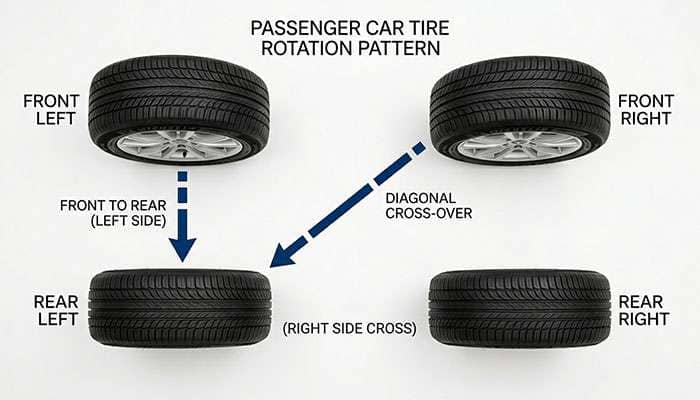
Here's the cycle as it was taught to me back when I was turning wrenches in the late seventies:
First rotation: Move the fronts straight back to the rear, and crisscross the rears up to the front (so the right rear becomes the left front, left rear becomes the right front). Second rotation: Full X-pattern — every tire moves diagonally to the opposite corner. Third rotation: Crisscross the fronts to the rear and bring the rears straight up to the front. After the third one, you start the cycle over.
The reason it works: every tire spends time in every position over the course of those three rotations. Drive wheels wear different than free-rolling wheels. Front tires scrub more than rears because they're doing the steering. Road crown loads the right side a little harder than the left. Cycling through all four corners on a 5,000-to-7,500-mile interval evens that out and you can squeeze 15-20% more life out of a set, in my experience.
Now — fair warning — the Rule of 3X assumes four matched, non-directional tires of the same size. If you're running directional tires (with the arrow on the sidewall), staggered fitments (different sizes front and rear), or any AWD setup with tight tolerance specs, the rotation pattern changes. We've got the full breakdown of the patterns by drivetrain in our how to rotate tires guide. Skip directional tires across sides and you'll ruin the tread quicker than you can ruin a pair of new shoes.
One more thing — if you're rotating yourself and your car has TPMS sensors, the system may need a relearn after the wheels swap positions. Some vehicles auto-relearn after a few miles, others need a scan tool. Read up on TPMS sensors and aftermarket wheels if you've never dealt with this before, because a flashing TPMS light after rotation is one of the most common "what did I do wrong" calls we get.
Now we get to the one I want to put in the ground for good. Somewhere along the way — probably the 1980s, judging by how often I heard it back then — a story started circulating that if somebody slashes three of your tires instead of all four, your insurance won't pay because "it's only vandalism if all four are damaged." So vandals supposedly slash three to stick you with the bill.
It's not true. It's never been true. And every insurance professional I've ever talked to has said the same thing.
My best guess is the myth grew out of a half-truth about deductibles. If your comprehensive deductible is $500 and three tires cost $480 to replace, you'd eat the cost yourself — not because the policy doesn't cover it, but because the damage is below your out-of-pocket. Replace four tires for $640, and now you're $140 above the deductible and a claim makes sense. Somewhere in that math, somebody decided "insurance won't cover three tires" was a tidy way to say it. Wrong, but tidy.
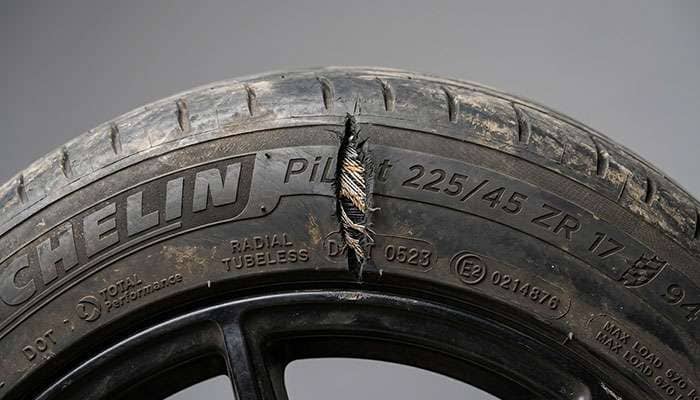
Comprehensive coverage — the optional part of your policy that handles non-collision events like theft, fire, hail, and vandalism — pays for slashed tires regardless of how many got hit. One tire, three tires, all four, doesn't matter. Vandalism is vandalism. The number on the count doesn't change the coverage. What changes the math is your deductible. If repairs come in under it, you pay. If they come in over it, the insurance company pays the difference.
A few practical notes from years of seeing this play out:
File a police report first if you suspect vandalism — most insurers want it on record before they'll process the claim. Take photos before you tow the car or buy replacements. And remember that filing a comp claim usually has a smaller premium impact than a collision claim, because you didn't cause it. If you're shopping new tires after vandalism, something durable like a Goodyear Assurance MaxLife or General Altimax RT45 will give you longer life than the cheap rubber some shops will try to push you toward when they hear "insurance is paying."
This is the bonus version of the question — the one that comes up when somebody picks up a nail in a single tire that won't take a patch, but the other three still have decent tread. Can you skip replacing all four? Sometimes yes, sometimes absolutely not, and the difference matters a lot.
If you have a front-wheel-drive or rear-wheel-drive car, your other three tires are less than half worn (say, 8/32" or deeper of remaining tread when new tires usually start at 10/32" to 11/32"), and you can find a replacement in the exact same model and size — you can get away with replacing just the damaged ones. The closer to factory-fresh your remaining tires are, the less the diameter difference matters. Same model, same size, similar wear, two-wheel drive — you're fine. We've covered the full scenario in our piece on what to do when you only need two tires, and the same logic applies to one or three.
All-wheel drive and four-wheel drive change the math completely. AWD systems use a center differential or transfer case that distributes torque based on the assumption that all four tires are turning at the same rate. Mismatched tread depth — even a half-inch of difference in circumference between a new tire and a worn one — can cook the differential, the transfer case, or the viscous coupling. Some manufacturers (Subaru is the famous example) will void warranty work on a drivetrain failure if they find mismatched tires. The rule for AWD is simple: replace all four, or shave the new tires down to match the worn ones at a tire shop that has a tread shaver. Most owners just bite the bullet and buy four.
The other situation where you need all four: when the remaining tires are more than 4/32" worn from new. At that point the diameter mismatch with a fresh tire is enough to confuse the ABS, traction control, and stability systems we talked about back in the 3% rule section — same problem, different cause.
And if you're due anyway, this is also a good moment to consider whether to do an alignment. New tires on a misaligned car will eat themselves alive in 10,000 miles. Our piece on alignment vs. rotation vs. balancing sorts out which service you actually need.
Here they all are side by side so you can match what somebody's asking you to which rule they actually mean.
Rule |
What It Means |
When It Matters |
Is It Real? |
|---|---|---|---|
The 3% Rule |
Replacement tire diameter must stay within 3% of factory size |
Upsizing wheels, plus-sizing, winter tire swaps, lifted trucks |
Yes — engineering-based industry standard |
The Rule of 3X |
Three rotation patterns cycled in sequence to even tire wear |
Every 5,000-7,500 miles for matched, non-directional tires |
Yes — long-standing shop best practice |
Three-Slashed-Tires Myth |
Insurance supposedly won't cover three slashed tires, only four |
Never — comprehensive coverage applies regardless of count |
No — pure urban legend |
Replace-Just-Three Question |
Whether you can buy fewer than four new tires at once |
Single-tire damage on FWD/RWD with mostly fresh remaining tires |
Sometimes yes, never on AWD/4WD with significant wear difference |
Three different "3 tire rules," three different answers. The 3% rule is the one to take seriously when you're picking new tires or wheels — keep your replacement diameter within that window or be ready to recalibrate. The Rule of 3X is solid old-school wisdom that still holds up: rotate every 5,000-7,500 miles, cycle through the patterns, and your tires will pay you back with extra miles. The slashed-tires insurance story is a myth that's wasted enough breath, so let it go. And the question of replacing just three tires comes down to drivetrain and tread depth — straightforward once you know what to look at.
Whichever version of the question got you here, we've got you covered. If you're in the market for a fresh set, take a look at our full selection of replacement tires — anything from a budget-friendly General Altimax RT45 to a long-life Goodyear Assurance MaxLife or a premium Continental ProContact GX, all in stock and ready to ship.
When most people search "3 tire rule" they mean the 3% rule — a sizing guideline that says your replacement tire's overall diameter should be within 3% of the original factory tire diameter, in either direction. Staying inside that window keeps your speedometer, ABS, and traction control reading accurately.
Yes. Comprehensive auto insurance covers slashed tires from vandalism regardless of whether one, two, three, or all four tires were damaged. The popular myth that insurance only covers four slashed tires is false. Your deductible still applies, so if the repair cost is below your deductible you'll pay out of pocket regardless.
Some vandals believe the myth that insurance only covers four slashed tires, so slashing three supposedly sticks the owner with the bill. They're wrong — comprehensive coverage applies to any number of slashed tires. The myth probably grew out of confusion about deductibles, since three replacement tires sometimes cost less than the typical $500 comprehensive deductible while four tires push the claim above it.
It depends on your drivetrain and how worn your remaining tires are. On front-wheel or rear-wheel drive vehicles with relatively fresh remaining tires (within 2/32" of new), replacing one or three is fine. On all-wheel drive or four-wheel drive vehicles, mismatched tire diameters can damage the differential or transfer case, so most manufacturers require replacing all four — or shaving the new tires to match.
The Rule of 3X is a tire rotation system that cycles through three different patterns — front-to-rear with a cross at the back, full X-pattern, and reverse cross — over three rotation intervals before repeating. Used every 5,000 to 7,500 miles on matched non-directional tires, it spreads wear evenly across all four positions and can extend tire life by 15-20%.
Exceeding 3% in either direction will throw off your speedometer and odometer readings, and may trigger ABS, traction control, or stability system warnings. Larger-than-spec tires can also rub the fenders or suspension components when turning or hitting bumps. Past 5%, most vehicles need a speedometer recalibration or ECU tune to compensate, and lifted trucks may need a fender trim to clear the new diameter.



