
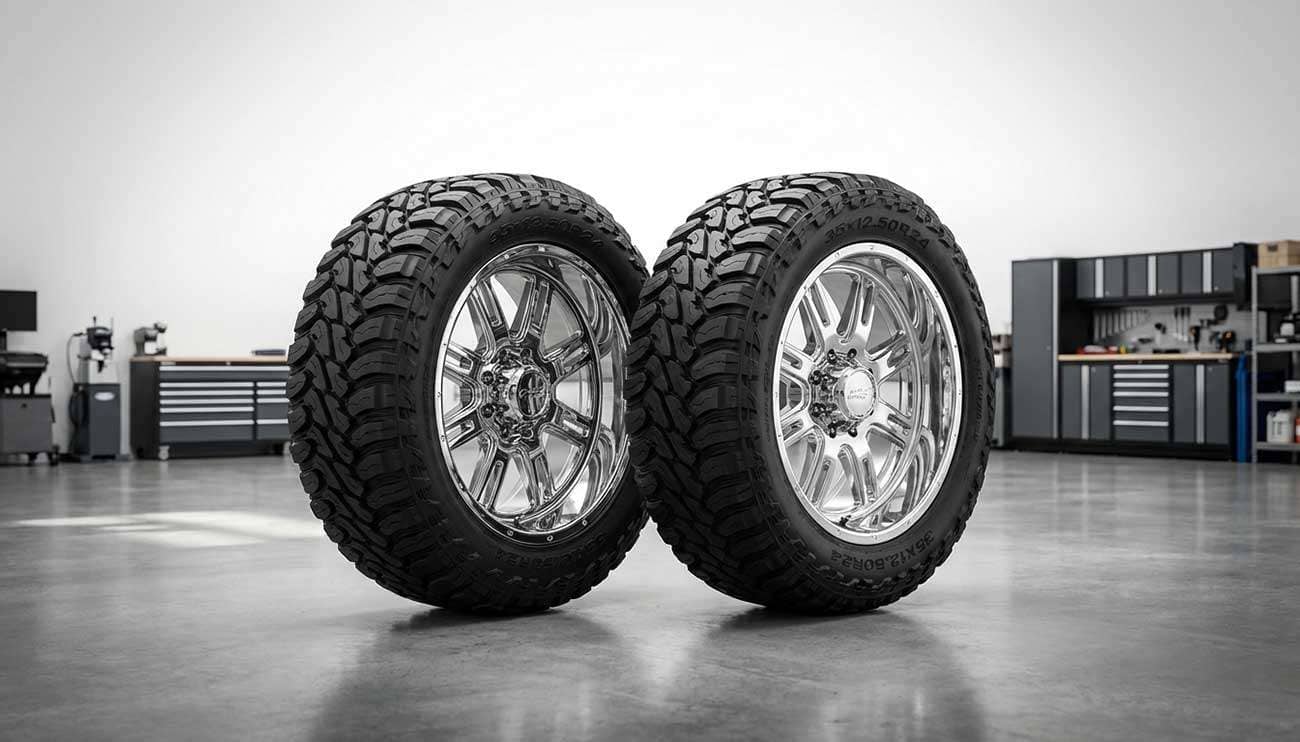
35x12.50R24 tires deliver exactly what truck and SUV owners demand - a full 35 inches of diameter when properly inflated, combining serious performance with commanding road presence. These dimensions aren't just numbers on a sidewall. They represent precise specifications that directly affect your vehicle's capability, appearance, and driving characteristics.
Breaking down this tire size reveals critical fitment information. You get a 35-inch overall diameter, 12.5-inch section width, and compatibility with 24-inch wheel diameter. The tire's circumference measures approximately 110 inches and completes around 576 revolutions per mile. Whether you're shopping for 35x12.50r24 all terrain tires or 35x12.50r24lt tires, these specifications ensure you select the right match for your vehicle's requirements.
Understanding equivalent sizes becomes essential when replacement time arrives. Smart shopping means knowing your options. We'll examine metric conversions for 35x12.50 24 tires, compare them against similar sizes like 295/40R24 and 315/40R26, and explain how these differences impact your vehicle's performance. Expect detailed analysis of speedometer accuracy, fuel economy changes, and overall driving experience modifications that come with different tire choices.
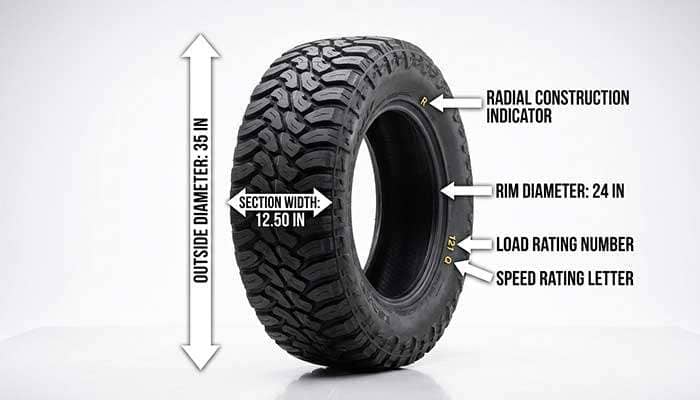
Breaking down the numbers in a 35x12.50R24 tire specification reveals precise dimensional information that affects everything from vehicle handling to fuel economy. Each component of this tire designation carries specific meaning for performance and fitment.
The first number in the 35x12.50R24 designation indicates the tire's overall height or diameter when properly inflated but not under load. This measurement represents the total distance from the ground to the top of the tire (or from one side to the other through the center). At exactly 35.0 inches, this dimension affects your vehicle's ground clearance, gear ratio performance, and speedometer accuracy.
The second number represents the tire's section width—measured from sidewall to sidewall at the widest point. For 35x12.50r24 tires, this width is precisely 12.5 inches (or about 317.5 mm). This dimension determines how the tire performs in different conditions, its stability during cornering, and the amount of surface area that contacts the road.
The third number after the "R" (which stands for "Radial" construction) specifies the wheel diameter that this tire is designed to fit. 35x12.50r24lt tires are manufactured specifically for 24-inch wheels or rims. This measurement is critical for proper tire-to-wheel mounting and ensures safe, secure fitment.
The sidewall height—the distance from the wheel's edge to the outer edge of the tread—measures 5.5 inches for this particular tire. This measurement isn't directly stated in the tire size but can be calculated using a simple formula.
For 35x12.50R24 tires, we can derive the sidewall height by:
Starting with the overall diameter (35 inches)
Subtracting the rim diameter (24 inches)
Dividing the result by 2
Thus: (35 - 24) ÷ 2 = 5.5 inches
These dimensions together contribute to the tire's total circumference of 109.9 inches, which means it will complete approximately 577 revolutions per mile of travel. This information becomes particularly valuable when comparing 35x12.50 24 tires to other similar sizes or when considering how changing tire dimensions might affect your vehicle's performance.
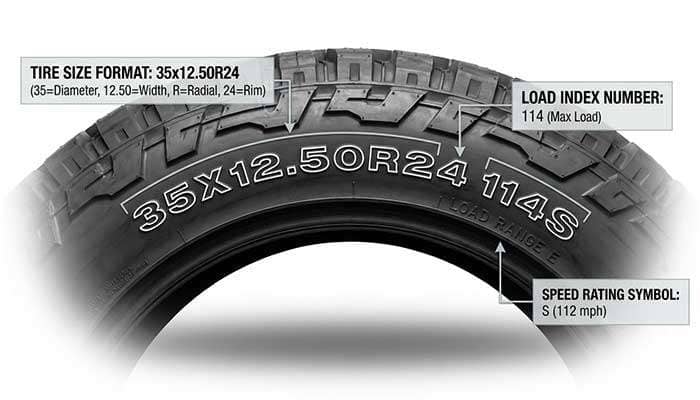
Converting 35x12.50r24 tires to metric sizing requires precise calculations and understanding of both measurement systems. Truck and SUV owners seeking metric alternatives need accurate equivalents to ensure proper fitment and maintain vehicle performance characteristics.
Converting 35x12.50r24 tires into metric dimensions follows a straightforward process with three key calculations:
Width conversion: 12.5 inches × 25.4 = 317.5mm (commercial tires round to 315 or 325mm)
Height calculation: Metric tires express sidewall height as aspect ratio - a percentage of the tire width
Overall diameter calculation: (Width × Aspect Ratio × 2) ÷ 2540 + Wheel Diameter
The conversion works in reverse as well. A 315/75R16 tire equals 35 × 12.4 - 16 inches, demonstrating the mathematical relationship between sizing systems.
315/40R24 provides the most accurate metric equivalent to 35x12.50r24. Compare the key dimensions:
Dimension |
35x12.50R24 |
315/40R24 |
Difference |
|---|---|---|---|
Diameter |
35.02 inches (889.44mm) |
~35 inches (889mm) |
Minimal |
Width |
12.52 inches (318mm) |
12.4 inches (315mm) |
~0.12 inches |
Sidewall Height |
5.51 inches (139.92mm) |
~5.0 inches (126mm) |
~0.5 inches |
Additional metric alternatives for 35x12.50r24lt tires offer different performance characteristics:
325/35R24 features increased width with reduced sidewall:
Width: 12.8 inches (325mm)
Aspect ratio: 35% (shorter sidewall)
Overall diameter: Approximately 34.8 inches
305/45R24 provides narrower width with taller sidewall:
Width: 12.0 inches (305mm)
Aspect ratio: 45%
Overall diameter: 32.8 inches
Charts sometimes list 305/45R24 as a 32-inch diameter tire, though the increased sidewall height partially compensates for the diameter difference. 315/40R24 remains the optimal choice for 35x12.50 24 tires, delivering comparable ground clearance and speedometer accuracy.
When selecting 35x12.50r24 all terrain tires in metric sizing, prioritize 315/40R24 for the closest match. Consider 325/35R24 only if you specifically want wider contact patch with similar overall dimensions.
Popular tire sizes create distinct performance differences that directly impact your truck's capabilities. Here's how 35x12.50R24 tires measure against common alternatives.
The 35x12.50R24 dominates the 295/40R24 with a substantial 1.73-inch height advantage. At 35.02 inches versus 33.29 inches, this difference transforms both appearance and functionality. The 35x12.50R24 also provides 0.91 inches of additional width, creating a larger contact patch for enhanced off-road traction.
The 315/40R26 runs slightly taller at 35.92 inches compared to 35.02 inches for the 35x12.50R24. However, the 35x12.50R24 offers more sidewall cushioning at 5.51 inches versus 4.96 inches, which translates to better ride comfort over rough surfaces and improved tire protection.
Measurement |
35x12.50R24 |
295/40R24 |
315/40R26 |
|---|---|---|---|
Diameter |
35.02" |
33.29" |
35.92" |
Width |
12.52" |
11.61" |
12.4" |
Circumference |
110.01" |
104.59" |
112.85" |
Revolutions/Mile |
577 |
606 |
561 |
Tire size changes alter speedometer readings significantly. Upgrading from 295/40R24 to 35x12.50R24 causes your speedometer to read 60 mph while actually traveling 63.11 mph—a 5.2% increase that affects fuel economy calculations. Conversely, switching from 315/40R26 to 35x12.50R24 means traveling 58.49 mph when your speedometer shows 60 mph.
Get the best deal on 35X12.50R24 tires by comparing options from trusted suppliers who understand these performance differences.
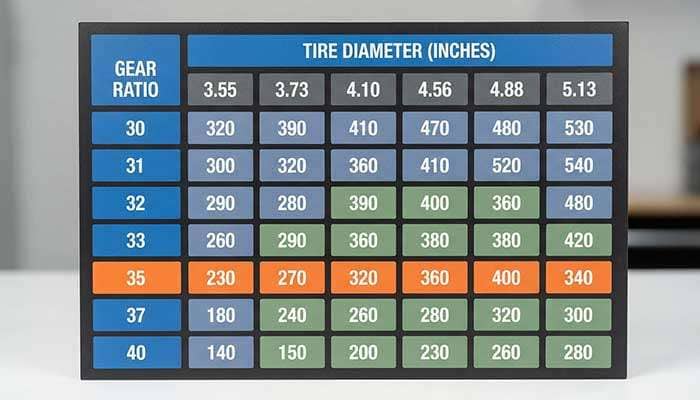
35x12.50R24 tires demand gear ratio considerations that most truck owners overlook. The larger diameter fundamentally changes your vehicle's mechanical relationship between engine power and wheel rotation.
Engine RPM drops substantially with 35x12.50r24 tires compared to stock sizes. At 65 mph, vehicles with 3.55 gears experience approximately 6% lower RPM, which directly impacts highway pulling power. Here's what happens across common gear ratios:
Gear Ratio |
RPM at 65 mph with Stock Tires |
RPM at 65 mph with 35x12.50 24 |
|---|---|---|
3.55:1 |
2000 |
1880 |
3.73:1 |
2100 |
1974 |
4.10:1 |
2300 |
2162 |
Rotational mass and altered gear ratios create measurable changes in both power delivery and efficiency. Switching to 35x12.50r24lt tires effectively forces your transmission to operate in a "taller" gear setup, potentially impacting fuel economy by approximately 6%. Smaller engines struggle more with this change, while larger engines with greater torque output adapt better to the increased rotational mass.
Daily driving with 35x12.50r24 tires performs best with 3.73 or 4.10 ratios rather than factory 3.55 gears. Towing applications, particularly with loads around 5000 lbs, benefit significantly from 4.10 ratios for improved driveability. Performance enthusiasts often choose even higher ratios like 4.56 or 4.88 for maximum power delivery, especially when running these tires in challenging off-road conditions.
The right gear ratio compensates for the tire's larger diameter, restoring lost low-end torque and maintaining responsive acceleration.
35x12.50R24 tire specifications directly impact your vehicle's performance, appearance, and capability. These tires provide substantial 35-inch diameter with 12.5-inch width, specifically engineered for 24-inch rims. The metric equivalent 315/40R24 delivers nearly identical performance with minimal dimensional variation.
Size changes affect vehicle dynamics significantly. Expect approximately 5% speedometer reading changes compared to stock sizes, plus reduced engine RPM at highway speeds. These modifications require gear ratio considerations, especially for frequent towing or challenging terrain applications.
The 5.5-inch sidewall height balances road comfort with off-road capability that truck owners prefer. The 110-inch circumference and roughly 576 revolutions per mile create distinctly different driving characteristics compared to smaller options like 295/40R24.
Before making your final selection, get the best deal on 35X12.50R24 tires by comparing options from trusted suppliers who understand these specialized dimensions.
Performance applications benefit from 3.73 or 4.10 gear ratios for daily driving with these tires instead of factory 3.55 gears. Proper tire and gearing combinations enhance both appearance and functional capability, delivering trucks that look impressive while performing reliably across various terrains.
With complete knowledge of 35x12.50R24 specifications and equivalents, you can confidently choose tires that match your visual preferences with your vehicle's performance demands.
Understanding tire specifications and equivalents helps you make informed decisions when upgrading or replacing your vehicle's tires.
35x12.50R24 dimensions: 35-inch diameter, 12.5-inch width, fits 24-inch rims with 5.5-inch sidewall height
Closest metric equivalent: 315/40R24 provides nearly identical performance with minimal dimensional differences
Speedometer impact: Switching tire sizes affects readings by ~5%, requiring recalibration for accuracy
Gear ratio adjustment needed: Consider upgrading to 3.73 or 4.10 ratios for optimal performance with larger tires
Performance trade-offs: Larger tires reduce engine RPM at highway speeds, affecting fuel economy by approximately 6%
When upgrading to 35x12.50R24 tires, proper gear ratio selection becomes crucial for maintaining vehicle performance, especially for towing applications or daily driving scenarios.
The closest metric equivalent to a 35x12.50R24 tire is 315/40R24. This size provides nearly identical dimensions with minimal differences in overall performance.
Switching to 35x12.50R24 tires can impact speedometer readings by about 5%, reduce engine RPM at highway speeds, and potentially affect fuel economy by approximately 6%. It may also require gear ratio adjustments for optimal performance.
For daily driving with 35x12.50R24 tires, gear ratios of 3.73 or 4.10 are generally recommended over factory 3.55 gears. These ratios provide better performance and driveability, especially for vehicles with larger engines.
The 35x12.50R24 tire has a sidewall height of 5.5 inches, which offers a good balance between road comfort and off-road capability. This is slightly taller than some comparable sizes, potentially providing better cushioning on rough terrain.
A 35x12.50R24 tire has a circumference of approximately 110 inches and completes around 576 revolutions per mile. This information is crucial for understanding how the tire size affects vehicle speed and odometer readings.



