
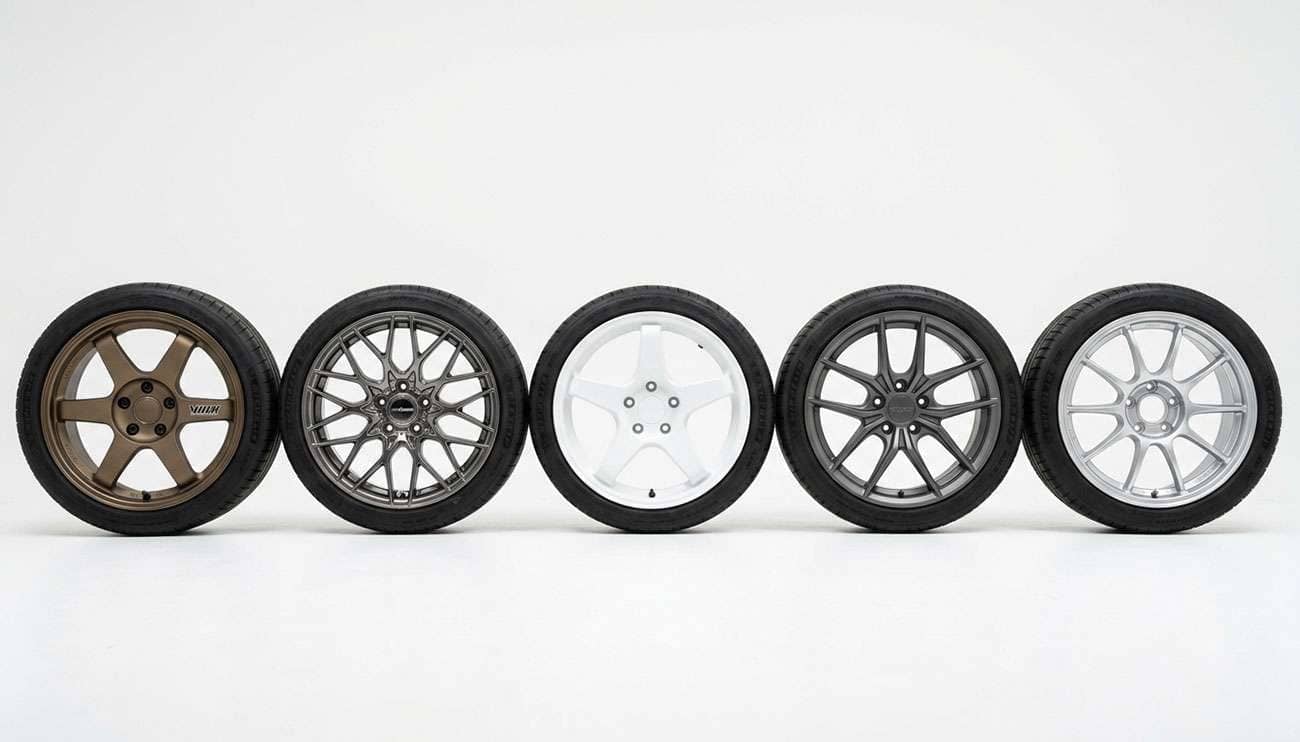
The term "tuner wheels" gets thrown around a lot — usually next to words like JDM, import, and sport compact. But what does it actually mean? Is a tuner wheel just a regular wheel with a Japanese brand name, or is there something genuinely different about how they're engineered?
The answer matters if you care about performance. A real tuner wheel isn't defined by its country of origin or its brand — it's defined by a specific set of engineering priorities that directly affect how your car accelerates, brakes, corners, and feels. Let me break down what those priorities are, why they matter, and which wheels deliver on them versus which ones just look the part.
Most people think "tuner wheel" means a wheel designed for Japanese cars. That's partially true historically — the tuner wheel category emerged from Japan's sport compact scene in the 1980s and 1990s, where companies like Enkei, RAYS (Volk Racing), and Work Wheels built lightweight performance wheels for cars like the Honda Civic, Nissan Silvia, and Subaru WRX. The term JDM (Japan Domestic Market) became synonymous with these wheels.
But the real definition is broader. A tuner wheel is any lightweight, performance-focused wheel designed primarily for sport compact and performance cars — regardless of where it's made. An Enkei RPF1 from Japan is a tuner wheel. A Konig Hypergram from the US market is a tuner wheel. A Rotiform designed in California is a tuner wheel. What they all share is a focus on reducing unsprung weight, offering aggressive fitment options, and prioritizing performance over luxury.
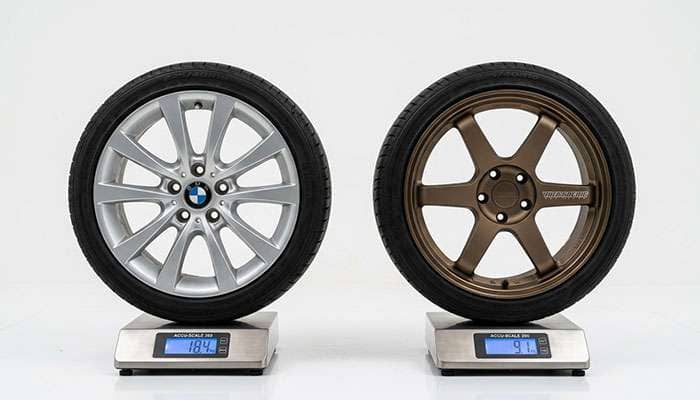
If there's one thing that separates a tuner wheel from a regular aftermarket wheel, it's weight. And this isn't about bragging rights — the physics are real and measurable.
Wheels are unsprung, rotating mass. That means they sit below the springs (unsprung) and spin constantly while driving (rotating). Reducing this type of weight delivers disproportionate performance gains compared to reducing weight elsewhere on the car. Here's what saving 5 pounds per wheel — a typical gain from switching to quality tuner wheels — actually does:
Acceleration improves. The engine doesn't just push the car forward — it also has to spin the wheels. Lighter wheels require less energy to accelerate rotationally. The rule of thumb is that one pound of rotating weight feels like roughly 3-4 pounds of static weight in terms of acceleration response. Save 5 pounds per wheel and it's the equivalent of removing 60-80 pounds from the car.
Braking distances shorten. Your brakes have to stop the wheels from spinning. Less rotating mass means less energy to dissipate, which translates to shorter stopping distances. On a track, this compounds over dozens of braking zones per session.
Suspension responds faster. Lighter unsprung mass allows your springs and dampers to control the wheel more precisely. The tire follows the road surface more closely, improving grip and ride quality simultaneously. This is one of those rare cases where a performance upgrade also improves comfort.
Steering feels sharper. Less mass at the end of the steering geometry means quicker turn-in response and more precise feedback through the wheel. The car feels more alive and connected.
A typical OEM wheel on a sport compact car weighs 20-25 pounds in a 17-inch size. A quality cast tuner wheel in the same size weighs 17-20 pounds. A flow-formed tuner wheel weighs 15-18 pounds. A forged tuner wheel can weigh as little as 12-15 pounds. Every pound you save compounds across four corners.
Tuner wheels are available in the same three construction types as other aftermarket wheels, but the priorities are different — weight and strength-to-weight ratio matter more than raw load capacity.
Construction |
Weight (17x8 typical) |
Strength |
Price Per Wheel |
Best For |
|---|---|---|---|---|
Cast Aluminum |
17–21 lbs |
Good — adequate for street use |
$120–$250 |
Daily drivers, budget builds |
Flow Formed |
15–18 lbs |
Very good — near-forged barrel strength |
$180–$350 |
Track days, spirited street driving |
Forged Aluminum |
12–16 lbs |
Exceptional — strongest and lightest |
$400–$1,000+ |
Competitive track use, serious builds |
Flow forming is the sweet spot for most tuner enthusiasts. The process starts with a cast center, then uses extreme pressure and heat to stretch and compress the barrel, creating a thinner, denser, stronger rim section. You get 80-90% of a forged wheel's weight savings at 50-60% of the price. The Enkei PF series and Konig Hypergram both use flow forming, and they're among the most popular tuner wheels in the market for exactly this reason.
Tuner wheels tend to be designed around the bolt patterns, offsets, and widths that fit sport compact and performance cars — which are different from trucks and SUVs. The most common tuner fitments are 4x100, 5x100, 5x114.3, and 5x112 bolt patterns in 15-19 inch diameters with higher positive offsets (typically +30 to +45mm).
That higher offset is critical. Sport compact cars have narrower fender openings than trucks, so the wheel needs to sit further inboard to avoid rubbing. A tuner wheel in 17x8 with +35 offset will tuck neatly under the fender of a Civic or WRX. The same dimensions with -12 offset (typical off-road spec) would stick out four inches past the fender.
Width is another differentiator. Tuner wheels are commonly available in 7-9.5 inch widths for the front and 8-10.5 for the rear in staggered applications. This range accommodates the 205-275mm performance tires that sport compact cars typically run. Some tuner wheels are available in extreme widths (10-12 inches) for builds with widebody kits and aggressive fender modifications.
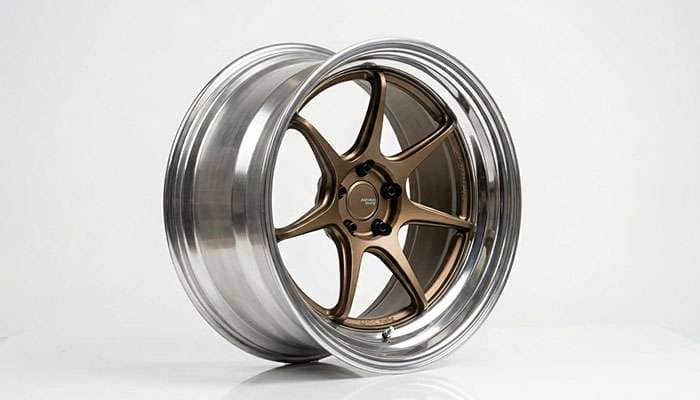
Performance is the foundation, but tuner wheels are also the most style-driven segment of the wheel market. Several design elements define the tuner aesthetic:
Concave faces are the dominant tuner wheel trend. Instead of spokes that sit flat or protrude outward, concave wheels have spokes that curve inward toward the hub, creating depth and visual aggression. The deeper the concave, the more dramatic the look. Many tuner wheels are available in multiple concave depths for the same spoke design.
Thin, multi-spoke designs maximize the open area between spokes, which reduces weight and improves brake cooling. Classic tuner designs like the Enkei RPF1 (6 spokes), the Volk TE37 (6 spokes), and mesh-style wheels all prioritize open spoke patterns. This isn't just aesthetic — more airflow to the brakes means more consistent braking on track.
Deep lip wheels have a wide, visible barrel section between the spoke face and the outer edge of the rim. A deep lip creates visual depth and the impression of a wider wheel. Multi-piece tuner wheels (2-piece and 3-piece construction) can achieve deeper lips than one-piece wheels because the barrel and center are manufactured separately.
Flush fitment — where the wheel face sits perfectly even with or slightly inside the fender line — is the gold standard in tuner culture. Achieving flush fitment requires precise wheel width and offset selection for your specific car. It's the difference between a car that looks dialed-in and one that looks like it just grabbed any wheel off the shelf.
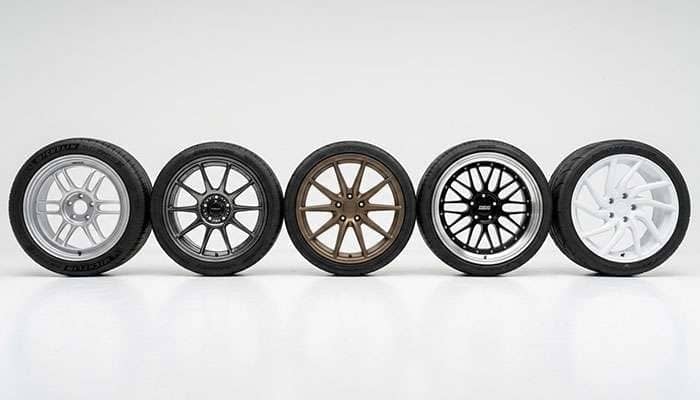
We carry a deep selection of tuner wheels at Performance Plus Tire. Here's where each brand excels:
Enkei — The benchmark. Enkei pioneered the MAT (Most Advanced Technology) process for flow-formed wheels and produces some of the lightest cast and flow-formed wheels in the market. The RPF1 is arguably the most iconic tuner wheel ever made — simple six-spoke design, crazy light weight, proven on track at every level. The GTC01RR and NT03+M cover the premium forged end. If you want proven track performance with brand credibility, Enkei is the default.
Konig — The value leader. Konig's flow-formed Hypergram and Dekagram wheels deliver near-Enkei weight savings at a lower price point. Outstanding for budget track builds and daily-driven sport compacts. The Ampliform is their entry-level performance cast wheel that undercuts most competitors on price without sacrificing quality.
Motegi Racing — Part of the same family as American Racing, Motegi focuses on lightweight designs for imports and sport compacts. The MR146 SS6 and MR140 are solid flow-formed options with aggressive styling and competitive pricing.
TSW — TSW bridges the gap between tuner performance and luxury styling. Their Rotary Forged line delivers excellent weight savings with sophisticated designs that work on European sport sedans and coupes as well as Japanese sport compacts. Great choice if you want a wheel that looks premium on a BMW, Audi, or Mercedes without sacrificing performance.
Rotiform — Style-forward tuner wheels with a strong stance and show car following. Rotiform's designs lean aggressive — deep concave, bold finishes, wide-body-friendly widths. Less track-focused than Enkei but unmatched in visual impact for show builds and street presence.
XXR — The budget entry point for tuner wheels. XXR offers JDM-inspired designs at prices that make them accessible to first-time builders. Cast construction keeps costs low. A good choice for someone building their first project car who wants the tuner look without a premium investment.
Browse our full tuner wheel selection or build a complete wheel and tire package for your sport compact. Call us at 888-926-2689 for help with fitment — we can confirm width, offset, and bolt pattern for your specific car.
No. While the tuner wheel category originated in Japan's sport compact scene, modern tuner wheels are designed for a wide range of performance cars. Brands like TSW, Rotiform, and Fifteen52 build tuner-style wheels for European sport sedans, American muscle cars, and hot hatches. The common thread is lightweight construction and performance-focused engineering, not the country of origin. If your car is a performance-oriented sedan, coupe, or hatchback that benefits from reduced unsprung weight, tuner wheels are a legitimate upgrade regardless of the make.
The main difference is weight priority. Tuner wheels are engineered to be as light as possible within their price category — every design decision, from spoke thickness to barrel construction, is made with weight reduction as a primary goal. Regular aftermarket wheels may prioritize appearance, load capacity, or cost over weight savings. A standard cast aftermarket wheel in 17x8 might weigh 22-25 pounds. A comparable tuner wheel in the same size weighs 15-19 pounds. That 5-8 pound difference per wheel directly translates to measurable improvements in acceleration, braking, and handling.
Reputable budget tuner brands like XXR and entry-level Konig wheels are safe for street use — they meet JWL and VIA certification standards and carry appropriate load ratings. The concern with very cheap, no-name wheels is that they may lack proper certification, use inferior aluminum alloys, or cut corners in quality control. A wheel failure at highway speed is catastrophic. Our advice: buy the lightest wheel you can afford from a recognized brand with proper certifications. A $130 Konig Ampliform is a far better investment than a $70 mystery-brand wheel from an unknown seller.
Flow forming is a manufacturing process where a cast aluminum wheel center is placed on a spinning mandrel and the barrel section is stretched and compressed under extreme heat and pressure. This process makes the barrel thinner, denser, and stronger than a standard cast barrel — approaching the strength characteristics of a forged wheel at a significantly lower price. The result is a wheel that weighs 15-20% less than a comparable cast wheel while being measurably stronger. Flow-formed wheels are widely considered the best value in the tuner wheel market for anyone who tracks their car or drives enthusiastically.
Yes — and the difference is immediately noticeable behind the wheel. Because wheels are rotating mass, the effect of weight reduction is amplified compared to removing weight from the body of the car. Most drivers who switch from 22-pound OEM wheels to 16-pound tuner wheels report that the car feels noticeably quicker off the line, the steering is more responsive, and the brakes feel stronger. On a track, the improvement shows up in lap times. On the street, it shows up in how alive and connected the car feels. Saving 5 pounds per wheel across four corners is one of the most cost-effective performance upgrades available.
For most sport compact cars, 17x8 or 17x9 is the ideal starting point. This diameter is large enough to clear most performance brake kits, small enough to allow a meaningful tire sidewall for ride comfort and grip, and is the size where tire selection is deepest and most affordable. Going to 18 inches adds visual presence but increases weight and reduces tire sidewall. Going to 15 or 16 inches saves weight and improves ride quality but limits brake clearance and tire selection. For track-focused builds, many drivers actually downsize to 15x8 or 16x8 to minimize weight — provided their brakes fit inside.



