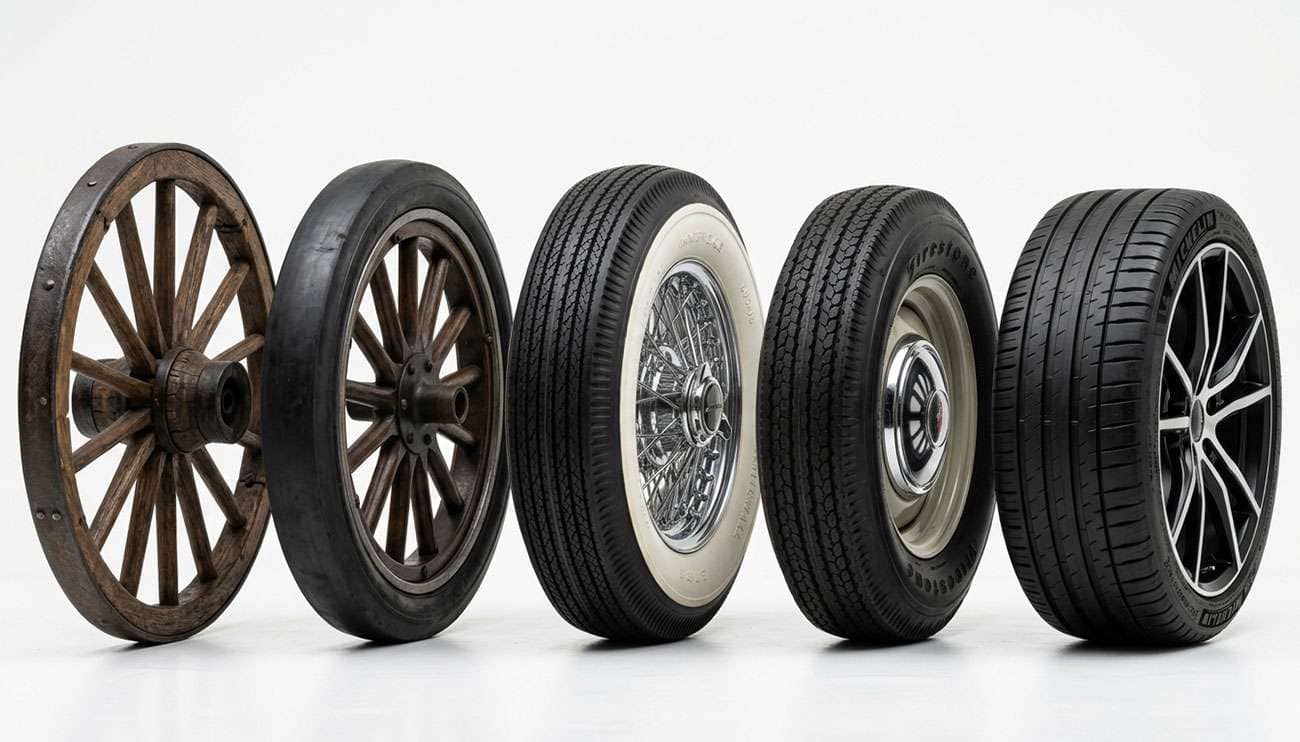
I've been in the tire business since 1968, and the history of what we sell is one of the most fascinating stories in American industry. The tire isn't just a round piece of rubber — it's the single most important safety device on your car, the product of roughly 180 years of engineering, and the reason modern transportation works at all.
Most people don't realize how recent the tire actually is. The wheel goes back 5,000 years. The tire? About 180. Almost every tire innovation that matters happened between 1839 and 1946 — roughly a century of concentrated genius that transformed wooden carriage wheels into the radials on your daily driver. Let me walk you through it.
Before rubber, there were tires — they just weren't rubber. The wooden-wheeled carriages that dominated transportation for thousands of years used steel bands around the outside of the wheel to protect the wood from wear. Blacksmiths called this steel band a "tie" — it held the wheel together and tied the wooden spokes to the rim. Most historians believe this is where the word "tire" comes from.
The process was pure craftsmanship. A wheelwright would heat the steel band in a forge, slip it over a wooden wheel that had been soaked in water, then quench the whole thing in a cold water bath. The steel contracted as it cooled, pulling the wheel tight together. Those steel-banded wooden wheels rolled the wagons that tamed the American West. They lasted forever. They also rode like hell — the only thing between you and a rutted road was the carriage's leaf springs.
Some early transportation used leather bands wrapped around wooden wheels for softer ride. Steel won out because leather wore through in weeks while steel lasted years. Ride comfort wasn't anyone's priority until later in the 1800s.
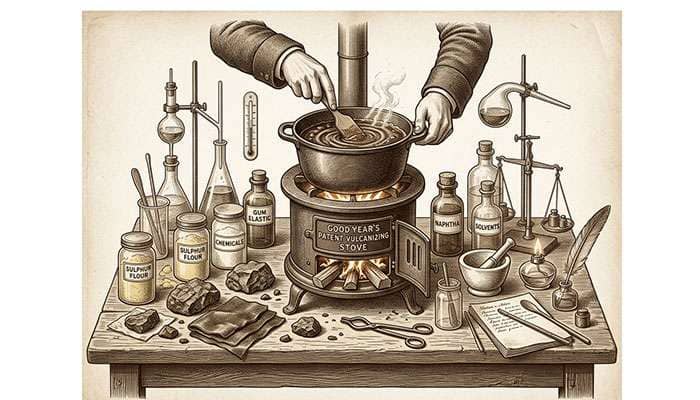
Everything about modern tires starts with one man accidentally dropping rubber on a hot stove. Charles Goodyear was an American inventor obsessed with rubber. The problem in 1839 was that natural rubber was useless for practical applications — it was sticky in summer heat, brittle in winter cold, and had no durability at all. Goodyear had spent a decade trying to stabilize it.
The legend — not entirely accurate but close enough — is that Goodyear accidentally dropped a rubber-sulfur mixture on a hot stove in 1839 and discovered that the combination of heat and sulfur transformed the rubber into a stable, elastic, durable material. He called the process vulcanization after Vulcan, the Roman god of fire. It was the single most important discovery in the history of rubber products.
Here's the bittersweet part: Goodyear died broke in 1860, never making significant money from his invention. The Goodyear Tire and Rubber Company, founded in 1898, was named after him but had no connection to him — Frank Seiberling just wanted to honor the inventor whose work made his business possible. Goodyear's vulcanization process is why every tire on the road today can handle summer heat without melting and winter cold without cracking.
Here's a name most people have never heard: Robert William Thomson. In 1845, this Scottish engineer patented the world's first pneumatic (air-filled) tire. He called it the "aerial wheel" — rubber tubes wrapped in a leather cover, inflated with air, designed to cushion horse-drawn carriages. Thomson's tire worked brilliantly in limited testing. One pair was tested for 1,200 miles with no wear.
But it never caught on. The manufacturing was too complex for the technology of the 1840s. The tires were too expensive for a market that was perfectly happy with steel-banded wooden wheels. Thomson moved on to other inventions. His patent expired. The pneumatic tire idea sat dormant for 43 years until another Scot accidentally reinvented it without knowing Thomson had done it first.
John Boyd Dunlop was a Scottish-born veterinarian working in Belfast, Ireland in the 1880s. His ten-year-old son rode a tricycle on the cobblestone streets in front of their house and complained constantly about how rough the ride was on solid rubber tires. Dunlop, being both a father and an inventor at heart, decided to fix it.
In 1887, Dunlop experimented with inflated rubber tubes bonded to wooden wheel rims. By 1888 he had a working design, patented it, and fitted it to his son's tricycle. The boy immediately started winning bicycle races against kids on solid-tire bikes. The difference in speed and comfort was dramatic.
Dunlop's timing was perfect. The 1880s and 1890s saw an explosion in bicycling — the "bicycle boom" — creating massive demand for anything that made bicycles ride better. Dunlop's company (Pneumatic Tyre Company, later Dunlop Rubber) grew fast. When Thomson's prior 1845 patent was rediscovered in 1892, Dunlop's patent was invalidated. But by then the market momentum was his. Dunlop is still credited as the father of the modern pneumatic tire because he's the one who made it a commercial reality.
Dunlop Tires is still a major brand today — one of the oldest continuously operating tire companies in the world.
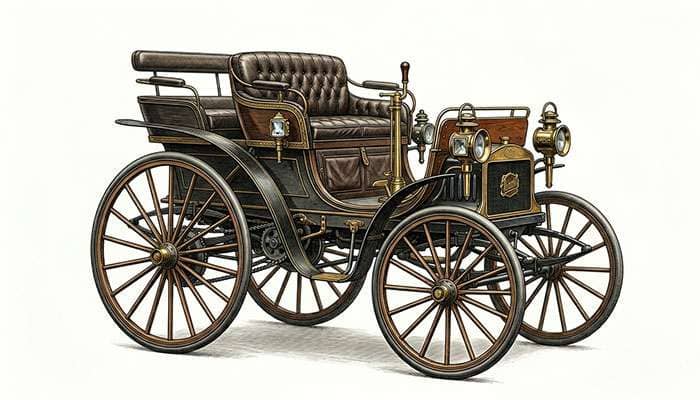
Karl Benz had built the first gasoline-powered automobile in 1886, but it ran on solid rubber tires. The pneumatic tire had been proven for bicycles, but nobody had tried putting air-filled tires on a car. That changed in 1895 when two French brothers did something audacious: they entered the Paris-Bordeaux-Paris automobile race with a car called "L'Eclair" — the Lightning — fitted with pneumatic tires.
The brothers were André and Édouard Michelin. Their car didn't win the race — they suffered 22 tire punctures over the 730-mile course — but they proved the concept. Pneumatic tires made the car ride dramatically better than any competitor on solid tires. Within a few years, every car manufacturer was switching to pneumatic tires. Michelin became one of the dominant tire brands globally and remains one to this day.
This period — roughly 1895 to 1920 — was the Wild West of tire development. Dozens of companies started up. B.F. Goodrich (founded 1870) became a major American manufacturer. Goodyear Tire and Rubber (founded 1898) grew fast. Firestone Tire and Rubber opened in 1900 in Akron, Ohio and soon became Henry Ford's tire supplier for the Model T.
From roughly 1900 through the late 1940s, the dominant tire construction was called bias-ply. These tires used layers of fabric cord — called plies — angled at about 40-55 degrees relative to the direction of travel, crisscrossed in alternating layers. The plies provided structural strength while the rubber provided grip. Early bias-ply tires required an inner tube — a separate rubber bladder that held the air inside the outer casing.
Key developments during this era:
Carbon black (early 1900s). Adding carbon black to rubber dramatically improved durability. Early tires were white or cream colored because natural rubber is light. Carbon black made them black — and tripled their lifespan. White sidewalls (whitewalls) became a luxury feature because they required extra manufacturing steps.
Synthetic rubber (1931). DuPont successfully synthesized rubber. When Japan occupied Southeast Asia during WWII and cut off natural rubber supplies, synthetic rubber kept the American war effort moving. Today most tires use a blend of natural and synthetic rubber.
Tubeless tires (1947). Goodyear developed the first commercially successful tubeless tire, eliminating the separate inner tube by making the outer casing airtight. This reduced weight, improved reliability, and made flat-tire repair easier.
American tire manufacturing boomed through the 1920s, survived the Depression, fed WWII, and hit a peak in the postwar era. Bias-ply tires were the American standard — and they'd remain the American standard longer than they should have.
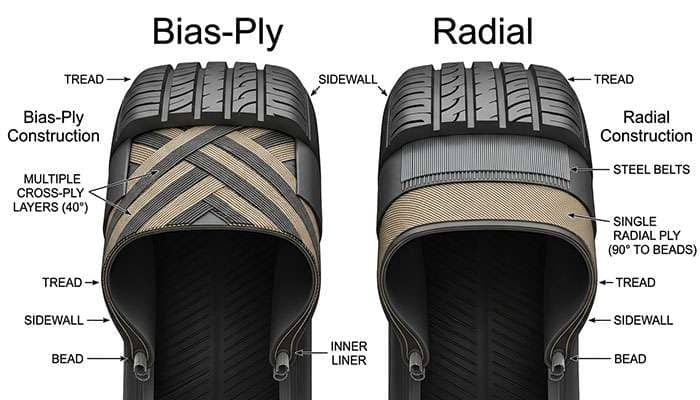
The next revolution came from Michelin in France. In 1946, Michelin engineer Marius Mignol developed a fundamentally different tire construction called the radial. Instead of crisscrossed fabric plies at 40-degree angles, radial construction runs the plies straight across the tire at 90 degrees to the direction of travel, with a separate steel belt underneath the tread.
The advantages were enormous: better grip, longer tread life, improved fuel economy, cooler running temperatures, and better handling. Michelin called their first commercial radial the Michelin X, and it hit the European market in 1949. Within a decade, European car manufacturers had standardized on radial tires.
But here's where American history gets embarrassing. American drivers rejected radials for almost 25 years. The ride was different — stiffer initial feel, but better at speed. American consumers and manufacturers preferred the squishy, floaty bias-ply feel they were used to. American manufacturers kept building bias-ply tires while European and Japanese manufacturers built radials. American bias-ply tires wore out in 25,000-30,000 miles while Michelin radials lasted 50,000+ miles.
Two things broke the logjam:
Consumer Reports, 1968. An influential article showed that radials outperformed bias-ply tires in virtually every test. American consumers started asking for radials.
The 1973 OPEC oil embargo. Gas prices quadrupled overnight. Radials got 3-5% better fuel economy than bias-ply tires. Suddenly the fuel efficiency advantage mattered enormously. Combined with the flood of Japanese imports (Toyota, Honda, Datsun) that came with radial tires standard, the American market finally switched.
By the mid-1980s, every new car sold in America came with radial tires from the factory. The bias-ply era was over for passenger cars. You'll still see bias-ply tires today on antique cars and hot rods, drag racing slicks, and some trailer applications — but not on anything modern.
From the 1980s to today, tire development has been about incremental improvement on the radial foundation. Here are the big milestones:
1980s — Performance tires and asymmetric tread. As horsepower returned to American cars, manufacturers developed high-performance summer tires with specialized tread patterns. Asymmetric designs (different tread patterns on inside and outside of the tire) optimized grip and wet weather performance simultaneously.
1990s — All-season tires and H/V speed ratings. The compromise tire — neither summer nor winter — became dominant for daily drivers. Speed ratings became standardized for safety.
2000s — Low rolling resistance and run-flats. Rising gas prices pushed manufacturers to develop tires that reduced rolling resistance. Run-flat tires (Bridgestone, Michelin, Continental) eliminated the need for a spare tire in some applications.
2010s — EV-specific tires and ultra-high-performance. Electric vehicles required tires optimized for their unique weight and torque characteristics. Performance tires reached levels previously seen only in racing.
Today — Smart tires and sustainable materials. Modern tire technology includes embedded sensors that monitor pressure, temperature, and wear in real-time. Silica compounds have replaced much of the carbon black. Graphene-enhanced rubber offers 40% better strength. Bio-based materials are replacing petroleum-derived synthetic rubber.
Browse our full tire selection or our antique and classic tire catalog — we're one of the biggest dealers of period-correct tires in the country. Call us at 888-926-2689 to talk to someone who actually knows this history firsthand.
There's no single inventor — the tire evolved through several key breakthroughs. Charles Goodyear invented the vulcanization process in 1839 that made rubber practical. Robert William Thomson patented the first pneumatic (air-filled) tire in 1845 but never commercialized it. John Boyd Dunlop reinvented the pneumatic tire in 1888 and built the first commercially successful tire business. The Michelin brothers first used pneumatic tires on an automobile in 1895. Each of these men contributed essential innovations that made the modern tire possible.
The Goodyear Tire and Rubber Company was founded in 1898 by Frank Seiberling, 38 years after Charles Goodyear's death. Seiberling named his company in honor of Goodyear's 1839 vulcanization discovery, which was the foundation of the entire rubber industry. Charles Goodyear had no ownership stake, no royalties, and no involvement with the company. He had died in 1860 deeply in debt, never profiting significantly from his own invention. The company name is simply a tribute to the man whose work made the tire industry possible.
Michelin invented the radial tire in 1946 and it was standard in Europe by the mid-1950s. American drivers rejected radials for about 25 years, preferring the softer feel of bias-ply tires. The switch happened between 1973 and the mid-1980s, driven primarily by the 1973 OPEC oil embargo that made fuel efficiency suddenly critical. Influential 1968 Consumer Reports testing also showed radial superiority. By 1985, virtually every new car sold in America came with radial tires. Today, radials are essentially the only option for passenger cars, with bias-ply tires surviving only in specialty applications like antique cars, drag racing, and some trailer tires.
The difference is in the internal construction. Bias-ply tires have their reinforcement cords running diagonally (at roughly 40-55 degree angles) across the tire, with multiple plies crisscrossed in alternating directions. This creates a stiff, interconnected structure. Radial tires have their cords running straight across at a 90-degree angle to the direction of travel, with a separate steel belt under the tread. This design allows the sidewall to flex independently from the tread, improving grip, handling, tread life, and fuel efficiency. Radials are superior in every measurable performance metric — which is why they replaced bias-ply tires almost completely for passenger cars.
The first car to use pneumatic (air-filled) tires was the Michelin brothers' "L'Eclair" (The Lightning), which they entered in the 1895 Paris-Bordeaux-Paris automobile race. The car suffered 22 tire punctures during the 730-mile race and didn't win, but it proved that pneumatic tires could work on automobiles. Within a few years, virtually every car manufacturer had switched from solid rubber tires to pneumatic tires. Before this, Karl Benz had used solid rubber tires on his pioneering 1886 Benz Patent-Motorwagen — the first gasoline-powered automobile.
Tires are black because of carbon black, a material added to rubber starting in the early 1900s. Natural rubber is a milky white or cream color, and early tires were that natural color. Adding carbon black — essentially finely ground carbon particles — dramatically improves the durability, strength, and UV resistance of rubber. Carbon black-reinforced tires last roughly 3 times longer than unreinforced tires. The black color is a side effect of the durability benefit. White sidewalls became a luxury feature because they required extra manufacturing steps to keep the outer sidewall white while the tread compound was still reinforced with carbon black underneath.