

Yes. Putting scrap tires in household trash or a landfill is illegal across most of the country. The US EPA counts 48 states with scrap tire laws on the books, and roughly 38 of them ban whole tires from landfills outright. But disposal is only half of the regulation. Moving the tires is governed separately, and that is the half nobody mentions. In California, transporting 10 or more used tires without a hauler registration is its own violation. In Maryland, the number is five per year. You can break the law driving them to the recycler.
Read a dozen articles on this and you will get the same advice every time: do not throw tires in the trash, take them to a tire shop. That advice is correct and it is incomplete. It tells you where the tires are allowed to end up. It does not tell you how many you are allowed to carry in the bed of your truck to get them there, who is required to write down that trip, or what happens when the recycler on the receiving end is legally obligated to report you.
That gap matters because the person most likely to get caught is not the person sneaking one tire into a dumpster. It is the guy who did his own brake and tire job across three vehicles over a winter, stacked twelve carcasses behind the garage, and finally loaded all twelve into a pickup on a Saturday morning to do the responsible thing. In Ohio, transporting more than ten scrap tires in a single load without a registration certificate is prosecutable as a felony carrying a fine of at least $10,000 and up to $25,000. He is in deeper water than the dumpster guy, and he has no idea.
So the honest answer to whether it is illegal to throw away old tires is: it depends on which of eight situations you are actually in. Below is each one, what triggers enforcement, and what the exposure looks like.
Find your row. The exposure column reflects state statutory maximums, not what a first-time offender typically pays, but every number listed is written into law somewhere in the United States.
Situation |
Legal |
Exposure |
Do This Instead |
|---|---|---|---|
One to four tires in your household trash or bin |
No, in most states |
Refused pickup, municipal citation |
Drop at any tire retailer |
One to four tires driven to a retailer or recycler |
Yes, everywhere |
$1 to $5 per tire drop fee |
Nothing, this is the correct path |
Five or more tires hauled in Maryland |
Not without a license |
Scrap tire hauler license required above five per year |
Split across years or use a licensed hauler |
Ten or more tires in one load in CA, OH, or MI |
Not without registration |
Ohio: felony, $10,000 to $25,000 |
Licensed hauler, or check your state exemption |
Tires in a rented dumpster or roll-off |
Usually prohibited by contract |
$10 to $20 per tire surcharge, or rejected load |
Confirm in writing before loading |
Tires stacked on your own property |
Depends on count and local code |
Nuisance abatement, cleanup lien on the property |
Keep them dry, covered, and under the local cap |
Tires left at a curb, vacant lot, or behind a shop |
No |
$500 to $25,000, felony in several states |
No legal version of this exists |
Burning them |
No |
State air quality enforcement plus felony exposure |
No legal version of this exists |
This is the version of the question most people are actually asking, and the answer is no, you cannot do it, but the reason is more specific than "tires are bad for the environment."
A passenger tire contains steel belts under the tread. In a landfill cell, those belts puncture the synthetic liner that separates the waste mass from the soil and groundwater underneath it. That liner is the entire engineering premise of a modern landfill. Worse, a whole tire traps a large volume of air inside its casing, and buried air does what buried air always does: it migrates upward. Tires that are covered today work their way back to the surface over the following years, breaking the cap and the liner from the inside. Landfill operators call this floating, and it is why the ban on whole tires exists even in states with no broader scrap tire program.
The practical consequence for you is simple. Municipal collection crews are trained to leave tires at the curb, and most cities treat a tire in a residential bin as an improper setout subject to citation. Bulk pickup programs, the ones that will take a couch or a mattress, almost universally exclude tires by name.
Some states close the loop from the other direction by forcing retailers to accept them. New York requires businesses that sell tires to take back used tires for recycling, and New York City is explicit that car tires cannot go in the trash while bicycle tires can. That distinction is not arbitrary. A bicycle tire has no steel belt and almost no trapped air volume.
Homeowners doing a garage cleanout reason that a rented roll-off is a legitimate waste container, so anything can go in it. That reasoning fails on a detail in the rental agreement.
The container is rented to you, and the load inside it is traced to your name and your address when it reaches the transfer station. Most dumpster rental companies exclude tires outright because the landfill they tip into will not take them. A minority accept tires with a per-tire surcharge in the $10 to $20 range, which is roughly four times what a tire retailer charges to take the same tire. Loading tires into a container without authorization typically results in either a surcharge added to your invoice after the fact or a rejected load, meaning the truck comes back and dumps the contents on your driveway.
If you are already renting a container for a larger project, ask the question in writing before the truck arrives. The answer costs nothing and it is the difference between a $60 surcharge and a $500 problem.
Here is the part that is missing from every consumer guide on this topic. States do not just regulate where scrap tires end up. They regulate the trip. The reason is that illegal tire dumping is almost always committed by someone in a vehicle with a load of tires, so states built enforcement around the vehicle rather than the dump site.
The mechanism is a hauler registration threshold. Below the threshold you are a private citizen moving your own property. At or above it, you are a regulated scrap tire transporter, and you are expected to carry paperwork.
State |
Threshold |
What Is Required |
Notable Detail |
|---|---|---|---|
California |
10 or more used or waste tires |
CalRecycle hauler registration, $10,000 surety bond, Comprehensive Trip Log, windshield decal |
Anyone receiving 10 or more tires from an unregistered hauler is required by law to report them |
Ohio |
More than 10 in a single load |
Ohio EPA transporter registration certificate, windshield decal since May 2024 |
Transporting without registration may be prosecuted as a felony, $10,000 to $25,000 |
Michigan |
More than 10 at once on a public road |
EGLE scrap tire hauler registration and transportation record |
Statute exempts a non-commercial person transporting that person's own tires to an authorized location |
Maryland |
More than 5 per year |
Maryland Department of the Environment scrap tire hauler license |
County facilities cap residents at five tires annually at standard rates |
Read the Michigan row carefully, because it shows how much the fine print matters. Michigan's statute specifically carves out a person, other than a commercial business, transporting that person's own tires to an authorized location. Under that language, the homeowner with twelve of his own tires is fine. California's registration requirement applies to every person who transports 10 or more, with narrow exemptions for common carriers, agricultural haulers, and government agencies, and even those exempt parties still have to comply with the manifest system. Same threshold number, different answer for the same driver.
Enforcement is not theoretical. Ohio EPA guidance written for police officers lists the objective facts that create reasonable suspicion of illegal scrap tire transport, and the first item on the list is transporting more than ten tires in a vehicle that is not displaying a company placard. That is a description of a private pickup truck with a full bed.
The practical move if you have accumulated a pile: call the receiving facility first and tell them the count. Recyclers deal with this constantly and will tell you whether your number puts you over the line in your state, whether a resident exemption applies, and whether they will accept the load from an unregistered driver. If the answer is no, splitting the load across two trips on separate days solves it in most states, because the thresholds are written per load rather than per year. Maryland is the exception worth remembering, since its five-tire limit is annual.
Leaving the pile behind the garage feels like the safe holding pattern. It is a different violation rather than no violation, and it runs on a slower clock.
Two enforcement paths reach a residential tire pile. The first is fire code. A tire fire is not a normal fire. The 1983 tire fire in Winchester, Virginia burned for roughly nine months and produced around 240 million gallons of contaminated runoff into the local watershed. Once a pile ignites, the rubber melts and pools, feeding the fire from below while shedding an oily pyrolytic discharge that flows into ditches and groundwater. Fire codes in most jurisdictions restrict outdoor stockpiling of tires on residential property well below the numbers people assume, and a stack visible from the street is an easy complaint for a neighbor to file.
The second path is vector control, and it is the one that actually generates citations. A tire lying on its side holds a permanent reservoir of warm, shaded, protected water that is nearly impossible to flush out. That is close to ideal habitat for Aedes aegypti and Aedes albopictus, the mosquito species associated with West Nile virus, dengue, and Zika. Both the CDC and EPA have identified scrap tire accumulations as a significant vector control concern, and county vector control districts have independent inspection and abatement authority that does not require a police officer or an environmental agency to get involved.
Abatement is where this turns expensive. If a county abates the nuisance because you did not, the cleanup cost is typically recoverable against you, and in many jurisdictions it attaches to the property as a lien. A pile you kept because you did not want to pay $40 in drop fees becomes a four-figure line item attached to your title.
If you are holding tires legitimately, such as a set of winters or a spare set for a track car, store them indoors, off the ground, out of sunlight, and dry. That is both the compliant approach and the correct one for the rubber. Our guide to repurposing old tires covers the versions of this that keep a carcass genuinely useful rather than just stored.
This is the conduct the statutes were written for, and the penalties reflect it. Two features of these laws surprise people.
The first is that tires frequently get their own enhancement. California's anti-dumping statute allows fines reaching $3,000 for a third or subsequent conviction, and those fines are doubled specifically when the dumped material is tires, and tripled when the waste was generated in the course of a trade, business, or occupation. California also treats each day the material remains in place as a separate violation, which is how a single act becomes a compounding number.
The second is that weight and volume thresholds convert into surprisingly small tire counts. A standard passenger tire runs roughly 20 to 25 pounds. Texas classifies dumping between 500 and 1,000 pounds as a Class A misdemeanor carrying up to $4,000 and a year in jail, and 1,000 pounds or more as a state jail felony carrying 180 days to two years plus a possible $10,000 fine. Do that arithmetic in tires and the felony line lands somewhere around 40 to 50 passenger tires. That is one small trailer load. Illinois wrote the conversion directly into its statute, setting a Class 4 felony at 250 cubic feet of waste or 50 waste tires.
State |
Penalty Structure |
Where It Escalates |
|---|---|---|
California |
Up to $3,000 by third conviction, doubled for tires |
Tripled for business-generated waste, each day is a separate violation |
Texas |
Class A misdemeanor at 500 to 1,000 pounds, up to $4,000 |
State jail felony at 1,000 pounds, roughly 40 to 50 passenger tires |
Illinois |
Class A misdemeanor for a first open dumping violation |
Class 4 felony at 50 waste tires, felony penalty up to $25,000 |
Georgia |
Felony violations of the illegal dumping statute |
Up to $25,000 per charge, charges stack per dump site |
New Jersey |
$2,500 minimum for a first offense |
Up to $50,000 for repeat violations, vehicle forfeiture possible |
Note the Georgia row. Charges stack per site, which is why operators who spread a load across several locations to stay under a threshold end up facing multiple counts instead of one. Cleanup restitution is assessed on top of the fine in nearly every state, and municipalities calculate tire cleanup at roughly $600 per ton.
Burning is the fastest way to convert a disposal problem into a criminal one, and it is worth stating plainly because it still happens on rural property where people assume open burning rules cover it.
Incomplete combustion of tire rubber releases sulfur dioxide, nitrogen oxides, and a dense particulate smoke, along with the oily discharge described earlier that carries into soil and water. Open burning of scrap tires is prohibited under state air quality regulations essentially everywhere, and Ohio groups open burning with open dumping and unregistered transport in the same felony provision carrying $10,000 to $25,000. There is no residential exemption, no small-quantity allowance, and no version of this that is legal.
You can put a broken lawn mower at the curb. You cannot put four tires there. Understanding why makes the rest of the rules predictable rather than arbitrary.
Scale is the first factor. The EPA has estimated roughly one scrap tire generated per person per year in the United States, which puts national annual volume in the range of 260 to 275 million tires. Nothing else in a typical garage is produced and discarded at that rate.
Persistence is the second. A tire is engineered to resist heat, ozone, ultraviolet light, water, and abrasion for tens of thousands of miles. Those same properties mean it does not meaningfully break down in a landfill on any human timescale, which we cover in detail in how long a tire takes to decompose in landfills. A buried tire is effectively permanent, and it is permanent while also floating, holding water, and puncturing liners.
Fire load is the third. The energy density of tire rubber is comparable to coal, which is exactly why tire-derived fuel is a legitimate industrial product. The property that makes a shredded tire valuable to a cement kiln makes a pile of whole tires behind your fence a nine-month fire waiting for a spark.
Put those three together and the regulatory posture makes sense. Every state that built a scrap tire program built the same set of pieces: a per-tire fee at point of sale to fund it, registration for the people who move tires, manifests to track loads, and cleanup money for the piles that got away. The rules you run into as a homeowner are the consumer-facing edge of that system.
Set the legal exposure aside for a moment. Holding a set of scrap tires has a running cost, and it moves in one direction.
Month one: they have resale value. A used tire with more than half its tread remaining, no sidewall damage, and a recent date code moves on the private market in the $15 to $40 range. Four of those is real money and the fastest exit from the whole problem.
Month six: the clock starts working against you. Rubber ages whether or not it rolls. Antiozonants migrate out of the compound, the surface stiffens, and fine cracking begins at the flex points. Our breakdown of tire dry rot and how to prevent it covers the chemistry, but the short version is that outdoor storage in sun accelerates it dramatically over indoor storage.
Year two: the date code has become the disqualifier. Buyers check the DOT code, and many shops decline to mount anything past a certain age regardless of tread. If you are not sure how to read yours, here is how to tell how old your car tires are. Once the code reads old, the resale market closes and your $120 set is worth zero.
Year three: you are paying to leave. The tires that were an asset are now a $40 disposal bill, and if a neighbor filed a complaint anywhere in that window, the county abatement invoice is a different order of magnitude.
One thing worth checking before you write any of them off as scrap. Plenty of tires get pulled and stacked over damage that does not actually condemn the tire, and plenty of others get kept over damage that absolutely does. Our guide to sidewall damage and whether it is safe to drive on is the fastest way to sort a repairable tire from a genuine carcass before you decide what the pile actually is.
Ranked cheapest to most expensive for a typical four-tire household situation.
1. Buy new tires and hand off the old set at the same time. This is functionally free because you already paid for it. Nearly every state collects a per-tire fee at the point of new tire sale to fund its scrap tire program: $1.75 per tire in California, $2.50 in New York, $1.00 in Washington, with most states landing between $1 and $3. That money exists specifically to move your old tires through the recycling chain. When you buy a new set and leave the old one, you are spending a credit you have already bought. Walking those same four tires in separately later means paying a second time.
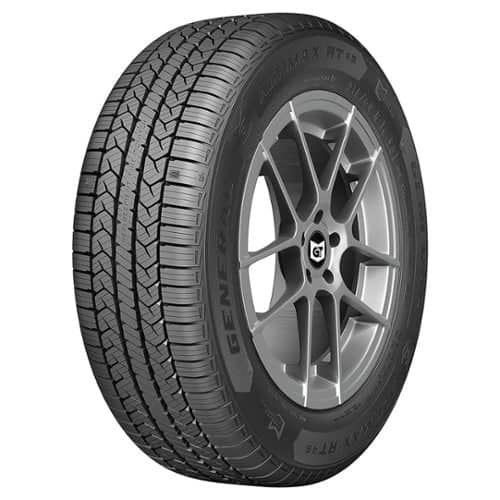
For the daily driver that generated the pile in the first place, the General Altimax RT45 is the straightforward replacement, running about $128.99 in 205/55R16 and $165.99 in 225/65R17. It is a touring all-season with a long treadwear rating, which is the practical answer to not repeating this exercise sooner than necessary.
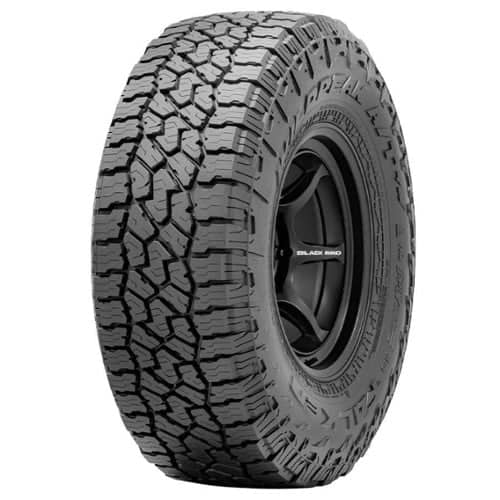
If the tires came off a truck or SUV, the Falken Wildpeak A/T4W is the all-terrain to look at, around $234 in 265/70R17 and $297 in LT265/70R17. Severe snow rated, and heavy enough in construction that the replacement interval is genuinely long.
2. Retailer take-back without a purchase. Most tire shops will accept scrap tires whether or not you bought from them, generally $1 to $5 per passenger tire. Expect a surcharge of a few dollars per tire if they are still mounted on rims, because dismounting is labor. Take them off yourself if you have the tools and you will usually avoid it.
3. Municipal recycling center or collection event. County transfer stations and seasonal amnesty events are frequently free or near-free for residents, funded by the same state fee described above. Bring proof of residency. Nearly all of them cap the count, commonly four to eight tires per household, and that cap exists precisely because of the hauler thresholds discussed earlier. Our walkthrough of how to dispose of car tires covers the drop-off process, and how to recycle used tires covers what happens to them after you leave.
4. Licensed hauler pickup. Once you are past your state's threshold, this stops being the expensive option and starts being the only clean one. A licensed hauler carries the registration, writes the manifest, and takes the compliance risk off you. Priced per tire, it is higher than a drop-off, and it is cheaper than a felony.
If you are replacing the set anyway, start there. Browse tires at Performance Plus Tire and the disposal question resolves itself as part of the transaction rather than as a separate Saturday project.
Is it illegal to throw away old tires? Yes, in the sense that almost everyone means it: tires do not go in your trash, your bin, your bulk pickup, or a landfill, and that holds across nearly the entire country. But the version of this law that actually catches people is not about the trash can. It is about the truck.
The number to remember is ten. In California, Ohio, and Michigan, that is where you cross from private citizen into regulated hauler, with registration, bonding, and manifest obligations attached. In Maryland it is five, and it is annual rather than per load. Below your state's number, driving your own tires to a retailer or transfer station is legal everywhere and costs a few dollars. Above it, make one phone call to the receiving facility before you load anything.
And if the pile exists because the tires wore out, the cheapest legal disposal in the country is the one bundled into buying the next set. You already paid the fee.
No. The landfill ban applies to whole tires regardless of quantity, so one tire is the same violation as four. In practice the collection crew will leave it at the curb, and most municipalities treat a tire in a residential bin as an improper setout subject to citation. Bicycle tires are an exception in some jurisdictions, including New York City, because they have no steel belt and almost no trapped air volume.
It depends on your state, and ten is the most common threshold. California requires a waste tire hauler registration, a $10,000 surety bond, and a Comprehensive Trip Log for anyone transporting ten or more used or waste tires. Ohio and Michigan set their line at more than ten in a single load, though Michigan exempts non-commercial individuals moving their own tires. Maryland is stricter at five per year. Call the receiving facility with your count before you load.
In some states, yes. New York requires businesses that sell tires to accept used tires back for recycling. Elsewhere it is standard practice rather than a legal obligation, and most shops will take scrap tires from anyone for roughly $1 to $5 per passenger tire. Expect a small additional charge per tire if they are still mounted on rims, since dismounting is labor.
It can be, through fire code and vector control rather than waste law. Fire codes commonly restrict outdoor tire stockpiling on residential property, and county vector control districts have independent authority to inspect and abate tire piles because standing water inside a tire is prime mosquito breeding habitat. If the county abates the nuisance for you, the cleanup cost is generally recoverable and in many places attaches as a lien on the property.
Penalties range from a few hundred dollars to felony charges depending on quantity and state. New Jersey sets a $2,500 minimum for a first offense with vehicle forfeiture possible. Illinois makes 50 waste tires a Class 4 felony with penalties up to $25,000. Georgia charges felony violations at up to $25,000 per count, and counts stack per dump site. Cleanup restitution is assessed on top of the fine almost everywhere.
That is the state scrap tire fee, collected at the point of new tire sale to fund recycling programs, hauler registration systems, and cleanup of abandoned tire piles. It is $1.75 per tire in California, $2.50 in New York, and $1.00 in Washington, with most states between $1 and $3. It is the reason leaving your old set at the shop when you buy new is effectively free, and why bringing them back separately later means paying twice.



