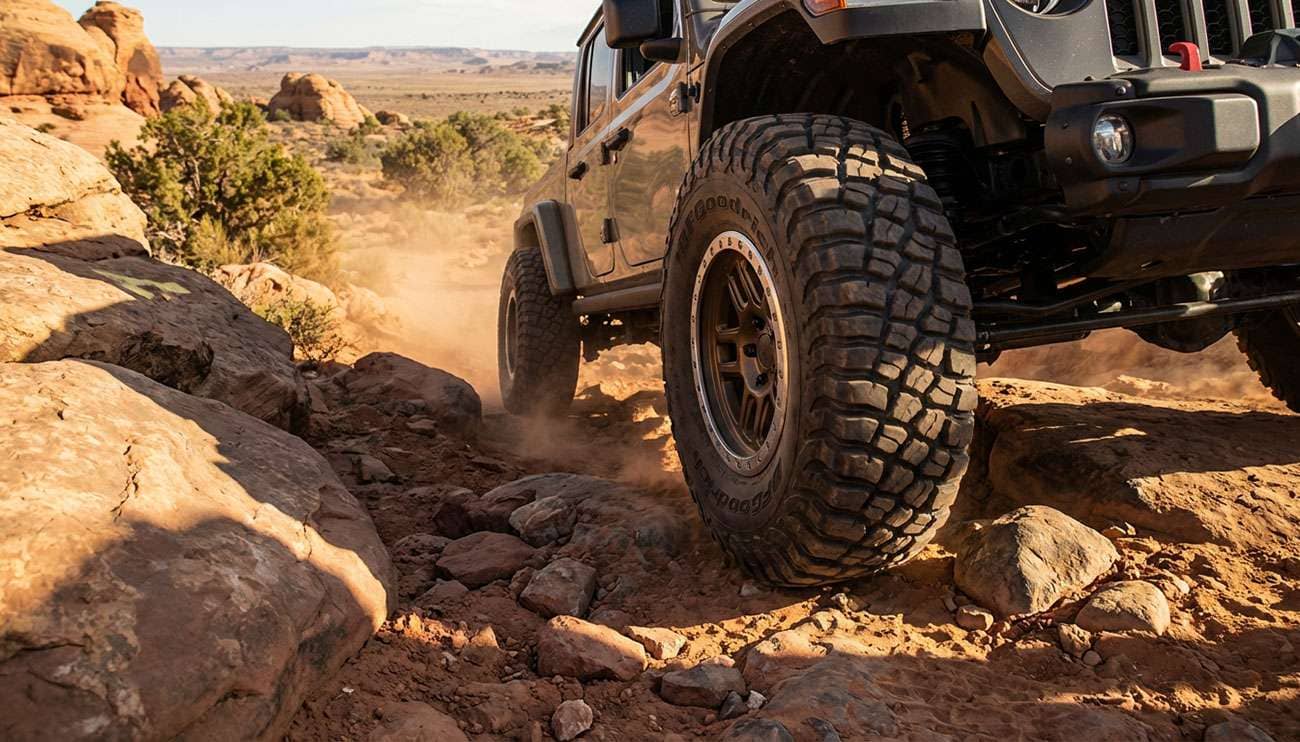
Off-road tires are the difference between conquering challenging terrain and finding yourself stuck miles from civilization. The right set of tires transforms your vehicle's capability on trails, rocks, mud, and sand.
Proper tire selection for off-road adventures is crucial for both performance and safety. Off-road tires feature deeper, more aggressive tread patterns than standard highway tires, designed specifically to grip loose surfaces like mud, sand, and rocks. These tires also withstand impacts and resist punctures from sharp obstacles you'll encounter on the trail.
Off-road enthusiasts choose from three main categories when venturing beyond paved roads: All-Terrain (A/T), Mud-Terrain (M/T), and Rugged-Terrain (R/T) tires. Each category serves distinct purposes and driving conditions. Mud-terrain tires deliver maximum traction in extreme off-road situations, excelling in dirt, mud, gravel, and rock. All-terrain tires offer the best balance for drivers who tackle occasional gravel roads and sandy beaches during weekend adventures.
Tire size directly impacts your vehicle's ground clearance, stability, and overall trail performance. Matching tires to your specific off-road applications, vehicle weight, and driving conditions ensures safe and effective performance on every adventure.
At Performance Plus Tire, we understand that choosing off-road tires can seem overwhelming with so many options available. Our expert guide breaks down everything you need to know to select the perfect tires for your next adventure.
Off-road tires come in several distinct categories, each engineered for specific terrains and driving applications. Understanding these differences is essential before making a purchase decision for your adventure vehicle.
All-terrain tires offer versatility for drivers who split time between highways and trails. These tires feature balanced tread patterns that handle uneven trails, light mud, gravel, and winter conditions while maintaining comfortable highway driving. AT tires typically deliver 45,000-65,000 miles of service life. Mud-terrain tires sacrifice longevity for extreme performance, lasting approximately 35,000-45,000 miles.
Cost considerations matter when selecting between these options. AT tires generally cost $50 less per tire than equivalent MT models, with AT prices ranging $200-$400 versus $300-$500 for MTs.
Fuel economy differences are significant—MT tires reduce fuel efficiency by about 1 MPG compared to AT options. This happens because mud-terrain designs use heavier construction, softer rubber compounds, and create more rolling resistance.
AT tires perform well across varied conditions but struggle in deep mud where they clog easily. MT tires excel in extreme conditions through their aggressive design featuring fewer, larger tread lugs with wider spacing for superior mud ejection.
Rugged terrain tires represent a newer category that bridges AT and MT capabilities. RT designs combine large open tread blocks and aggressive sidewall patterns for mud evacuation while maintaining reasonable highway manners.
These hybrid tires provide sufficient traction for varied terrain while offering better highway characteristics than mud-terrains, including reduced noise and improved ride quality. RT tires work best for vehicles spending 15% to 50% of their time off-road, making them ideal for overlanding enthusiasts who encounter diverse surfaces.
Specific challenges require specialized solutions beyond standard categories. Sand driving demands tires with wide, paddle-like treads designed for flotation over loose surfaces.
Serious rock crawling requires tires with reinforced sidewalls and flexible tread compounds that conform to jagged surfaces. These specialty options excel in their intended applications but sacrifice versatility for extreme performance.
Ready to explore your tire options? Visit Performance Plus Tire for expert guidance on selecting the right tires for your specific off-road needs.
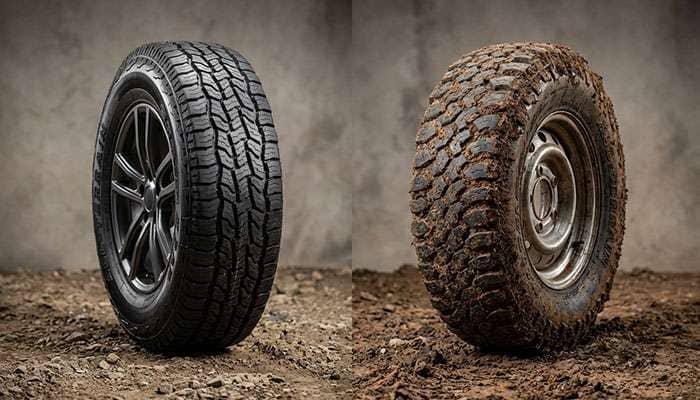
Your driving terrain determines which tire characteristics deliver the best performance. Matching tire design to your specific conditions ensures maximum traction and safety on every adventure.
Mud conditions require tires with aggressive tread patterns featuring large lugs and wide voids for debris evacuation. Mud-terrain tires excel here with deep, widely-spaced tread blocks that prevent clogging and maintain grip in soft, slippery conditions. The self-cleaning design allows these tires to bite through mud and maintain traction when all-terrain options would fail.
Sand presents completely different challenges. Sand tires feature wide, paddle-like treads that create a flotation effect, distributing your vehicle's weight across the surface to prevent sinking. Experienced desert drivers reduce tire pressure to 10-20 PSI, dramatically increasing the tire's contact patch for improved traction and floatation.
Snow performance demands tires with Three-Peak Mountain Snowflake (3PMSF) certification. This rating requires specific winter testing, unlike the basic M+S designation found on many tires. Look for extensive siping—small cuts across the tread blocks that create additional biting edges on ice and packed snow.
Rock crawling demands tires with reinforced sidewall construction and flexible rubber compounds. The best rock tires conform to uneven stone surfaces, maximizing contact area for superior grip. Choose models with 3-ply sidewall construction to resist punctures from sharp, jagged rocks.
Gravel roads perform best with all-terrain tires featuring stone ejector technology. These special tread features prevent rocks from embedding in the tire, reducing damage and maintaining performance. The balanced construction provides stability across varying speeds on loose gravel surfaces.
Drivers who split time between highways and trails benefit most from rugged terrain (RT) tires. These hybrid designs combine mud-terrain shoulder lugs for off-road traction with all-terrain center blocks for highway comfort. RT tires deliver strong performance across varied conditions without the excessive road noise or fuel economy penalties of pure mud-terrain designs.
Ready to find the perfect tires for your specific terrain? Performance Plus Tire offers extensive testing data showing how different tire models perform across everything from deep mud to rocky ascents, helping you make the right choice for your adventures.
Tire sizing and load ratings determine whether your off-road adventure ends successfully or leaves you stranded with damaged equipment. These specifications directly affect vehicle performance, safety, and capability on challenging terrain.
Larger tire diameters increase your vehicle's ground clearance, essential for navigating steep inclines and clearing trail obstacles. However, bigger isn't always better without proper planning. A 35-inch tire typically requires only a suspension leveling kit and minor fender modifications. Jump straight to 37-inch tires and you'll need substantial drivetrain upgrades.
Width matters as much as diameter. A 33×12.50 flotation tire won't interchange directly with a 285/70R17 despite similar overall dimensions. Check both measurements to avoid clearance problems with fenders, suspension components, and steering systems.
Off-road tires use two primary sizing systems with different applications. LT-metric tires like 315/70R17 measure width in millimeters, while flotation tires like 35×12.50R17 use inches for both height and width. Both systems offer similar performance capabilities but serve distinct purposes.
Flotation sizing excels in loose terrain conditions. These tires maximize surface contact area to prevent sinking in sand, mud, or snow. LT-metric options typically come standard on heavy-duty trucks, engineered specifically for towing capacity and durability.
Modern "ply ratings" indicate strength equivalency rather than actual fabric layers. Today's "10-ply rated" tire might contain only 2-3 physical plies made from advanced materials.
Higher load ratings feature reinforced internal construction that prevents dangerous tire deformation under heavy loads. Serious off-roaders carrying heavy modifications or equipment should consider load range E (10-ply) ratings. Exceeding your tire's load capacity significantly increases blowout risk.
At Performance Plus Tire, our experts help you determine the ideal size and load rating combination for your specific vehicle and off-road requirements. Proper sizing ensures optimal performance while maintaining safety margins for your adventures.
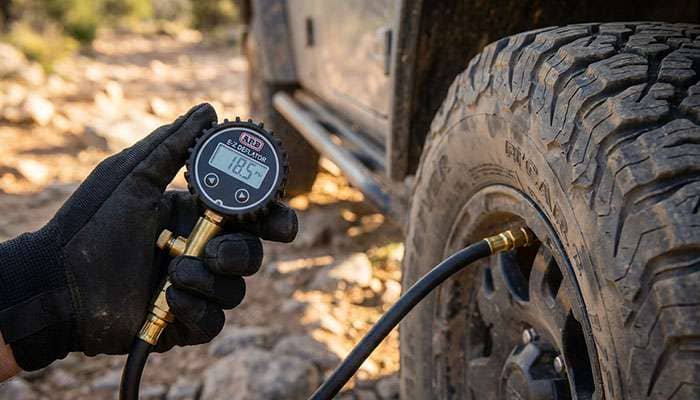
Proper off-road tire maintenance extends tire life and ensures peak performance on challenging terrain. Tire pressure management stands as the most critical factor for successful trail adventures.
Terrain-specific tire pressures maximize traction while protecting your tires from damage. Sand driving requires 12-15 PSI to increase the tire's footprint and prevent sinking into soft surfaces. Mud conditions perform best at 15-20 PSI, providing enough flexibility for traction without risking bead separation. Rocky terrain benefits from 10-15 PSI when running beadlock wheels, allowing tires to conform around obstacles. General trail riding works effectively at 18-25 PSI for balanced performance. Check tire pressure when tires are cool for accurate measurements.
Airing down creates a larger contact patch between your tire and the ground, dramatically improving traction on loose surfaces. Lower tire pressure allows the tire to wrap around rocks and obstacles rather than being punctured by sharp edges. Softer tires also absorb impacts more effectively, reducing stress on your vehicle's suspension and providing a smoother ride over rough terrain.
Successful off-road adventures require proper preparation. Carry these essential items on every trail:
Tire repair kit with plugs and patches for puncture repairs
Portable air compressor for reinflating tires after trail use
Tire sealant for emergency puncture repairs
High-lift jack with base plate for lifting on uneven terrain
A full-size spare tire mounted on a matching wheel provides the best insurance against trail damage. Experienced off-roaders often carry spare valve stems, as these can break off when hitting rocks at low tire pressures.
Regular tire inspections help identify problems before they become dangerous. Tires naturally lose approximately 1 PSI per month, making regular pressure checks essential. Watch for these wear indicators: edge wear suggests underinflation, center wear indicates overinflation, and uneven inside-to-outside wear points to alignment issues.
Replace off-road tires after 5-6 years regardless of remaining tread depth, as rubber compounds degrade over time. When a penny inserted into the tread shows Lincoln's entire head, immediate tire replacement is necessary for safe operation.
Selecting off-road tires requires matching tire type to your specific driving conditions and terrain challenges. All-terrain tires serve weekend adventurers who split time between highways and moderate trails. Mud-terrain tires excel in extreme conditions with aggressive tread patterns designed for deep mud and loose surfaces. Rugged-terrain tires bridge both worlds for overlanding enthusiasts who demand versatility.
Terrain dictates tire choice more than any other factor. Sand driving benefits from flotation-style treads that distribute weight evenly across loose surfaces. Mud requires self-cleaning tread patterns with wide voids between lugs. Rock crawling demands reinforced sidewalls and flexible rubber compounds that conform to jagged surfaces.
Proper sizing and load ratings prevent dangerous situations on remote trails. Larger diameter tires increase ground clearance but may require suspension modifications and affect vehicle handling. Load range E (10-ply) ratings provide the strength needed for heavy modifications and extreme terrain challenges.
Tire pressure management separates experienced off-roaders from beginners. Airing down to 12-15 PSI in sand, 15-20 PSI in mud, and 10-15 PSI on rocks dramatically improves traction and prevents punctures. Always carry a portable compressor and tire repair kit for trail emergencies.
Quality off-road tires from reputable manufacturers ensure reliability when you're miles from civilization. Weekend warriors benefit most from versatile all-terrain options, while serious off-roaders tackling extreme conditions need specialized mud-terrain designs.
Ready to upgrade your off-road capability? Visit Performance Plus Tire today and let our tire experts help you select the perfect set for your next adventure. We'll ensure proper fitment and provide the technical guidance you need for safe, successful off-road experiences.
Choosing the right off-road tires is crucial for safe and successful adventures beyond paved roads. Here are the essential insights every beginner should know:
• Match tire type to your terrain: All-terrain tires work for mixed use, mud-terrain excels in extreme conditions, and rugged-terrain bridges both worlds effectively.
• Size impacts performance significantly: Larger tires increase ground clearance but may require vehicle modifications and affect handling characteristics.
• Proper tire pressure is terrain-specific: Lower pressure (10-20 PSI) for sand/rocks, higher (18-25 PSI) for general trails to maximize traction and prevent damage.
• Load ratings prevent dangerous blowouts: Choose tires with appropriate weight capacity for your vehicle and gear, especially for heavy modifications or towing.
• Regular maintenance extends tire life: Monitor pressure monthly, carry repair tools, and replace tires after 5-6 years regardless of tread condition.
The key to successful off-roading lies in understanding that no single tire excels everywhere. Your choice should balance your specific driving conditions, budget, and safety requirements. Whether you're a weekend warrior or serious off-road enthusiast, selecting tires that match your actual needs—not just your aspirations—ensures better performance and safer adventures.
All-terrain tires offer a balance of on-road comfort and off-road capability, suitable for light to moderate off-roading. Mud-terrain tires have more aggressive tread patterns for extreme off-road conditions but are noisier on highways and reduce fuel efficiency.
Larger tire diameters increase ground clearance, which is beneficial for clearing obstacles. However, they can also affect vehicle handling and may require modifications to your vehicle's suspension or body. It's important to choose a size that balances performance with your vehicle's capabilities.
Adjusting tire pressure, often called "airing down," increases the tire's contact patch with the ground. This provides better traction on loose surfaces like sand or mud and helps the tire conform to obstacles, reducing the risk of punctures on rocky terrain.
Off-road tires should typically be replaced after 5-6 years, regardless of tread condition, as rubber compounds deteriorate over time. However, if you notice uneven wear patterns or the tread depth becomes too shallow, you may need to replace them sooner.
When off-roading, it's crucial to carry a portable air compressor for reinflation, a tire repair kit with plugs and patches, and a full-size spare tire. Additionally, consider bringing a hi-lift jack with a base plate for uneven terrain and tire sealant for minor punctures.