

I have been around tires long enough to be suspicious of anything that wins everything. The Continental SportContact 7 wins just about everything, and I still watched a customer come back into the shop unhappy about a set. Both of those things are true at the same time, and figuring out why is the whole point of this article.
Yes, the SportContact 7 is a very good tire. On grip it is arguably the best ultra high performance summer tire you can bolt to a street car right now. That is not my opinion talking, that is the independent test record, and I will lay it out below.
The catch is that the SportContact 7 asks something of your car. Specifically, it asks your car not to be too heavy and not to make too much torque. Get that wrong and you will love how the car drives and hate how fast the tread disappears. Get it right and you will wonder why you ever ran anything else.
Find your vehicle in this table before you read another word.
Your Vehicle |
Typical Size |
What You Will Get |
Verdict |
|---|---|---|---|
Light hot hatch or compact sport sedan under about 3,400 lbs |
215/40R18, 245/45R18 |
Class-leading grip with tread life that holds up |
Buy it |
Sports car or coupe, 3,400 to 4,200 lbs |
245/40R21, 255/45R19, 285/30R21 |
Outstanding handling, wear that depends on your right foot |
Buy it |
Performance sedan or wagon over 4,200 lbs with big torque |
265/40R21, 295/35R21 |
Superb grip, noticeably faster rear wear |
Buy with eyes open |
Performance SUV or heavy EV over 5,000 lbs |
285/40R22, 315/35R22 |
Great on day one, short life if you drive it hard |
Consider the alternative below |
Anything that sees below 45 degrees regularly |
Any |
Reduced grip, faster wear, hardened compound |
Wrong tire entirely |
If you landed in the first two rows, you can stop worrying. If you landed in the last three, keep reading, because the details matter to your wallet.
I want to be straight about how good this tire is before I start poking at it, because the record is genuinely remarkable.
Aggregated across sixteen independent tire tests, the SportContact 7 took fourteen wins with an average finishing position of 1.3. It ranked first in dry braking, first in dry handling, and first in wet braking. It came second in straight-line aquaplaning resistance and second in rolling resistance.
Read that again. First in dry braking and first in wet braking, in the same tire. Those two usually pull against each other, because the compound and tread void that help you stop on water are not the same ones that help you stop on hot asphalt. Continental found a way to have both, and that is the engineering achievement here.
The hardware behind it is not exotic marketing. The tread uses Continental's Black Chili compound with a high silica content. Underneath sits a twin-ply casing with spirally wrapped nylon overlays for high-speed stability, plus a layer of rigid polyamide reinforcement that stiffens the tire laterally so steering inputs arrive at the contact patch without slop. Continental's Traction Grooves add biting edges and water evacuation paths across the face.
The SportContact 7 arrived in 2022 as the replacement for the SportContact 6, and production runs out of Continental's European plants in the Czech Republic, Slovakia, and Portugal.
So when someone asks me whether the SportContact 7 is a good tire, the honest answer is that on pure capability it is the current benchmark. That is not the interesting question. The interesting question is why some owners are still unhappy.
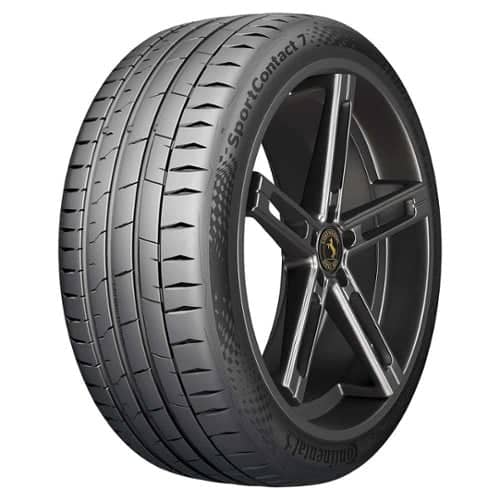
Here is the other half of the picture. Across roughly 98 owner reviews, the SportContact 7 draws consistent praise for wet and dry grip, braking, and confidence near the limit. The most consistent complaint, by a wide margin, is short tread life, described as rapid wear and specifically called out on heavier and higher-torque cars. A secondary theme is road noise and ride harshness on certain surfaces.
Notice how specific that complaint is. It is not everybody. It is heavy cars and torquey cars.
The mechanism is not complicated once you have swept up enough rubber off a shop floor. A tire wears by abrasion, and abrasion scales with the energy you put through the contact patch. Weight increases the normal load on that patch. Torque increases the shear force across it. Stack both and the compound gives up rubber faster, and a soft, grippy, 240-treadwear compound has less to give up in the first place.
Now look at what the SportContact 7 gets fitted to at the big end of the range. We stock it up to a 315/35R22. Nothing that takes a 315/35R22 is light. That size goes on performance SUVs and heavy electric vehicles, and electric vehicles are the worst case of all because they deliver peak torque from a standstill every single time you touch the pedal.
So the tire is not defective and the owners are not wrong. A compound tuned to win braking tests is being asked to survive loads that a braking test never simulates. Both experiences are real.
The lesson I give people at the counter is simple. The heavier and torquier your car, the more you should treat the SportContact 7 as a performance purchase rather than a value purchase. You are buying the grip, and the tread life is what it is. If cost per mile is what keeps you up at night, there is a better answer further down this page.
I have to say this part plainly, because it is the mistake that costs people the most money and occasionally a lot more than money.
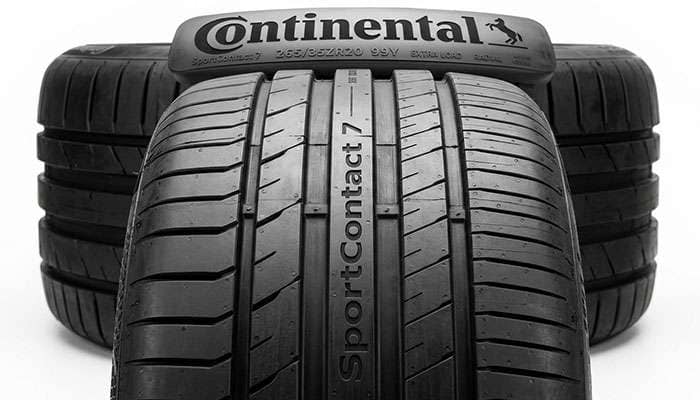
The SportContact 7 is a summer tire. Not an all-season with a sporty attitude. A summer tire. Continental lists it that way, we list it that way, and the compound behaves that way.
Summer compounds are formulated to stay pliable and grippy when they are warm. Below roughly 45 degrees Fahrenheit they begin to stiffen, and as they stiffen they stop conforming to the road surface at a microscopic level. Grip falls off. It does not fall off gently at the limit either, it falls off in normal driving, in the rain, at the stoplight where you needed to stop and did not.
Tire testers make the same point without drama. Asked about running the SportContact 7 in ambient temperatures around 2 to 7 degrees Celsius, roughly 36 to 45 Fahrenheit, the answer is that it is a summer tire and will not be at its optimum in those temperatures.
Cold also accelerates wear, which loops right back to the previous section. A stiff compound scrubs rather than deforms, and scrubbing is abrasion. Plenty of people who complain about SportContact 7 tread life are running them through a winter they should not be running them through.
If your car sleeps outside through a real winter, you need a second set of wheels with winter tires, or you need to be shopping a different category entirely. Our breakdown of summer tires vs all-season tires lays out where the line sits, and if you want the temperature specifics, what temperature is too cold covers how compounds behave as the thermometer drops.
This question deserves a more careful answer than most articles give it, because wet performance is not one number.
Wet braking: exceptional. First place across the aggregated test record. If you need to stop on a wet road, there is currently nothing better in this class. That is the single most important safety metric a tire has, and the SportContact 7 owns it.
Straight-line aquaplaning: excellent. Second place. The circumferential grooves move standing water efficiently.
Wet handling: good, not class-leading. This is where the tire ranks lower relative to its rivals. It stops beautifully in a straight line but it is not the sharpest thing out there when you are carrying speed through a wet corner.
That combination tells you something about the tire's personality. It was optimized for the emergency, not for the wet track day. For a street car that is exactly the right priority, and I would take that trade every time. But if you specifically want a tire to hustle on soaked back roads, know that this one is very good rather than untouchable in that particular discipline.
One more caveat that applies to every summer tire including this one. All of that wet capability assumes a warm road. In a cold rain the compound stiffens and the numbers you just read do not describe the tire you are driving on.
People ask what the downsides of Continental tires are, and with the SportContact 7 the honest list is short but real. I would rather you hear it from me than find out in your driveway.
Now the flip side, and I say this as someone who is naturally skeptical of hype. Every one of those drawbacks is a direct consequence of the choices that make it grip. Soft compound gives you braking and gives up tread life. Stiff construction gives you steering and gives up compliance. Aggressive tread gives you water evacuation and gives up quiet. There is no version of this tire that keeps the grip and fixes the list. That is not a flaw in the design, that is the design.
If the noise question is what is nagging at you, our guide on tire noise causes explained separates the noise a tire makes by design from the noise that means something is wrong.
Continental builds a whole ladder of summer tires and they are not interchangeable. The SportContact 7 sits at the uncompromisingly sporty end, with the PremiumContact 7 as the more versatile all-rounder below it and the efficiency-focused options below that. Each one is built for a different job.
Based on the thirteen fitments we carry, running from a 215/40R18 up to a 315/35R22, the SportContact 7 is aimed squarely at:
Every size we stock is Extra Load, and nearly all are Y-rated for sustained speeds up to 186 mph. One fitment, the 255/45R19, is W-rated at 168 mph instead. That is not a downgrade in quality, it is Continental matching the rating to the vehicles that use that size, but check it against your door placard rather than assuming the whole line is identical.
If you are cross-shopping the wider performance category, our roundup of the 15 best high performance tires for sports cars puts the SportContact 7 alongside its direct rivals.
This is the part most reviews skip, and it is the part that actually helps you.
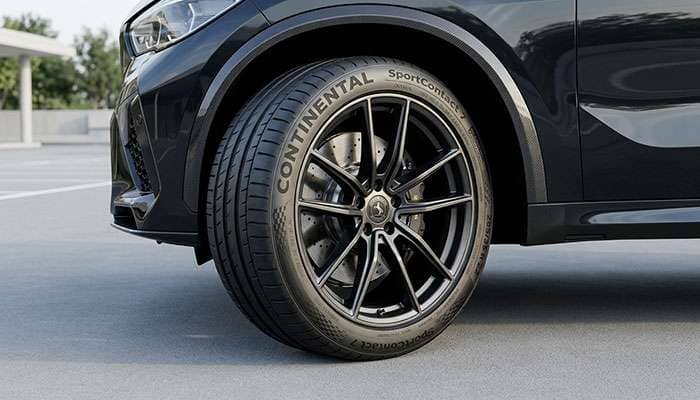
If you read the wear section and recognized your own vehicle in it, you have two good alternatives sitting in our inventory, and both are Continentals.
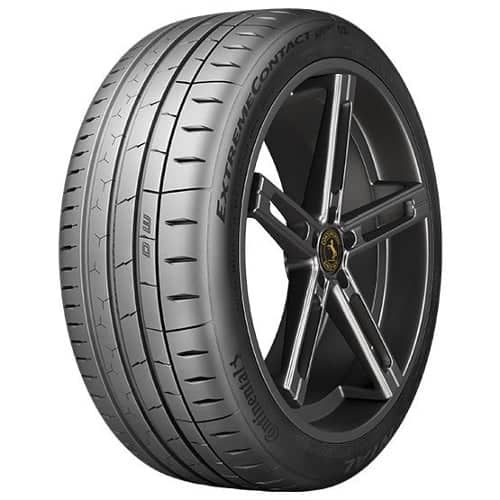
The ExtremeContact Sport 02. This is Continental's North American ultra high performance summer tire, and it is the one I steer people toward when they want serious summer grip on a car that eats tires. We stock 79 fitments from 15 through 21 inch, running from USD 145.95 to USD 641.99. You give up a small amount of outright braking performance against the SportContact 7 and you get a tire that was developed with American roads and American driving in mind.
The ExtremeContact DWS06 Plus. If the summer-only restriction is your actual problem rather than the wear, this is the answer. It is an all-season ultra high performance tire, so you keep real grip and gain cold weather and light snow capability. We stock 113 fitments from 16 through 22 inch, USD 158.99 to USD 554.99. You will not match the SportContact 7 on a hot dry road, and you will not be parking the car in December either.
We also still carry the outgoing SportContact 6 in 37 fitments from USD 199.67 to USD 567.75, mostly in the larger diameters. If your size is available in both and the price gap is meaningful, the 6 remains a strong tire.
Our full assessment of the all-season option is in are Continental DWS06 Plus good tires, which covers where it lands against dedicated summer rubber.
We carry thirteen SportContact 7 fitments spanning 18 through 22 inch diameters. Every one is Extra Load construction with a 240 AA A UTQG rating and 9/32 inch of tread depth on the sizes we have measured.
Size |
Load and Speed |
Price Each |
Typical Application |
|---|---|---|---|
215/40R18 |
89Y |
USD 211.29 |
Hot hatch, compact sport sedan |
245/45R18 |
100Y |
USD 238.26 |
Sport sedan |
245/35R21 |
96Y |
USD 332.90 |
Performance sedan front |
245/40R21 |
100Y |
USD 389.99 |
Performance sedan, SUV front |
255/45R20 |
105Y |
USD 339.81 |
Performance SUV |
265/40R21 |
105Y |
USD 379.39 |
Performance sedan, wagon |
285/30R21 |
100Y |
USD 398.72 |
Sports car rear |
295/35R21 |
107Y |
USD 332.90 |
Performance sedan rear |
285/30R22 |
101Y |
USD 464.02 |
Large performance sedan |
285/40R22 |
110Y |
USD 387.25 |
Performance SUV, EV |
315/35R22 |
111Y |
USD 497.14 |
Performance SUV rear, heavy EV |
We also stock the 255/35R21 and the W-rated 255/45R19. Pricing on those two moves often enough that it is worth checking the live listing rather than trusting a number in an article.
On warranty, Continental covers these under the Total Confidence Plan, which runs up to 72 months from purchase with free replacement in the first twelve months, plus road hazard and roadside assistance. Mileage coverage applies on select products, so check the treadwear figure listed for your specific size before you buy rather than assuming. If you want to understand what these warranties actually obligate a manufacturer to do, and what quietly voids them, that is worth reading up on separately.
Six steps. None of them take long and all of them save money.
1. Be honest about your climate. If you see sustained temperatures below 45 degrees, this is the wrong tire unless you are storing the car or swapping to winters. Settle this first, because nothing else matters if you get it wrong.
2. Weigh your car, roughly. Curb weight is in your owner's manual. Over about 5,000 pounds with real torque, read the alternatives section again before you commit.
3. Check the door placard for size and speed rating. Most of the line is Y-rated, but the 255/45R19 is W. Match or exceed what the placard specifies.
4. Sort out staggered fitment properly. Several of these sizes are clearly front or rear specific on a staggered car. Confirm which corner each size belongs on before ordering, not after.
5. Buy all four, and align on installation. A soft compound punishes an alignment error faster than a hard one does. On a tire at this price, a fresh alignment is cheap insurance.
6. Rotate if your fitment allows it. Square setups should rotate on schedule. Staggered setups cannot rotate front to rear, which is another reason rear wear runs ahead on powerful cars. Plan for it. Our guide to how to read tire treadwear ratings explains what that 240 grade is actually telling you about the rubber.
Ready to find your size? Shop the Continental SportContact 7 at Performance Plus Tire, with free shipping on every fitment.
Is the Continental SportContact 7 any good? On the merits, it is the best-testing ultra high performance summer tire on the market right now, and the test record is not close. First in dry braking, first in dry handling, first in wet braking, out of sixteen independent evaluations. If grip and stopping distance are what you are buying, you are done shopping.
The reason some owners are unhappy has almost nothing to do with the tire being bad and almost everything to do with the tire being asked to do a job it was not built for. Heavy vehicle, heavy torque, cold weather, or all three. Put it on a light car in a warm climate and you will get a tire that flatters your driving and lasts respectably. Put it on a two and a half ton electric SUV that you drive hard through a Midwest winter and you will be back for new rubber sooner than you wanted.
That is not a warning, it is just the trade. The compound that stops you shortest is the compound that wears fastest, and no amount of engineering has repealed that yet. Know which side of the trade your car sits on and buy accordingly.
If you are still weighing brands at the top of the market, our comparison of Continental vs Michelin tires covers how the two stack up on value across the range.
Yes. Across sixteen independent tire tests it took fourteen wins with an average finishing position of 1.3, ranking first in dry braking, dry handling, and wet braking. On outright capability it is the current benchmark among ultra high performance summer tires. The qualifier is that it performs best on lighter vehicles in warm climates, because its soft compound wears quickly under the combination of high weight and high torque.
It depends heavily on the vehicle. The SportContact 7 carries a 240 UTQG treadwear grade, which is a soft performance compound, and 9/32 inch of tread depth on the sizes we have measured. Owners of lighter cars in warm climates generally report satisfactory life, while owners of heavy or high-torque vehicles consistently report rapid wear. Cold weather running, skipped alignments, and staggered fitments that cannot be rotated all shorten it further.
In wet braking they are the best in class, ranking first across the aggregated test record, and they place second in straight-line aquaplaning resistance. Wet handling is good but not class-leading, so the tire is stronger in an emergency stop than it is carrying speed through a wet corner. All of that assumes a warm road, since a summer compound stiffens and loses grip in cold rain.
For the SportContact 7 specifically, the documented drawbacks are faster tread wear on heavy or high-torque vehicles, more road noise than the quietest tires in its category, a firmer ride from its reinforced construction, no cold weather or snow capability, and a premium price. Each of those is a direct consequence of the choices that produce its class-leading grip rather than a defect. Continental's broader range includes softer-riding and longer-wearing options for drivers who want a different balance.
We stock thirteen fitments from 215/40R18 up to 315/35R22, covering hot hatches and compact sport sedans in the 18 inch sizes, sports coupes in the 19 and 20 inch fitments, performance sedans and wagons in the 21 inch sizes, and performance SUVs and high-output electric vehicles in the 22 inch sizes. All are Extra Load, and all are Y-rated to 186 mph except the 255/45R19, which is W-rated to 168 mph.
Both are premium manufacturers and the honest answer depends on the specific models being compared rather than the badge. In the ultra high performance summer category the SportContact 7 currently leads the independent test record on braking and dry handling. Michelin's comparable offerings tend to be praised for tread life and refinement. Compare the two specific tires available in your size rather than the brands in the abstract.
No. The SportContact 7 is a summer tire with no cold weather, snow, or ice capability. Below roughly 45 degrees Fahrenheit the compound stiffens, grip drops noticeably in ordinary driving, and wear accelerates. If your vehicle stays on the road through a real winter you need either a second set of wheels with winter tires or an all-season ultra high performance tire such as the ExtremeContact DWS06 Plus.



