
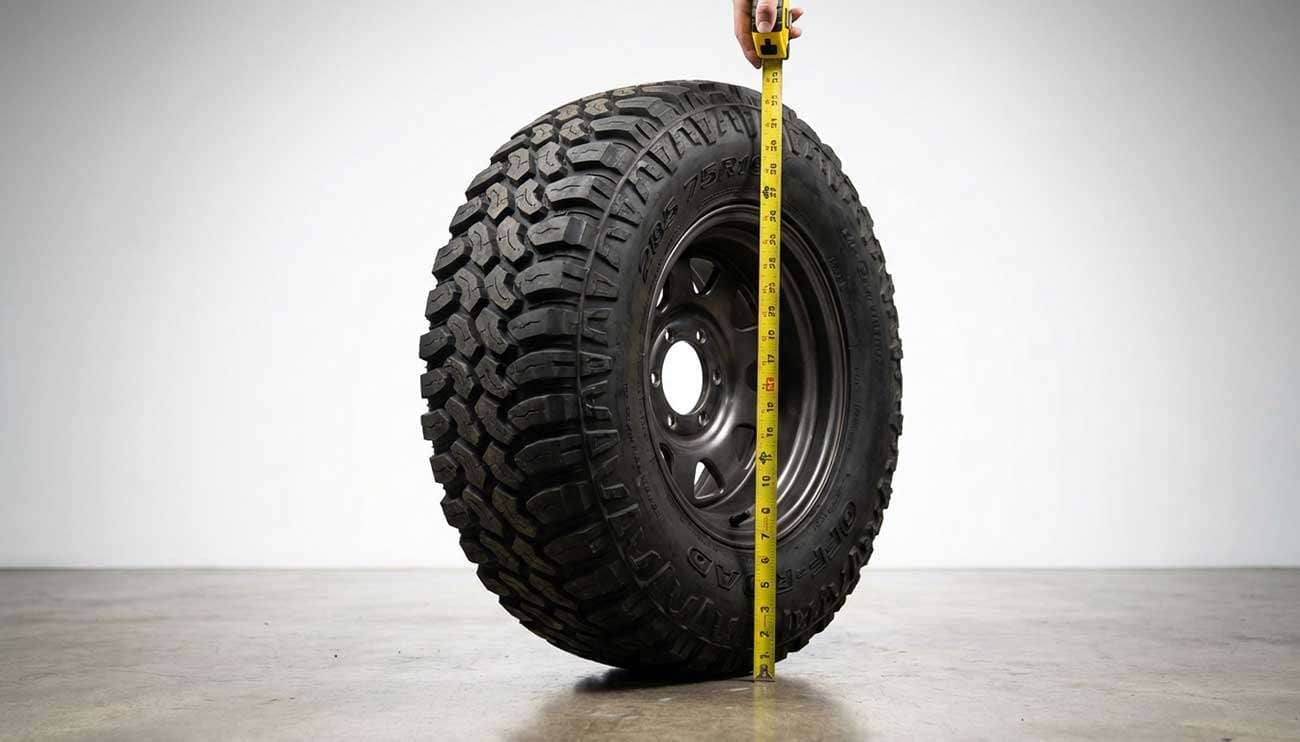
Those numbers on your tire sidewall tell a precise story about your tire's dimensions and capabilities. What size is a 285 75R16 tire? This popular tire size delivers specific measurements that directly affect your vehicle's performance, ground clearance, and overall appearance.
A 285/75R16 tire measures 32.8 inches (834 mm) in diameter with sidewall height reaching 8.4 inches (214 mm). The section width spans 11.2 inches (285 mm) while the circumference extends approximately 103.1 inches (2619 mm), resulting in about 615 revolutions per mile. These measurements are crucial for proper vehicle fitment, speedometer accuracy, and determining how much ground clearance you'll gain.
We'll break down exactly what each number in the 285/75R16 code represents, convert these measurements to inches, and compare this size to similar options. Whether you're upgrading your truck or need to understand your current tire setup better, this information helps you make informed decisions about your vehicle's configuration.
Understanding 285/75R16 tire dimensions is essential before making any vehicle modifications or upgrades. These precise measurements determine everything from ground clearance to speedometer accuracy, and getting them right makes the difference between a successful upgrade and costly fitment issues.
At 32.8 inches or 834 millimeters from edge to edge through the center, a 285/75R16 tire delivers substantial height that transforms your vehicle's capabilities. This full diameter measurement, taken when properly mounted on a wheel, directly impacts three critical factors: ground clearance, speedometer readings, and wheel well fitment.
Off-road enthusiasts benefit tremendously from the 32.8-inch diameter, which provides exceptional ground clearance for navigating obstacles without scraping your undercarriage. Depending on your specific vehicle, you may need lift kits or fender modifications to accommodate these larger tires without rubbing issues.
The impressive 11.2-inch (285 mm) section width creates a substantial footprint that enhances traction across multiple driving scenarios. This measurement spans from sidewall to sidewall at the tire's widest point, with the 285 designation in the tire code representing this width in millimeters.
Wider tires like the 285/75R16 generate a larger contact patch with the road surface, significantly improving traction during acceleration, braking, and cornering maneuvers. However, this increased width may create slightly higher rolling resistance, potentially affecting fuel economy.
For optimal performance, 285/75R16 tires are engineered to mount on rims between 7.5 and 9 inches in width, ensuring proper bead seating and performance characteristics.
The generous 8.4-inch (214 mm) sidewall height provides the cushioning and flexibility that serious off-road drivers demand. This measurement extends from the rim edge to the tread surface. The "75" in the tire code indicates the sidewall height equals 75% of the section width – calculated as 75% of 285 mm, yielding approximately 213.75 mm or 8.42 inches.
These taller sidewalls excel at absorbing impacts and providing superior cushioning over rough terrain. This characteristic makes 285/75R16 tires particularly valuable for off-road applications where comfort and tire durability over uneven surfaces matter most.
With a circumference measuring approximately 103.1 inches or 2618.8 millimeters, the 285/75R16 tire covers significant ground with each revolution. This circumference measurement – the distance around the entire tire – determines how many revolutions occur per mile of travel.
A 285/75R16 tire completes approximately 615 revolutions per mile, though manufacturers may vary between 614 and 634 revolutions per mile. These variations result from differences in tread design and manufacturing specifications between tire brands.
The revolutions per mile figure becomes crucial when calculating speedometer accuracy. Upgrading from a different tire size requires understanding how the circumference change affects your speedometer readings to avoid tickets or safety issues.
Looking for high-quality 285/75R16 tires that deliver reliable performance for your vehicle? Check out the selection available at Performance Plus Tire, where you'll find options suited for various driving conditions and terrains.
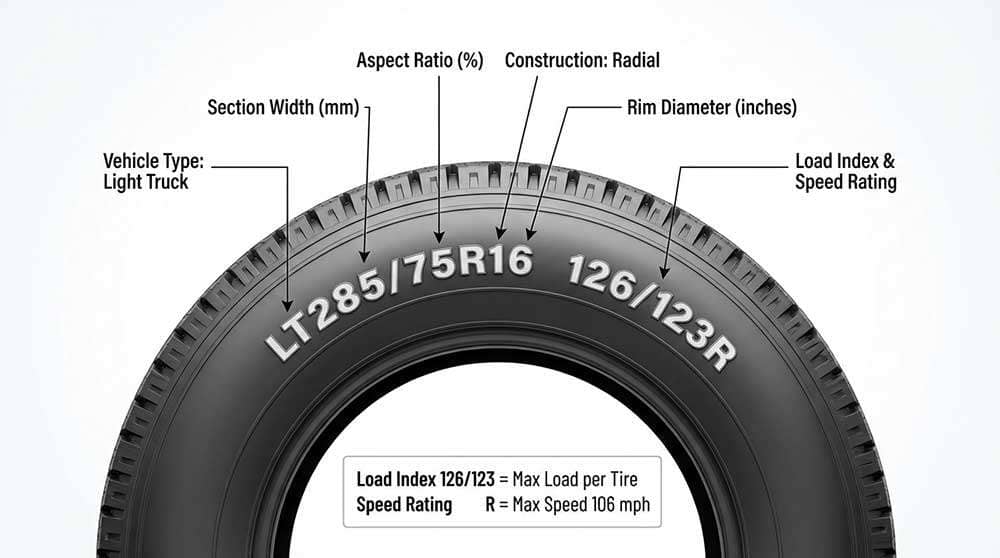
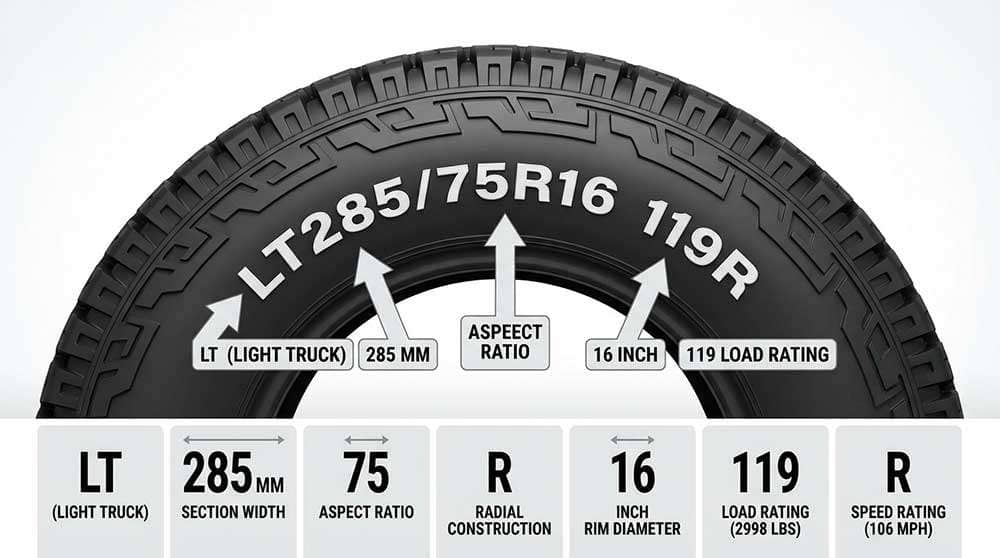
Tire codes appear complex, but each character provides specific information about your tire's dimensions and construction capabilities. Decoding the 285/75R16 format reveals essential details about performance characteristics and fitment requirements.
The first number indicates the tire's section width measured in millimeters. This three-digit figure represents the widest point from sidewall to sidewall. At 285 millimeters (approximately 11.22 inches when divided by 25.4), this measurement determines how much rubber makes contact with the road surface.
Section width differs from tread width—the actual rubber touching the ground versus the entire tire measurement from outer edge to outer edge. Width directly impacts your vehicle's handling, traction, and stability. Wider tires like the 285mm typically provide better grip but may increase rolling resistance.
Proper fitment requires rims between 7.5 and 9 inches wide. Mounting these tires outside this range affects both performance and safety.
The number after the slash represents the aspect ratio—the sidewall height expressed as a percentage of the section width. For a 285/75R16, the 75 means the sidewall height equals 75% of the tire's width.
Calculating sidewall height: 285 mm × 0.75 = 213.75 mm (approximately 8.4 inches). This calculation proves crucial when determining overall tire diameter and matching different tire sizes.
A higher aspect ratio creates taller sidewalls that provide better shock absorption and off-road performance. Lower aspect ratios typically improve handling response but sacrifice ride comfort. The 75-aspect ratio strikes a balance between off-road capability and on-road manners.
The "R" designates radial construction—the most common tire type for modern vehicles. Radial tires feature internal cord plies arranged perpendicular (at a 90-degree angle) to the direction of travel.
This construction method delivers several advantages over older bias-ply designs:
Improved fuel efficiency through reduced rolling resistance
Enhanced traction and cornering stability
Better heat dissipation for longer tread life
More comfortable ride quality
Some specialty applications still use bias-ply construction (marked with "B" or "D"), but radial construction dominates the market for good reason.
The final number specifies the wheel diameter in inches that the tire fits. A 285/75R16 tire mounts exclusively on 16-inch diameter wheels—never 15-inch or 17-inch rims.
This diameter measurement refers to the bead seat diameter where the tire contacts the wheel, not the outer edge of the rim. Matching wheel diameter with tire specifications ensures proper bead seating, prevents mounting failures, and maintains safe operation.
Attempting to mount a tire on the wrong wheel diameter creates dangerous situations including bead failures, sudden deflation, and loss of vehicle control.
Proper wheel fitment directly impacts tire performance, safety, and longevity. Installing 285/75R16 tires on incorrect wheel widths creates handling problems, accelerated wear, and potential failure risks.
The tire industry specifies a recommended rim width range of 7.5 to 9 inches for 285/75R16 tires. This range ensures proper tire bead seating, maintains designed sidewall angles, and delivers optimal performance characteristics.
Different rim widths within this range produce subtle performance variations:
7.5-inch rims create a slightly narrower tire profile with taller sidewalls
8-inch rims (middle of the range) provide balanced performance
9-inch rims produce a wider footprint with slightly shorter effective sidewalls
Most manufacturers recommend 8-inch wheels as the optimal width for 285/75R16 tires, delivering the best combination of handling, comfort, and tire longevity.
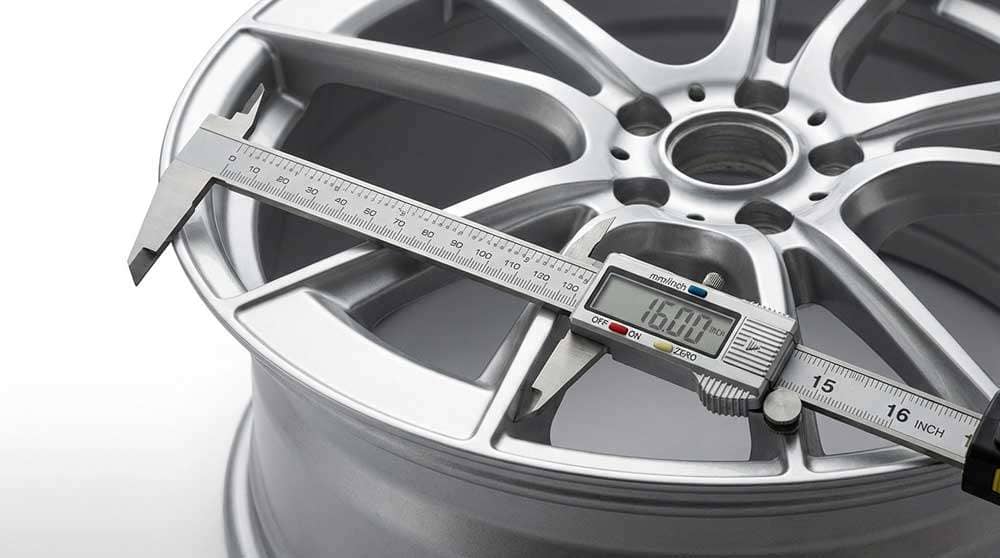
Wheel width represents the distance between the inside edges of the bead seats (not the outer rim edges). This internal measurement determines whether your wheels fall within the acceptable range for 285/75R16 tires.
Professional tire shops use specialized tools, but you can verify wheel width through these methods:
Check wheel markings stamped on the back side (format: width × diameter)
Measure manually from bead seat to bead seat
Consult manufacturer specifications for your specific wheel model
Accurate width measurement prevents compatibility issues before purchasing new tires.
Mounting 285/75R16 tires on wheels narrower than 7.5 inches or wider than 9 inches creates multiple problems. Narrow wheels pinch the tire bead, creating an overly tall and unstable sidewall profile. This configuration leads to poor handling, excessive sidewall flex, and increased risk of tire damage.
Conversely, excessively wide wheels stretch the tire bead outward, reducing effective sidewall height and creating an unnatural tire profile. This setup accelerates tread wear, particularly at the shoulders, and compromises ride comfort.
Beyond performance issues, improper fitment may void tire warranties and create safety hazards including bead failures or unexpected tire separation.

Upgrading from stock tires to 285/75R16 creates measurable changes in how your vehicle performs. Understanding these impacts helps set realistic expectations and avoid surprises after installation.
The off-road community commonly refers to 285/75R16 tires as "33s," though this terminology isn't technically accurate. At 32.8 inches in diameter, these tires fall approximately 0.2 inches short of true 33-inch tires.
This minor difference rarely matters in practical applications. The 285/75R16 delivers nearly identical ground clearance and visual appearance as actual 33-inch tires. Most lift kit manufacturers and wheel well modification guides designed for 33-inch tires work perfectly with 285/75R16 sizes.
When shopping for tires or discussing modifications with other enthusiasts, recognize that "33s" often serves as shorthand for tires in the 32.5 to 33.5-inch diameter range rather than exact measurements.
Larger tire circumference causes your speedometer to read slower than your actual speed. The 285/75R16 creates a 3.7% underreading compared to most stock tire sizes.
Practical speed differences:
Indicated 60 mph = Actual 64.4 mph
Indicated 65 mph = Actual 67.4 mph
Indicated 70 mph = Actual 75.14 mph
This discrepancy affects more than just knowing your true speed. Your odometer also reads low, showing fewer miles than actually traveled. Over time, this creates confusion about maintenance intervals and resale value.
Some drivers report their factory speedometers already read inaccurately with stock tires. Interestingly, several Ford owners discovered that upgrading to 285/75R16 tires actually improved speedometer accuracy rather than worsening it, suggesting their factory calibration compensated for larger optional tire sizes.
The larger circumference reduces your engine RPMs at highway speeds. At 65 mph with 3.55 gears, expect around 2000 RPM compared to higher RPMs with smaller tires. This creates an effect similar to switching from 3.73 to 3.60 gear ratios.
Practical RPM reference points:
65 mph: Approximately 2000 RPM
70 mph: Approximately 2125 RPM
This RPM reduction feels like a mild gear ratio change and may affect towing performance on steep grades.
Fuel economy results vary depending on your driving conditions. Some owners report 1.7-2.0 mpg losses across all driving situations. Others notice minimal changes or even slight improvements during highway cruising due to lower engine RPMs.
Power delivery experiences mixed results with larger 285/75R16 tires creating reduced acceleration compared to smaller sizes. This becomes noticeable during:
Towing heavy loads uphill
Accelerating from stops
Performing passing maneuvers
Several owners report feeling slight power loss, especially in trucks with smaller engines or when carrying loads. Some owners with heavy-duty applications consider re-gearing to restore optimal performance.
When selecting different tire sizes for your truck or SUV, understanding the dimensional differences helps you make the right choice. Here's how 285/75R16 stacks up against similar sizes.
The 285/75R16 and 265/75R16 differ primarily in width but share the same aspect ratio. The 285/75R16 measures 32.8 inches in diameter and 11.2 inches wide, while the 265/75R16 stands at 31.6 inches tall and 10.4 inches wide. This creates a significant difference of 1.2 inches (3.7%) in overall diameter and 0.8 inches (7%) in width.
The sidewall heights also vary notably—8.4 inches for the 285/75R16 versus 7.8 inches for the 265/75R16, a difference of 0.6 inches (7%). Performance-wise, the 285/75R16 typically offers greater load capacity, with some models rated 300 pounds higher than their 265/75R16 counterparts.
The 285/75R16 tire stands taller than comparable 275-series tires. When compared with the 275/70R16, the 285/75R16 provides noticeably more height. This difference comes from both the wider width (285mm vs 275mm) and the taller aspect ratio (75 vs 70).
For highway driving, the taller 285/75R16 might be slightly more susceptible to crosswind effects than the 275/70R16. However, the 285's deeper tread depth (17/32" vs 13/32" in some models) offers potential benefits in tread life.
Several tire sizes fall within 3% of the 285/75R16's 32.8-inch diameter. The closest alternative is the 305/70R16 measuring 32.81 inches (just 0.06% difference). Other viable options include:
33×11.50R16 at 33.01 inches (0.56% difference)
255/85R16 at 33.07 inches (0.72% difference)
315/70R16 at 33.36 inches (1.62% difference)
Looking for quality 285/75R16 tires or considering these alternative sizes? Check out the selection at Performance Plus Tire for options that match your specific needs and terrain requirements.
The 285/75R16 tire size delivers specific dimensions that directly impact your vehicle's capabilities and performance. These tires provide the ground clearance and load capacity many truck owners need while offering a practical upgrade path from stock configurations.
Understanding what each number means in the tire code helps you make better decisions for your specific needs. Whether you're planning modifications, calculating compatibility, or comparing options, this knowledge proves valuable when talking with tire professionals or researching alternatives.
Performance changes are part of the equation when upgrading to this size. Your speedometer will read differently, RPMs drop at highway speeds, and you may notice changes in acceleration and fuel economy. Some drivers find these trade-offs worthwhile for the improved off-road capability and appearance.
When comparing tire sizes, the 285/75R16 sits between smaller options like 265/75R16 and larger alternatives. Several sizes offer nearly identical dimensions if you need slight variations for specific applications.
Your vehicle's requirements, driving conditions, and performance goals determine whether this tire size fits your situation. Consider factors like wheel well clearance, intended use, and how the changes affect your driving experience. Armed with the dimensional details and performance impacts we've covered, you can make an informed choice about whether 285/75R16 tires work for your setup.
Understanding tire dimensions helps you make informed decisions about vehicle performance, clearance, and compatibility. Here are the essential facts about 285/75R16 tires:
• 285/75R16 tires measure 32.8 inches tall and 11.2 inches wide - despite being called "33s," they're actually 0.2 inches shorter than true 33-inch tires
• Each number in the code has specific meaning: 285 = width in millimeters, 75 = sidewall height as 75% of width, R = radial construction, 16 = wheel diameter in inches
• Upgrading affects speedometer accuracy by 3.7% - when your speedometer shows 60 mph, you're actually traveling 64.4 mph due to larger tire circumference
• Expect performance trade-offs: slightly reduced acceleration and 1.7-2.0 mpg fuel economy loss, but improved ground clearance and off-road capability
• Proper fitment requires 16-inch wheels between 7.5-9 inches wide - mounting on incorrect wheel sizes affects safety and performance
These measurements directly impact your vehicle's handling, ground clearance, and gear ratios, making proper understanding crucial for safe and optimal performance.
A 285/75R16 tire has an overall diameter of 32.8 inches, a width of 11.2 inches, and a sidewall height of 8.4 inches. Its circumference is approximately 103.1 inches.
Upgrading to 285/75R16 tires typically results in a 3.7% lower speedometer reading, decreased RPMs at highway speeds, and potential fuel economy changes. It may also slightly reduce acceleration but improve ground clearance and off-road capability.
In the 285/75R16 code, 285 represents the width in millimeters, 75 is the aspect ratio (sidewall height as a percentage of width), R indicates radial construction, and 16 is the wheel diameter in inches.
While often referred to as "33s" in off-road communities, 285/75R16 tires actually measure 32.8 inches in diameter, falling slightly short of true 33-inch tires by about 0.2 inches.
285/75R16 tires require 16-inch diameter wheels with a width between 7.5 and 9 inches for proper fitment and optimal performance.



