
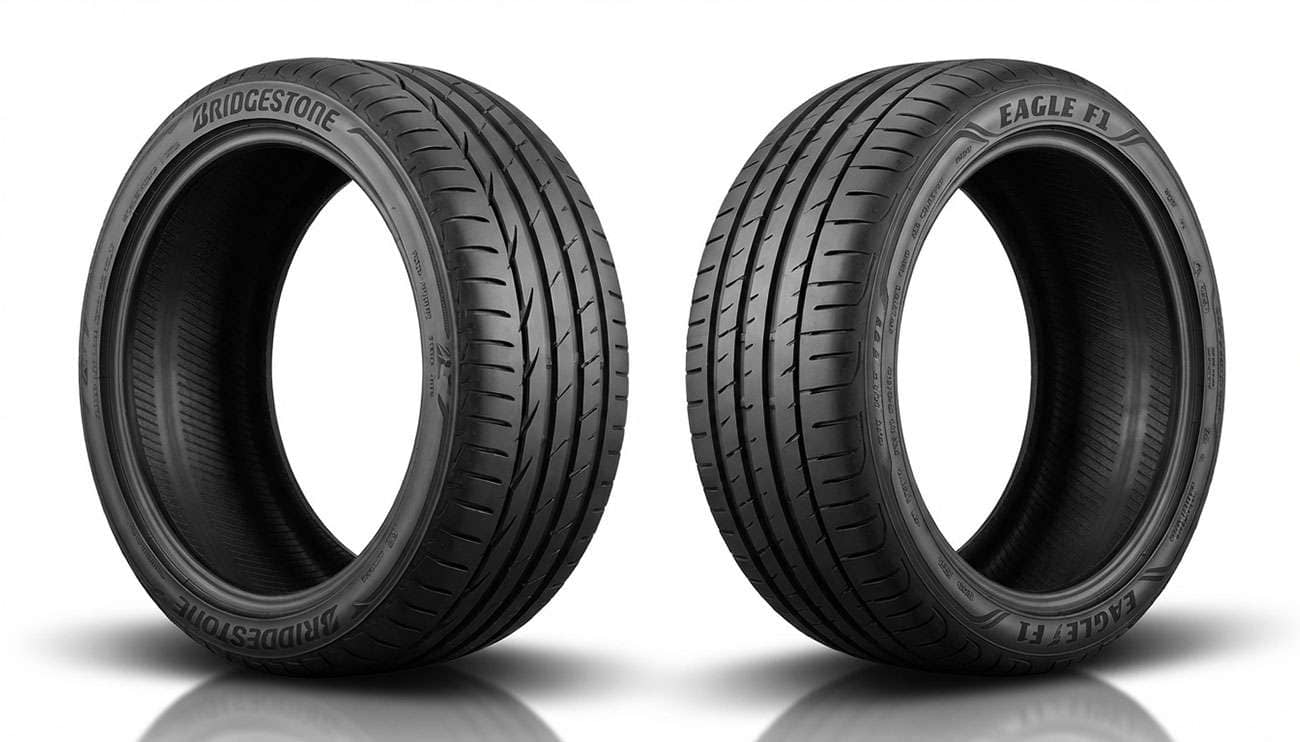
When you're ready to upgrade your tires, two names consistently dominate the conversation: Bridgestone and Goodyear. Both manufacturers have built impressive reputations, but which one deserves your investment?
The numbers tell an interesting story. Bridgestone tires range from $87 to $420 per tire, while Goodyear offers a wider selection spanning $40 to $900, averaging around $137. But smart tire buyers know that price tags only reveal part of the picture. Customer satisfaction speaks volumes too - Goodyear has earned over 43,000 reviews from satisfied drivers, while Bridgestone maintains strong loyalty with more than 27,600 customer reviews.
Here's where the bridgestone vs goodyear tires debate gets really compelling. Bridgestone's Turanza QuietTrack backs its premium positioning with an 80,000-mile warranty, while Goodyear's Assurance MaxLife pushes even further with an impressive 85,000-mile guarantee.
Both companies bring decades of expertise to your driveway. Bridgestone has grown from its 1931 Japanese roots into arguably the world's largest tire manufacturer. Goodyear has been driving American innovation since 1898, pioneering everything from tubeless designs to modern performance compounds.
We'll examine exactly what each brand delivers in performance, durability, and real-world value to help you make the right choice for your vehicle and driving needs.
Bridgestone's journey to tire manufacturing excellence started in 1931 when Shojiro Ishibashi founded the company in Kurume, Japan. The company has built its reputation through strategic growth and continuous innovation, rising to become one of the largest tire manufacturers globally.
The defining moment in Bridgestone's international expansion came in 1988 with its acquisition of American tire giant Firestone for $2.60 billion, significantly strengthening its global presence. This move demonstrated the company's commitment to dominating the worldwide tire market.
Bridgestone's dedication to quality has earned recognition from major automakers. The company received General Motors' Supplier of the Year award in 2024—marking its 10th consecutive and 23rd overall recognition. This consistent recognition speaks to the reliability and performance standards that Bridgestone maintains across its product lines.
Goodyear's American heritage stretches back to 1898, when Frank Seiberling established the company in Akron, Ohio. Named after Charles Goodyear, who discovered the vulcanization process for rubber in 1839, the company began with just 13 employees manufacturing bicycle tires.
The company's rapid growth is impressive. By 1916, Goodyear had become the world's largest tire manufacturer. Throughout its history, Goodyear has pioneered numerous tire innovations, including developing the first tubeless tires and introducing the first nylon tires for consumers in 1947. A notable milestone occurred in 1963 when the company produced its one billionth tire.
Both manufacturers now prioritize environmental responsibility alongside tire performance. Bridgestone stands out with its commitment to eco-friendly manufacturing and carbon neutrality, investing in guayule farming as a renewable rubber source. The company has successfully produced tires made from 75% renewable materials.
Goodyear introduced an environmentally friendly tire using cornstarch-based materials in 2008 and joined the EPA's SmartWay Transport Partnership that same year. Their fuel-efficient tires deliver up to 4% improved truck fuel economy. More recently, Goodyear developed a demonstration tire comprised of 90% sustainable materials.
The goodyear vs bridgestone competition now extends well beyond traditional performance metrics into environmental responsibility and sustainable manufacturing practices.
Both manufacturers offer extensive lineups designed for specific driving needs. Understanding these specialized options helps you choose the right tire for your vehicle and driving style.
Bridgestone's Turanza QuietTrack targets coupes and sedans with exceptional wet and light snow performance. Goodyear's Assurance ComfortDrive covers a broader range, fitting coupes, sedans, CUVs, SUVs, and minivans. Both score identical 9.5 ratings for handling, but Bridgestone pulls ahead with its 80,000-mile warranty versus Goodyear's 60,000-mile coverage.
Off-road capability comes down to the details. The Bridgestone Dueler A/T Ascent scores 8.8 overall, edging out Goodyear's Wrangler All-Terrain Adventure with Kevlar at 8.7. The Wrangler delivers superior traction (9.2 vs 8.9), but Bridgestone maintains advantages in handling (9.0 vs 8.9) and longevity (8.5 vs 8.3). Both back their durability with identical 60,000-mile warranties.
Performance enthusiasts face a compelling choice. Bridgestone's Potenza Sport dominates dry conditions with precise steering response. The Eagle F1 Asymmetric 6 counters with better wet grip and longer lifespan (40,000-50,000 km versus 35,000-45,000 km). Eagle F1 also runs quieter at 68-71 dB compared to Potenza's 69-72 dB range. Our expert team at Performance Plus Tire can help you select the right performance tire for your driving style.
Bridgestone's Ecopia earns an A-rating for fuel efficiency, while Goodyear's EfficientGrip balances fuel economy with wet performance. The Ecopia maintains comfortable noise levels and rolling resistance, making it ideal for daily commuting. EfficientGrip focuses more on highway stability without sacrificing fuel savings.
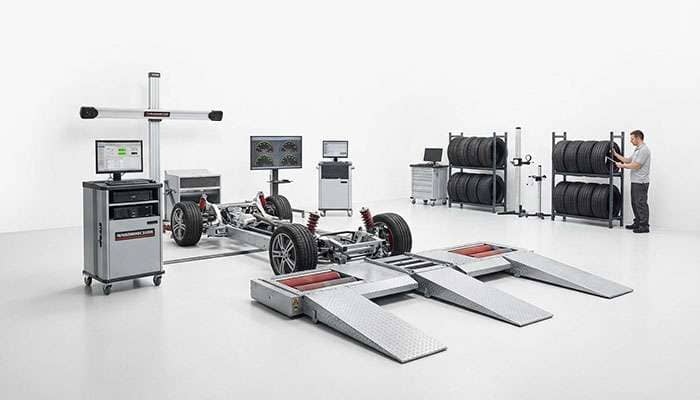
Independent tests reveal how these brands perform when rubber meets road. Let's break down the key performance categories that matter most to everyday drivers.
Track testing demonstrates clear performance distinctions. The Bridgestone Potenza Sport achieves lap times 0.66 seconds slower than the Goodyear Eagle F1 Asymmetric 6. Cornering speeds favor Goodyear at 100.2 km/h versus Bridgestone's 99.9 km/h.
Braking tests show the differences narrow in real-world conditions. The Potenza Sport stops from 62 mph in 108.9 feet dry and 140.7 feet wet. Both brands demonstrate consistent grip levels during repeated hard braking sessions.
Wet weather performance separates these competitors more clearly. Goodyear's Eagle F1 Asymmetric 6 edges ahead with slightly shorter wet braking distances and better hydroplaning resistance. Bridgestone's Turanza QuietTrack counters with strong light snow capability, earning high marks in winter testing.
For drivers in mixed conditions, the all-season options from both brands deliver reliable traction. Bridgestone's Weather Control A005 balances year-round performance effectively, while Goodyear's Assurance series provides solid all-weather confidence.
Extended testing reveals durability differences. Bridgestone maintains a 9.8 longevity SimpleScore, reflecting consistent performance throughout the tire's lifespan. The Turanza QuietTrack specifically targets long-distance comfort with reduced road noise and vibration.
Both brands excel in highway stability testing. Goodyear's Assurance series demonstrates minimal performance degradation over 50,000+ miles of mixed driving conditions.
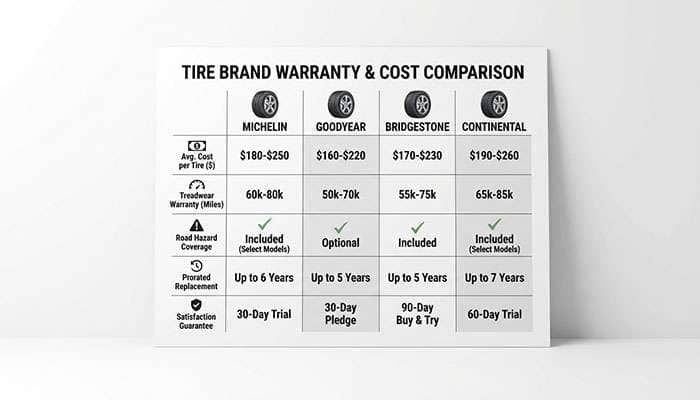
Understanding warranty coverage and pricing helps make smart tire buying decisions. Both brands offer competitive programs, but the details matter.
Goodyear leads with its Assurance MaxLife delivering an 85,000-mile limited warranty. The warranty coverage comparison shows Bridgestone's Turanza QuietTrack at 80,000 miles. Both manufacturers require proof of proper tire rotation every 6,000-8,000 miles and original purchase receipts.
High-performance tires carry reduced warranties. The Bridgestone Potenza Sport and Goodyear Eagle F1 typically offer no mileage warranties due to their softer compound designs prioritizing grip over longevity.
The bridgestone vs goodyear price difference averages $10-$20 per tire, with Bridgestone typically commanding higher prices. Budget-conscious buyers benefit from Goodyear's broader price range ($40-$900), while those prioritizing build quality often choose Bridgestone ($87-$420).
Looking at cost-per-mile calculations, both brands deliver comparable value when warranty coverage is factored in. The tire pricing guide at Performance Plus Tire helps compare specific models for your vehicle.
Both manufacturers require specific documentation for successful claims. Keep your original purchase receipt and maintain regular rotation records. Tire damage from road hazards typically falls under separate road hazard coverage, available from both brands at additional cost.
Professional installation records strengthen warranty claims. The expert team at Performance Plus Tire ensures proper documentation for future warranty needs.
The table below summarizes the key differences between Bridgestone and Goodyear tires:
Comparison Criteria |
Bridgestone |
Goodyear |
|---|---|---|
Price Range |
$87 - $420 per tire |
$40 - $900 per tire |
Average Price |
Not mentioned |
$137 |
Customer Reviews |
27,600+ reviews |
43,000+ reviews |
Flagship Warranty |
80,000 miles (Turanza QuietTrack) |
85,000 miles (Assurance MaxLife) |
Traction Score |
9.7 SimpleScore |
9.7 SimpleScore |
Handling Score |
9.5 SimpleScore |
9.5 SimpleScore |
Year Founded |
1931 (Japan) |
1898 (USA) |
Key Performance Tire |
Potenza Sport (69-72 dB) |
Eagle F1 (68-71 dB) |
SUV/4x4 Model |
Dueler A/T Ascent (8.8 SimpleScore) |
Wrangler All-Terrain (8.7 SimpleScore) |
Eco-Innovation |
75% renewable materials tire |
90% sustainable materials tire |
Notable Achievement |
10-time consecutive GM Supplier of Year |
First tubeless & nylon tires for consumers |
Track Performance |
0.66 seconds slower lap times |
Faster cornering speeds |
The data reveals how closely matched these manufacturers are in core performance metrics. Both achieve identical traction and handling scores, making your choice dependent on specific needs like budget flexibility, warranty coverage, or specialized tire applications for your driving conditions.
Both tire giants deliver exceptional quality, but your choice comes down to matching the right brand to your specific needs and budget.
Choose Goodyear if you want immediate value. With prices ranging $40-$900 per tire and typically costing $10-$20 less than comparable Bridgestone models, Goodyear offers better upfront savings. The Assurance MaxLife's 85,000-mile warranty beats most competitors, and over 43,000 customer reviews confirm consistent performance across different driving conditions.
Choose Bridgestone for long-term investment. Despite higher initial costs ($87-$420 per tire), Bridgestone's superior build quality and extended tread life can deliver better value over time. The Turanza QuietTrack's 80,000-mile warranty and 9.8 longevity score demonstrate the brand's commitment to durability.
Performance differences are minimal between these manufacturers. Both score identical 9.7 for traction and 9.5 for handling, so your decision shouldn't hinge on basic performance metrics. Specialized needs matter more - Bridgestone's Potenza Sport excels in dry conditions, while Goodyear's Eagle F1 handles wet weather better.
For SUV and off-road applications, the Bridgestone Dueler (8.8 SimpleScore) edges out the Goodyear Wrangler (8.7 SimpleScore), but both deliver solid capability for truck owners.
Making the Right Choice
Consider these factors when selecting between bridgestone vs goodyear tires:
Budget priority: Goodyear for lower upfront costs, Bridgestone for potential long-term savings
Driving conditions: Goodyear for wet weather, Bridgestone for dry performance
Warranty needs: Goodyear's 85,000-mile coverage vs Bridgestone's 80,000-mile guarantee
The expert team at Performance Plus Tire can help you select the perfect tires based on your vehicle specifications and driving requirements.
Both brands offer quality products backed by decades of innovation. Your choice should align with whether you prioritize immediate savings or long-term durability. Either way, you're investing in proven tire technology from industry leaders.
Both Bridgestone and Goodyear offer excellent tire quality, but your choice depends on budget priorities and specific driving needs.
• Performance is virtually identical: Both brands score 9.7 for traction and 9.5 for handling, making performance differences negligible for most drivers.
• Goodyear offers better upfront value: With prices ranging $40-$900 versus Bridgestone's $87-$420, Goodyear typically costs $10-$20 less per tire.
• Bridgestone provides superior longevity: Despite higher initial costs, Bridgestone may deliver better long-term value through extended tread life and durability.
• Warranty coverage favors Goodyear: Goodyear's Assurance MaxLife offers 85,000-mile warranty compared to Bridgestone's 80,000-mile coverage on comparable models.
• Choose based on priorities: Select Goodyear for immediate savings and broader price range, or Bridgestone for premium build quality and potential long-term value.
The decision ultimately comes down to whether you prioritize lower upfront costs (Goodyear) or potentially better long-term investment (Bridgestone), as both deliver exceptional performance and customer satisfaction.
The better value depends on your priorities. Goodyear typically offers lower upfront costs and a wider price range ($40-$900 per tire), making it attractive for budget-conscious buyers. Bridgestone, while often pricier ($87-$420 per tire), may provide better long-term value through extended tread life and durability.
Both brands offer excellent performance, with nearly identical traction (9.7) and handling (9.5) scores. Bridgestone's Potenza Sport excels in dry grip, while Goodyear's Eagle F1 performs better in wet conditions. The choice often comes down to specific driving needs and conditions.
Goodyear generally offers slightly better warranty coverage. Their Assurance MaxLife model comes with an 85,000-mile limited warranty, compared to Bridgestone's Turanza QuietTrack with an 80,000-mile warranty. Both brands require proof of proper tire rotation and original purchase receipts for warranty claims.
Both brands offer strong options for SUVs and off-road use. Bridgestone's Dueler A/T Ascent scores slightly higher (8.8) than Goodyear's Wrangler All-Terrain Adventure with Kevlar (8.7). However, Goodyear's Wrangler series is highly regarded for all-terrain use and off-road durability.
Both companies are making significant strides in sustainability. Bridgestone has successfully produced tires made from 75% renewable materials and focuses on eco-friendly manufacturing. Goodyear has developed a demonstration tire comprised of 90% sustainable materials and offers fuel-efficient tires that can improve truck fuel economy by up to 4%.



