

The 215/55R17 tire measures exactly 26.31 inches (668.3 mm) in diameter. This tire size features a section width of 8.46 inches (215 mm) and a sidewall height of 4.66 inches (118.25 mm). Getting these tire dimensions right matters for your vehicle's performance, handling, and safe operation.
These tires also have a circumference of 82.66 inches (2099.53 mm) and complete approximately 766.53 revolutions per mile. Your speedometer accuracy depends on these measurements. So does your fuel efficiency and how your vehicle responds on the road. Small changes in tire size can alter your car's behavior in different driving situations.
This guide explains what those numbers mean in the 215/55R17 tire code. You'll get size charts, comparisons with similar tire sizes, and a list of vehicles that use these tires. Looking for replacement tires or want to understand what's currently on your car? You'll find the details you need right here.
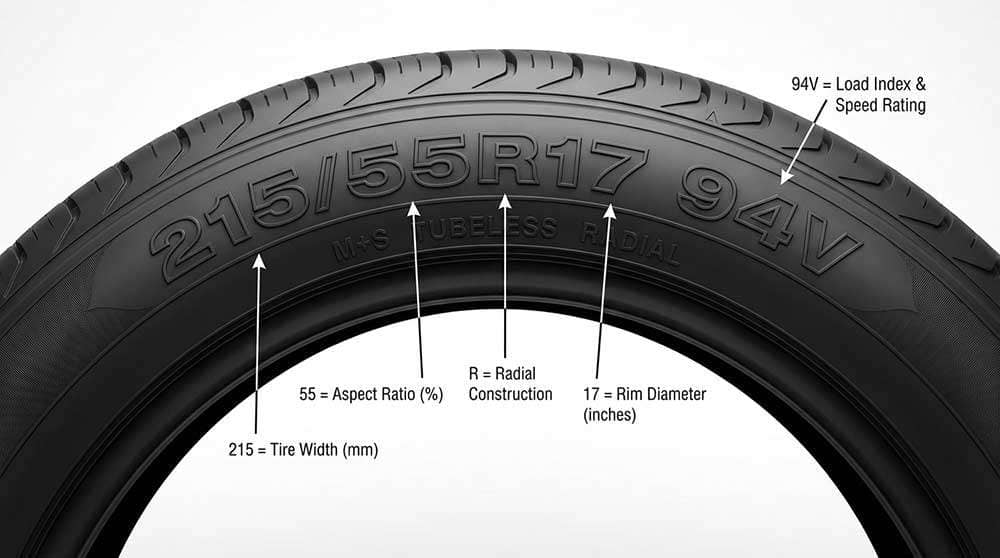
Those numbers and letters on your tire sidewall aren't random. They follow a standardized format that tire manufacturers use worldwide to specify exact dimensions and construction details. The 215/55R17 code gives you precise information needed for proper tire fitment.
Reading tire's sidewall markings reveals essential details about size and design characteristics. The 215/55R17 code breaks down into three main measurements plus a construction indicator. Each part tells you something specific about how the tire performs and which vehicles it fits.
Here's what each number means:
215 shows the tire width in millimeters from sidewall to sidewall
55 represents the aspect ratio (sidewall height as a percentage of width)
R indicates radial construction
17 specifies the rim diameter in inches
You might also see additional codes after these core numbers, like 98V, which indicate load capacity and speed ratings.
The width measurement (215) represents the tire's section width in millimeters. This translates to 215 millimeters or about 8.46 inches. Width affects handling, traction, and fuel economy. Wider tires generally grip better on dry pavement but can reduce fuel efficiency due to higher rolling resistance.
The aspect ratio (55) means the sidewall height equals 55% of the tire's width. For a 215/55R17 tire, that calculates to 118.25 mm or 4.66 inches. This measurement significantly impacts ride quality and handling. Lower aspect ratios give you sharper handling and better cornering but create a firmer ride. Higher aspect ratios provide more cushioning over rough roads.
The rim size (17) tells you the wheel diameter in inches that this tire mounts on. Even though most tire measurements use metric units, rim sizes still use inches. Getting this right is critical—mounting a tire on the wrong rim size creates dangerous conditions or causes tire failure.
The R in 215/55R17 stands for radial construction, the industry standard for passenger vehicles for over 25 years. Radial tires have internal ply cords running perpendicular to the direction of travel. This differs from older bias-ply designs where cords crisscrossed at angles.
Radial construction delivers several key advantages:
Better heat dissipation, reducing blowout risk
Improved road contact and cornering grip
Longer tread life and better fuel economy
Greater stability at highway speeds
Before radials became standard, vehicles used bias-ply tires with inferior construction that produced poor handling characteristics. The engineering advantages of radials made them the choice for virtually all modern passenger vehicles.
Understanding these code components helps you choose the right replacement tires for your vehicle while maintaining optimal performance, safety, and handling.
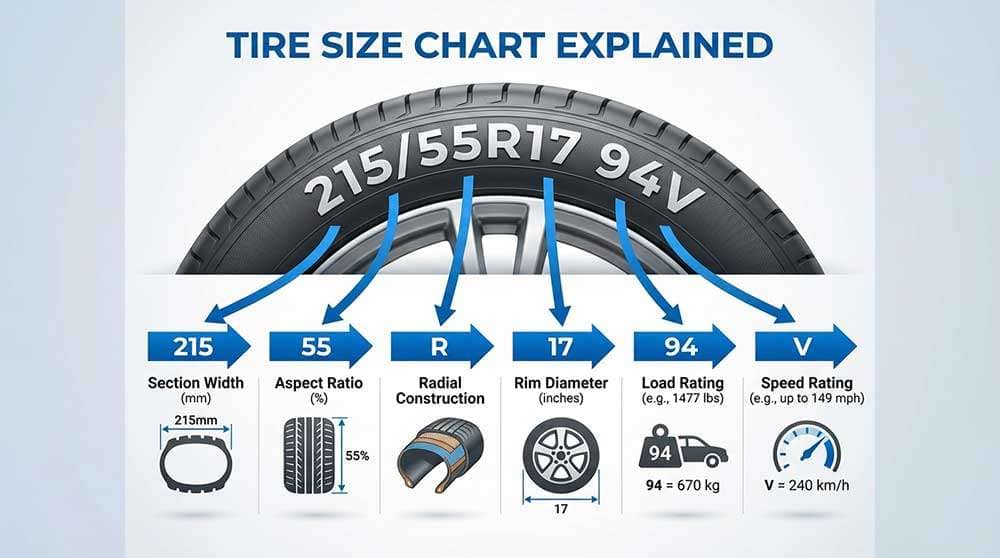
We carry detailed specifications for every tire dimension to help you make the right choice. The 215/55R17 tire size delivers specific measurements that directly impact your vehicle's performance and compatibility.
The overall diameter of a 215/55R17 tire spans 26.3 inches or precisely 668.3 millimeters. This represents the complete height from the road surface to the top of the tire when properly mounted. More accurate calculations show 26.31 inches, though this minimal difference won't affect most applications.
Your vehicle's ground clearance depends on this measurement. Speedometer calibration also relies on maintaining the correct diameter. When you replace tires, keeping the same overall diameter ensures your vehicle's electronic systems work exactly as the manufacturer intended.
Section width measures 8.5 inches or 215 millimeters across the tire's widest point. Professional calculations show a more precise 8.46 inches for exact fitment purposes.
This width measurement affects several key performance areas:
Traction and road grip capability
Steering response and precision
Resistance to hydroplaning
Fuel economy (wider contact patches increase rolling resistance)
Sidewall height measures 4.6 inches or approximately 118 millimeters from rim edge to tread surface. Exact measurements show 4.66 inches or 118.25 mm for precise applications.
This dimension controls important driving characteristics:
Ride comfort levels (higher sidewalls absorb road impacts better)
Protection against pothole damage
Handling sharpness (lower profiles provide more responsive steering)
Vulnerability to rim damage from road hazards
The 215/55R17 tire circumference measures 82.66 inches or 2099.53 millimeters. This measurement determines how far your vehicle travels with each complete tire rotation.
Based on this circumference, the tire completes approximately 766.53 revolutions per mile. These figures directly affect speedometer accuracy and vehicle computer calculations for fuel efficiency, odometer readings, and transmission shift points.
Changing to tires with significantly different circumferences throws off these calculations. Your speedometer might read 60 mph when you're actually traveling 58 or 62 mph. That's why staying within the manufacturer's recommended tire size range matters for accurate vehicle operation.
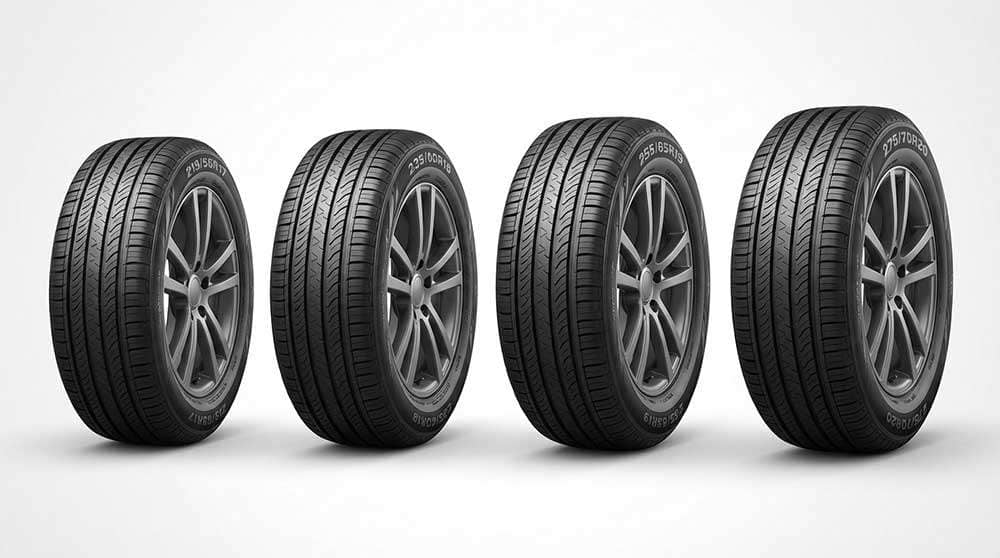
Comparing tire sizes helps you understand how small changes in numbers create different driving experiences. The 215/55R17 sits in the middle of several popular sizes, each offering distinct characteristics.
The following chart shows how the 215/55R17 compares to common alternative sizes:
Tire Size |
Diameter (in) |
Width (in) |
Sidewall (in) |
Circumference (in) |
|---|---|---|---|---|
215/50R17 |
25.45 |
8.46 |
4.23 |
79.96 |
215/55R17 |
26.31 |
8.46 |
4.66 |
82.66 |
225/55R17 |
26.69 |
8.86 |
4.84 |
83.87 |
215/60R17 |
27.16 |
8.46 |
5.08 |
85.33 |
225/50R17 |
25.83 |
8.86 |
4.43 |
81.17 |
Even small diameter changes affect speedometer readings. A 215/50R17 tire (25.45") measures 0.86 inches smaller than a 215/55R17 (26.31"). That creates a 3.27% difference—just outside the recommended 3% variance threshold.
When your actual speed is 60 mph, different tire diameters produce these speedometer readings:
215/50R17: Speedometer shows 62 mph (reads 2 mph fast)
215/55R17: Speedometer shows 60 mph (accurate reading)
225/55R17: Speedometer shows 59 mph (reads 1 mph slow)
215/60R17: Speedometer shows 58 mph (reads 2 mph slow)
The 225/55R17 stays within the 3% rule with only a 1.44% difference from the 215/55R17. This makes it a popular upgrade option for drivers seeking slightly more width without accuracy problems.
Width changes alter your contact patch with the road. Moving from 215mm to 225mm width adds about 0.4 inches of tire on the pavement. That extra width improves dry grip and cornering but might increase road noise and rolling resistance.
Aspect ratio modifications change ride quality significantly:
Lower profiles (like 50 instead of 55) give sharper steering response but harsher rides
Higher profiles (like 60 instead of 55) provide more comfort over rough roads but reduce handling precision
The 215/55R17 strikes a balance that works well for most sedan and crossover applications. It offers reasonable comfort without sacrificing too much handling performance.

Vehicle manufacturers set specific tire size recommendations for good reasons. Staying within proper tolerance ensures your car's systems work correctly and maintains safe operation.
The automotive industry's standard practice limits tire diameter changes to 3% of the original size. This rule protects your vehicle's electronic systems, transmission programming, and safety features that rely on accurate tire rotation data.
For a 215/55R17 tire with its 26.31-inch diameter, the acceptable range spans:
Minimum diameter: 25.52 inches (3% smaller)
Maximum diameter: 27.10 inches (3% larger)
Exceeding this range creates several problems:
Inaccurate speedometer and odometer readings
Anti-lock braking system (ABS) malfunctions
Traction control errors
Transmission shift timing issues
Possible warranty coverage denial
Several alternative sizes work as direct replacements for 215/55R17 tires while staying within the 3% rule:
Tire Size |
Diameter (in) |
Difference (%) |
Compatible? |
|---|---|---|---|
225/55R17 |
26.69 |
+1.44% |
Yes |
215/60R17 |
27.16 |
+3.23% |
Marginal |
225/50R17 |
25.83 |
-1.82% |
Yes |
215/50R17 |
25.45 |
-3.27% |
No |
235/50R17 |
26.22 |
-0.34% |
Yes |
The 225/55R17 proves most popular as an alternative because it stays well within tolerance at just 1.44% larger. This option gives you slightly more width for improved grip without causing system problems.
Installing tires outside the 3% range creates immediate and long-term problems. Your Anti-lock Braking System (ABS) relies on precise wheel speed data. When tire diameters don't match specifications, the ABS receives incorrect information and might activate inappropriately or fail to engage when needed.
Modern vehicles with electronic stability control (ESC) face similar issues. These systems monitor individual wheel speeds to detect loss of traction. Mismatched tire sizes confuse the sensors, potentially disabling crucial safety features.
Transmission problems develop over time with incorrect tire sizes. Automatic transmissions use wheel speed data to determine shift points. Wrong tire diameters cause the transmission to shift at improper engine speeds, leading to:
Reduced fuel economy
Premature transmission wear
Harsh or delayed shifting
Possible transmission overheating
Always verify compatibility before purchasing alternative tire sizes. When in doubt, stick with the manufacturer's original specification or consult a tire professional.

This versatile tire size appears on a wide range of vehicles from economy sedans to luxury crossovers. Manufacturers choose 215/55R17 tires for models that need balanced performance, comfort, and efficiency.
Many mainstream sedans rely on 215/55R17 tires for their blend of comfort and performance. The Toyota Camry uses this size across multiple trim levels, particularly in SE and XSE configurations. Honda Accord Sport models also come standard with 215/55R17 tires, chosen for their responsive handling characteristics.
The Nissan Altima fits this tire size on several variants, especially those with 17-inch alloy wheels. Mazda6 models frequently use 215/55R17 tires to balance their sporty handling with reasonable ride quality. These sedans benefit from the tire's moderate sidewall height that provides decent road impact absorption while maintaining sharp steering response.
Compact models also use this size. The Kia Soul offers 215/55R17 tires on higher trim levels. The Toyota Corolla Hatchback XSE model comes equipped with these tires for enhanced performance over base models.
The crossover segment extensively uses 215/55R17 tires for their combination of load capacity and comfortable ride. Popular models include:
Toyota RAV4 (certain trim levels)
Honda CR-V (base and mid-level trims)
Nissan Rogue Sport
Mazda CX-5 (select configurations)
Subaru Crosstrek (higher trims)
These vehicles benefit from the 215/55R17's ability to support higher vehicle weights while maintaining good fuel economy. The aspect ratio provides enough sidewall to handle light off-road conditions and rough pavement without excessive harshness.
Several European manufacturers specify 215/55R17 tires for their compact luxury models. Audi uses this size on certain A3 and A4 configurations, particularly base trims with 17-inch wheels. The BMW 3 Series (older generations) came with 215/55R17 run-flat tires as standard equipment.
Mercedes-Benz fits 215/55R17 tires on some C-Class variants, especially those prioritizing comfort over sport handling. Volkswagen Passat models often use this size across multiple trim levels.
These luxury applications typically require tires with higher speed ratings (V or W) compared to economy vehicles. They also frequently specify run-flat construction for models without spare tires.
The growing electric vehicle market increasingly adopts 215/55R17 tires for their low rolling resistance characteristics. The Nissan Leaf uses this size to maximize range efficiency. Certain Chevrolet Bolt configurations come standard with 215/55R17 tires specifically designed for electric vehicle applications.
Hybrid vehicles like the Toyota Prius Prime and Honda Insight also use this size. These applications prioritize low rolling resistance compounds and construction techniques that improve fuel economy without sacrificing wet traction or tread life.
Always verify your specific vehicle's tire requirements through the door jamb sticker or owner's manual. Model years, trim levels, and optional packages can all affect which tire size your vehicle needs.

Cold weather demands specialized tires that maintain grip when temperatures drop below 45°F. The 215/55R17 size offers excellent winter tire options from leading manufacturers.
Look for the Three-Peak Mountain Snowflake symbol on your winter tires. This certification means the tire passed standardized snow traction tests and meets specific performance requirements for severe winter conditions. The symbol appears as a mountain profile with a snowflake inside it, molded into the tire's sidewall.
3PMSF certification requires tires to deliver at least 10% better snow traction than a standard reference tire. This testing occurs under controlled conditions with specific snow depths, temperatures, and vehicle loads. Not all "winter" or "snow" tires carry this certification—only those meeting the strict standards.
Nokian Hakkapeliitta 10 (studded)
This studded tire represents the gold standard for extreme ice conditions. The Hakkapeliitta 10 uses 190 studs positioned for maximum ice grip while minimizing road noise. Its specialized rubber compound stays flexible down to -40°F, ensuring consistent traction in the coldest climates.
Best for: Regions with frequent ice, rural roads with minimal winter maintenance, and areas where studded tires are legal.
Bridgestone Blizzak WS90
The Blizzak WS90 dominates the studless winter tire market with its proprietary Multi-Cell compound. Microscopic bite particles in the tread maintain grip on ice throughout the tire's life. This tire excels in mixed winter conditions—handling everything from dry pavement to deep snow.
Best for: Urban and suburban drivers facing variable winter weather, areas prohibiting studded tires, and vehicles driven year-round in moderate winter climates.
Michelin X-Ice Snow
Michelin's X-Ice Snow combines excellent ice traction with class-leading tread life. Its V-shaped tread pattern efficiently evacuates slush and snow while maintaining road contact. The tire uses FlexIce 2.0 compound technology that stays pliable in extreme cold.
Best for: Drivers wanting maximum winter tread life, highway commuters, and those seeking quiet operation on cleared roads.
Continental VikingContact 7
This tire balances winter performance with acceptable dry road handling. Its tread design uses countless biting edges that grip snow and ice effectively. The rubber compound maintains flexibility across a wide temperature range, making it suitable for regions with fluctuating winter conditions.
Best for: Areas with moderate winters, drivers who occasionally encounter severe weather, and those prioritizing handling balance.
Install winter tires when consistent temperatures drop below 45°F (7°C). This threshold marks the point where all-season tire rubber compounds begin losing flexibility and grip. Don't wait for the first snowfall—cold temperatures alone justify the switch.
Remove winter tires when spring temperatures consistently exceed 45°F. Winter tire compounds wear rapidly on warm, dry pavement. The soft rubber that grips ice and snow deteriorates quickly under summer heat, reducing tread life and increasing stopping distances.
Store removed winter tires properly to extend their lifespan. Keep them in a cool, dry location away from direct sunlight. Stacking tires vertically or hanging them prevents flat spots from developing during storage.
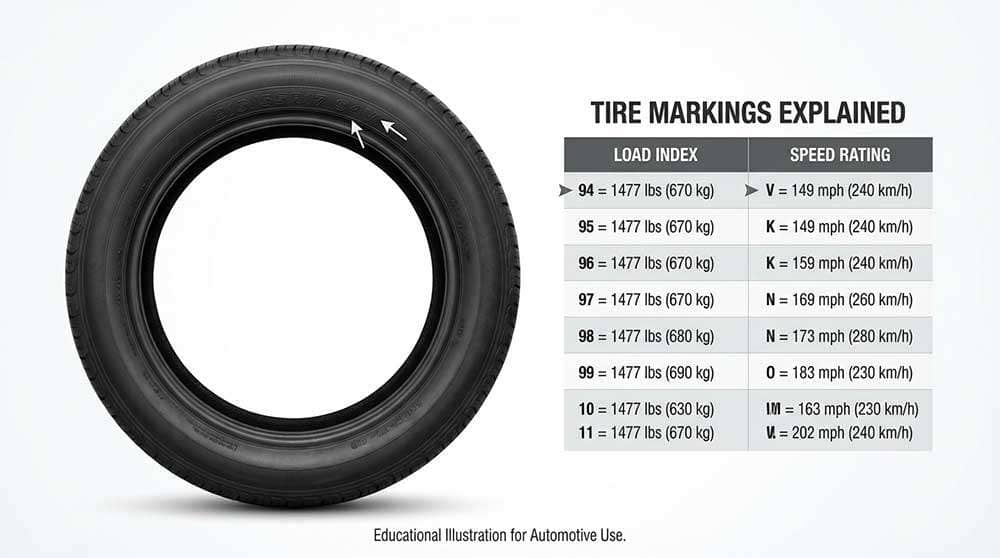
Those final numbers and letters after the tire size aren't suggestions—they're critical safety specifications. Understanding load index and speed ratings ensures your tires handle your vehicle's weight and performance capabilities.
The load index appears as a two or three-digit number immediately following the tire size. For a 215/55R17 98V tire, the 98 indicates the maximum load capacity per tire. Each number corresponds to a specific weight limit in pounds or kilograms.
Common load indices for 215/55R17 tires:
Load Index |
Max Load (lbs) |
Max Load (kg) |
Common Application |
|---|---|---|---|
94 |
1,477 |
670 |
Compact cars |
96 |
1,565 |
710 |
Mid-size sedans |
98 |
1,653 |
750 |
Full-size sedans, crossovers |
100 |
1,764 |
800 |
Small SUVs, loaded sedans |
Your vehicle's total weight capacity depends on multiplying this number by four (one per tire). A 215/55R17 98 tire supports up to 6,612 pounds total vehicle weight (1,653 lbs × 4 tires).
Never install tires with a lower load index than your vehicle requires. Doing so creates dangerous conditions where tires can fail under normal driving loads. You can install tires with a higher load index without problems—they simply offer extra safety margin.
The speed rating letter appears after the load index. This letter indicates the maximum sustained speed the tire safely handles under proper conditions. For a 215/55R17 98V tire, the V rating means up to 149 mph.
Speed ratings for 215/55R17 tires typically include:
Rating |
Max Speed (mph) |
Max Speed (km/h) |
Typical Use |
|---|---|---|---|
T |
118 |
190 |
Economy cars, winter tires |
H |
130 |
210 |
Standard passenger vehicles |
V |
149 |
240 |
Sport sedans, performance vehicles |
W |
168 |
270 |
High-performance sports cars |
Speed ratings reflect more than just maximum velocity. Higher-rated tires use construction techniques and compounds that improve handling, cornering stability, and heat dissipation. A V-rated tire handles better than an H-rated tire even at legal highway speeds.
Always match or exceed your vehicle manufacturer's speed rating specification. Installing lower-rated tires compromises safety and might void warranties. Your door jamb sticker or owner's manual shows the required rating.
Some 215/55R17 tires carry an XL or Reinforced designation after the size marking. These Extra Load tires feature stronger internal construction that supports higher inflation pressures and greater weight capacities than Standard Load (SL) versions.
The difference becomes clear when comparing load capacities:
215/55R17 94V SL: 1,477 lbs at 35 PSI
215/55R17 98V XL: 1,653 lbs at 41 PSI
Crossovers and heavier sedans often require XL tires to handle their increased weight. Check your vehicle's specifications—using Standard Load tires when XL versions are required creates unsafe conditions. The reverse situation (using XL tires when SL suffices) poses no problems and might even extend tire life slightly.
Your vehicle's tire specifications aren't arbitrary numbers. Engineers calculated exact load and speed requirements based on the vehicle's weight, performance capabilities, and intended use. Deviating from these specs compromises safety systems and handling characteristics.
Find your required specifications in three locations:
Door jamb sticker (driver's side door frame)
Owner's manual tire section
Inside fuel filler door (some vehicles)
When replacing tires, match these specifications exactly. If you're considering performance upgrades or changes, consult a tire professional who can verify compatibility with your vehicle's systems.
Many vehicles equipped with 215/55R17 tires use run-flat technology, especially luxury brands like BMW and Mercedes-Benz. Run-flat tires feature reinforced sidewalls that support the vehicle's weight even after complete air pressure loss.
Run-flat tires in 215/55R17 size typically allow 50 miles of driving at up to 50 mph after puncture. This eliminates the need for spare tires, creating more cargo space and reducing vehicle weight. However, run-flats cost more than conventional tires and provide a firmer ride due to their stiffer construction.
If your vehicle came with run-flat tires, you have two replacement options:
Continue using run-flats (recommended if no spare tire is present)
Switch to conventional tires and add a spare tire kit
Never mix run-flat and conventional tires on the same vehicle. This creates handling imbalances and might trigger stability control warnings.
The 215/55R17 size comes with different load indices and speed ratings to match your vehicle's needs. Most passenger car versions carry a Standard Load (SL) designation. Speed ratings typically include H (130 mph), V (149 mph), or W (168 mph).
Performance-oriented vehicles often require XL (Extra Load) versions with a 98 load index. These tires support approximately 1,650 pounds per tire. A 215/55R17 98V designation means the tire handles up to 1,650 pounds per tire at speeds up to 149 mph.
Always match these specifications to your vehicle's requirements. Your owner's manual or door jamb sticker shows the correct load index and speed rating for safe operation.
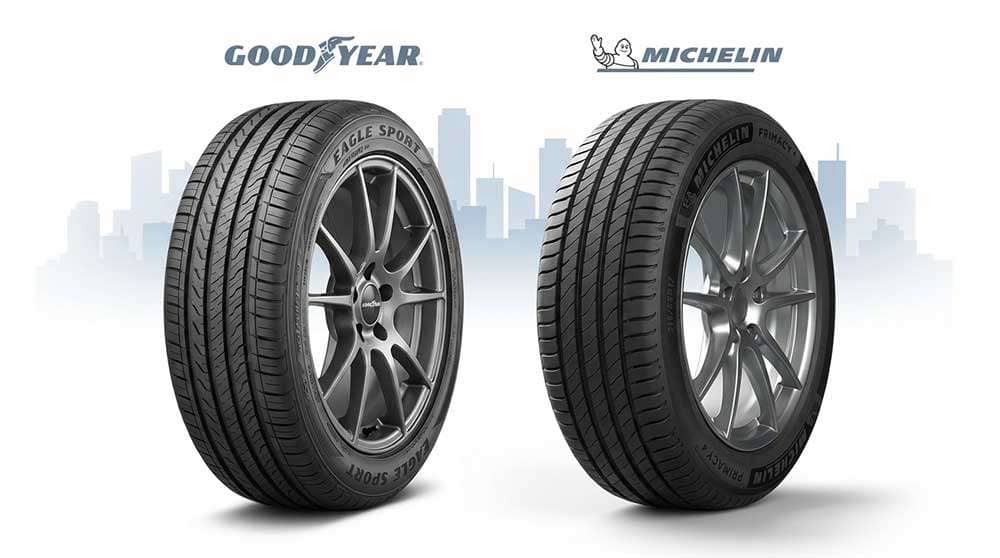
We carry the best selection of 215/55R17 tires from all the top brands. These five standout models deliver excellent performance and value for different driving needs and conditions.
The CrossClimate2 earns its reputation with Three-Peak Mountain Snowflake (3PMSF) certification, proving it handles winter conditions better than most all-season tires. This tire stops up to 56 feet shorter on wet roads when worn compared to four leading competitors. You also get excellent dry braking performance and up to 15,000 miles more tread life than rival brands.
Built with TredLife Technology, the Assurance MaxLife gives you reliable all-season traction and maximum wear performance. Built-in wear gages make it easy to monitor your tread depth. This tire comes with an industry-leading 85,000-mile warranty—one of the longest available in this size.
The Solus TA51a focuses on quiet operation with Noise Canceller technology that reduces air pumping resonance in the main channel grooves. It scores high in wet conditions (9/10) and comfort (8/10). T-speed rated versions include an impressive 75,000-mile warranty.
This tire uses proprietary Flask Siping to fight hydroplaning throughout its entire lifespan. Canyon Groove technology improves snow traction without sacrificing ride quality. With up to 65,000-mile warranty coverage, it works great on sporty sedans like the Honda Accord Sport and Tesla Model 3.
Continental's TrueContact Tour delivers exceptional tread life and excellent wet handling. EcoPlus Technology provides better fuel savings, shorter wet-road stopping distances, and extended longevity. An 80,000-mile warranty plus 12-month road hazard coverage makes it perfect for passenger cars, crossovers, and electric vehicles.
Looking for the perfect 215/55R17 tire for your vehicle? Check the latest inventory at Performance Plus Tire.
The 215/55R17 tire size delivers exactly what most drivers need: a 26.31-inch diameter that balances performance with comfort. This tire combines 215mm width with a 55% aspect ratio on a 17-inch rim. These measurements affect how your car handles, how much fuel it uses, and whether your speedometer reads accurately.
The 3% rule matters most when you're shopping for replacements. Stay within that diameter variance to avoid problems with your car's electronic systems and transmission. Check compatibility carefully if you're considering alternatives like 225/55R17 or 215/50R17 sizes.
You'll find 215/55R17 tires on popular vehicles like the Toyota Camry, Honda Accord, and various Audi models. Manufacturers choose this size because it offers solid performance without sacrificing ride quality. Michelin, Goodyear, and Continental make excellent options in this size, each with different strengths for specific driving needs.
Winter driving requires special consideration. Look for the Three-Peak Mountain Snowflake certification if you face snow and ice. The Nokian Hakkapeliitta 10 with studs handles extreme ice conditions best.
Load index and speed ratings must match your vehicle's specifications. A 215/55R17 98V rating means the tire supports about 1,650 pounds per tire with a maximum speed of 149 mph. Getting the right specifications keeps you safe and maintains optimal performance.
Ready to find the perfect 215/55R17 tires for your vehicle? At Performance Plus Tire, we carry the best selection at the lowest prices. Our experts can help you choose the right tires that match your driving needs and vehicle requirements.
Understanding tire specifications ensures proper vehicle performance, safety, and optimal replacement choices for your specific driving needs.
• A 215/55R17 tire measures 26.31 inches in diameter with 8.46-inch width and 4.66-inch sidewall height • Stay within 3% diameter variance when replacing tires to avoid speedometer errors and electronic system issues • This popular size fits Toyota Camry, Honda Accord, Nissan Altima, and many crossover SUVs perfectly • Top brands like Michelin CrossClimate2 and Goodyear Assurance MaxLife offer excellent all-season performance • Winter-rated 215/55R17 tires with 3PMSF certification provide reliable cold-weather traction and safety
When selecting replacement tires, always verify load index and speed ratings match your vehicle's requirements to maintain optimal performance and safety standards.
A 215/55R17 tire has an overall diameter of 26.31 inches (668.3 mm), a width of 8.46 inches (215 mm), and a sidewall height of 4.66 inches (118.25 mm). Its circumference is approximately 82.66 inches (2099.53 mm).
You can replace your 215/55R17 tires with a different size, but it's crucial to stay within 3% of the original tire's overall diameter. For example, 225/55R17 tires are often a compatible alternative. Always consult your vehicle's manual or a tire professional before making changes.
215/55R17 tires are commonly found on various compact and midsize sedans, crossover SUVs, and some smaller SUVs. Popular models include the Toyota Camry, Honda Accord, Nissan Altima, Kia Soul, and certain Audi and BMW configurations.
Yes, many 215/55R17 tires are suitable for winter driving, especially those designed specifically for cold weather conditions. Look for tires with the Three-Peak Mountain Snowflake (3PMS) certification, which indicates their capability in severe snow conditions.
When selecting a 215/55R17 tire, consider factors such as your driving conditions, desired performance characteristics (e.g., wet traction, longevity), and your vehicle's specific requirements for load index and speed rating. Also, look for reputable brands that offer good warranties and positive user reviews.



