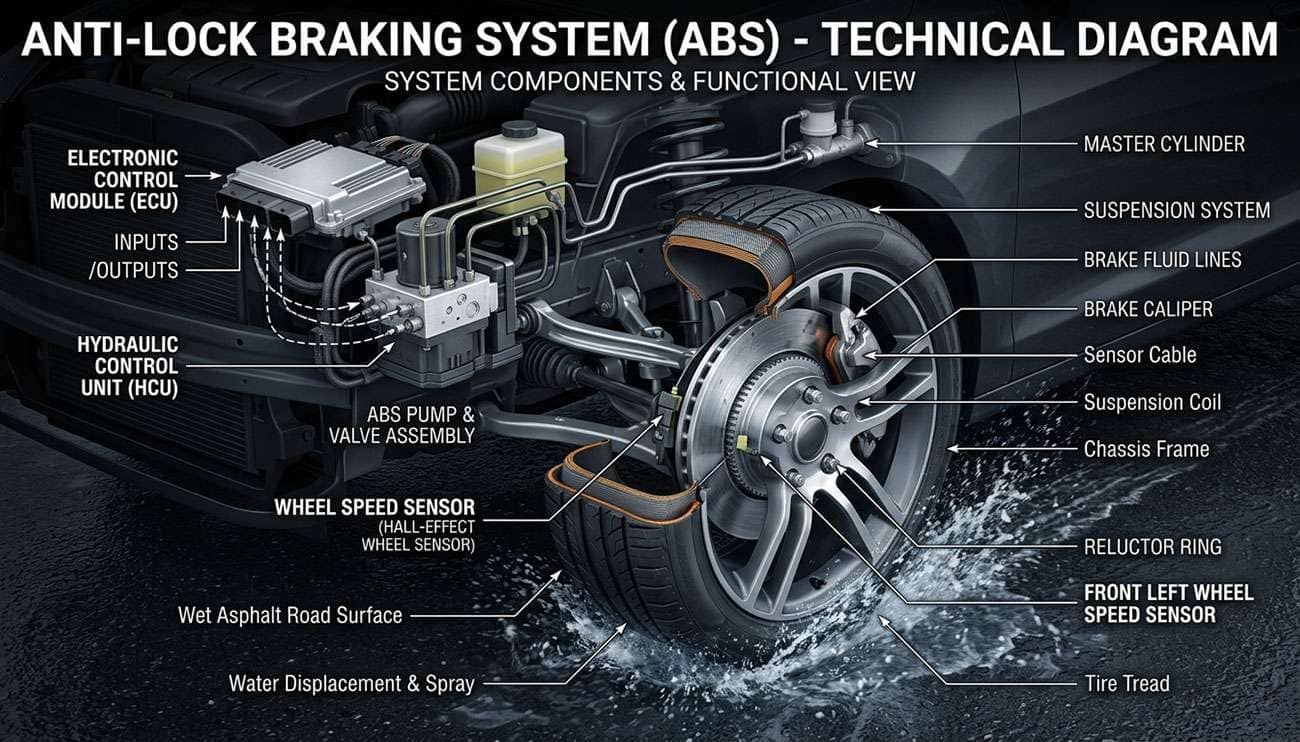
Rain hits your windshield at 70 mph. You tap the brakes and feel that rapid pulsing through the pedal—your ABS just kicked in. A split second later, your steering feels disconnected. Your car's floating. You've just experienced what over 1.2 million American drivers face every year when wet pavement turns deadly.
Here's what you need to understand: ABS keeps your wheels from locking so you can steer during emergency braking. Hydroplaning strips away the rubber-to-road contact that makes everything else work. These two systems interact in ways that could save your life—or fail you completely if you don't know their limits.
I'm going to show you exactly how ABS functions, what triggers hydroplaning, and most importantly, how to prevent both from catching you off guard. You'll learn the real science—not oversimplified explanations—and walk away with practical knowledge you can use the next time rain threatens your control. Whether you commute daily or push performance limits, understanding this relationship isn't optional. It's survival.
ABS and hydroplaning work against each other in a constant battle for control. Your anti-lock system tries to maintain traction. Hydroplaning destroys it. Most drivers don't grasp how quickly this dynamic shifts from safe to dangerous—or what their tires and brakes are actually doing when rain turns roads into skating rinks.
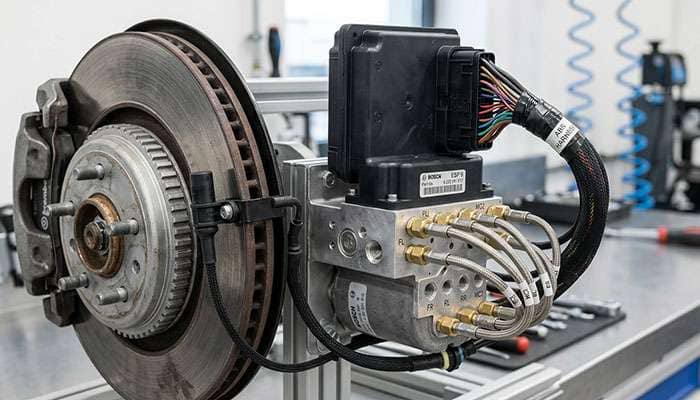
Your ABS monitors wheel speed 100 times every second. That's not marketing talk—that's real-time data flowing from sensors at each wheel to your electronic control unit. When the system detects a wheel about to lock, the hydraulic control unit pulses brake pressure 15 to 20 times per second. You feel this as that characteristic pedal vibration. The whole cycle—from detection to pressure modulation—happens in 0.04 seconds. Faster than you can blink.
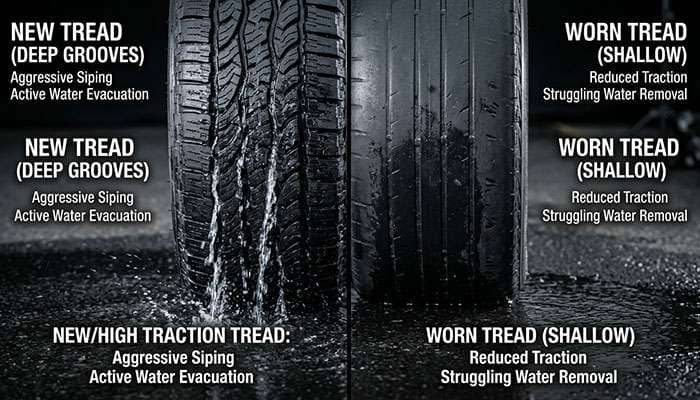
Hydroplaning kicks in when water depth hits just one-tenth of an inch and you're traveling as slow as 35 mph. Your tires need to displace water faster than it builds up between rubber and pavement. New tires with 10/32" of tread push aside roughly 8 gallons per second at highway speeds. Drop to 4/32" tread depth and you've lost more than half that capacity. The physics are straightforward: insufficient water evacuation equals zero traction.
The dynamic hydroplaning equation tells you exactly when trouble starts. Take 9 times the square root of your tire pressure in PSI. Running 32 PSI? You'll hydroplane around 51 mph in standing water. But that's theoretical baseline—real-world conditions vary based on your tread pattern, tire design, and road texture.
Tire manufacturers test for three distinct hydroplaning scenarios. Dynamic resistance measures high-speed water shedding. Viscous resistance handles thin water films where surface tension matters. Reverted rubber resistance addresses heat-induced steam between locked wheels and pavement. Quality all-season tires deliver across all three categories—cheaper alternatives sacrifice one or more.
Stop believing ABS prevents hydroplaning or shortens wet stopping distances. It doesn't. Your stopping distance increases 10 to 20 percent on wet pavement even with perfectly functioning ABS. What you get is steering control during panic braking—the ability to maneuver around obstacles while applying maximum pressure to that pedal.
Never pump your brakes when ABS activates. The system pumps faster and more precisely than you ever could. Your job is simple: press hard, keep pressing, steer where you want to go. The hydraulic control unit handles the rest, modulating pressure independently at each wheel based on available traction.
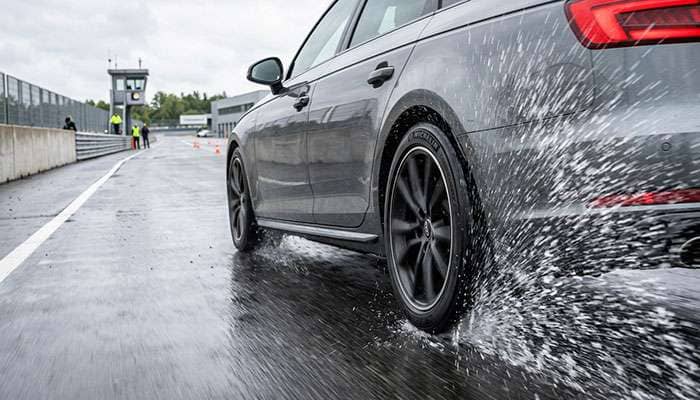
Drivers consistently underestimate how fast hydroplaning strikes. You don't need puddles. A thin film on smooth pavement at 65 mph will lift your tires off the road. The first 10 minutes of rainfall are most dangerous—water mixing with road oils creates an incredibly slippery surface. Most drivers maintain speed when rain starts. They're betting against physics and losing.
Ignoring tire maintenance is Russian roulette. Each tire contacts the road through a patch roughly the size of your palm. When tread drops below 4/32", your hydroplaning risk triples. Most drivers wait until the legal minimum of 2/32" before replacing tires. At that point, they've surrendered 70% of their wet-weather traction. That's not economy—that's gambling with your life.
Let's cut through the technical jargon and focus on numbers that matter when you're driving in the rain. These specifications directly impact whether you maintain control or lose it when conditions deteriorate.
Specification |
Measurement |
Safety Impact |
|---|---|---|
ABS Activation Cycles |
15-20 per second |
Prevents wheel lockup while maintaining steering control |
Wheel Speed Sensor Frequency |
100+ readings per second |
Detects impending lockup before it occurs |
Hydroplaning Start Speed |
35-55 mph (depends on conditions) |
Critical speed threshold for wet-weather driving |
Minimum Safe Tread Depth |
4/32" for wet conditions |
Below this, hydroplaning risk increases 3x |
Water Displacement (New Tires) |
8 gallons per second |
Maintains tire-to-road contact at highway speeds |
Wet Stopping Distance Increase |
10-20% vs. dry pavement |
Requires increased following distance in rain |
ABS response time sits at 0.04 seconds from skid detection to brake modulation. That's exponentially faster than human reaction time. The electronic control unit processes data from all four wheels simultaneously and makes independent braking decisions for each corner based on real-time traction. Never try to override this by pumping your brakes manually.
Tread void ratio determines how much water your tires can channel away from the contact patch. Performance tires typically run 25-30% void ratio—that's the percentage dedicated to grooves versus solid rubber. Dedicated winter tires push past 35% for maximum water evacuation. Higher void ratios sacrifice some dry-weather grip, so tire engineers constantly balance these competing demands.
You can't modify your ABS—it's engineered into your vehicle. But you absolutely control the tires mounted to your wheels, and that choice determines whether your safety systems work or fail when rain hits. Your tires are the interface between all that electronic wizardry and the wet road trying to kill you.
Passenger cars need symmetrical or asymmetrical tread patterns that balance dry grip with water channeling. These patterns feature continuous circumferential grooves running around the tire's circumference, pushing water out from under the contact patch. Done right, they prevent hydroplaning up to 70 mph in moderate rain.
Sport sedans and performance vehicles demand higher speed ratings and specialized compounds that maintain grip at elevated velocities. But here's the catch: many ultra-high-performance summer tires trade wet-weather capability for maximum dry grip. If you drive aggressively and face regular rainfall, high-performance all-season tires deliver better balance. These use advanced silica compounds that stay pliable in wet conditions while providing the responsive handling you expect.
Trucks and SUVs face unique challenges. Higher center of gravity plus increased weight means your tires must displace significantly more water to prevent hydroplaning. A 5,500-pound SUV puts far more pressure on each tire than a 3,200-pound sedan. You need reinforced sidewalls and robust tread blocks that maintain stability during emergency maneuvers. Check your vehicle's load index rating and never compromise—underrated tires flex excessively under load, reducing water channeling effectiveness.
AWD and 4WD systems create false confidence. All-wheel drive helps you accelerate on slippery surfaces. It does nothing for braking or hydroplaning resistance. Nothing. AWD can actually make things worse by encouraging higher speeds in dangerous conditions. If you drive an AWD vehicle, prioritize tires with exceptional wet-weather ratings and replace them well before reaching minimum tread depth.
Daily highway commuters face maximum hydroplaning risk because you're traveling at speeds where water evacuation becomes critical. At 65-70 mph, you need tires with deep circumferential grooves and proven high-speed water management. Your tires are working harder than you realize to maintain contact at these velocities.
Frequent wet-weather driving demands tires with documented hydroplaning resistance over other performance characteristics. Look for wide lateral grooves connecting to circumferential channels—this creates an efficient water evacuation network. High-density siping adds biting edges that improve wet grip. But excessive siping reduces tread block rigidity and can compromise dry-weather precision. Everything's a tradeoff.
Aggressive drivers who brake hard and corner at speed generate substantial heat in tires and braking systems. This heat affects both ABS performance and hydroplaning resistance. When tires heat up significantly, the compound softens and becomes more prone to reverted rubber hydroplaning—where heat from locked wheels creates a steam layer between tire and road. If you drive aggressively, choose tires with heat-resistant compounds and avoid sustained hard braking in wet conditions.
Performance enthusiasts who track their vehicles face a tough choice. Dedicated track tires sacrifice wet-weather performance completely—minimal tread patterns designed for maximum dry grip only. If you drive your car on public roads and at the track, you need either a compromise tire or two complete wheel sets. Many serious drivers run track tires for competition and high-performance all-seasons for daily use.
Tire prices span from under $80 to over $300 per tire. Understanding what you're paying for—and what safety compromises you're making—matters when wet pavement could determine whether you make it home.
Premium brands like Michelin, Bridgestone, and Continental invest heavily in wet-weather research and development. These manufacturers test in extreme conditions, developing proprietary compounds and tread patterns that maximize water evacuation. Premium tires feature advanced silica compounds that stay flexible in cold, wet conditions while delivering superior grip. You're also paying for consistency—strict quality control ensures every tire performs as designed.
Price Range |
Typical Features |
Wet Performance |
Expected Lifespan |
|---|---|---|---|
Budget ($60-$100) |
Basic tread compounds, simple patterns |
Adequate for light rain only |
40,000-50,000 miles |
Mid-Range ($100-$170) |
Improved compounds, better water channels |
Good wet traction and braking |
50,000-65,000 miles |
Premium ($170-$250) |
Advanced silica compounds, optimized patterns |
Excellent hydroplaning resistance |
60,000-80,000 miles |
Ultra-Premium ($250+) |
Proprietary compounds, maximum performance |
Superior wet grip at all speeds |
40,000-60,000 miles (performance focus) |
Budget tires perform acceptably in dry conditions. They make significant compromises in wet weather. These tires use harder compounds that take longer to reach optimal operating temperature and don't conform as well to wet road surfaces. Tread patterns may look similar to premium tires, but groove depths, angles, and spacing are less sophisticated—resulting in reduced water evacuation. If you live where it rains frequently, budget tires may cost you more through increased accident risk and premature replacement from uneven wear.
Mid-range tires from established manufacturers often deliver the best value for most drivers. These incorporate many technologies from premium lines at more accessible prices. You get solid wet-weather performance, reasonable tread life warranties, and adequate capabilities across various conditions. For drivers who don't push vehicles to extremes, mid-range tires provide excellent balance of safety, performance, and value.
Calculate total cost of ownership when evaluating options. A $200 premium tire lasting 70,000 miles with superior wet-weather safety costs less per mile than an $80 budget tire wearing out in 40,000 miles with marginal wet performance. Premium tires often deliver better fuel economy through reduced rolling resistance—potentially saving $100-$200 annually in fuel costs. Factor in the safety benefits of potentially avoiding even one accident, and the premium tire investment pays for itself multiple times over.
You need proven tire designs matched to your specific driving needs. Based on extensive testing data and real-world performance across varied conditions, here are my top recommendations organized by driver type and priorities. These selections excel in wet-weather performance and hydroplaning resistance while maintaining full compatibility with modern ABS systems.
Daily commuters need consistent performance across varied conditions, long tread life, and genuine value. You face changing weather, frequent highway travel, and the need for predictable capability every single day. These recommendations balance wet-weather safety with year-round versatility and extended wear characteristics.
The Michelin CrossClimate 2 is my top pick for commuters facing regular wet conditions. This tire delivers exceptional hydroplaning resistance through its V-formation tread pattern with wide circumferential grooves that evacuate water extremely efficiently. The advanced silica-based compound maintains flexibility in temperatures down to freezing while providing confident grip in heavy rain. Independent testing shows the CrossClimate 2 reduces wet braking distances by up to 15 feet from 60 mph compared to competitor tires. That could mean the difference between a close call and a collision. The tire carries the three-peak mountain snowflake symbol, meeting winter tire performance standards—excellent for drivers who experience occasional winter weather but don't want to swap to dedicated winter tires.
The Goodyear Assurance WeatherReady represents another excellent commuter option prioritizing wet-weather safety. This tire features Weather Reactive Technology that adapts its tread compound to changing temperatures, maintaining optimal grip whether you're driving in 35-degree rain or 85-degree sunshine. The evolving traction grooves maintain water evacuation capabilities as the tire wears, providing consistent hydroplaning resistance throughout the tire's life. The Assurance WeatherReady excels in heavy rain scenarios—testing shows it maintains control during hydroplaning events where other tires begin to float. The comfort and quiet ride make it ideal for highway commuting, while the 60,000-mile tread warranty provides excellent long-term value.
For budget-conscious commuters who still want solid wet-weather performance, the Continental PureContact LS delivers impressive capabilities at a mid-range price point. This tire incorporates Continental's EcoPlus Technology for improved fuel efficiency—potentially saving $150-$200 annually in fuel costs—while maintaining excellent wet grip through its +Silane compound. The QuickView indicators provide visual confirmation of alignment issues, uneven wear, or insufficient tread depth, helping you maintain optimal performance and safety. The PureContact LS features Continental's Comfort Ride Technology that absorbs road imperfections, making it particularly suitable for commuters logging high mileage on varied road surfaces.
Performance drivers demand maximum grip and precise handling response—but you also need tires that maintain these characteristics in wet conditions. The best performance tires balance aggressive dry-weather capabilities with sophisticated wet-weather technologies that prevent hydroplaning and maintain control during spirited driving in the rain.
The Michelin Pilot Sport All Season 4 sets the standard for performance all-season tires, delivering sports car handling with genuine wet-weather capability. This tire features Michelin's Extreme Silica+ compound that maintains grip across a wide temperature range, from cold morning commutes to hot afternoon drives. The Variable Contact Patch 3.0 optimizes the tire's footprint during acceleration, braking, and cornering, ensuring maximum rubber-to-road contact in all conditions. In wet performance testing, the Pilot Sport AS 4 outperforms many dedicated summer tires in both braking and cornering, while its four wide circumferential grooves provide excellent hydroplaning resistance at highway speeds. The tire heats up quickly and maintains consistent performance through multiple heat cycles—ideal for drivers who occasionally track their vehicles.
The Pirelli Cinturato P7 All Season Plus II offers performance drivers an excellent combination of sporty handling and advanced wet-weather technology. This tire incorporates Pirelli's Seal Inside technology on select sizes, automatically sealing punctures up to 1/4 inch in diameter—a practical feature for performance drivers logging high mileage. The optimized tread pattern balances large outer tread blocks for dry cornering grip with deep inner grooves for water evacuation. The compound formulation maintains flexibility in cold, wet conditions while providing the firm, responsive feel performance drivers expect. Independent testing confirms the P7 AS Plus II delivers wet braking distances within five percent of the best-performing tires in its category, while offering noticeably superior handling response compared to traditional all-season tires.
For drivers who prioritize ultimate wet-weather performance above all else, the Bridgestone Turanza QuietTrack deserves consideration. While this touring tire doesn't deliver the aggressive dry-weather handling of dedicated performance tires, it provides exceptional wet braking and hydroplaning resistance that could prove invaluable in emergency situations. The QuietTrack features Bridgestone's proprietary full-depth 3D siping technology that maintains biting edges throughout the tire's life, ensuring consistent wet grip even as the tire wears. The computer-optimized tread pattern creates efficient water evacuation channels that resist hydroplaning at speeds up to 75 mph in heavy rain. For performance drivers living in regions with frequent rainfall, this tire offers a compelling argument for prioritizing wet-weather safety over maximum dry grip.
Budget-conscious drivers don't have to sacrifice all wet-weather performance to meet financial constraints. While these tires won't match premium options in ultimate capabilities, they provide acceptable safety characteristics for drivers who primarily encounter light to moderate rain and maintain conservative speeds in severe weather.
The Cooper Discoverer EnduraMax delivers surprising wet-weather capability at an accessible price point. This tire incorporates Cooper's Stable Edge Technology, which maintains tread block rigidity for better wet braking while the high-density siping network creates numerous biting edges for improved wet grip. The wide circumferential grooves effectively channel water away from the contact patch, providing adequate hydroplaning resistance for daily driving speeds. The EnduraMax carries a 60,000-mile tread warranty, offering long-term value that narrows the cost gap with more expensive options. While this tire won't deliver the confidence-inspiring wet performance of premium alternatives, it provides competent all-around capabilities for drivers on strict budgets.
The General Altimax RT45 represents another solid budget choice for wet-weather driving. This tire features General's Visual Alignment Indicators that help you spot alignment issues before they cause uneven wear—a practical feature that can extend tire life and maintain safety. The optimized tread pattern includes wide lateral grooves connecting to deep circumferential channels, creating an effective water evacuation system. The replacement tread wear indicators provide clear visual confirmation when the tire reaches 2/32" depth, though you should consider replacement well before reaching this minimum legal limit for optimal wet-weather safety.
For drivers seeking the absolute lowest price point while maintaining basic wet-weather capability, the Hankook Kinergy ST offers an entry-level option worth considering. This tire provides fundamental wet-weather features including directional grooves for water evacuation and a silica-enhanced compound for improved wet grip. Be realistic about the limitations—this tire performs adequately in light rain at moderate speeds, but it's not your choice if you frequently encounter heavy rain, drive at highway speeds in wet conditions, or live in a region with aggressive weather patterns. If budget constraints force you toward this price tier, drive conservatively in wet weather and replace these tires before they reach minimal legal tread depth.
ABS gives you steering control during emergency braking—it doesn't overcome the fundamental physics of hydroplaning. When your tires lose contact with the road surface, no electronic system can restore traction. Your safety depends on prevention through proper tire selection, diligent maintenance, and adjusted driving habits when conditions deteriorate.
The tires you choose directly impact both ABS effectiveness and hydroplaning resistance. Premium tires with advanced compounds, sophisticated tread patterns, and deep grooves provide measurably better wet-weather performance than budget alternatives. These tires cost more initially, but the safety benefits and extended tread life often justify the investment. At minimum, never compromise on tread depth—replace your tires at 4/32" depth for wet-weather driving, not the legal minimum of 2/32".
AWD and 4WD provide zero advantage when braking or hydroplaning. These systems help you accelerate on slippery surfaces. They don't prevent your vehicle from sliding once traction is lost. The most important safety equipment on your vehicle isn't your ABS, traction control, or stability control—it's the four contact patches where your tires meet the road. When you're ready to invest in proven wet-weather performance, explore the tire options at Performance Plus Tire, where we specialize in matching drivers with tires that deliver genuine safety benefits in challenging conditions.
Here are the essential points you need to remember about ABS and hydroplaning:
• ABS prevents wheel lockup but doesn't stop faster: Your anti-lock braking system maintains steering control during emergency braking by pulsing brake pressure 15-20 times per second, but stopping distances actually increase in wet conditions. Never pump ABS brakes—the system works more effectively than human intervention.
• Hydroplaning can start at 35 mph in standing water: You don't need deep puddles to lose traction. Even thin water films become dangerous at highway speeds, especially during the first 10 minutes of rainfall when road oils mix with water to create extremely slippery conditions.
• Tread depth critically affects wet-weather performance: New tires with 10/32" tread can displace 8 gallons of water per second, while worn tires at 4/32" manage less than half that amount. Replace tires at 4/32" depth for optimal wet-weather safety, not the legal minimum of 2/32".
• Premium tires deliver measurable wet-weather advantages: Advanced silica compounds, optimized tread patterns, and superior water evacuation channels in premium tires provide up to 15 feet shorter wet braking distances—potentially the difference between a close call and a collision.
• AWD doesn't prevent hydroplaning or improve braking: All-wheel-drive systems help acceleration on slippery surfaces but offer zero advantage when braking or maintaining control during hydroplaning. Never let AWD create a false sense of security in wet conditions.
No. ABS cannot prevent hydroplaning. Hydroplaning occurs when a layer of water separates your tires from the road surface, eliminating the friction necessary for ABS to function. Once your tires are floating on water, the ABS system has nothing to work with—it can only modulate brake pressure, but it cannot restore physical contact between rubber and pavement. ABS helps maintain steering control during braking on wet roads before hydroplaning occurs. Once you're hydroplaning, no braking system can help until your tires regain contact with the road surface.
Hydroplaning can begin at speeds as low as 35 mph when water depth reaches one-tenth of an inch, though the exact speed depends on tire condition, tire pressure, vehicle weight, and road surface texture. A general formula suggests hydroplaning speed equals approximately 9 times the square root of your tire pressure in PSI—so for tires at 32 PSI, hydroplaning risk begins around 51 mph. Worn tires with shallow tread depth will hydroplane at significantly lower speeds, sometimes as low as 40 mph on smooth pavement with standing water. New tires with deep tread can resist hydroplaning up to 70-80 mph in moderate conditions.
Absolutely not. When you feel the pulsing sensation indicating ABS activation, maintain firm, constant pressure on the brake pedal. Modern anti-lock systems pulse the brakes 15-20 times per second—far faster than any human could pump manually. The system automatically modulates brake pressure to each wheel independently based on real-time data from wheel speed sensors. When you try to pump the brakes yourself, you're interfering with this precise process and potentially increasing your stopping distance. Your only job when ABS activates is to keep your foot pressed firmly on the brake and steer where you want to go.
For optimal wet-weather safety, replace your tires when tread depth reaches 4/32 inch, even though the legal minimum is 2/32 inch in most states. At 4/32 inch, your tires have already lost approximately 40% of their wet-weather traction capability compared to new tires. Below 4/32 inch, hydroplaning risk increases dramatically—testing shows that tires at 2/32 inch begin hydroplaning at speeds 30-40% lower than new tires with 10/32 inch tread. To check tread depth, insert a quarter into the tread groove with Washington's head pointing down. If you can see the top of his head, you're at or below 4/32 inch and should replace the tire soon.
If you feel your vehicle begin to hydroplane, immediately ease off the accelerator. Do not brake or make sudden steering movements. Keep your steering wheel pointed straight in the direction you want to travel. As you slow down naturally through air resistance and reduced acceleration, your tires will gradually regain contact with the pavement. Once you feel steering response return, you can begin gentle steering corrections if needed. Never slam on the brakes during hydroplaning—this won't slow you down and could cause your vehicle to spin when the tires regain traction. The entire hydroplaning event typically lasts only 1-3 seconds if you respond correctly by easing off the gas and waiting for traction to return.